

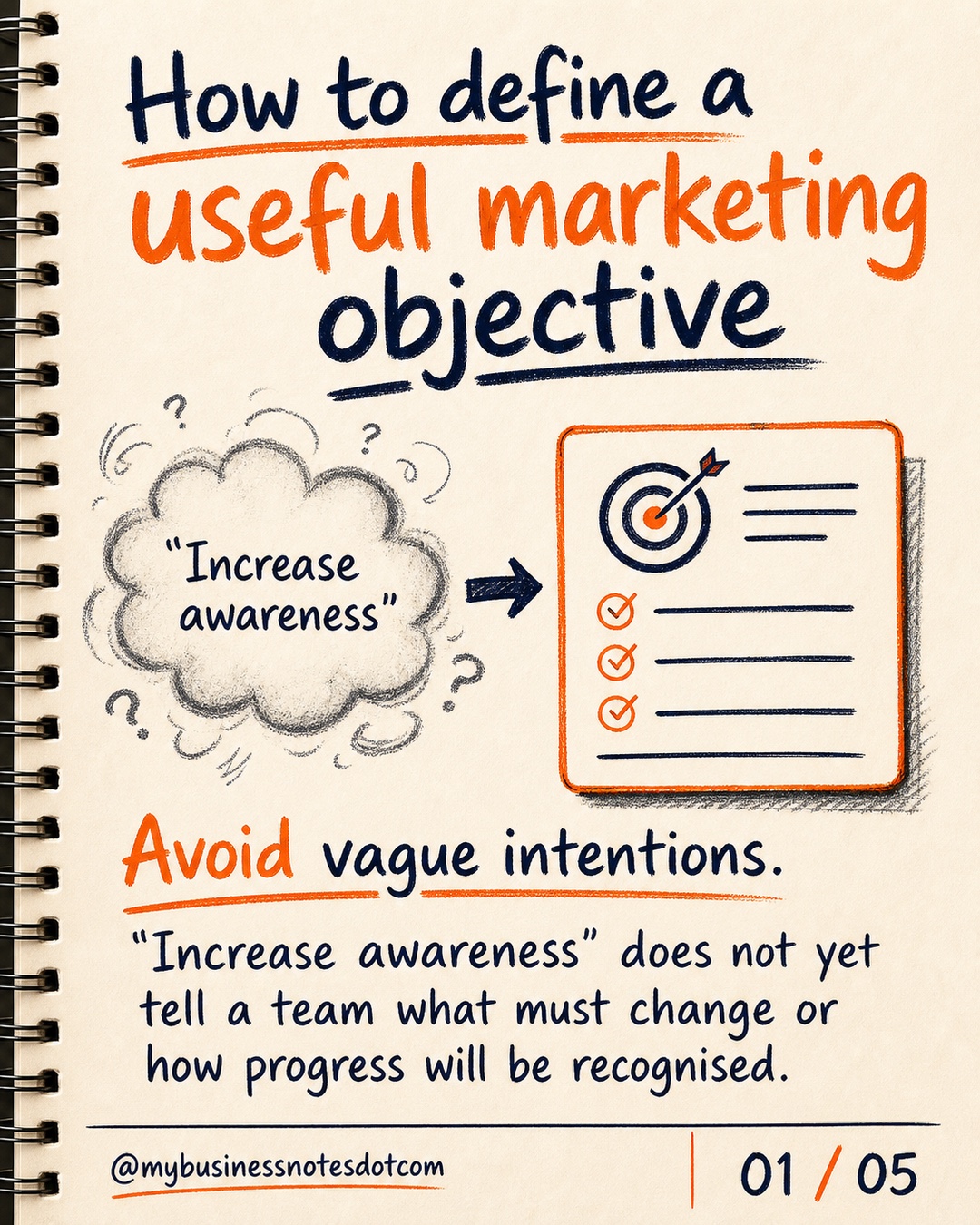
Marketing objective turns the central principle into an explicit decision: “Increase awareness” does not yet tell a team what must change or how progress will be recognised. This article develops that decision into a practical management framework, helping teams move from activity to coordinated action and useful evidence.
![Use one complete sentence.: By [date], help [audience] to [behaviour], evidenced by [signal].](https://mybusinessnotes.com/wp-content/uploads/2026/08/MBN11_slide_05.jpg)
Slide 1 of 5
What this framework helps you decide
“Increase awareness” does not yet tell a team what must change or how progress will be recognised.
The value of a framework is not the appearance of certainty. It is the quality of the conversation it creates. Use the following sections to expose assumptions, focus attention, and convert an abstract intention into a decision that can be reviewed.
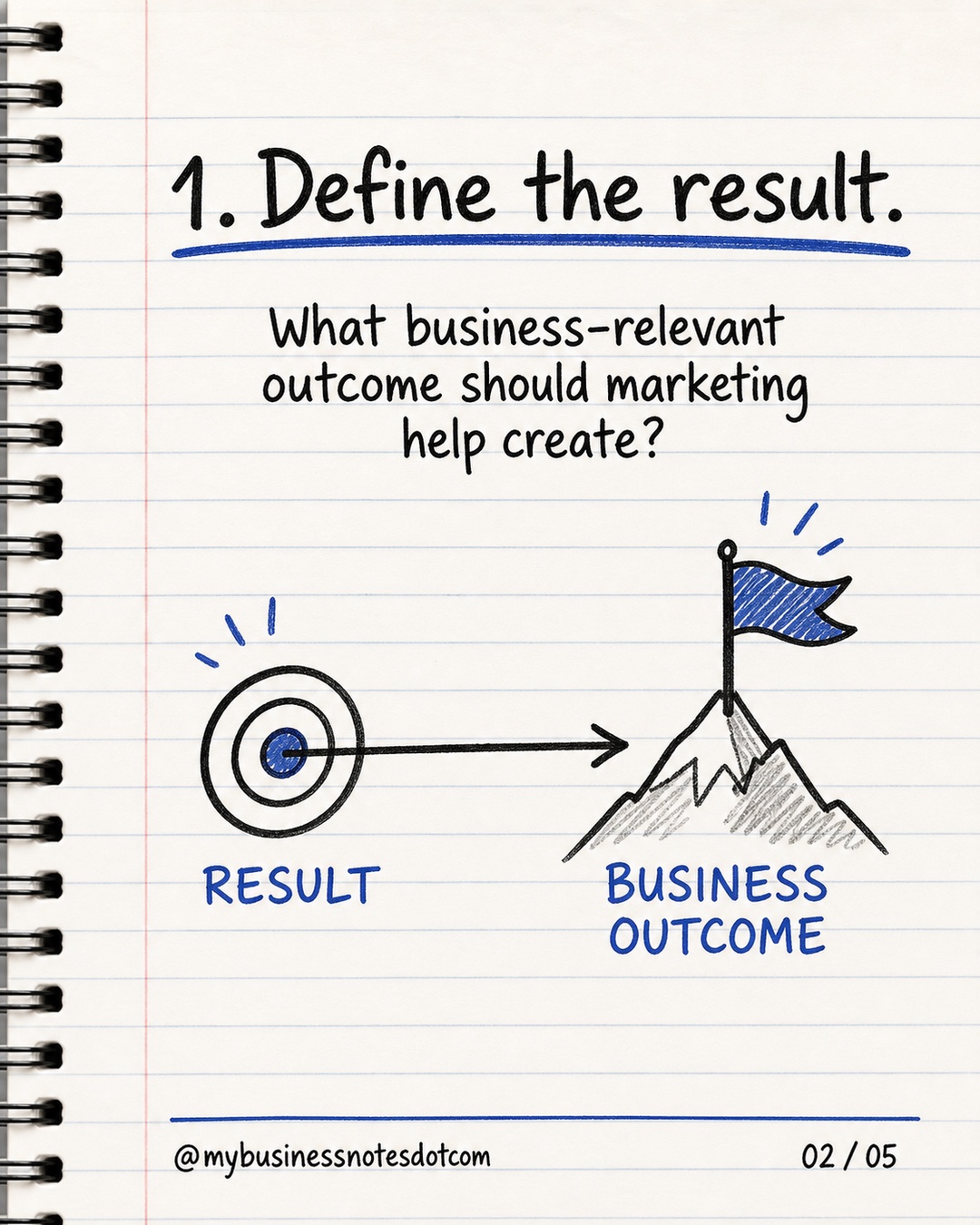
1. Define the result.
What business-relevant outcome should marketing help create?
Define the business or customer outcome before naming a campaign, channel, or deliverable. A useful objective describes the change that matters, not the volume of work the team intends to produce. This keeps execution subordinate to purpose.
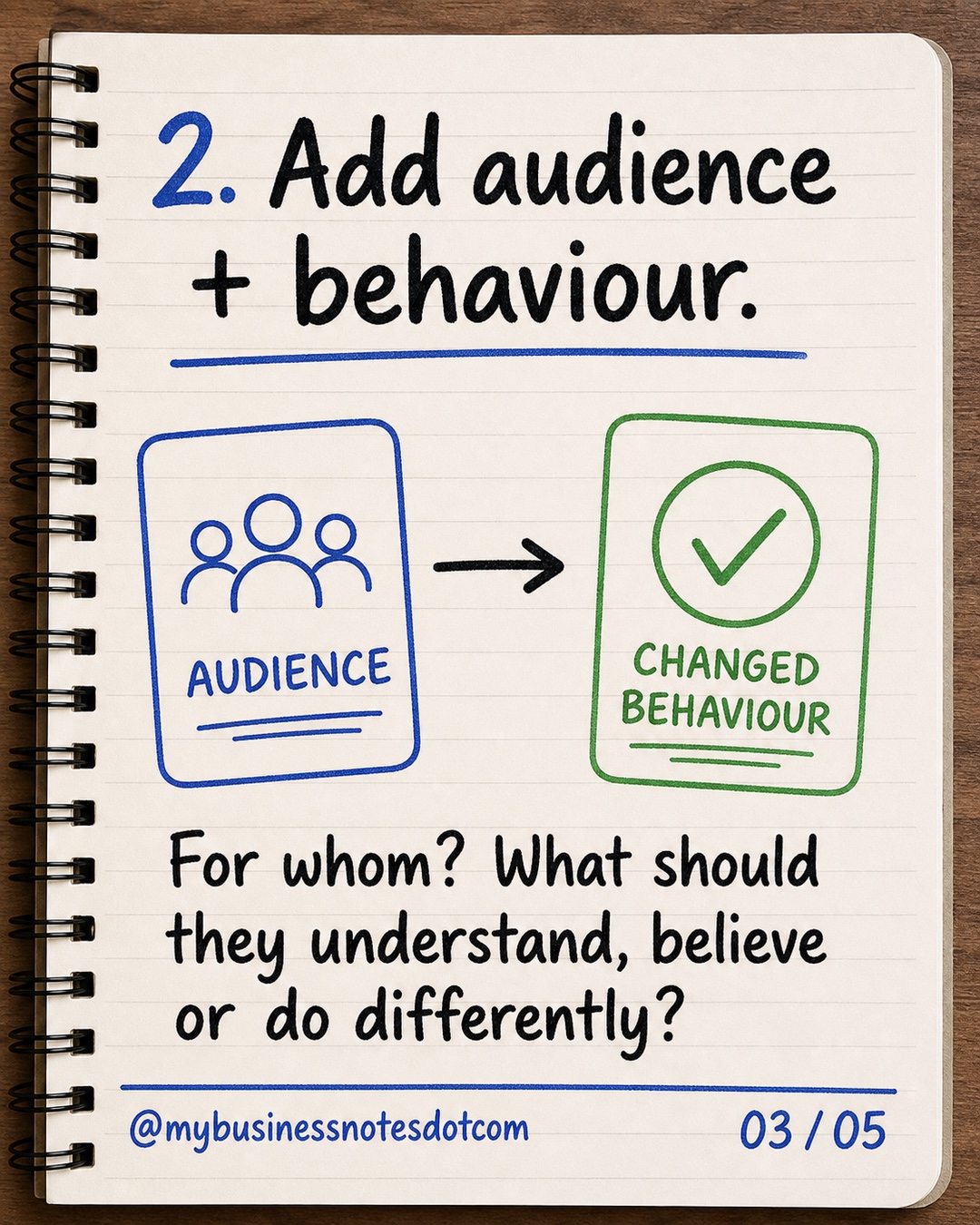
2. Add audience + behaviour.
For whom? What should they understand, believe or do differently?
Specify whose behaviour should change and in what context. The audience should be narrow enough to guide messaging, and the behaviour should be observable enough to distinguish genuine progress from passive exposure. Avoid vague verbs such as improve or strengthen without an explicit effect.
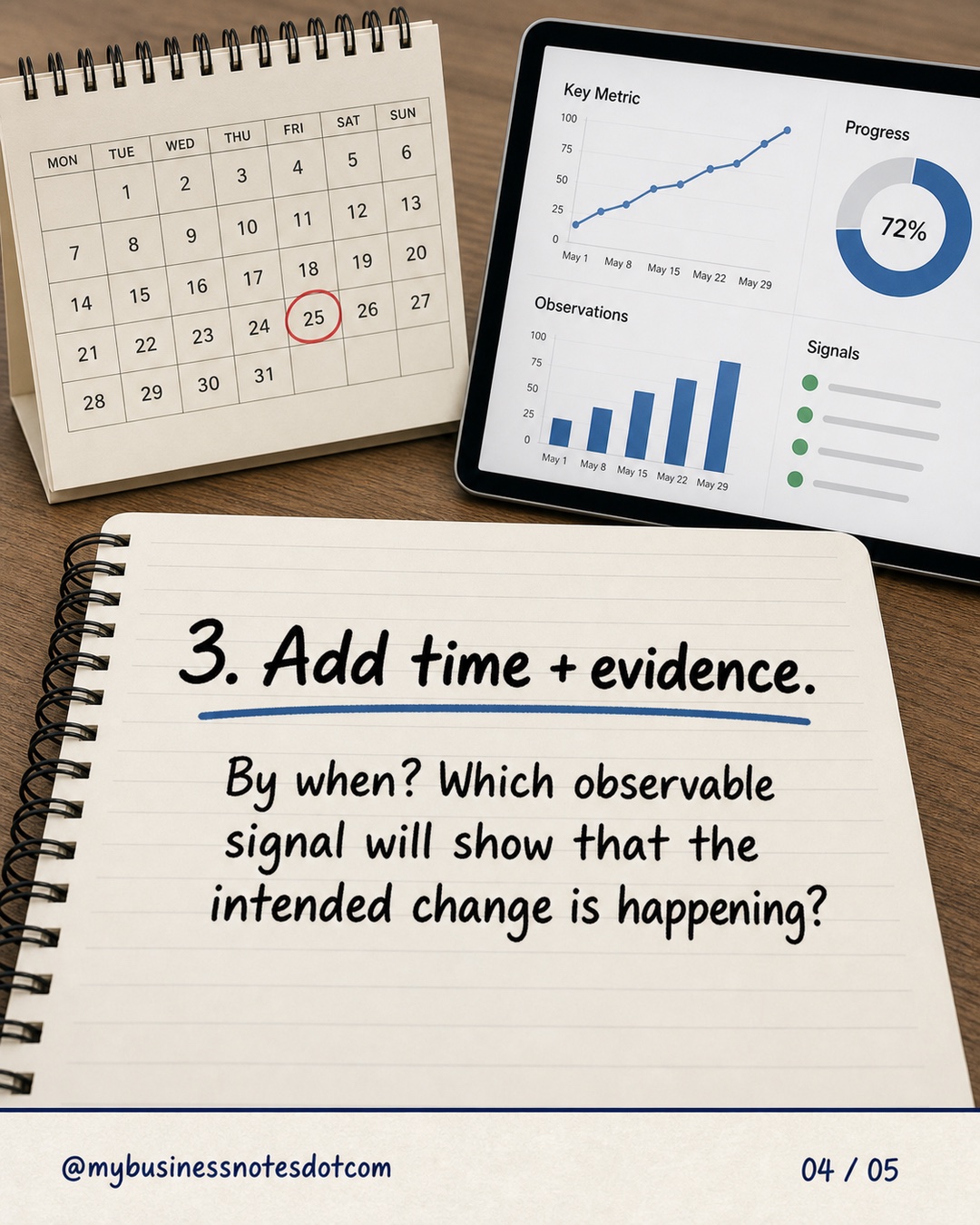
3. Add time + evidence.
By when? Which observable signal will show that the intended change is happening?
Add a time horizon, a baseline, and evidence that can be reviewed. Choose indicators close enough to the intended outcome to guide decisions, while recognising whether they are leading or lagging signals. The objective should make clear when the team will learn and reassess.
Use one complete sentence.
By [date], help [audience] to [behaviour], evidenced by [signal].
Combine result, audience, behaviour, timing, and evidence in one complete sentence. If the sentence cannot guide a choice between competing activities, refine it. The final objective should help the team decide what to prioritise, what to measure, and what not to do.
A practical example
Compare “increase awareness” with “By 30 September, help operations leaders in mid-market firms recognize the cost of fragmented reporting, evidenced by qualified visits to the assessment page and assessment requests.” The second version still needs targets and validation, but it gives the team a result, audience, behavior, time horizon and evidence.
The mistake to avoid
Choosing a channel output—such as publishing twelve posts—as the objective confuses work produced with the change marketing is meant to support.
How to apply the framework
Begin with the business result and the customer or operational context. Work through the framework in sequence, but spend more time where uncertainty is highest. Record the decision, the reasoning behind it, and the signal that would cause the team to reconsider.
A useful review ends with subtraction as well as addition. Identify what will stop, what will receive protected attention, and who is accountable for the next visible step. Without those trade-offs, even a clear discussion can dissolve into more activity.
For related guidance, see Strategy execution with the 4 Cs and 1 R and Marketing as value creation.
Frequently asked questions
What is marketing objective?
Marketing objective is a practical way to organize decisions around the result, audience, actions and evidence described in this article.
Why does marketing objective matter?
It matters because it connects activity to an explicit decision and makes progress easier to evaluate, explain and improve.
What is the most common mistake with marketing objective?
Choosing a channel output—such as publishing twelve posts—as the objective confuses work produced with the change marketing is meant to support.
How do you start using marketing objective?
Write the current decision in one sentence, apply the framework to the highest uncertainty, assign one owner and define the next observable evidence.
Put the framework into practice
Rewrite one objective using this structure. Use the carousel as a shared review tool, then capture the resulting priority, owner, next action, and evidence in the team’s working system.
Download the complete carousel
Keep the framework as a PDF for your next review.
International references