

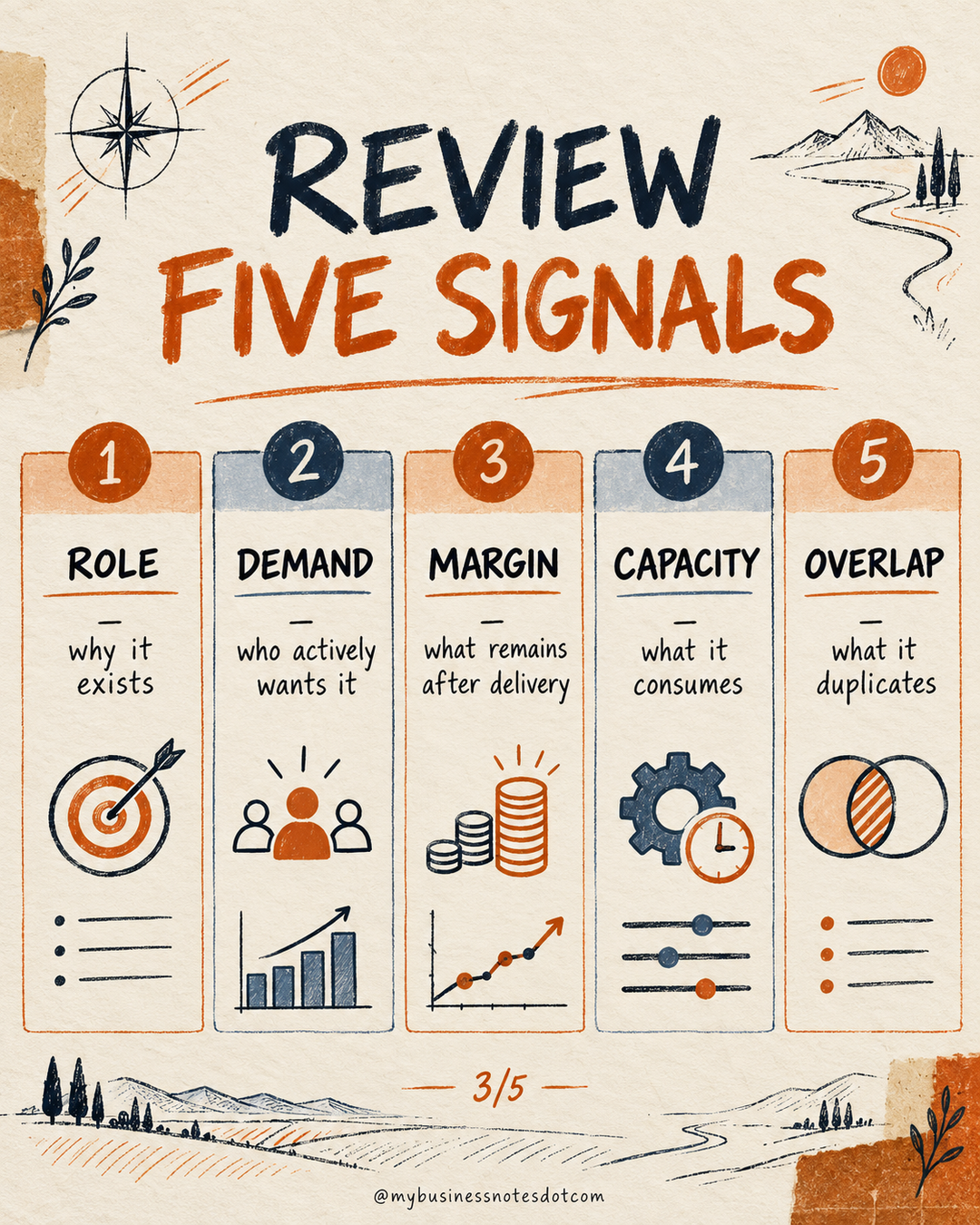
An offer portfolio review examines the role, demand, economics, capacity needs and overlap of each offer. Use it to decide what deserves attention across the whole business, not just which individual offer produces the most revenue.

Slide 1 of 5
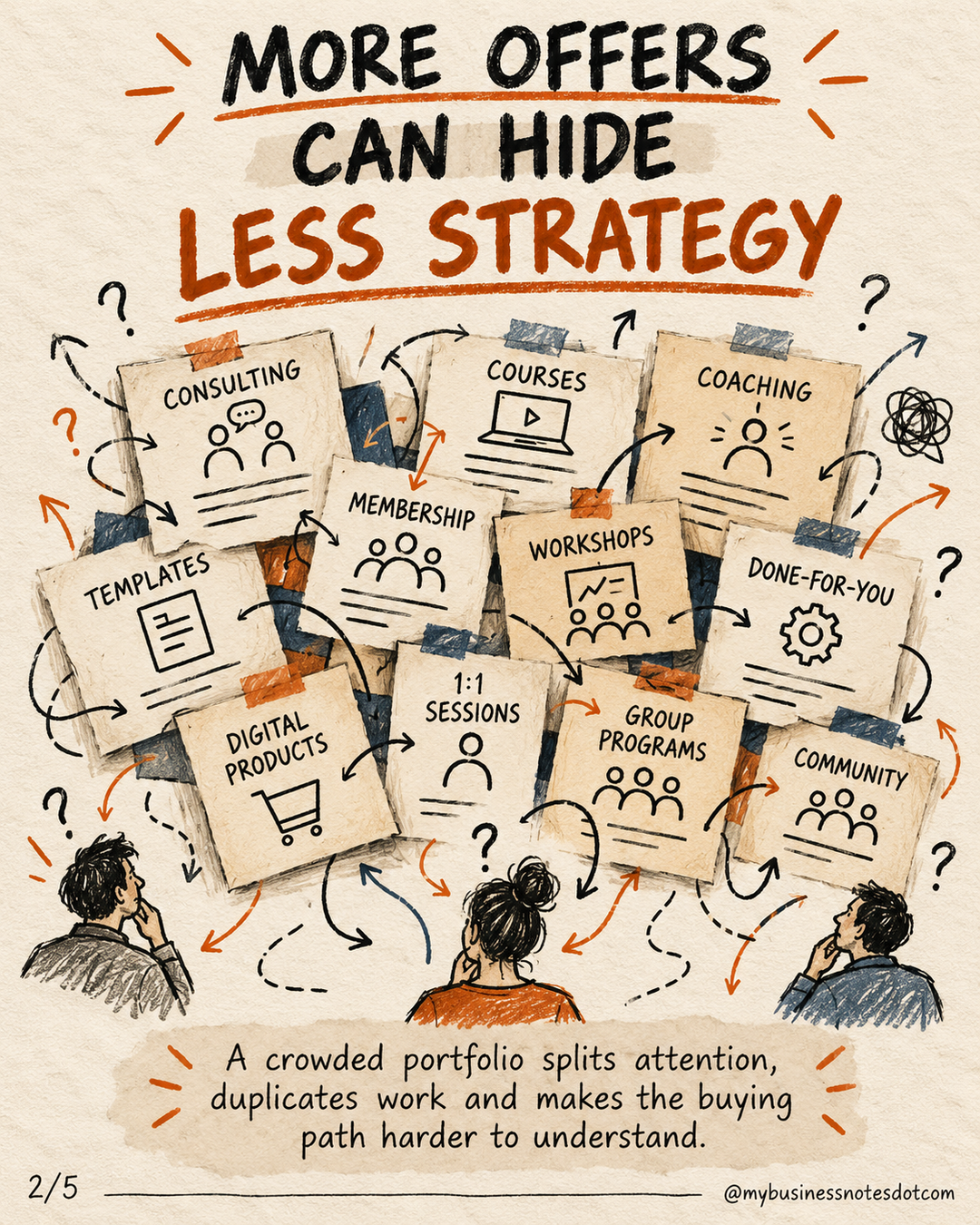
A portfolio is a set of connected choices
An entry service may help customers diagnose a problem. An implementation offer may perform the main work. Continuing support may help sustain it. These roles need to be deliberate; an old offer should not remain active solely because it has a page.
Harvard Business School's strategy guidance links value propositions to activities and trade-offs. Apply that lens across the portfolio: do the offers reinforce an operating model, or require incompatible ways of working?
Role and demand: separate intent from observation
Write the job each offer performs for the customer and the business. The Value Proposition Canvas helps expose assumptions about customer needs. Then examine actual inquiries, qualified choices, repeat use and reasons for declining.
Strategyzer distinguishes stated interest from behavior. Interviews can explain a pattern but cannot establish demand on their own. Follow GOV.UK's advice to ask for real examples, and avoid leading people toward the answer that protects a favored offer.
Economics: distinguish revenue from contribution
Review delivery costs, selling effort, support and recurring exceptions using consistent definitions. Compare like periods and similar customer situations. Do not label an offer profitable solely because it has a high selling price.
A simple contribution estimate is not the same as net profit. Shared costs, capacity changes and customer relationships can complicate decisions. Use appropriate accounting support for material financial choices; this review is a management aid, not personalized financial advice.
Capacity: account for the scarce resource
Identify the expertise or process each offer depends on. Atlassian's capacity-planning method includes ordinary duties and unplanned work rather than treating every hour as available for new projects. An offer may look attractive until its review burden is included.
In a hypothetical agency, two profitable services both need the same specialist at the same deadline. Adding their expected sales does not create delivery capacity. Compare sequencing, scope changes and realistic resource alternatives before making more commitments.
Overlap: identify duplication without erasing useful choice
Compare audience, problem, outcome and delivery model using consistent attributes. Nielsen Norman Group's comparison guidance provides a useful presentation discipline, though an internal portfolio review is broader than a customer-facing table.
Similar names do not prove duplication. Two offers may serve different circumstances; two differently branded offers may perform the same job. Check what buyers understand and what delivery teams actually do before merging anything.
Choose an action and a review point
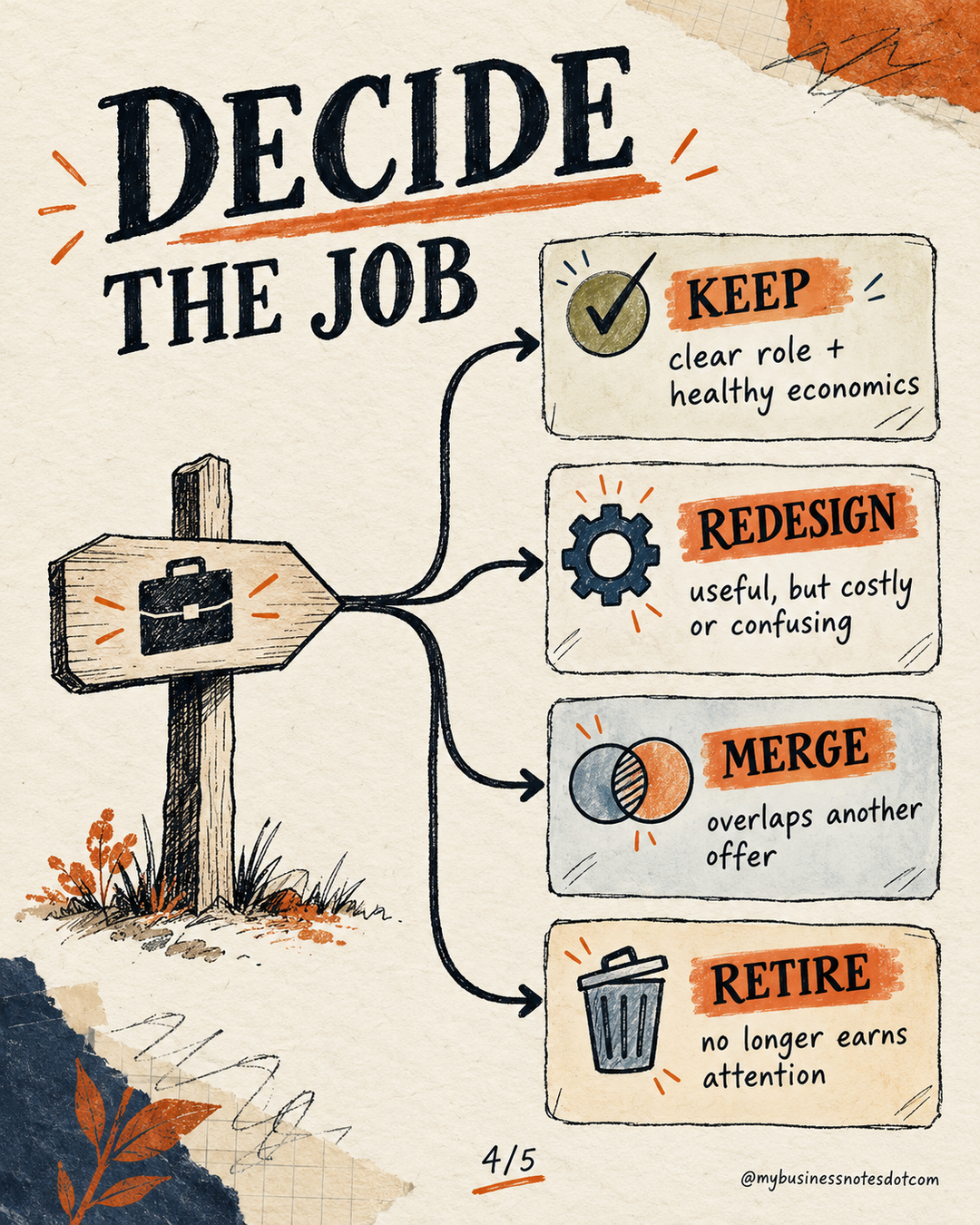
For each offer, choose a provisional action: keep, redesign, combine or retire. Record the evidence, unanswered questions, owner and conditions for reconsideration. GOV.UK's analysis guidance helps prevent interpretations from becoming supposed observations.
Use Atlassian's trade-off approach to make the consequences explicit. Retiring an offer can affect contracts, support and existing customers. Plan an appropriate transition rather than deleting access or changing agreed terms abruptly.
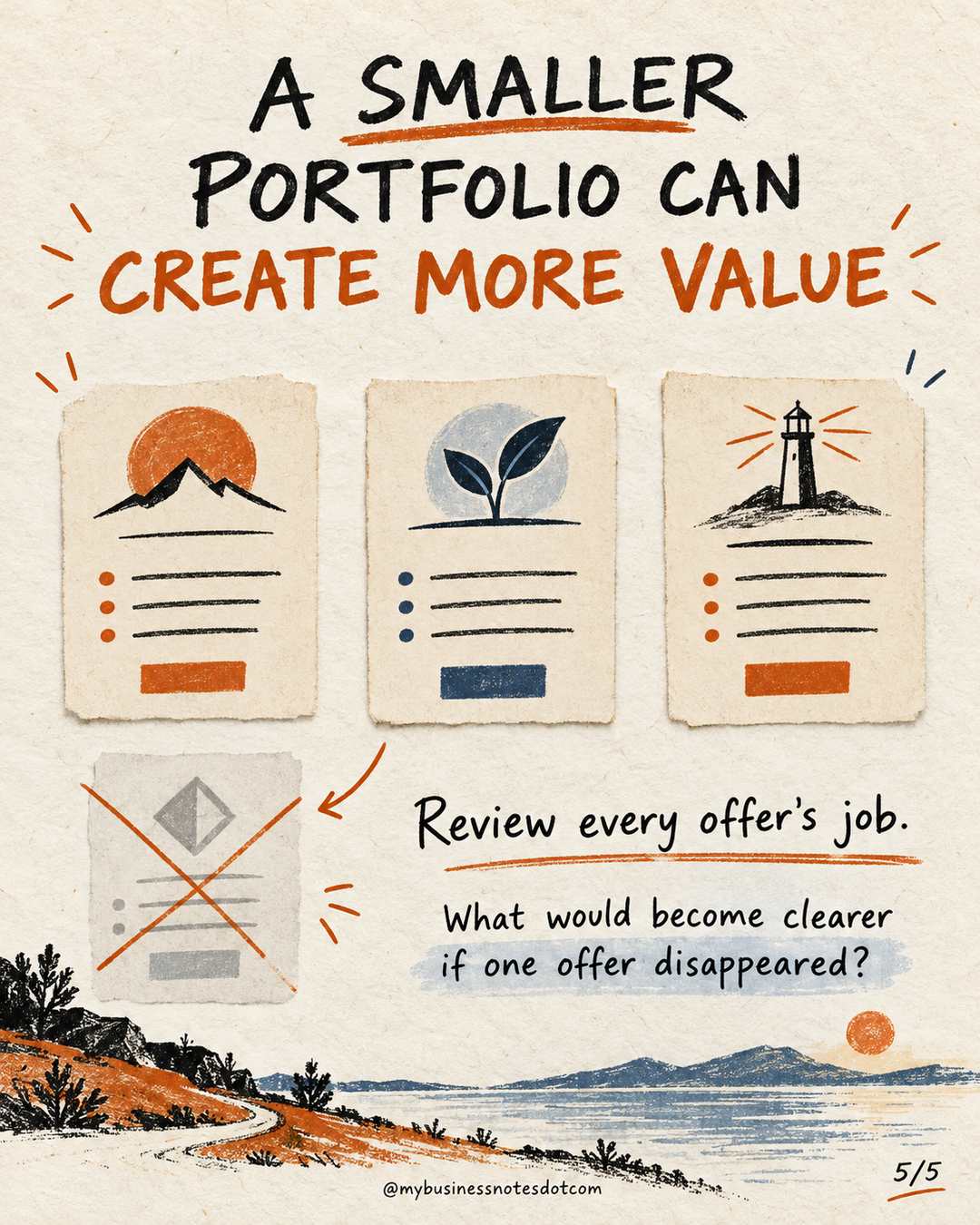
Apply PDCA to a limited change: define the expected improvement, test, compare results and decide what to retain. An offer portfolio review is successful when it produces a clearer resource decision, not when it assigns a confident score to every product.
Frequently asked questions
What should an offer portfolio review include?
Review each offer's role, observed demand, economics, capacity requirements and overlap. Keep the evidence and assumptions visible.
Should the lowest-revenue offer be retired?
Not automatically. It may have a useful role, serve an important segment or support another offer. Evaluate its costs and dependencies as well as revenue.
Does overlap mean two offers should be merged?
No. First check whether they serve distinct situations and whether buyers understand the difference. Combine only when the evidence supports it.
Download the complete carousel
Use the five-slide worksheet in your next working session.
Related reading: Turn learning into the next decision.
International references
- Harvard Business School ISC — Creating a Successful Strategy
- Lean Enterprise Institute — PDCA
- Strategyzer — Value Proposition Canvas
- Nabila Amarsy / Strategyzer — Ways to test your value proposition
- GOV.UK User research community — Analyse a research session
- GOV.UK User research community — Using in-depth interviews
- Atlassian — Capacity planning
- Kate Moran and Taylor Dykes / Nielsen Norman Group — Comparison tables
- Atlassian — Project trade-offs
- Amy Schade / Nielsen Norman Group — Avoid leading questions