

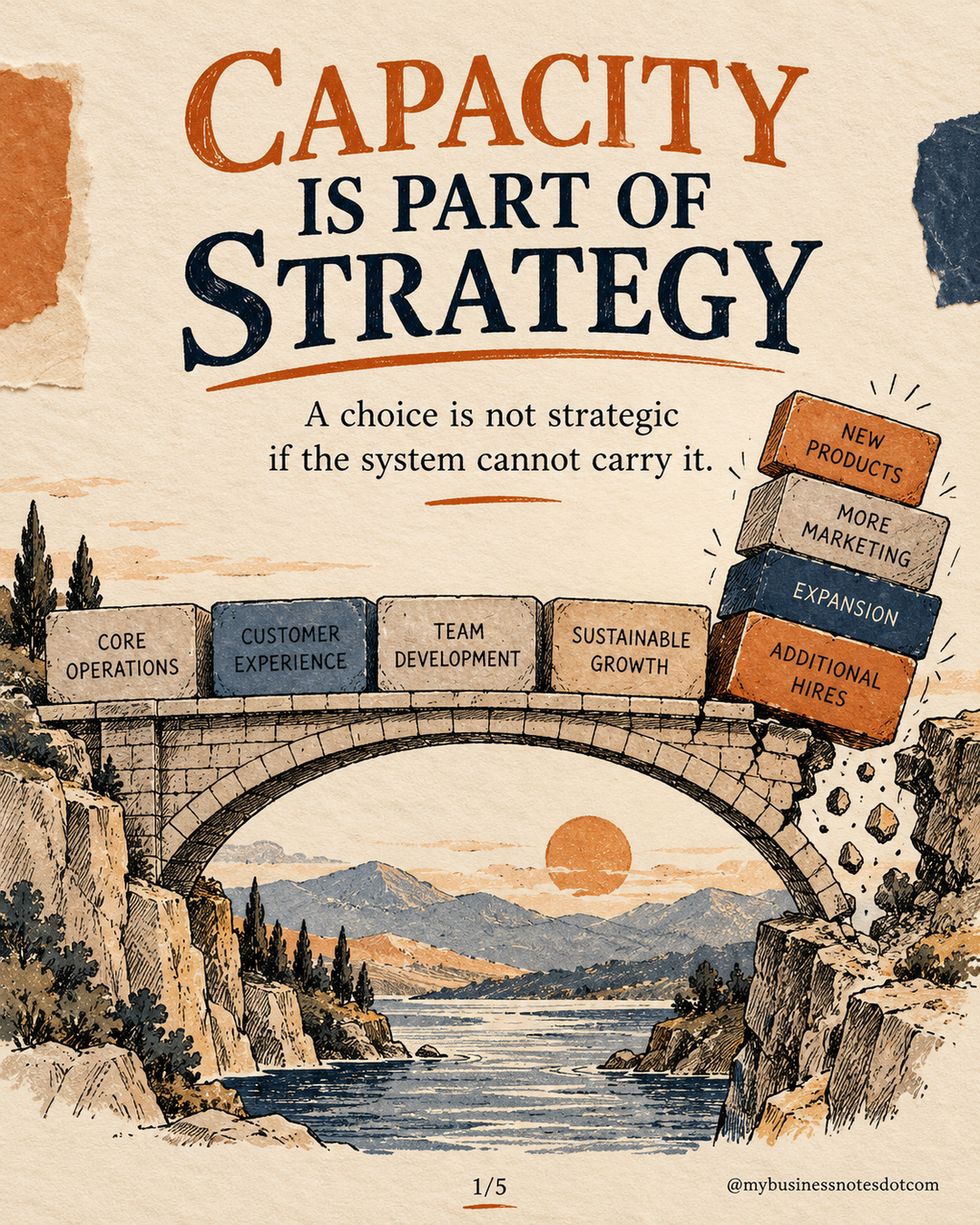
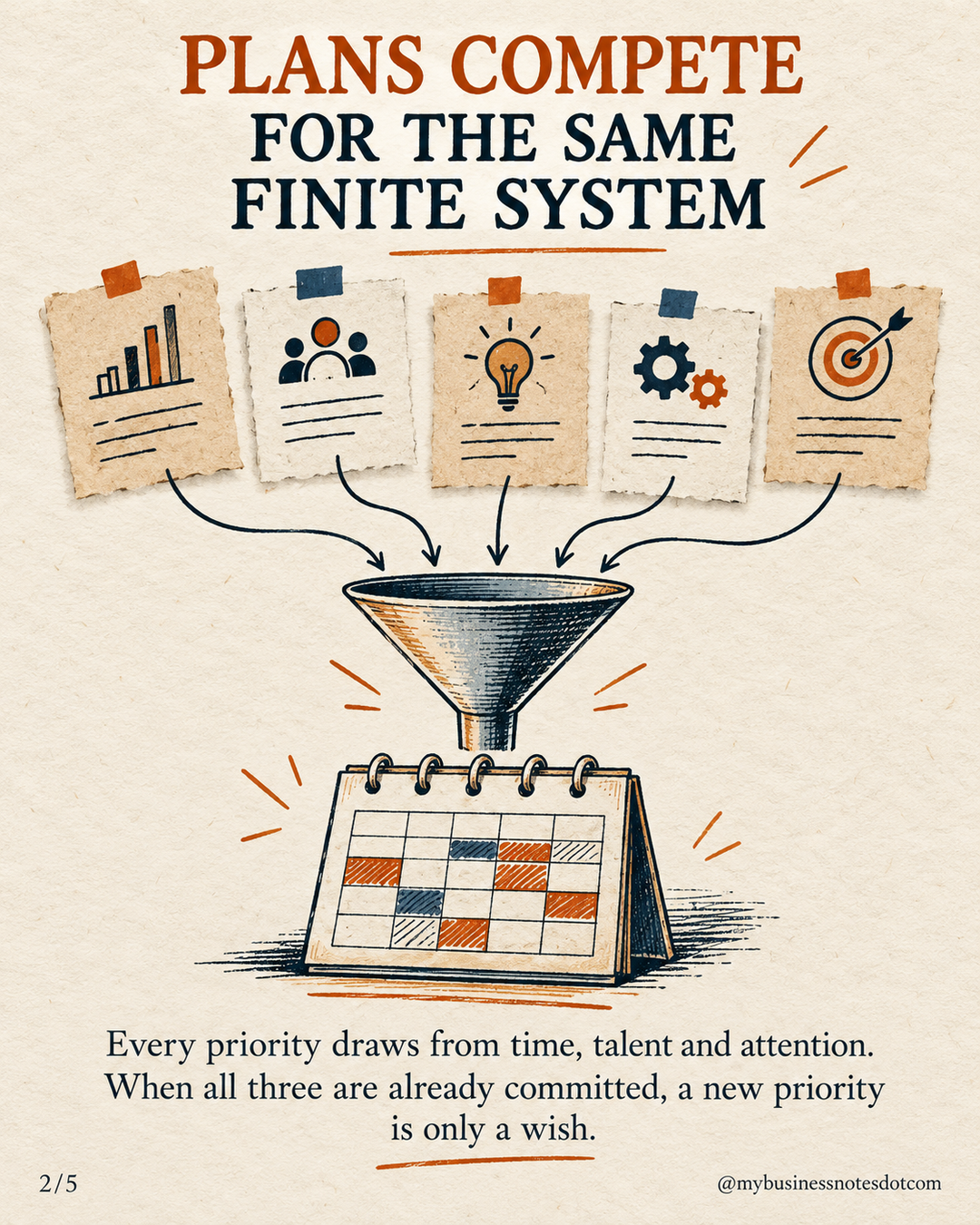
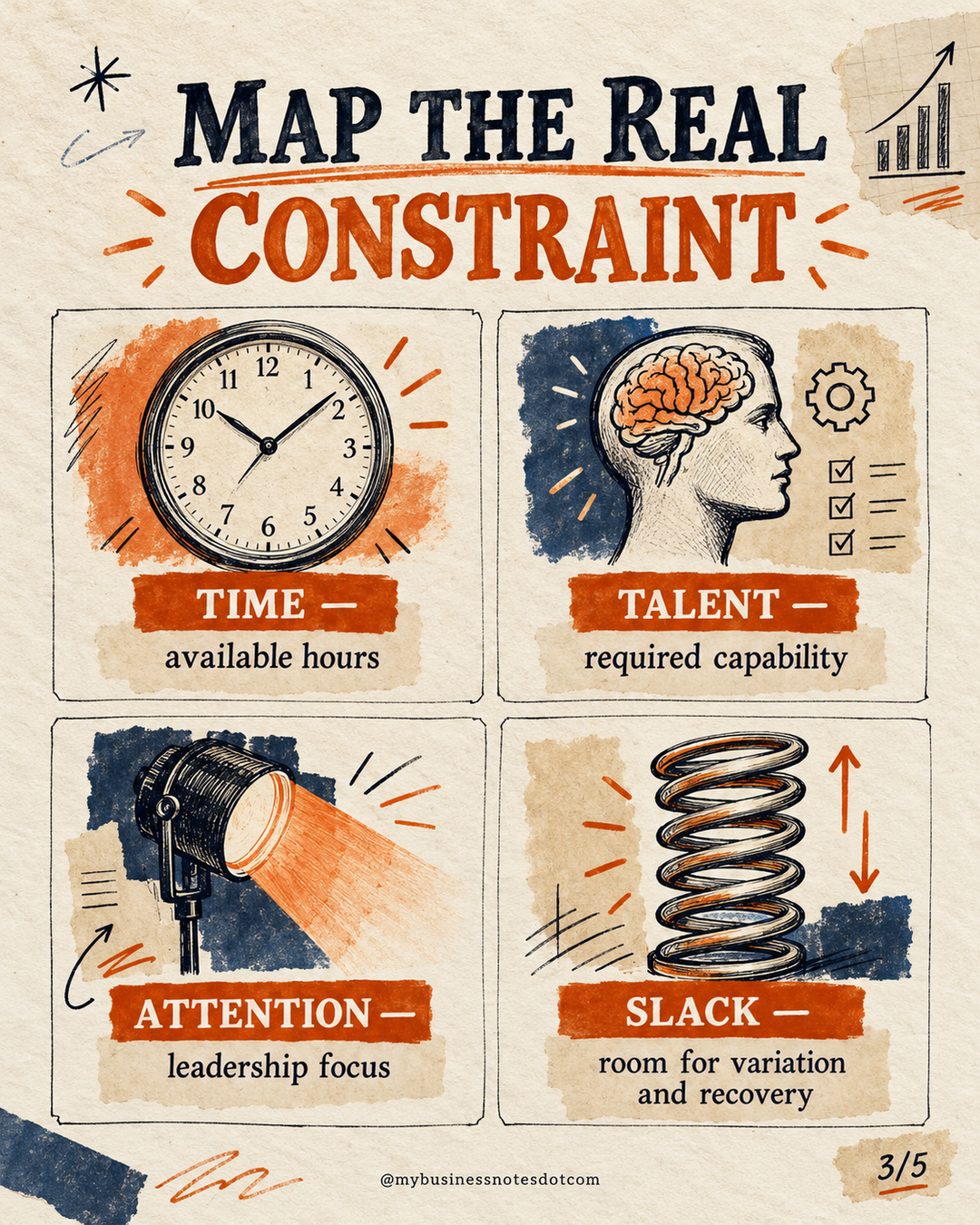
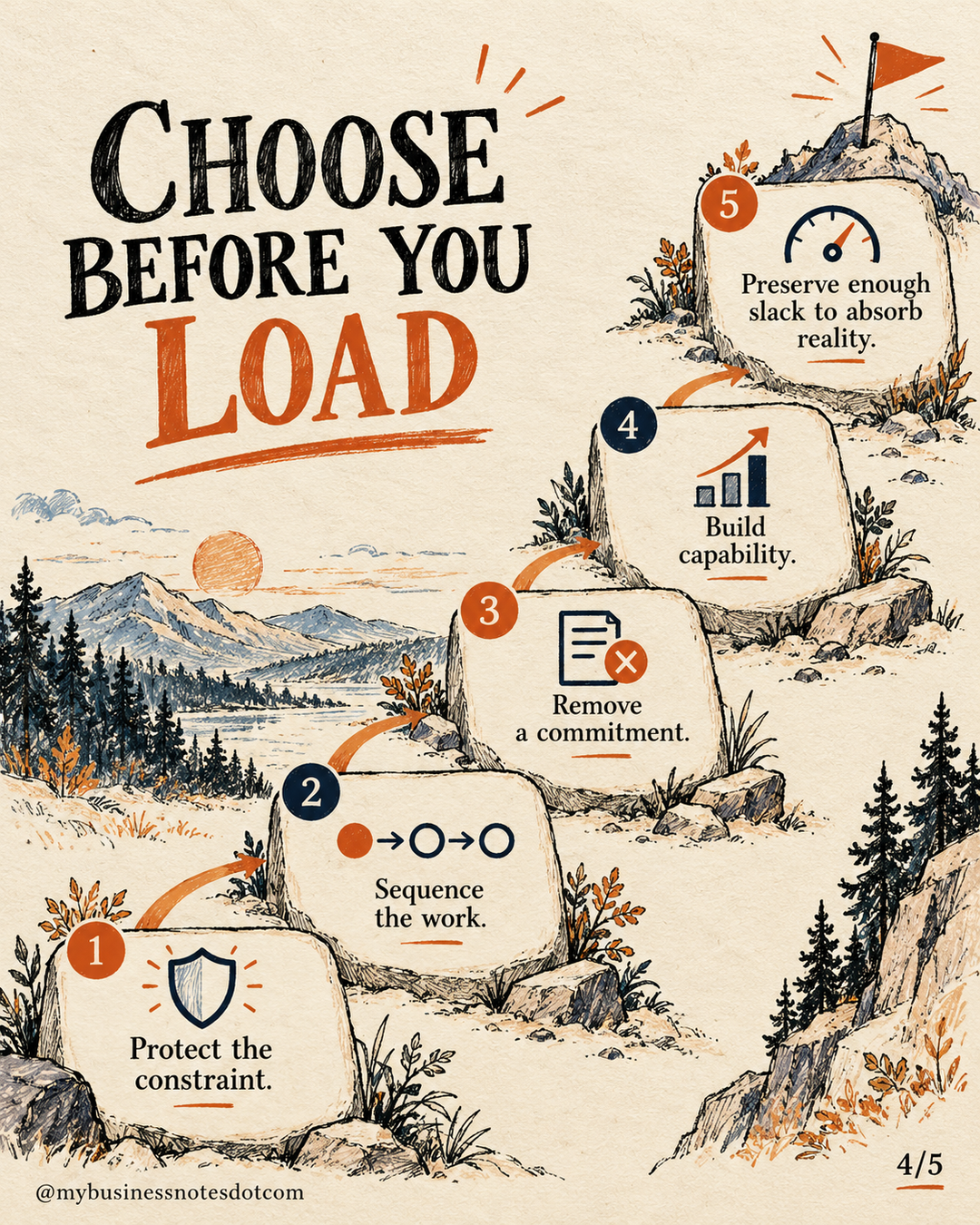
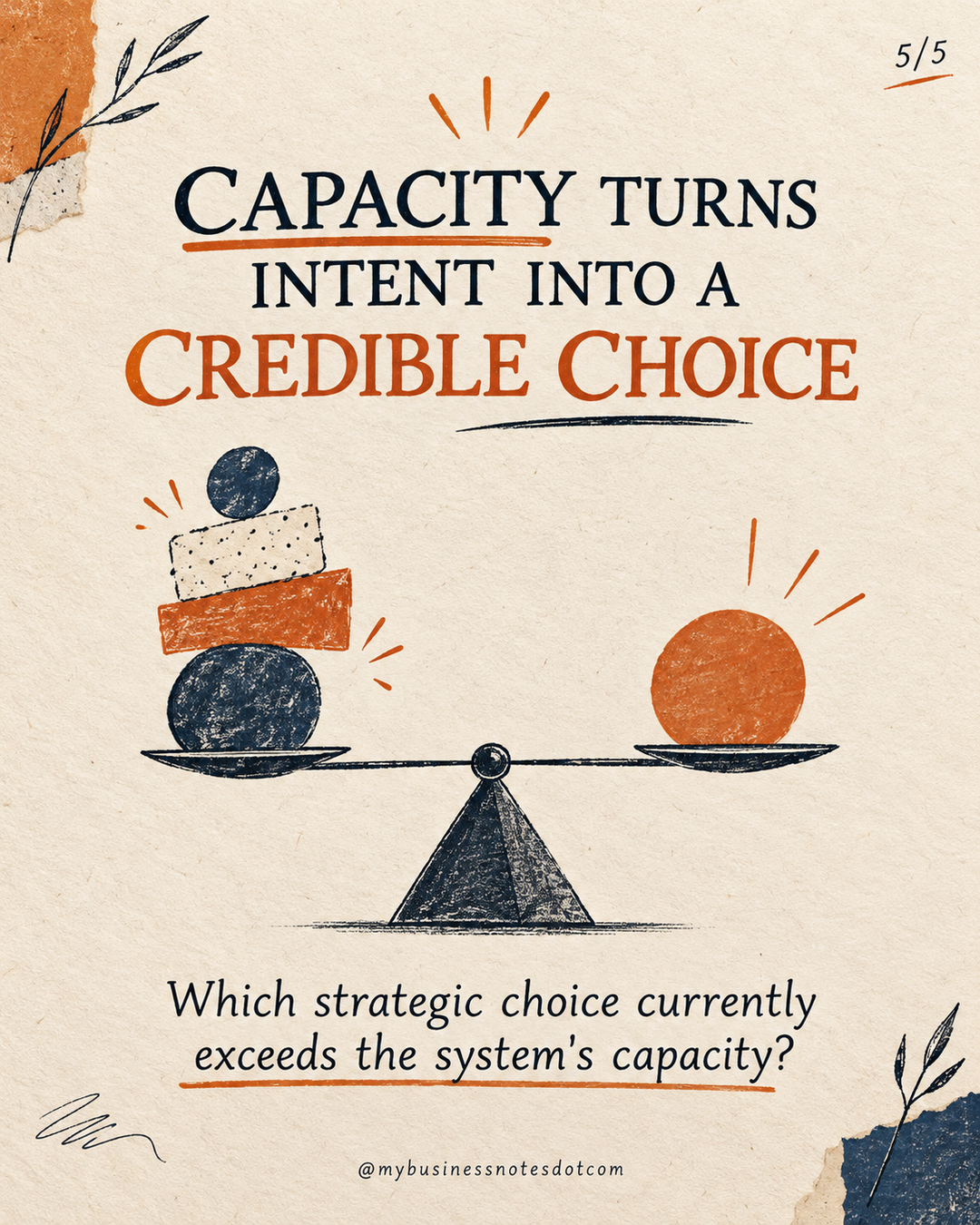
Capacity planning turns strategy into commitments the organization can realistically carry. Account for time, skills, attention and uncertainty before adding another priority, and name what must be delayed, reduced or stopped.
Slide 1 of 5
Capacity is not the same as a headcount
A team can have enough people on paper and still lack the skill or decision authority needed at a critical step. Hours are not interchangeable, and a free calendar slot does not establish readiness to perform specialized work.
Harvard Business School's strategy guidance emphasizes choices about activities and trade-offs. Capacity belongs in that conversation because every additional promise uses resources that could support something else.
Build a baseline from actual work
List delivery, support, administration, meetings, rework and known commitments by role. Atlassian's capacity-planning method asks people to examine a typical week, including informal and unplanned tasks. Use that as a starting point rather than treating contracted hours as fully available.
Ask neutral questions about recent work instead of asking whether the team can manage one more project. GOV.UK's interview approach helps surface concrete examples; leading questions can make people confirm an unrealistic plan.
Translate strategic demand into specific work
Define what each priority requires, from whom and when. The Value Proposition Canvas can clarify the customer job behind an offer; it cannot tell you the effort required to fulfill it. Validate the operating assumptions with the people who do the work.
A comparison of offers or priorities should use consistent attributes, such as specialist hours, required inputs and acceptance criteria. Nielsen Norman Group's comparison guidance is useful for making those differences legible, not as a capacity-estimation method.
Find the constraint and protect room for variation
Look for work waiting on a role, approval or dependency. A queue is a clue, not a complete diagnosis: missing information or unnecessary rework may be the cause. Inspect what actually prevents completion before adding staff.
In a hypothetical service team, production can finish quickly but all work waits for one expert's approval. Increasing production starts may enlarge the queue. A clearer review standard, better inputs or a different sequence may deserve testing before more work is accepted.
Make the trade-off explicit
Use Atlassian's trade-off approach to discuss scope, cost, time, quality and risk. Do not silently assume one can remain fixed while every other demand rises. State which promises can change and who has authority to decide.
Reserve appropriate room for uncertainty based on your own history and risk, not a universal utilization target. Slack is not automatically waste; nor is every delay a reason to create more buffer. Explain the purpose and review the actual effect.
Review the plan as evidence changes
Separate observations, interpretations and actions, following GOV.UK's research-analysis discipline. Record what was completed, what waited and why, alongside the assumptions in the original plan. Avoid turning one unusually easy week into the new baseline.
Strategyzer's testing guidance helps distinguish enthusiasm for an initiative from behavior that supports its assumptions. Before scaling a new offer, check real demand and the delivery work it creates.
Use PDCA for a bounded operational test, then decide whether to standardize the change. Capacity planning should support a choice about work, not become a ritual that makes an overloaded plan look precise.
Frequently asked questions
What should capacity planning measure?
Estimate the relevant time, skills, decision access and dependencies after accounting for existing duties and uncertainty. Headcount alone is insufficient.
Should every available hour be committed?
Not by default. The appropriate allowance for variation depends on the work and evidence. A universal utilization target can hide important differences.
Does a queue mean we need more people?
Not necessarily. Check missing inputs, approvals, rework and sequencing before concluding that staffing is the constraint.
Download the complete carousel
Use the five-slide worksheet in your next working session.
Related reading: Turn learning into the next decision.
International references
- Harvard Business School ISC — Creating a Successful Strategy
- Lean Enterprise Institute — PDCA
- Strategyzer — Value Proposition Canvas
- Nabila Amarsy / Strategyzer — Ways to test your value proposition
- GOV.UK User research community — Analyse a research session
- GOV.UK User research community — Using in-depth interviews
- Atlassian — Capacity planning
- Kate Moran and Taylor Dykes / Nielsen Norman Group — Comparison tables
- Atlassian — Project trade-offs
- Amy Schade / Nielsen Norman Group — Avoid leading questions