

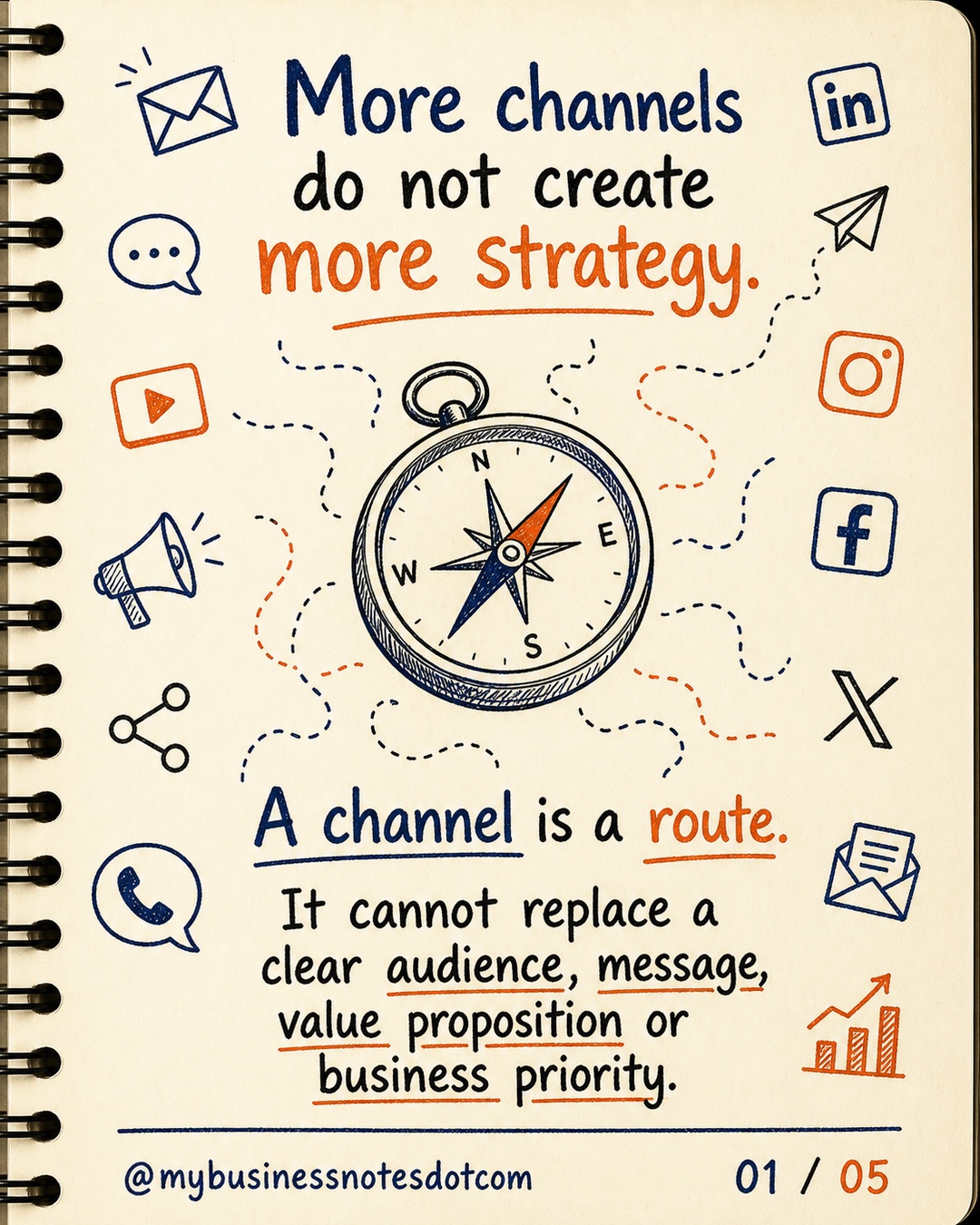
Channel strategy turns the central principle into an explicit decision: It cannot replace a clear audience, message, value proposition or business priority. This article develops that decision into a practical management framework, helping teams move from activity to coordinated action and useful evidence.
Slide 1 of 5
What this framework helps you decide
It cannot replace a clear audience, message, value proposition or business priority.
The value of a framework is not the appearance of certainty. It is the quality of the conversation it creates. Use the following sections to expose assumptions, focus attention, and convert an abstract intention into a decision that can be reviewed.
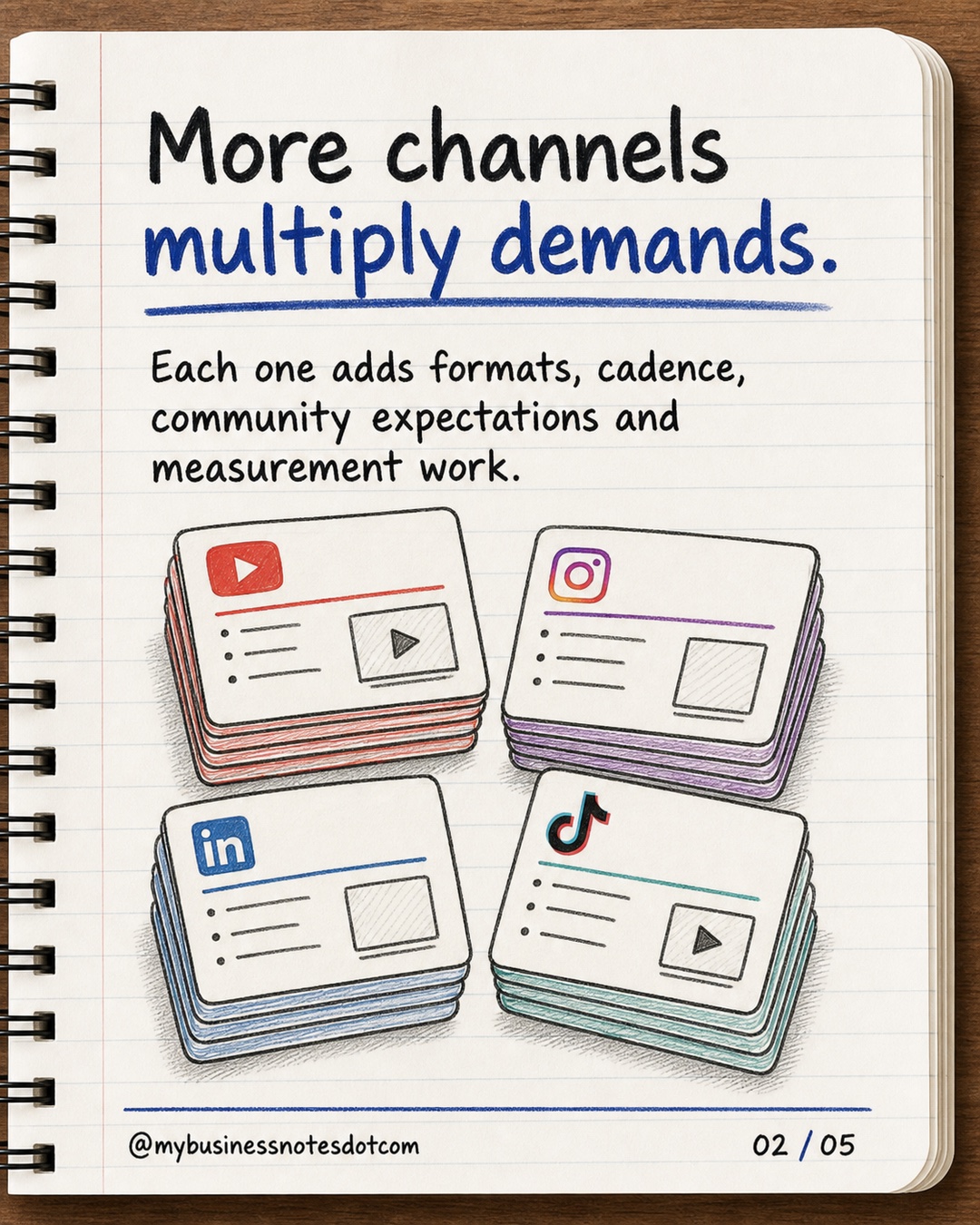
More channels multiply demands.
Each one adds formats, cadence, community expectations and measurement work.
Every additional channel introduces formats, publishing rhythms, skills, data, and response expectations. The operational burden compounds quickly, and inconsistent execution can weaken trust. Account for the full system required to sustain a channel before adding it to the plan.
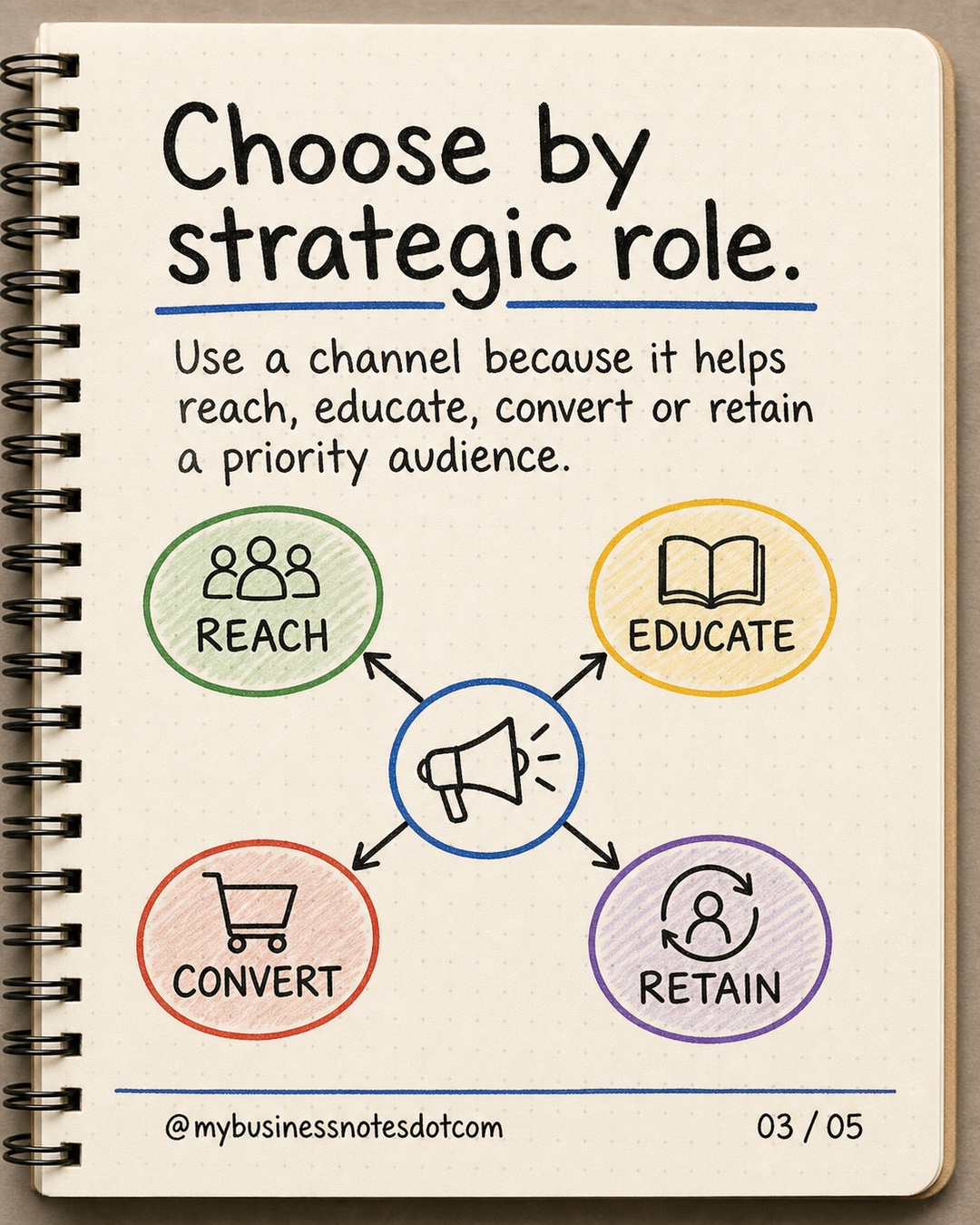
Choose by strategic role.
Use a channel because it helps reach, educate, convert or retain a priority audience.
Assign each selected channel a strategic role such as discovery, education, conversion, service, or retention. Match that role to audience behaviour and business capability, then define how people should move between channels. Presence alone is not a useful objective.
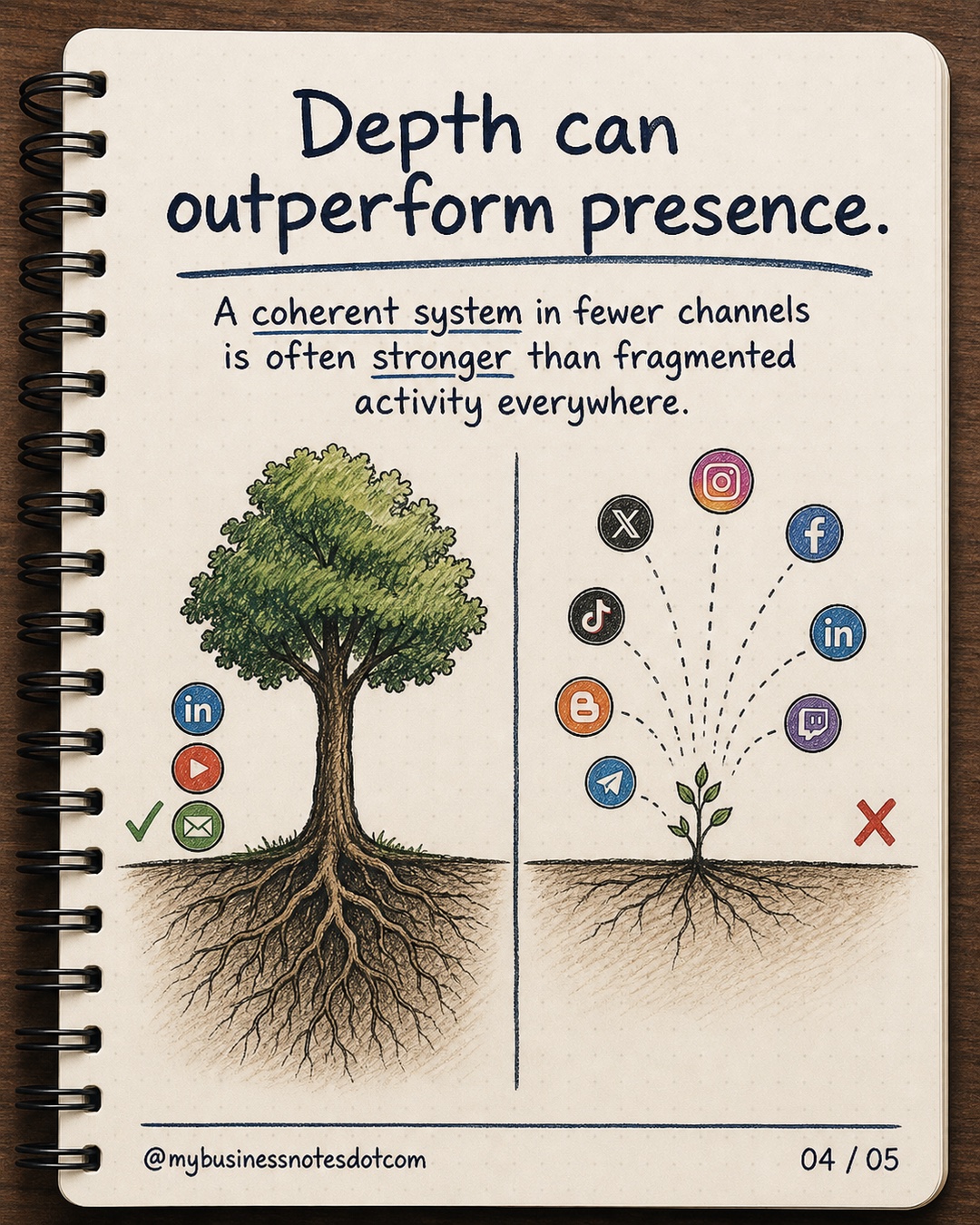
Depth can outperform presence.
A coherent system in fewer channels is often stronger than fragmented activity everywhere.
Depth creates familiarity, learning, and compounding performance. A smaller number of well-managed channels often provides better creative quality, faster feedback, and clearer attribution than shallow activity everywhere. Consistency matters when it is tied to a relevant job.
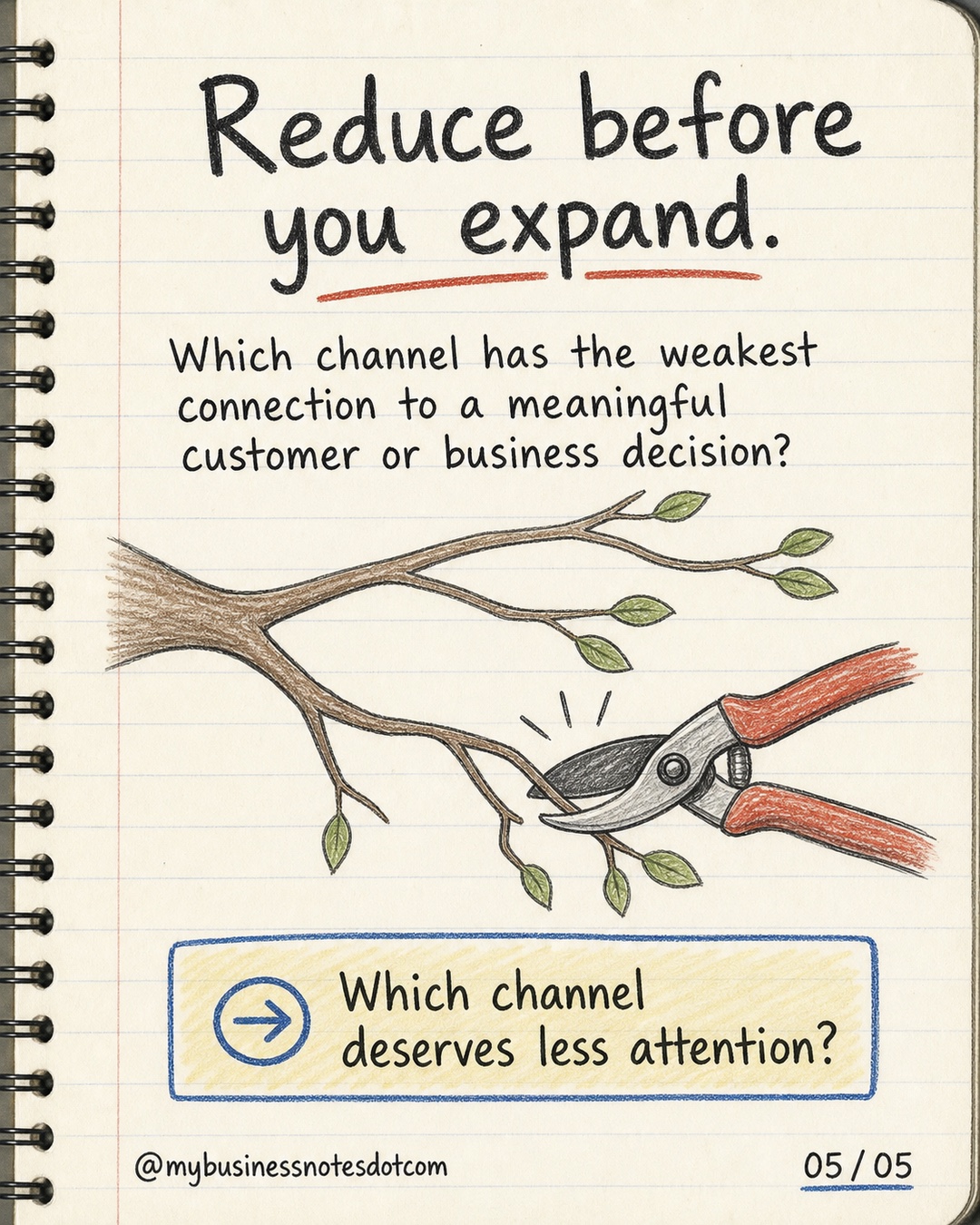
Reduce before you expand.
Which channel has the weakest connection to a meaningful customer or business decision?
Set criteria for reducing or leaving a channel before expanding the portfolio. Review strategic fit, audience quality, marginal return, learning value, and operating cost. Redirect resources when a channel no longer earns its role instead of preserving it because the account already exists.
A practical example
A specialist firm may use search to capture active demand, LinkedIn to educate a narrow professional audience and email to deepen relationships. Adding short-form video only makes sense if it performs a needed role better than the attention and production capacity it consumes.
The mistake to avoid
Presence everywhere can create shallow execution everywhere: inconsistent cadence, weak community response and measurements that never inform a business decision.
How to apply the framework
Begin with the business result and the customer or operational context. Work through the framework in sequence, but spend more time where uncertainty is highest. Record the decision, the reasoning behind it, and the signal that would cause the team to reconsider.
A useful review ends with subtraction as well as addition. Identify what will stop, what will receive protected attention, and who is accountable for the next visible step. Without those trade-offs, even a clear discussion can dissolve into more activity.
For related guidance, see Marketing as value creation and The four pillars of content strategy.
Frequently asked questions
What is channel strategy?
Channel strategy is a practical way to organize decisions around the result, audience, actions and evidence described in this article.
Why does channel strategy matter?
It matters because it connects activity to an explicit decision and makes progress easier to evaluate, explain and improve.
What is the most common mistake with channel strategy?
Presence everywhere can create shallow execution everywhere: inconsistent cadence, weak community response and measurements that never inform a business decision.
How do you start using channel strategy?
Write the current decision in one sentence, apply the framework to the highest uncertainty, assign one owner and define the next observable evidence.
Put the framework into practice
Which channel deserves less attention? Use the carousel as a shared review tool, then capture the resulting priority, owner, next action, and evidence in the team’s working system.
Download the complete carousel
Keep the framework as a PDF for your next review.
International references