
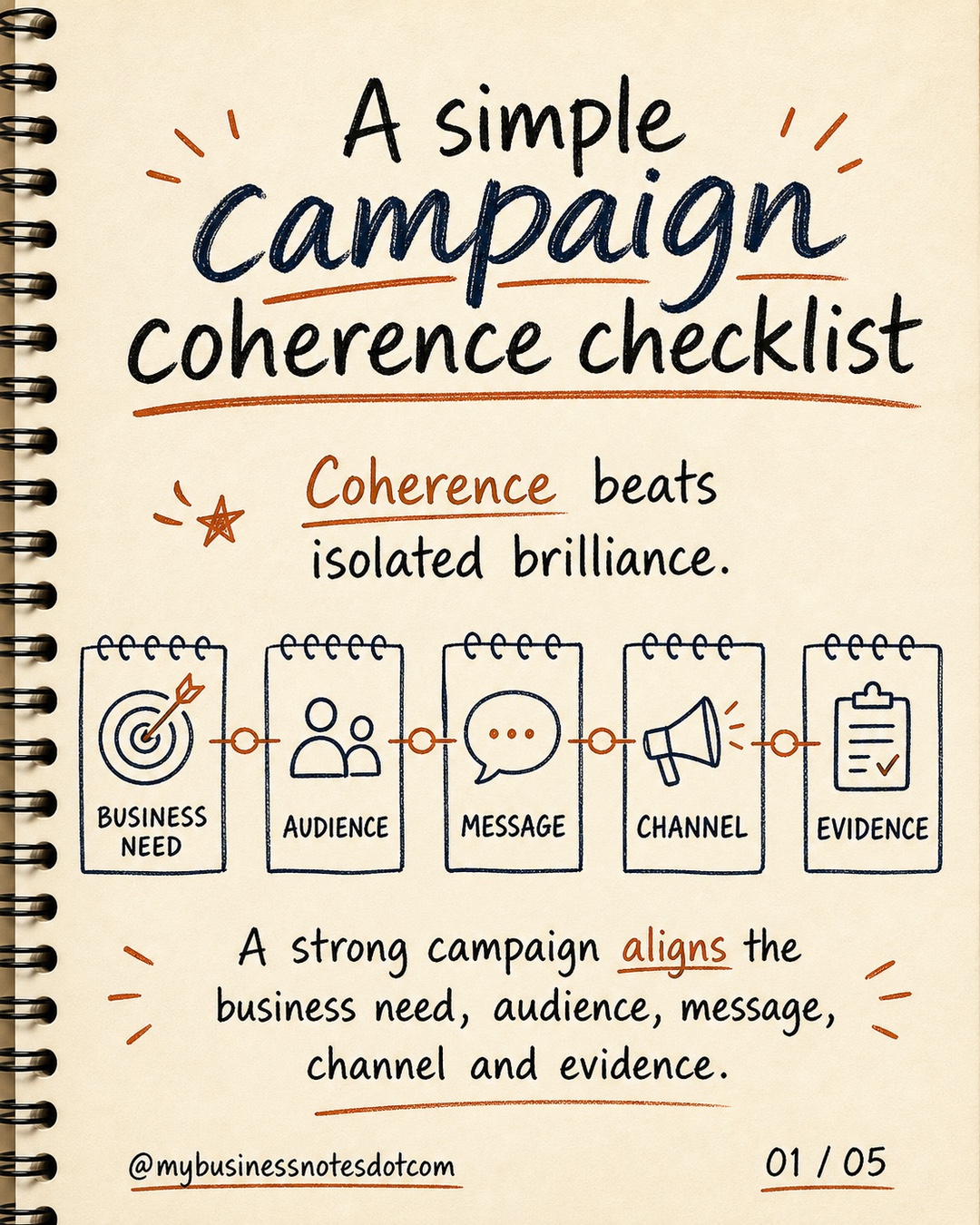
Campaign coherence turns the central principle into an explicit decision: A strong campaign aligns the business need, audience, message, channel and evidence. This article develops that decision into a practical management framework, helping teams move from activity to coordinated action and useful evidence.
Slide 1 of 5
What this framework helps you decide
A strong campaign aligns the business need, audience, message, channel and evidence.
The value of a framework is not the appearance of certainty. It is the quality of the conversation it creates. Use the following sections to expose assumptions, focus attention, and convert an abstract intention into a decision that can be reviewed.
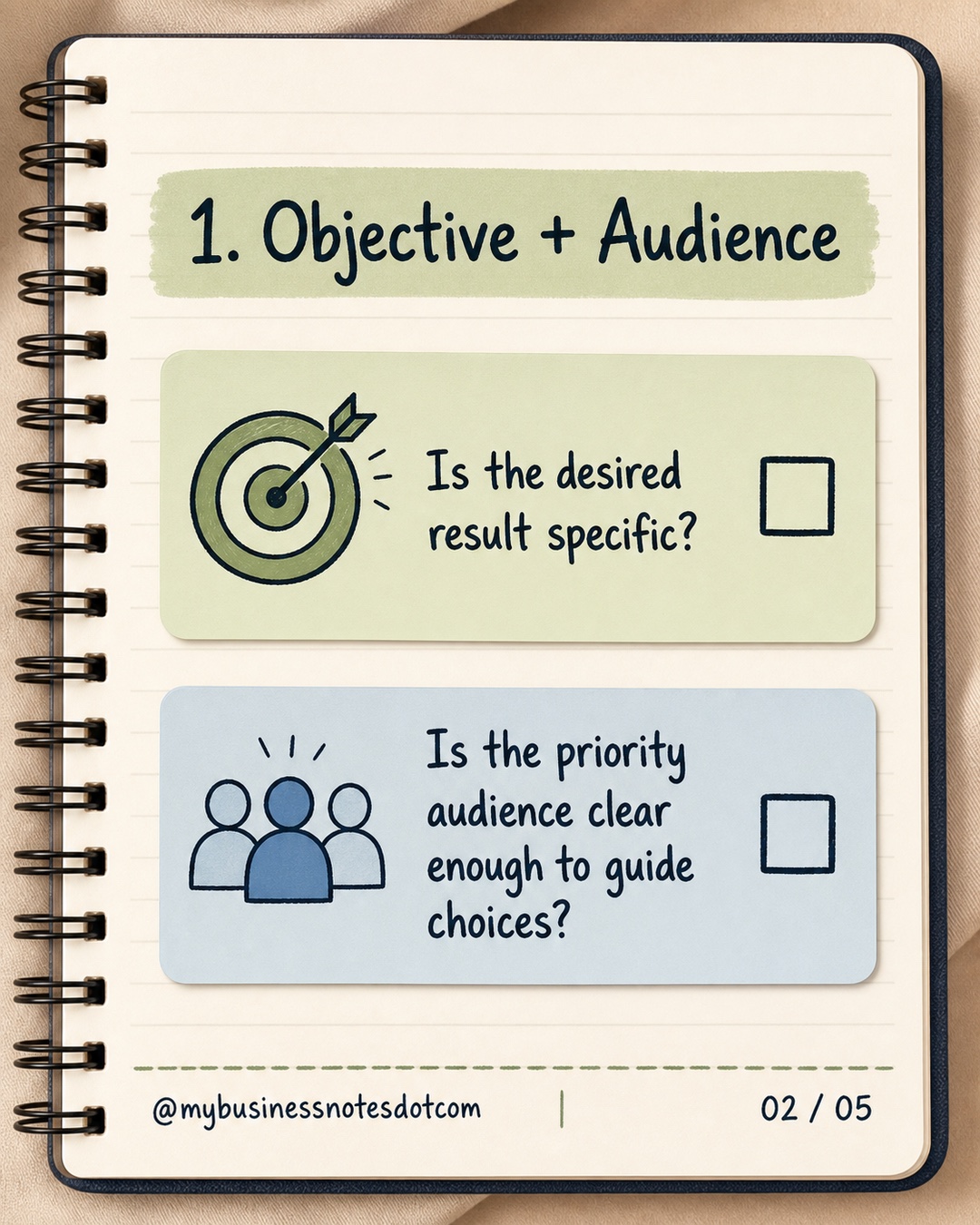
1. Objective + Audience
Is the desired result specific? Is the priority audience clear enough to guide choices?
Confirm that the campaign objective describes a meaningful change and that the selected audience is the group whose behaviour can contribute to it. If either remains broad, subsequent creative and media decisions will fragment because the campaign lacks a shared target.
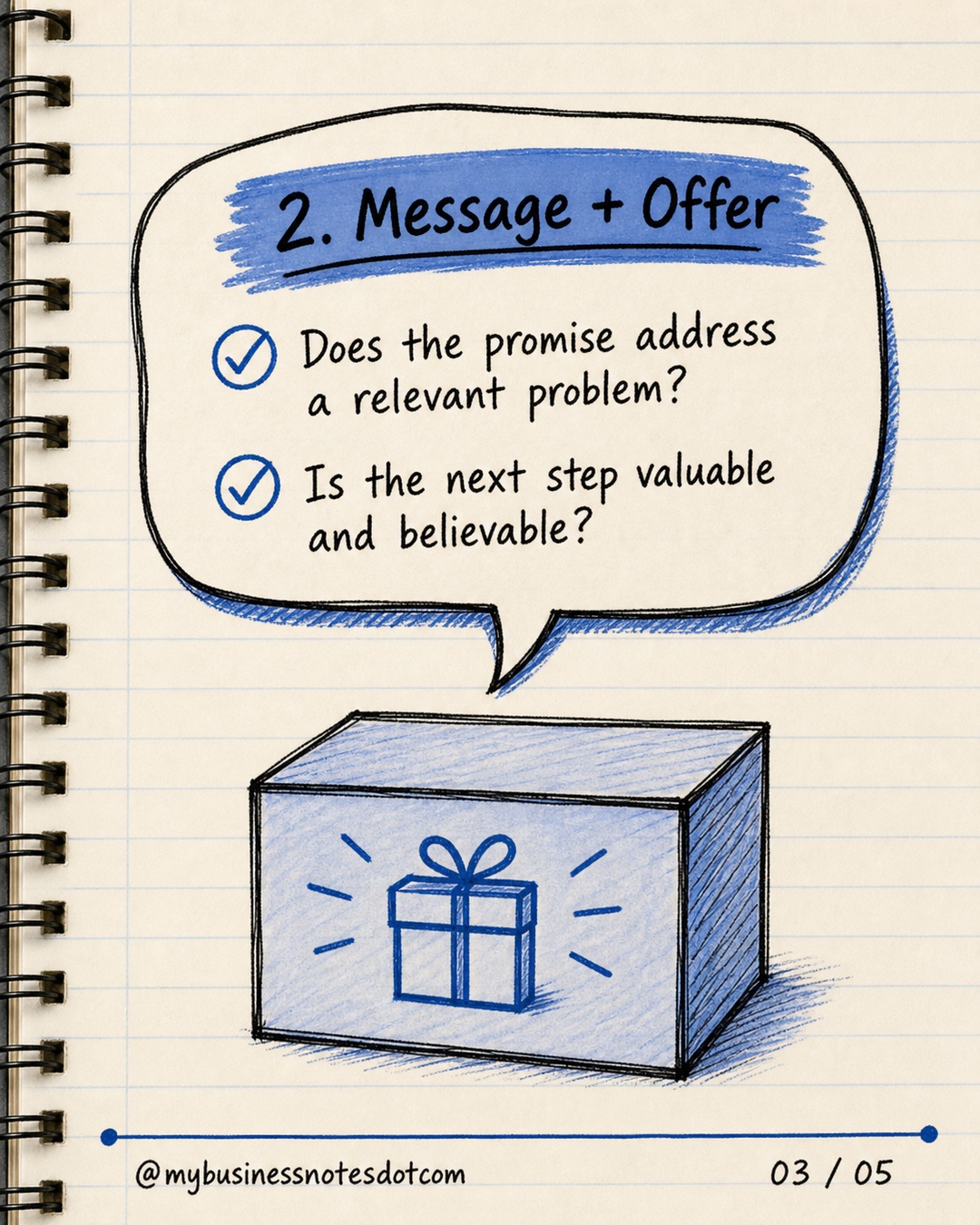
2. Message + Offer
Does the promise address a relevant problem? Is the next step valuable and believable?
The message should express the audience’s relevant problem or desired progress, while the offer provides a credible next step. Test whether the promise, proof, and action belong together. A strong message cannot compensate for an offer that is premature or unclear.
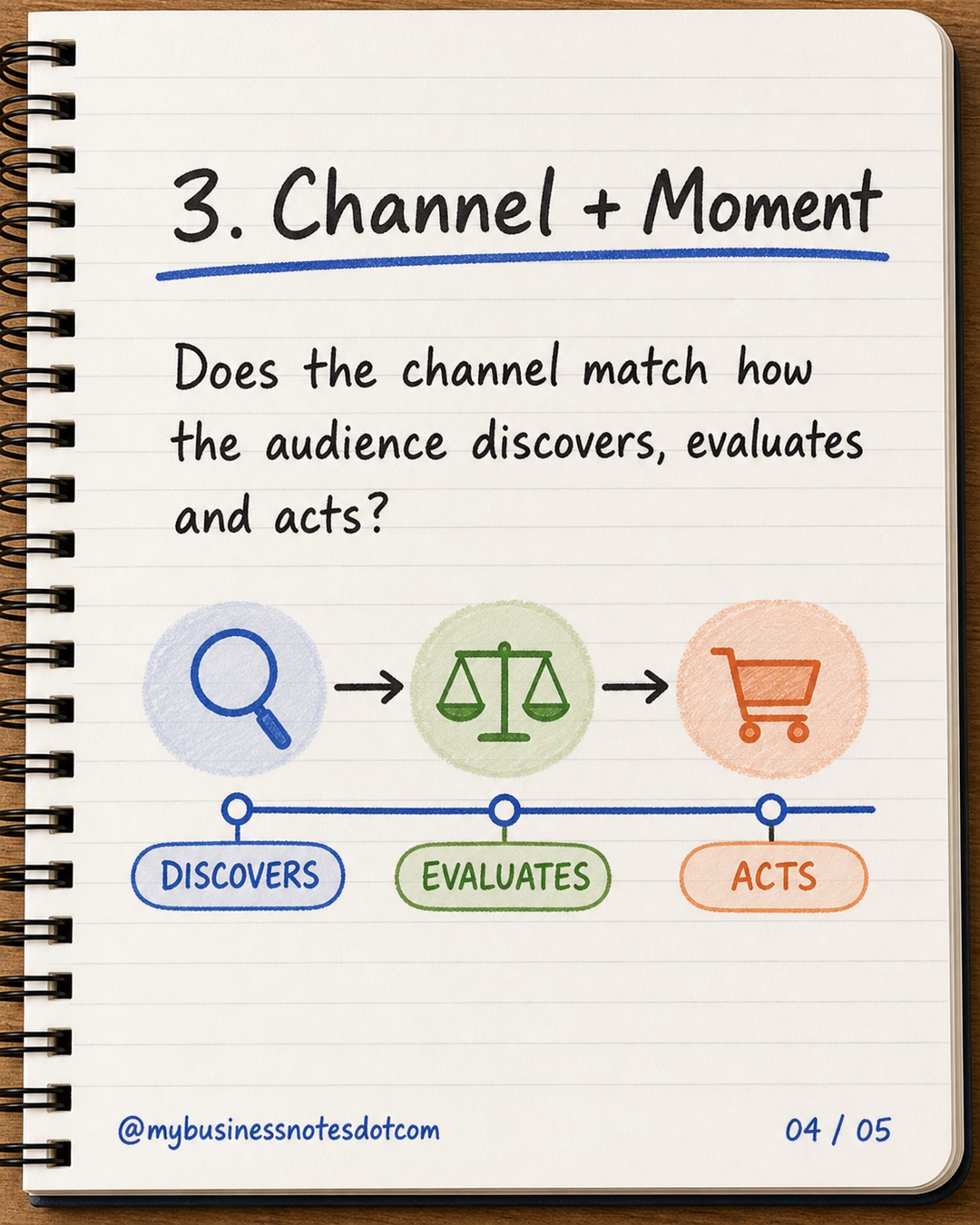
3. Channel + Moment
Does the channel match how the audience discovers, evaluates and acts?
Choose channels for the role they play and the moment in which the audience will encounter them. Consider intent, attention, format, and follow-up rather than copying the same execution everywhere. Coherence allows each channel to reinforce the same decision without becoming identical.
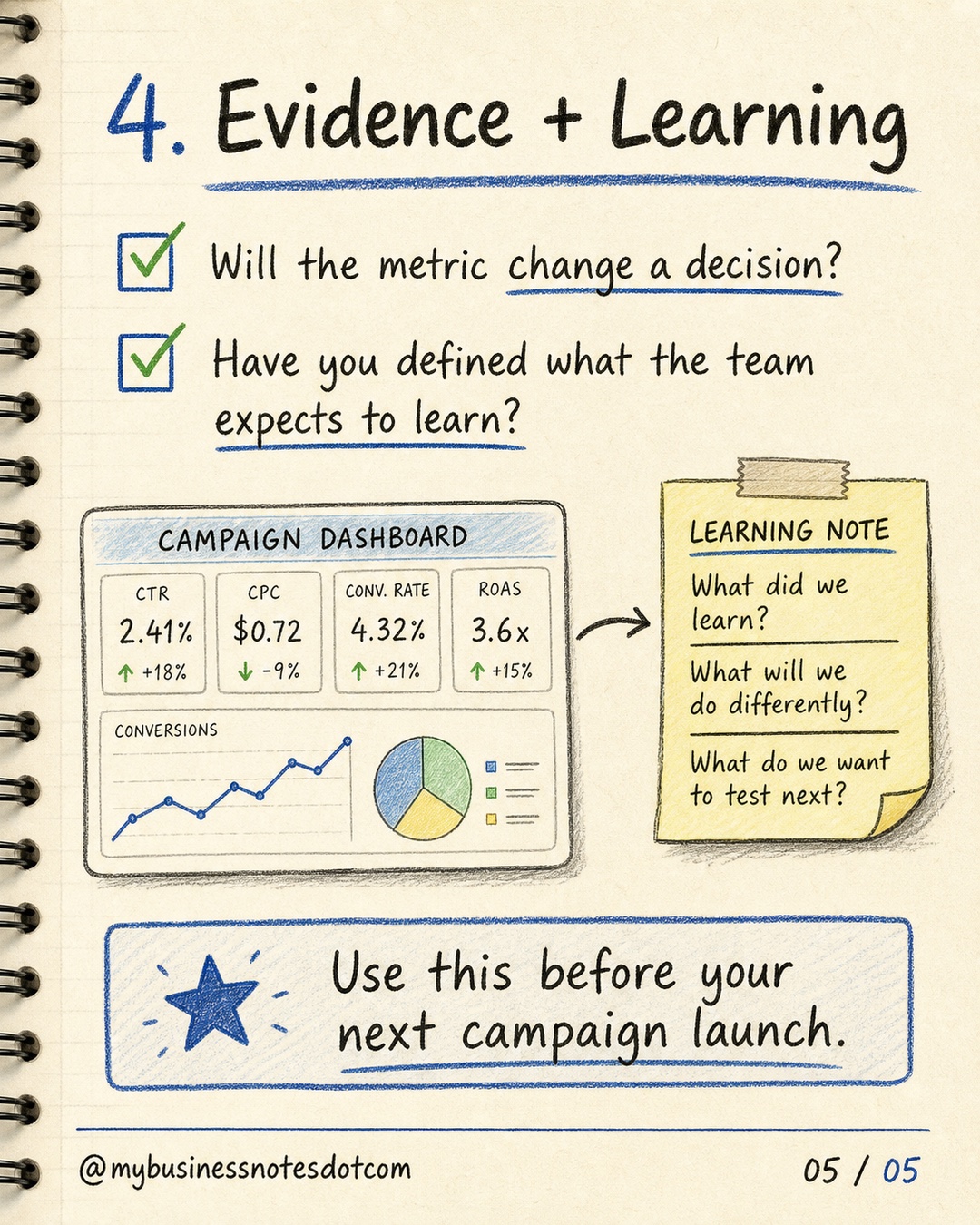
4. Evidence + Learning
Will the metric change a decision? Have you defined what the team expects to learn?
Define the evidence the campaign must generate before launch. Include outcome signals, diagnostic signals, a review date, and the decision each measure can inform. This turns measurement into a learning system and prevents dashboards from becoming a collection of numbers without consequences.
A practical example
A campaign can contain a brilliant video and still be incoherent if the offer solves a different problem from the message or if the selected channel reaches the audience in the wrong decision moment. Review the entire path from business need to learning before judging individual assets.
The mistake to avoid
Teams often review creative quality in isolation and discover after launch that the landing page, sales follow-up or measurement plan tells a different story.
How to apply the framework
Begin with the business result and the customer or operational context. Work through the framework in sequence, but spend more time where uncertainty is highest. Record the decision, the reasoning behind it, and the signal that would cause the team to reconsider.
A useful review ends with subtraction as well as addition. Identify what will stop, what will receive protected attention, and who is accountable for the next visible step. Without those trade-offs, even a clear discussion can dissolve into more activity.
For related guidance, see Marketing as value creation and The four pillars of content strategy.
Frequently asked questions
What is campaign coherence?
Campaign coherence is a practical way to organize decisions around the result, audience, actions and evidence described in this article.
Why does campaign coherence matter?
It matters because it connects activity to an explicit decision and makes progress easier to evaluate, explain and improve.
What is the most common mistake with campaign coherence?
Teams often review creative quality in isolation and discover after launch that the landing page, sales follow-up or measurement plan tells a different story.
How do you start using campaign coherence?
Write the current decision in one sentence, apply the framework to the highest uncertainty, assign one owner and define the next observable evidence.
Put the framework into practice
Use this before your next campaign launch. Use the carousel as a shared review tool, then capture the resulting priority, owner, next action, and evidence in the team’s working system.
Download the complete carousel
Keep the framework as a PDF for your next review.
International references