

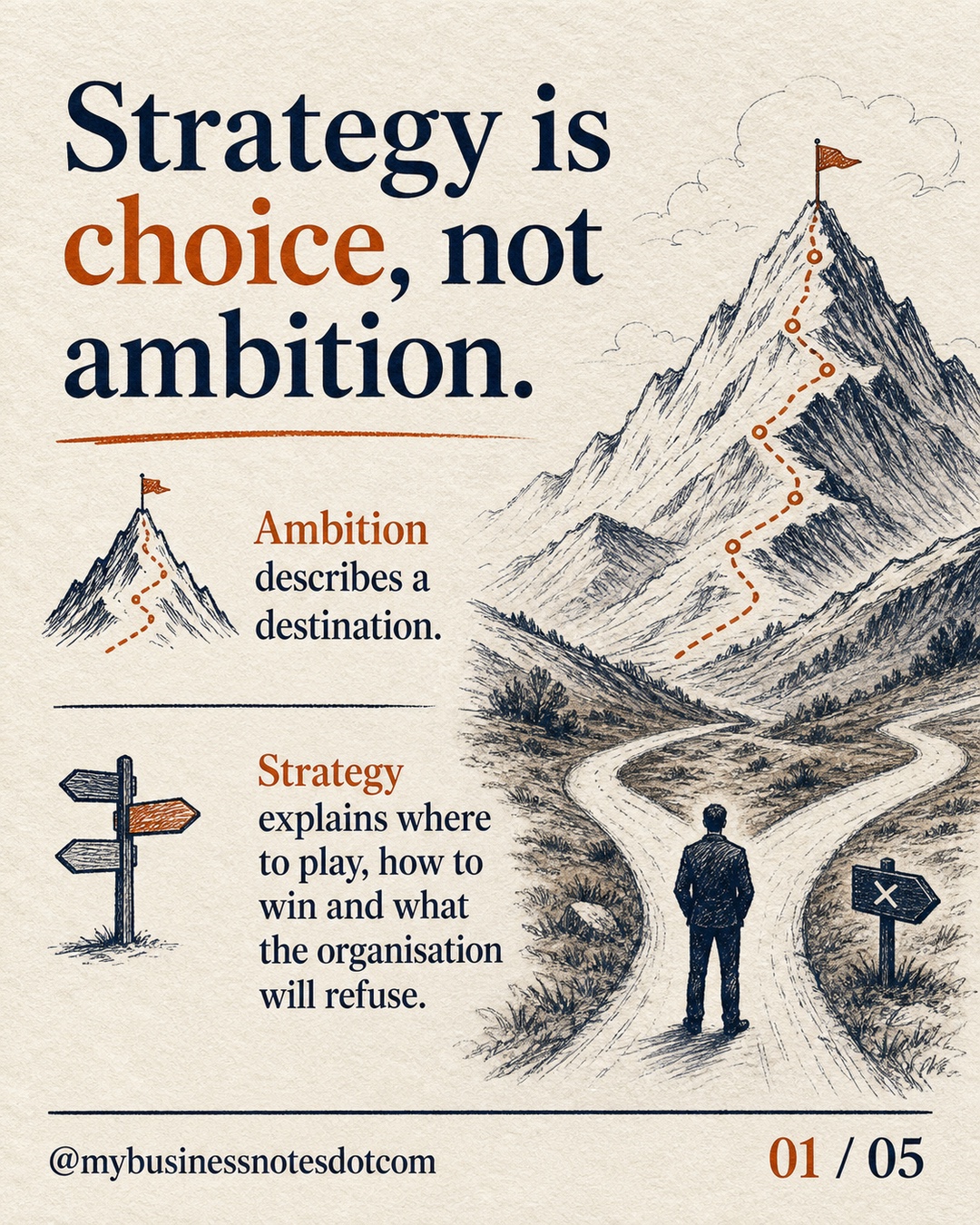
Strategy is choice turns the central principle into an explicit decision: Strategy explains where to play, how to win and what the organisation will refuse. This article develops that decision into a practical management framework, helping teams move from activity to coordinated action and useful evidence.
Slide 1 of 5
What this framework helps you decide
Strategy explains where to play, how to win and what the organisation will refuse.
The value of a framework is not the appearance of certainty. It is the quality of the conversation it creates. Use the following sections to expose assumptions, focus attention, and convert an abstract intention into a decision that can be reviewed.
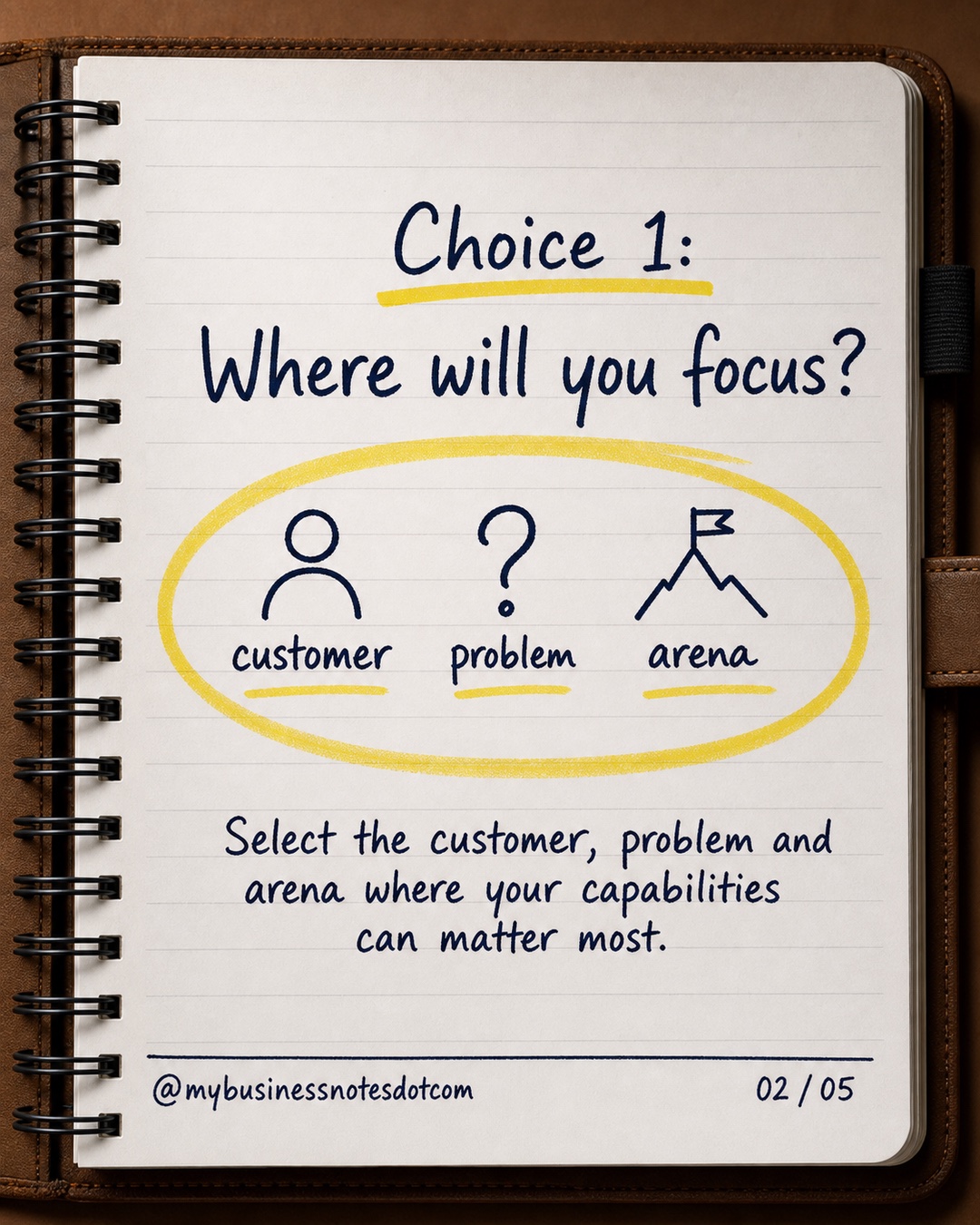
Choice 1: Where will you focus?
Select the customer, problem and arena where your capabilities can matter most.
Where to play defines the customers, problems, occasions, categories, or geographies that deserve concentrated attention. The choice should be specific enough to allocate resources and to explain why nearby opportunities will not receive the same priority.
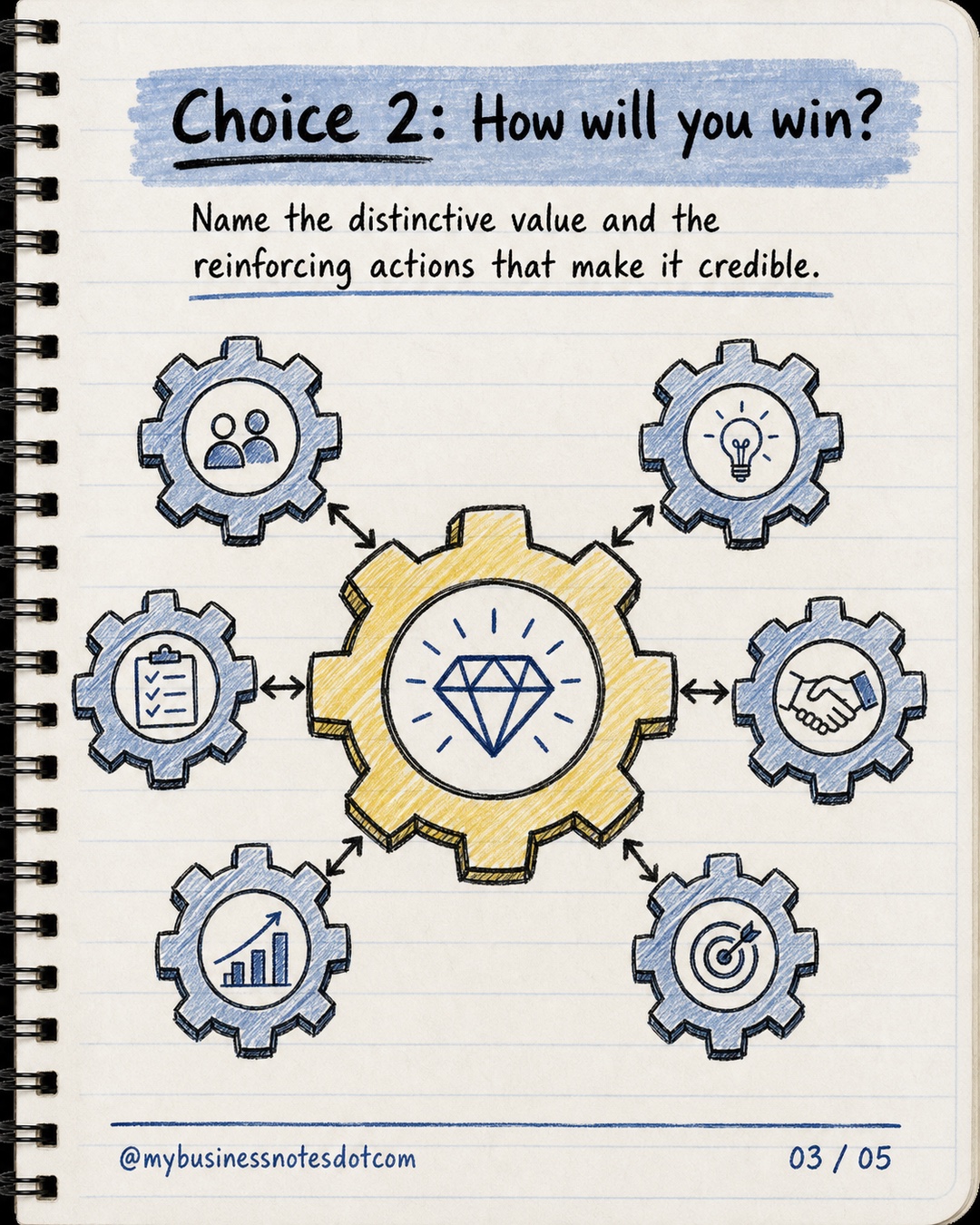
Choice 2: How will you win?
Name the distinctive value and the reinforcing actions that make it credible.
How to win describes the distinctive value and capabilities that can create an advantage in the chosen arena. Connect the customer outcome to the operating strengths required to deliver it; aspiration without a credible mechanism is not yet a strategy.
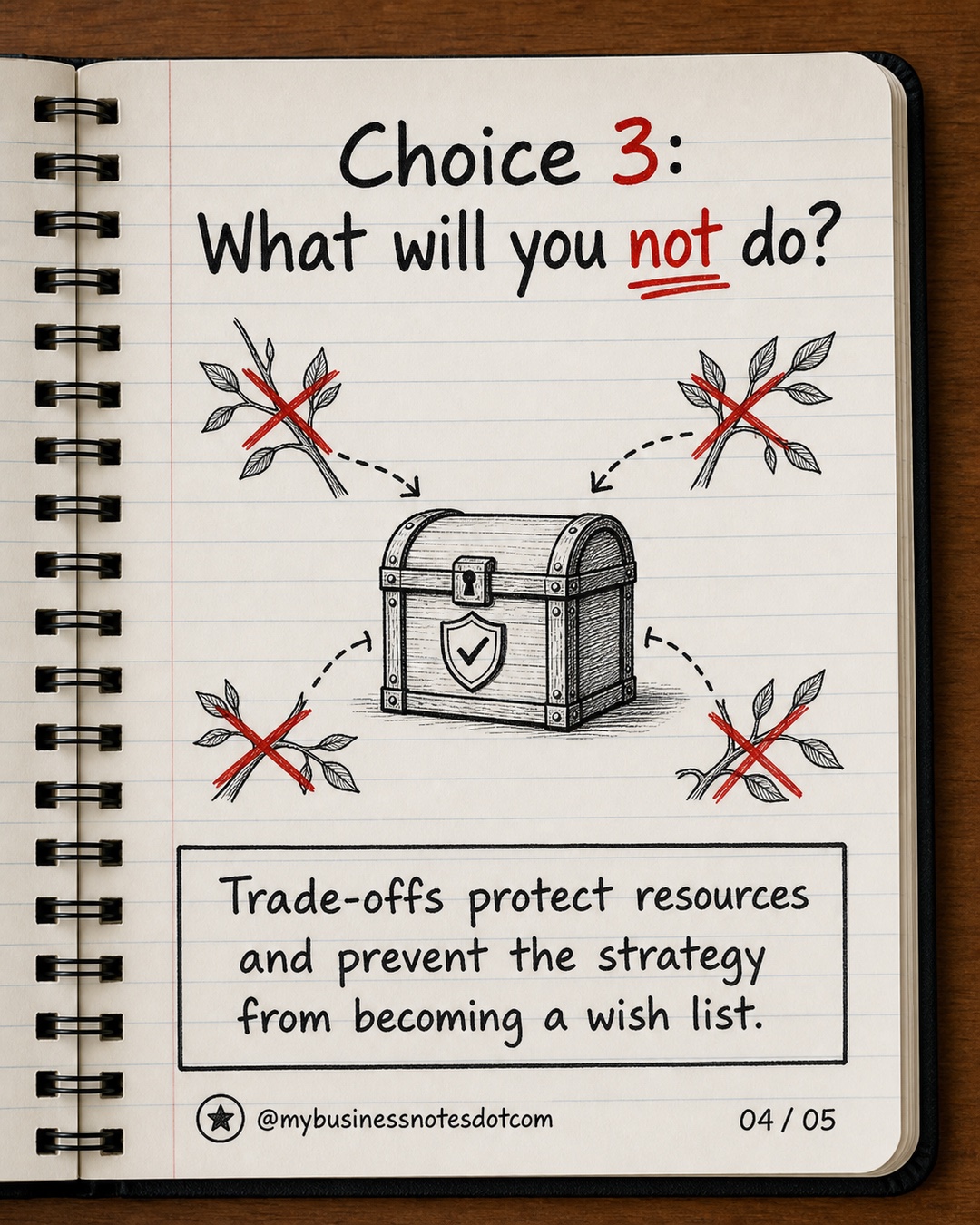
Choice 3: What will you not do?
Trade-offs protect resources and prevent the strategy from becoming a wish list.
Explicit refusals protect the strategy from dilution. Name the segments, offers, channels, and activities the organisation will not pursue for now, including attractive options that do not reinforce the chosen advantage. Resources become strategic only when alternatives are deliberately declined.
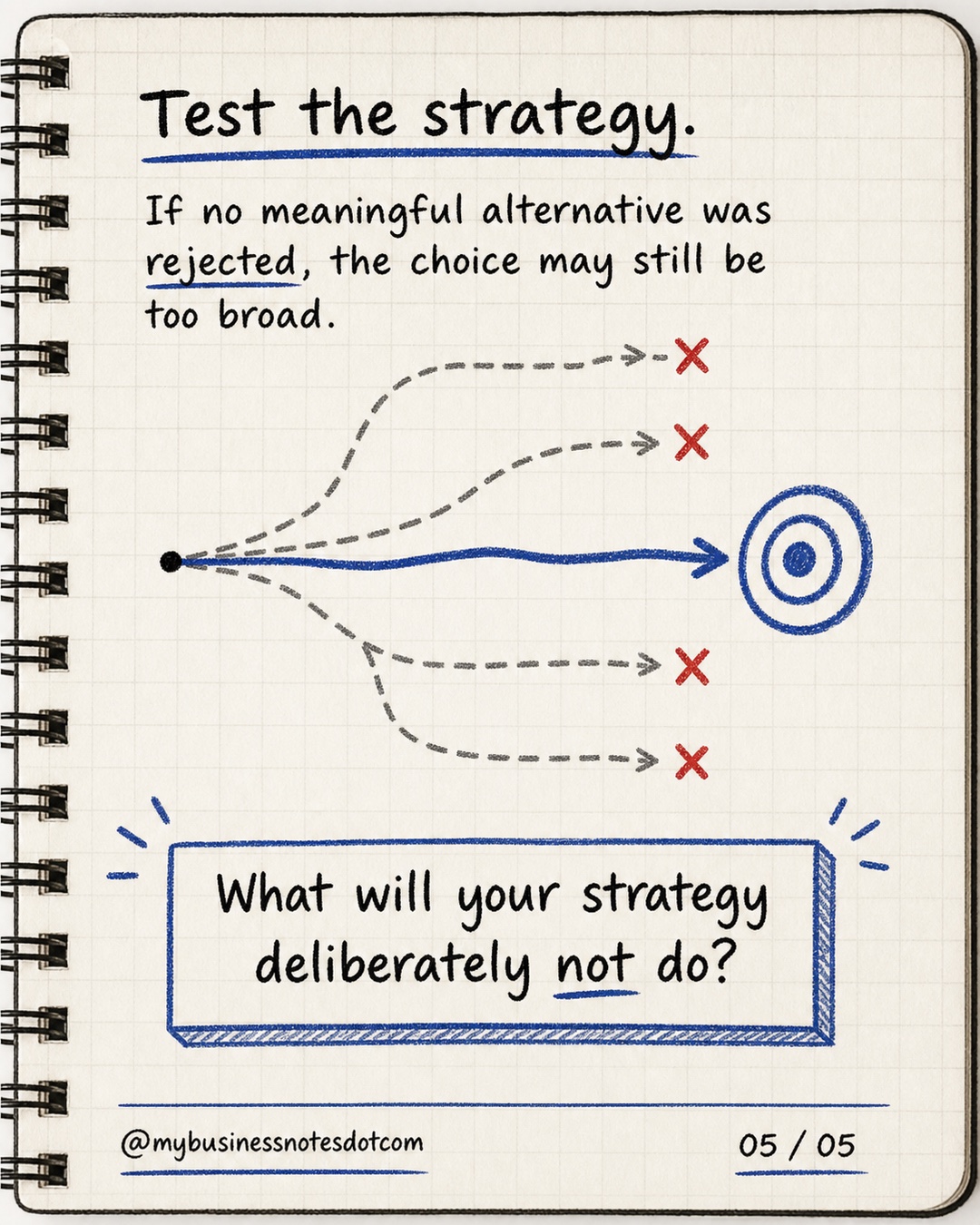
Test the strategy.
If no meaningful alternative was rejected, the choice may still be too broad.
Test the three choices as a coherent system. The arena should make the advantage relevant, the advantage should be supported by capabilities, and the refusals should preserve focus. State the assumptions and evidence that would justify revisiting any part of the system.
A practical example
“Become the market leader” expresses ambition. A strategy might choose to serve regional service firms with a standardized diagnostic, win through faster insight-to-action cycles and refuse heavily customized projects. The trade-offs make resource allocation and capability development coherent.
The mistake to avoid
If every segment, channel, offer and growth path remains important, the document describes aspiration rather than strategy.
How to apply the framework
Begin with the business result and the customer or operational context. Work through the framework in sequence, but spend more time where uncertainty is highest. Record the decision, the reasoning behind it, and the signal that would cause the team to reconsider.
A useful review ends with subtraction as well as addition. Identify what will stop, what will receive protected attention, and who is accountable for the next visible step. Without those trade-offs, even a clear discussion can dissolve into more activity.
For related guidance, see Strategy execution with the 4 Cs and 1 R and How to prioritize ideas with an evaluation matrix.
Frequently asked questions
What is strategy is choice?
Strategy is choice is a practical way to organize decisions around the result, audience, actions and evidence described in this article.
Why does strategy is choice matter?
It matters because it connects activity to an explicit decision and makes progress easier to evaluate, explain and improve.
What is the most common mistake with strategy is choice?
If every segment, channel, offer and growth path remains important, the document describes aspiration rather than strategy.
How do you start using strategy is choice?
Write the current decision in one sentence, apply the framework to the highest uncertainty, assign one owner and define the next observable evidence.
Put the framework into practice
What will your strategy deliberately not do? Use the carousel as a shared review tool, then capture the resulting priority, owner, next action, and evidence in the team’s working system.
Download the complete carousel
Keep the framework as a PDF for your next review.
International references