

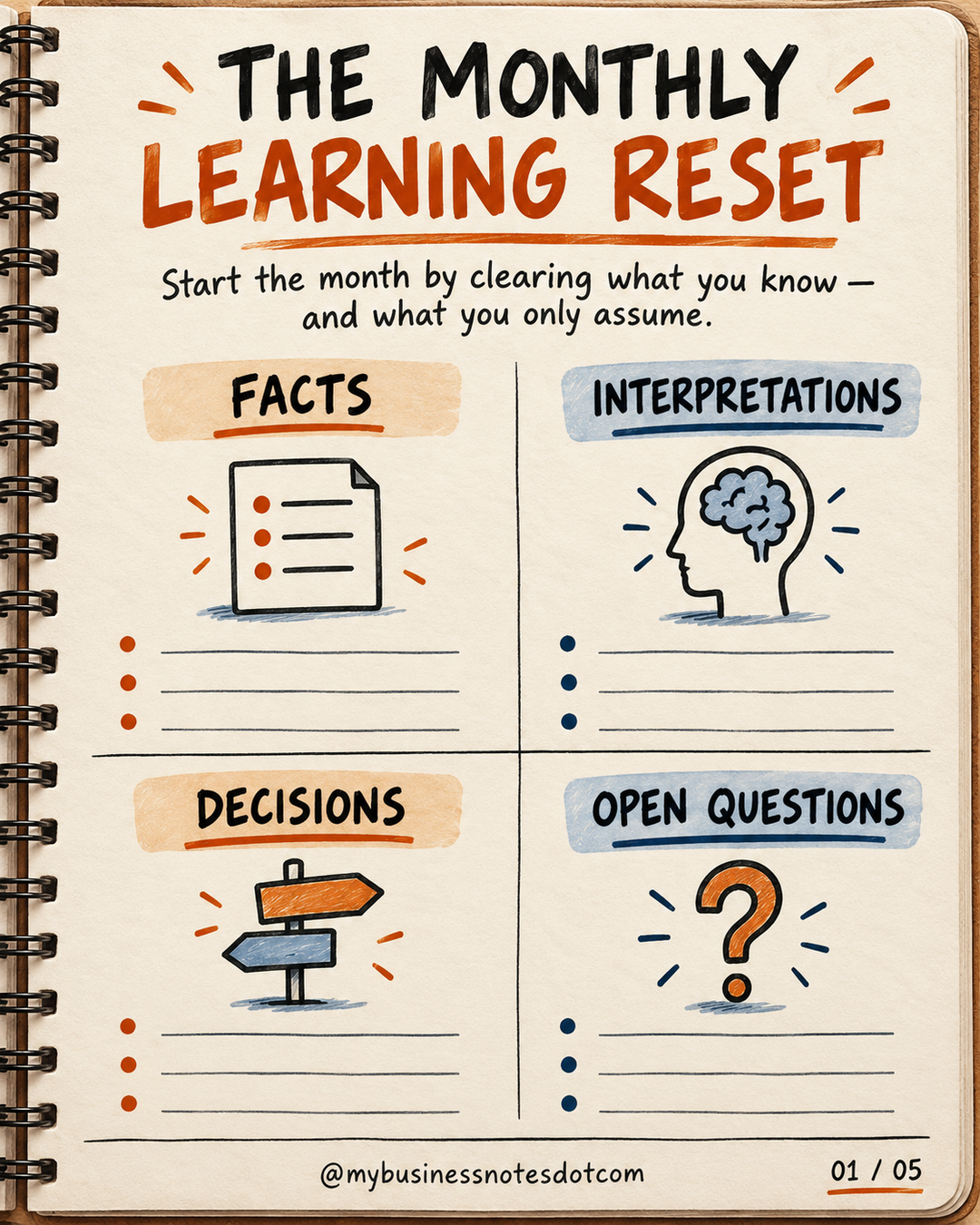
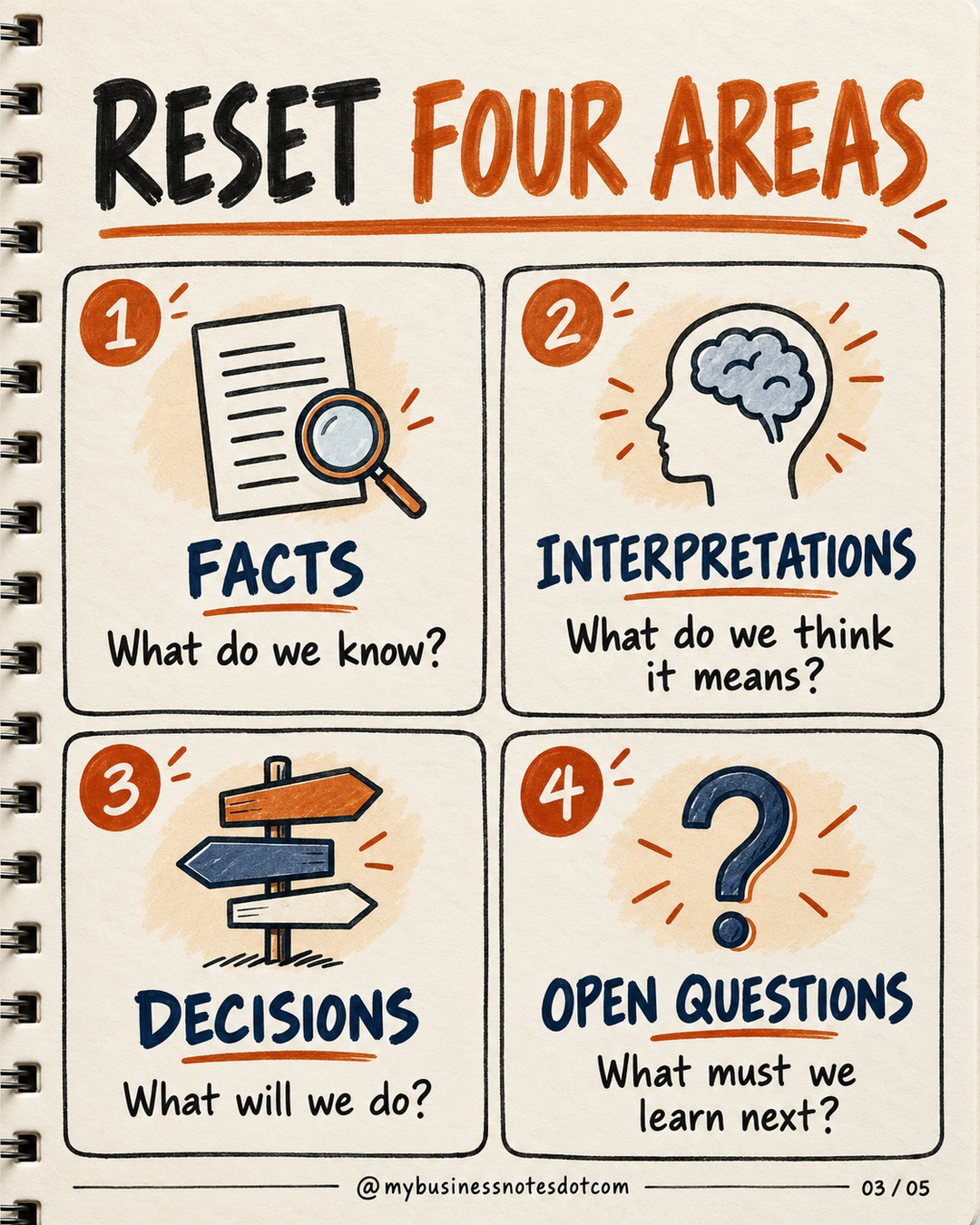
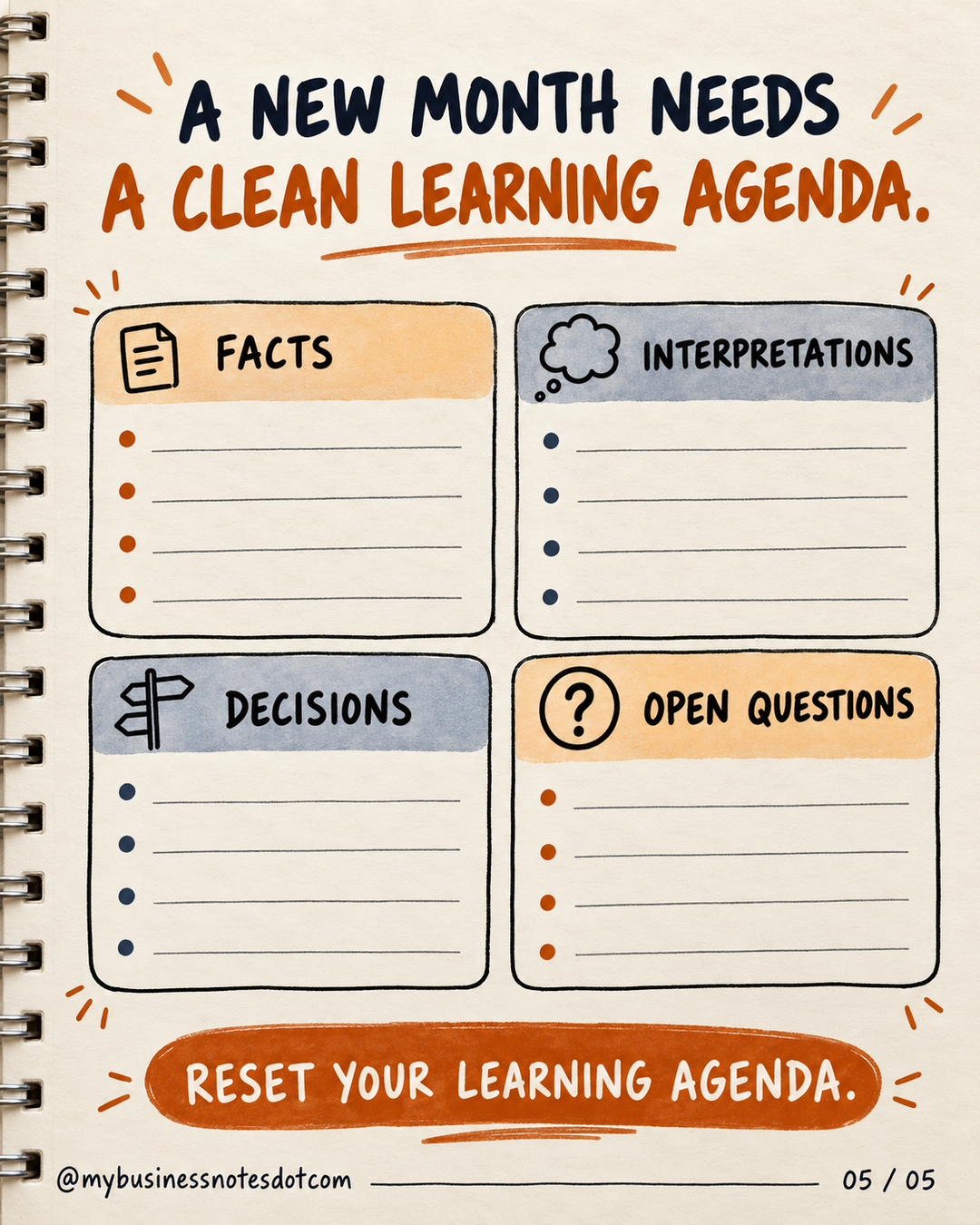
A monthly learning reset is a short review that separates facts, interpretations, decisions and open questions. Its purpose is not to summarize everything the team did. It is to decide what the next month should do differently because of what the last month revealed.
Slide 1 of 5
Why a monthly report is not enough
A dashboard can show that revenue rose while leaving the team unsure why. A busy month can generate pages of updates without changing a single assumption. Reporting describes results; learning changes the next choice. Keep both, but do not confuse them.
The reset proposed here is a practical MBN worksheet, not a validated diagnostic instrument. It builds on the reflection behind Lean Enterprise Institute’s hansei and PDCA guidance, while using a lighter structure for everyday business decisions.
Start with facts that another person could check
Bring the original target, the actual result and the underlying record. State the period and the population: a conversion rate without its denominator or a delivery time without its definition invites the wrong comparison. Include evidence that challenges the team’s preferred story.
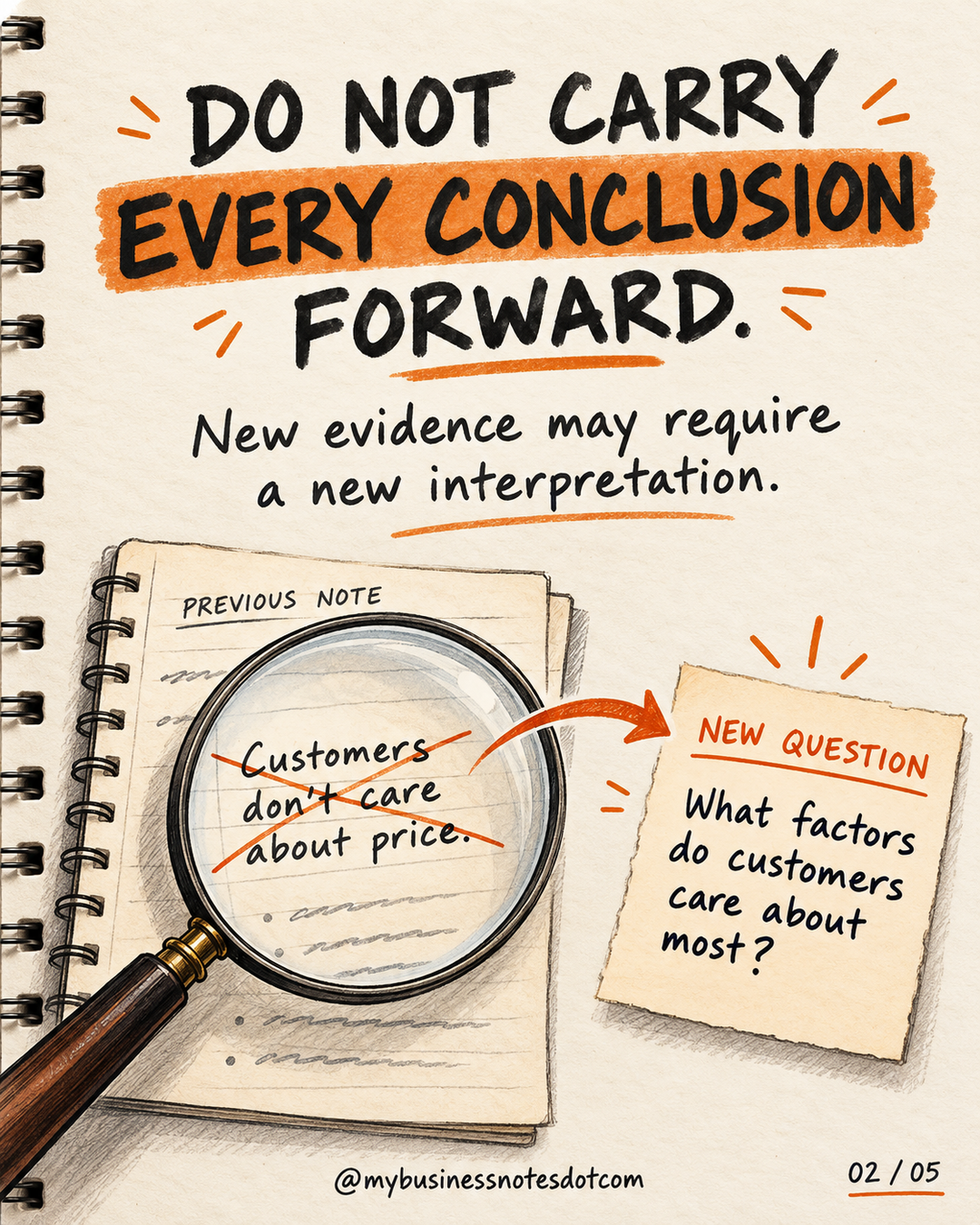
For example, ‘customers dislike the offer’ is an interpretation. ‘Six qualified prospects declined after receiving the proposal, and four mentioned implementation effort’ is a more useful observation. Even then, those comments do not establish what every prospect believes.
Keep explanations provisional
Write at least two plausible explanations for an important result. A slower sales cycle might reflect weaker demand, a different mix of buyers or a new approval step. Ask what evidence would distinguish those explanations before choosing a remedy.
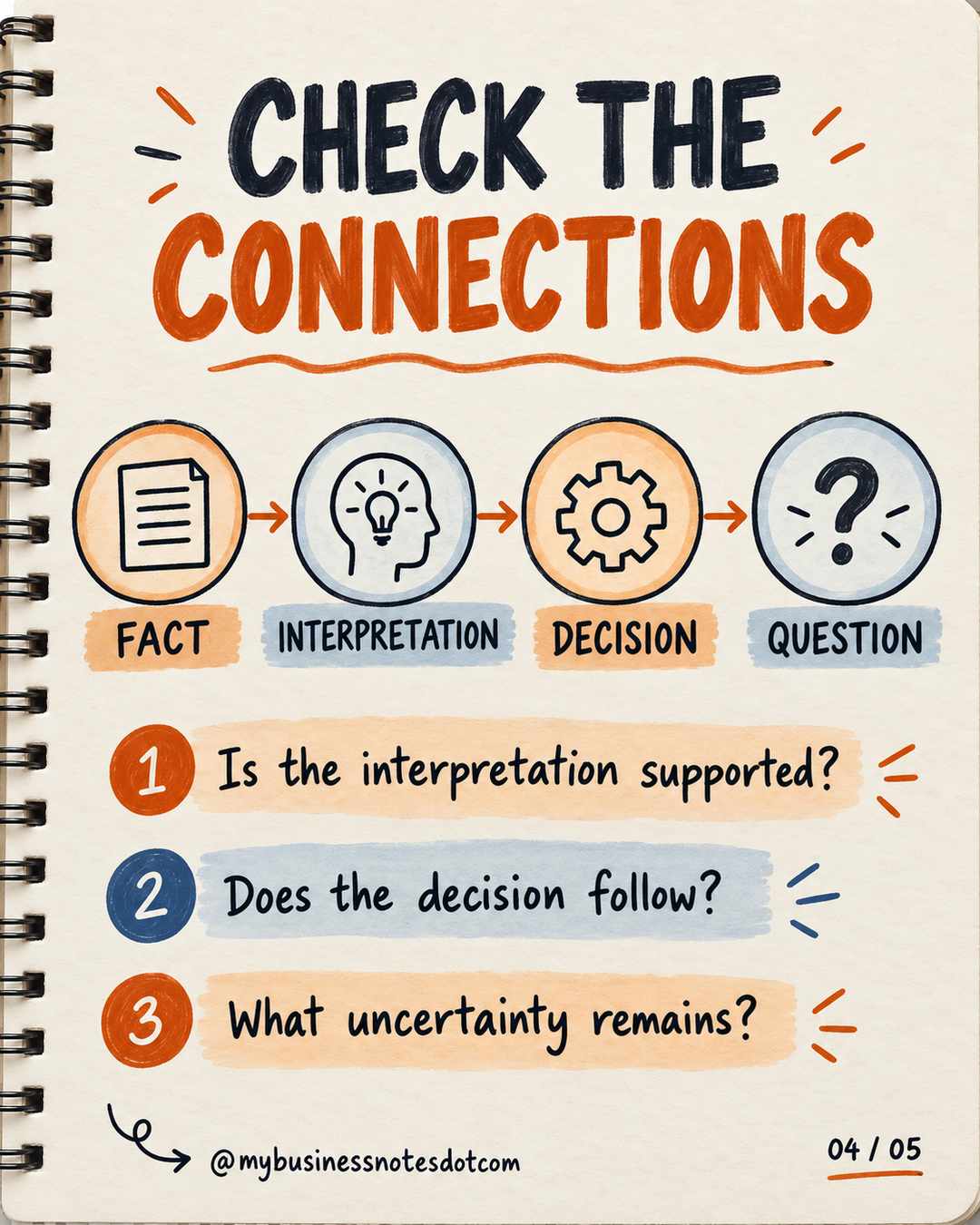
GOV.UK’s guidance on analysing research makes a useful distinction between observations, findings and actions. Apply that discipline to business reviews: record what happened before deciding what it means. Where the stakes are high, use a follow-up test rather than converting agreement in a meeting into certainty.
Convert learning into an owned decision
Every meaningful finding needs an implication: continue, adapt, stop or investigate. Name the person who will move the decision, the evidence they will bring and a review date. Atlassian’s DACI framework is helpful when gathering input and making the final call belong to different people.
A decision can also protect a successful practice. If a new handoff reduced missing information without adding delay, document the method and keep checking quality. Standardizing a useful change is different from declaring it permanently correct.
A worked example: more leads, fewer useful conversations
Imagine a small consultancy whose campaign doubled enquiry volume but produced fewer qualified calls. This is a hypothetical example. The team separates the count from its explanation and discovers that most new enquiries came from a broader audience.
Instead of demanding faster follow-up, it narrows the next test to a clearer customer situation, keeps response time stable and compares qualified conversations rather than total forms. The owner records an open question: did the message attract the wrong audience, or did the form hide an important qualification? One test is chosen to distinguish those possibilities.
Run the reset without adding another ritual
Before the meeting, circulate the few results that affect a real decision. During it, work through four columns: facts, interpretations, decisions and open questions. Let people add observations before the loudest explanation takes over.
End by choosing a small number of changes the team can actually execute. At the next reset, start with those commitments. If nothing was tried, the issue may be capacity or ownership, not a shortage of insights. The measure of a useful reset is a better next decision, not a longer learning document.
Frequently asked questions
Should every open question become an experiment?
No. Prioritize questions whose answers could change an important decision. Keep low-impact uncertainty visible without funding unnecessary research.
Can a small team use this reset?
Yes. One person can keep the same four columns, but should seek an outside challenge for consequential assumptions.
Is a monthly cadence mandatory?
No. Monthly is a practical starting point. Use a cadence that matches decision speed and the time needed for useful evidence to emerge.
Download the complete carousel
Use the five-slide worksheet in your next working session.
International references
- Atlassian — Sprint Retrospectives
- Atlassian — DACI
- Atlassian — Project Trade-Off Analysis
- Atlassian — Roles and Responsibilities
- Atlassian — Prioritization
- Lean Enterprise Institute — Hansei
- Lean Enterprise Institute — PDCA
- Lean Enterprise Institute — Standardized Work
- Lean Enterprise Institute — Hoshin Kanri
- Lean Enterprise Institute — Kaizen