

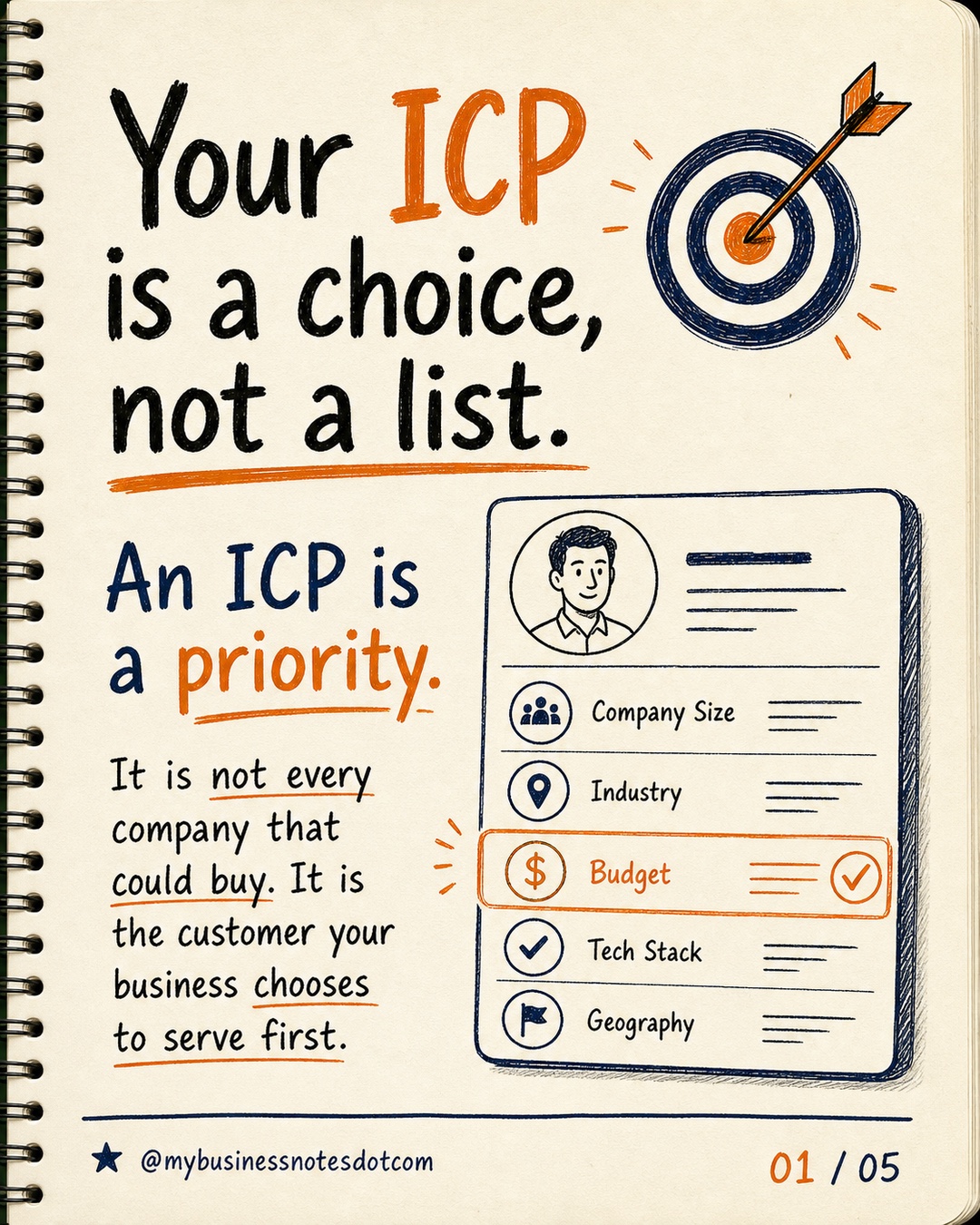
Ideal customer profile turns the central principle into an explicit decision: It is not every company that could buy. It is the customer your business chooses to serve first. This article develops that decision into a practical management framework, helping teams move from activity to coordinated action and useful evidence.

Slide 1 of 5
What this framework helps you decide
It is not every company that could buy. It is the customer your business chooses to serve first.
The value of a framework is not the appearance of certainty. It is the quality of the conversation it creates. Use the following sections to expose assumptions, focus attention, and convert an abstract intention into a decision that can be reviewed.
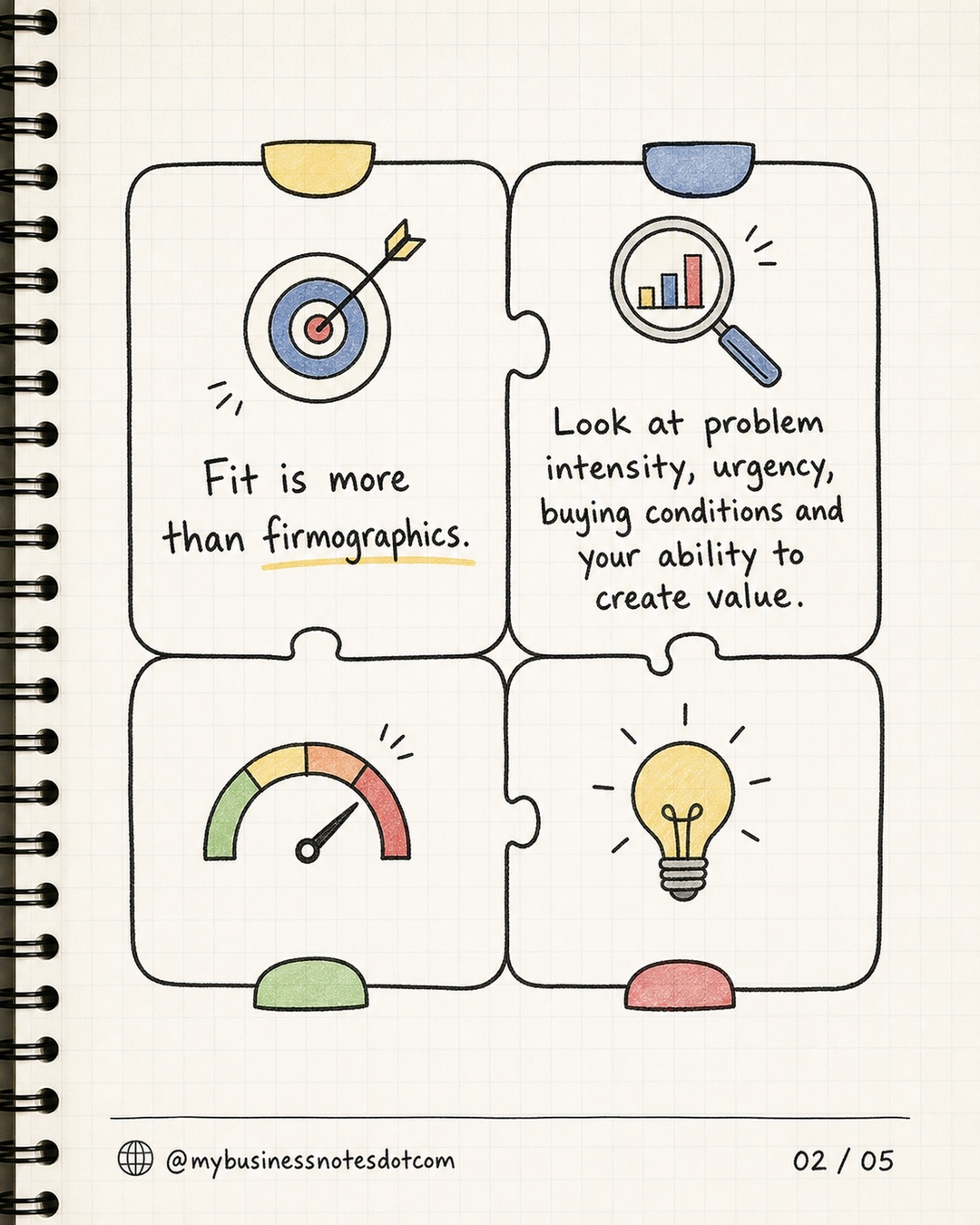
Fit is more than firmographics.
Look at problem intensity, urgency, buying conditions and your ability to create value.
Fit includes more than company size, sector, or job title. Examine the problem being experienced, its urgency, the ability to act, the conditions required for success, and the value your business can realistically create. These factors reveal whether a prospect is genuinely suitable.
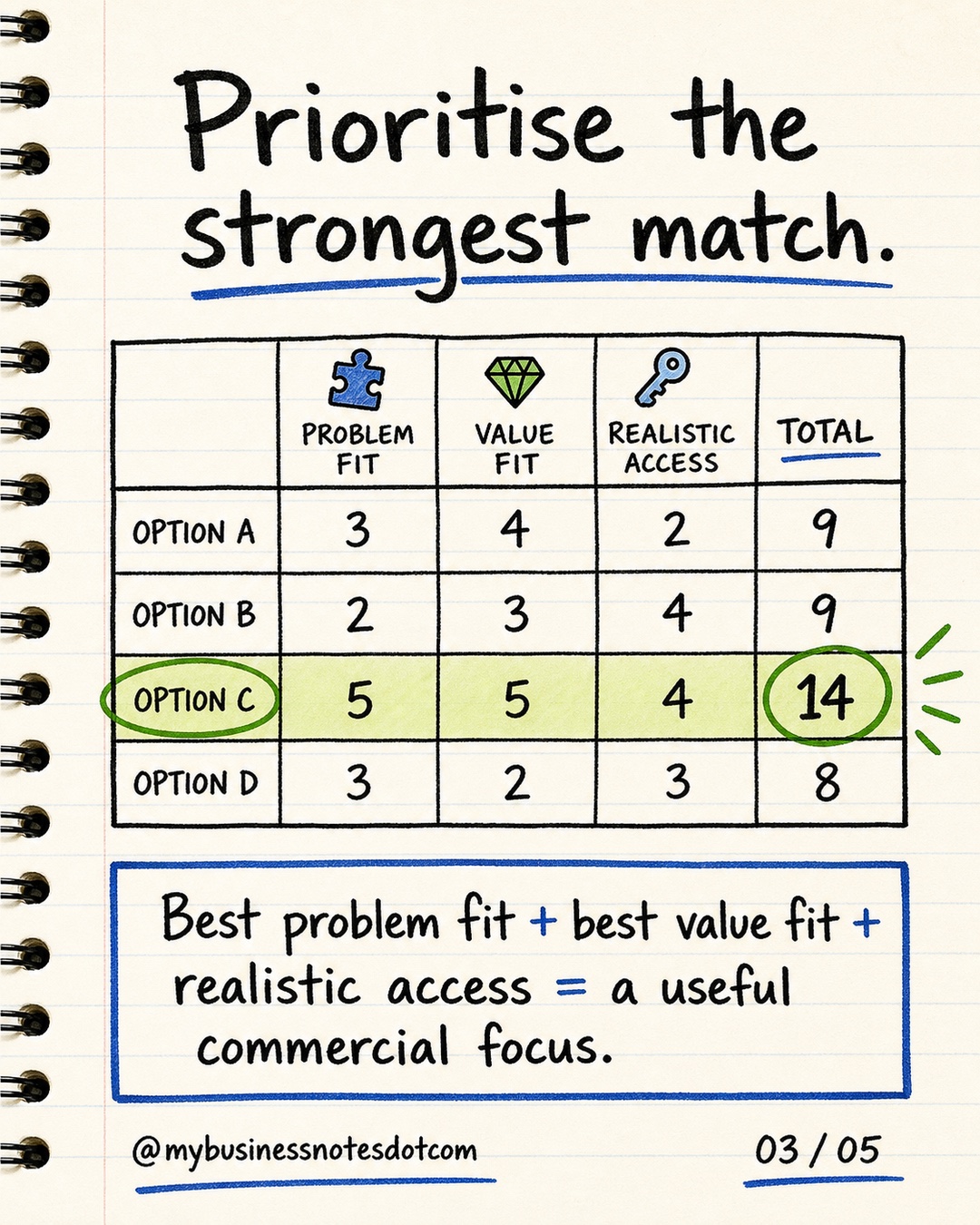
Prioritise the strongest match.
Best problem fit + best value fit + realistic access = a useful commercial focus.
Prioritise profiles with evidence, not enthusiasm. Compare customers by problem severity, buying readiness, strategic alignment, cost to serve, and realised outcomes. A simple scoring model can make assumptions visible and prevent one attractive attribute from dominating the decision.
Choice creates trade-offs.
A clear ICP also identifies who will not receive your attention right now.
An ideal customer profile is useful only when it excludes as well as includes. Naming weak-fit situations protects sales capacity, improves messaging, and reduces the risk of winning customers the business cannot serve well. Trade-offs make the profile operational.
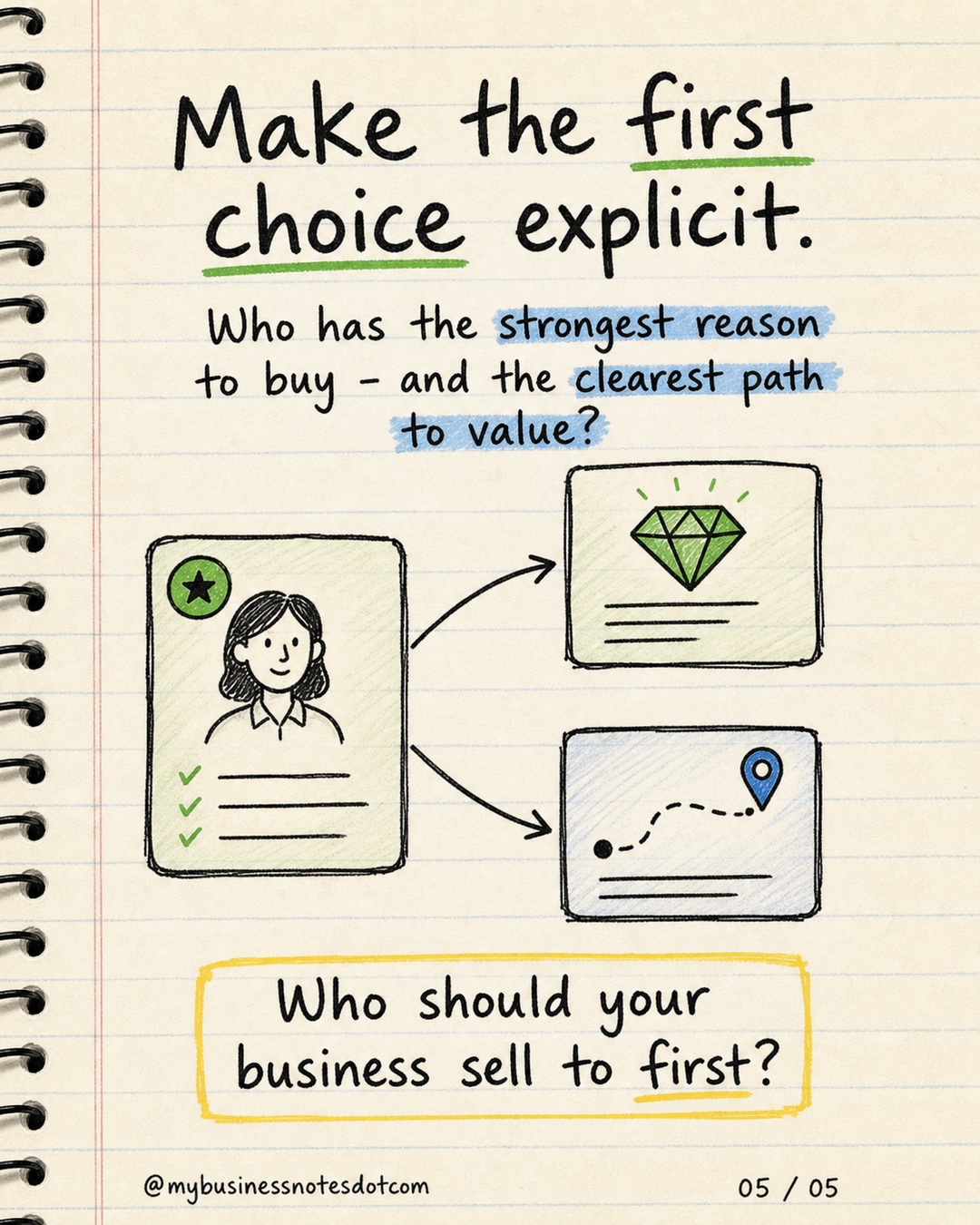
Make the first choice explicit.
Who has the strongest reason to buy – and the clearest path to value?
Write the first ICP as a testable choice that combines situation, need, capability, and expected value. Share it with marketing, sales, and delivery teams, then revise it using conversion quality, customer success, and retention evidence rather than treating it as a permanent description.
A practical example
A 50-person software company and a 500-person manufacturer may share firmographics yet have completely different urgency, buying processes and value potential. A useful ICP prioritizes the customer whose problem is important now, whose buying conditions are viable and for whom the company can produce distinctive value.
The mistake to avoid
Treating every possible buyer as ideal spreads prospecting effort and weakens messaging because no meaningful trade-off guides the commercial system.
How to apply the framework
Begin with the business result and the customer or operational context. Work through the framework in sequence, but spend more time where uncertainty is highest. Record the decision, the reasoning behind it, and the signal that would cause the team to reconsider.
A useful review ends with subtraction as well as addition. Identify what will stop, what will receive protected attention, and who is accountable for the next visible step. Without those trade-offs, even a clear discussion can dissolve into more activity.
For related guidance, see Trust, empathy and value-driven selling and Marketing as value creation.
Frequently asked questions
What is ideal customer profile?
Ideal customer profile is a practical way to organize decisions around the result, audience, actions and evidence described in this article.
Why does ideal customer profile matter?
It matters because it connects activity to an explicit decision and makes progress easier to evaluate, explain and improve.
What is the most common mistake with ideal customer profile?
Treating every possible buyer as ideal spreads prospecting effort and weakens messaging because no meaningful trade-off guides the commercial system.
How do you start using ideal customer profile?
Write the current decision in one sentence, apply the framework to the highest uncertainty, assign one owner and define the next observable evidence.
Put the framework into practice
Who should your business sell to first? Use the carousel as a shared review tool, then capture the resulting priority, owner, next action, and evidence in the team’s working system.
Download the complete carousel
Keep the framework as a PDF for your next review.
Practical PDF e-book
Take the next step with Social Selling.
Once you know who to serve, build a clearer path to reaching them and starting relevant conversations. This paid e-book is separate from the free article resources.
Explore the Social Selling GuideInternational references