

A content system is a coordinated portfolio in which every post has a defined business function. Unlike a content calendar, which primarily organizes when and where you publish, a system explains why each piece exists—whether its main job is to attract, educate, connect, convert, sell, or retain. The calendar remains useful, but it becomes the scheduling layer of the strategy rather than the strategy itself.

What is a content system?
A content system connects audience needs, business goals, editorial decisions, production, distribution, and measurement. It gives each asset a role and shows how different assets reinforce one another over time. This is consistent with the Content Marketing Institute’s definition of content marketing as a strategic approach built around valuable, relevant, and consistent content that attracts and retains a defined audience while supporting profitable customer action.
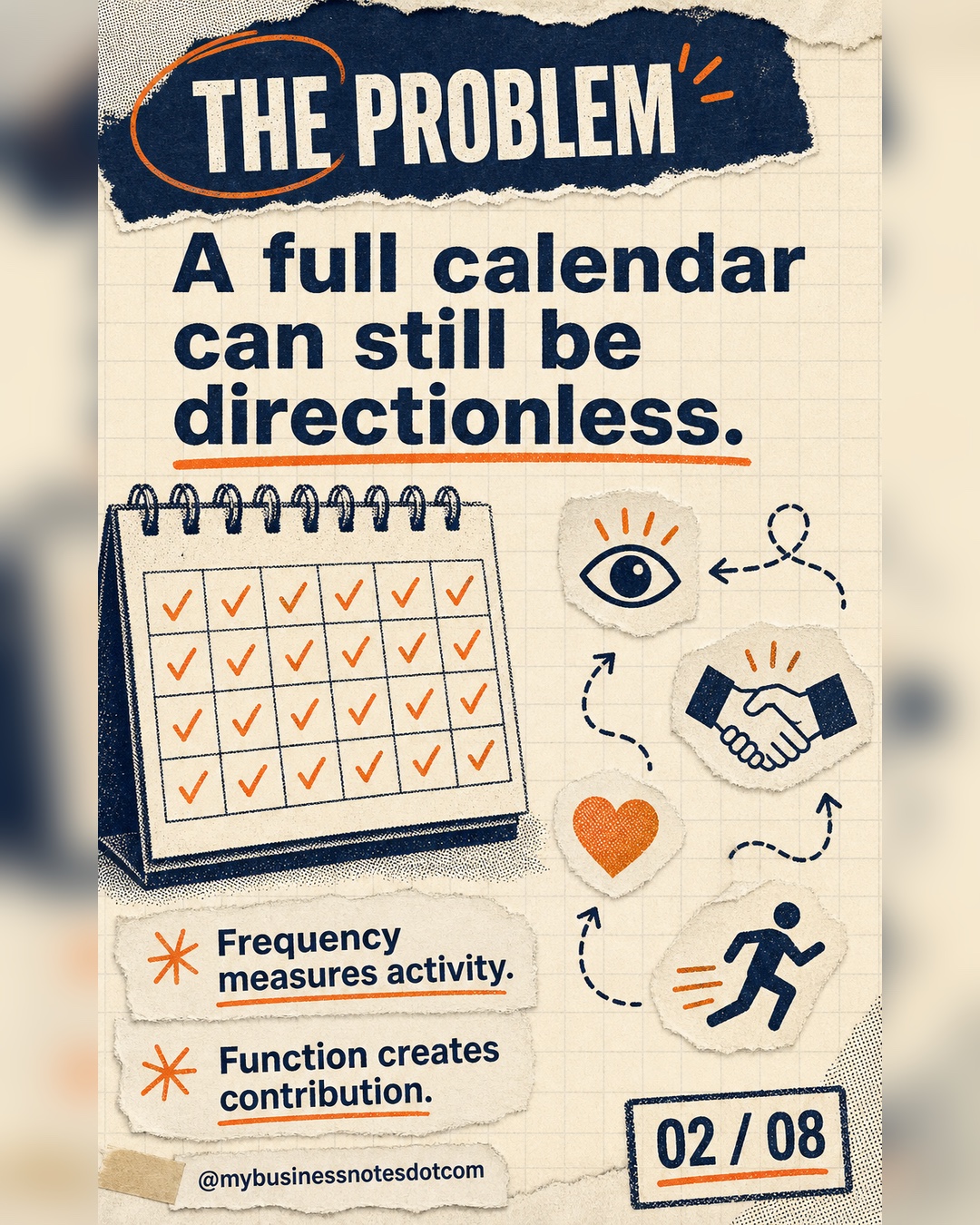
The practical implication is simple: publishing regularly is not the same as progressing strategically. A team can maintain a flawless cadence and still produce little understanding, trust, demand, or customer value. Activity becomes useful only when it contributes to a relationship or outcome the business has chosen deliberately.
Content calendar vs. content system
The two tools are complementary, but they solve different problems.
| Content calendar | Content system |
|---|---|
| Defines dates, channels, owners, and deadlines | Defines purpose, audience, role, and desired behavior |
| Answers “When will we publish?” | Answers “Why should this exist?” |
| Optimizes workflow and consistency | Optimizes strategic coverage and contribution |
| Tracks production activity | Connects content to customer and business outcomes |
| Can be full while remaining unbalanced | Reveals missing or overused functions |
A strong practice starts with the system and then uses the calendar to operationalize it. If the sequence is reversed, dates tend to fill with convenient topics rather than intentional contributions.
The six functions of a content system
Every post may influence more than one outcome, but assigning one primary function improves the brief, message, call to action, and success measure. The six functions below cover the relationship from first contact through continued customer value.
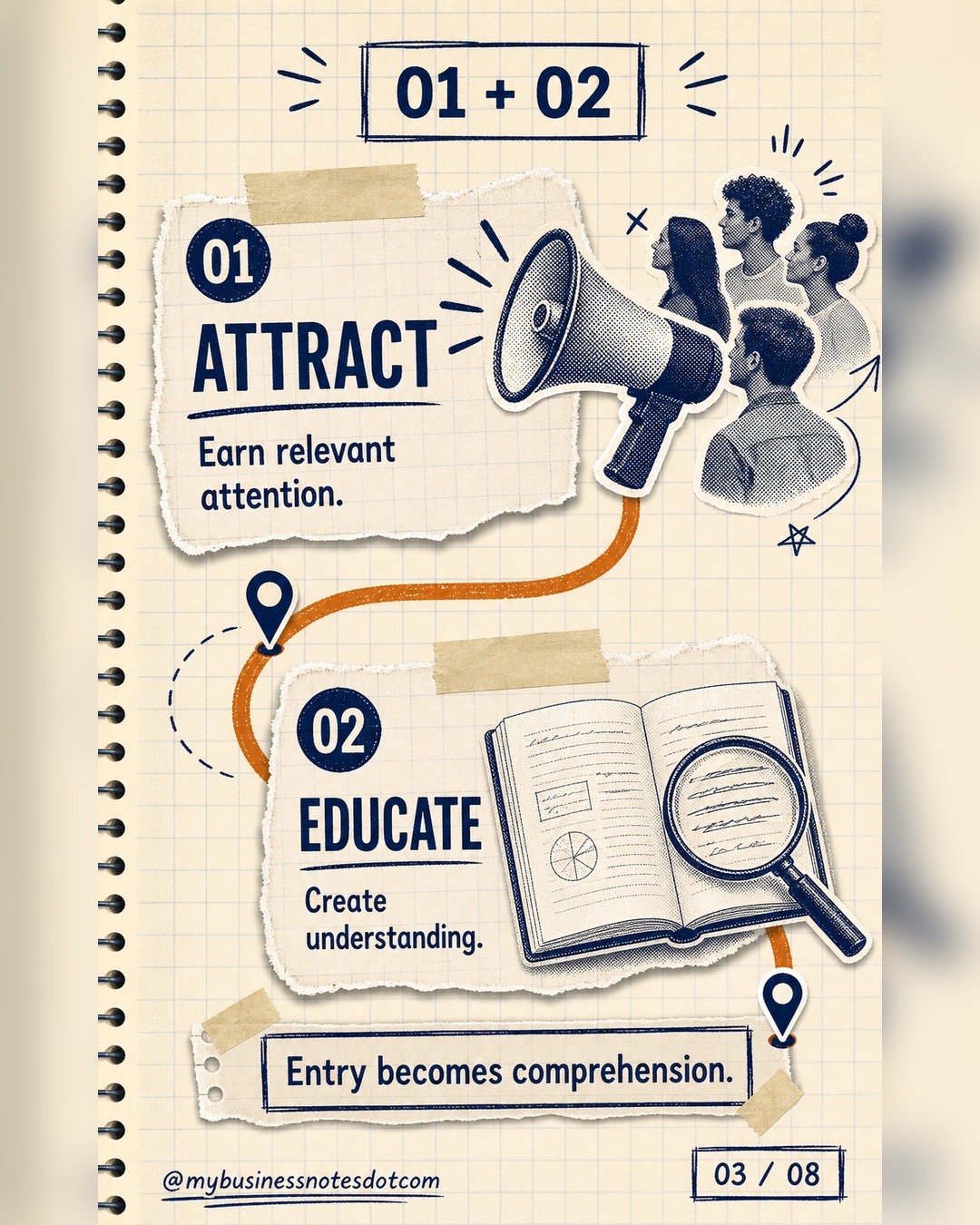
1. Attract: earn relevant attention
Attract content helps the right people discover the business. It addresses a recognizable problem, aspiration, event, or question and makes the audience want to enter the conversation. Search-led articles, useful observations, original data, and timely analyses can all attract—provided the attention comes from people the business can genuinely help.
Measure more than reach. Relevant impressions, qualified organic visits, new visitors from priority segments, and saves or shares are better signals than raw exposure alone.
2. Educate: create understanding
Educate content explains a problem, criterion, trade-off, method, or opportunity. Its job is to help readers make better sense of their situation. Guides, frameworks, comparisons, tutorials, glossaries, and diagnostic tools are common formats.
Education is not disguised promotion. The reader should gain a useful model even before considering an offer. Useful measures include engaged time, scroll depth, return visits, newsletter subscriptions, and movement to related resources.
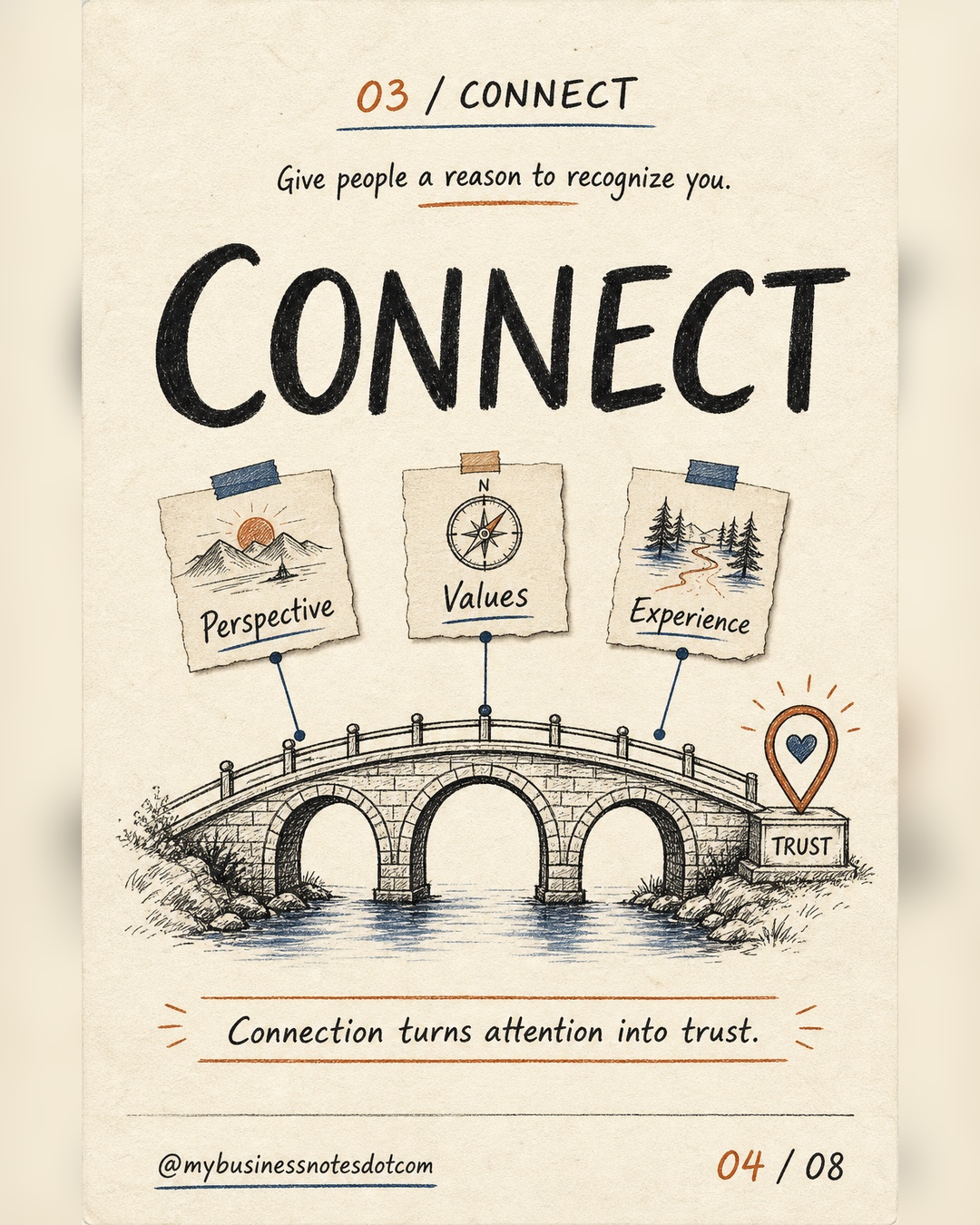
3. Connect: make the brand recognizable
Connect content gives the audience reasons to recognize the people, principles, and perspective behind the brand. It can share informed opinions, lived experience, decision principles, customer stories, or the reasoning behind a method.
This function is especially important when competitors can make similar technical claims. Connection makes the choice less abstract. Look for thoughtful comments, direct replies, repeat engagement, branded search, and qualitative feedback rather than forcing every post to generate an immediate lead.
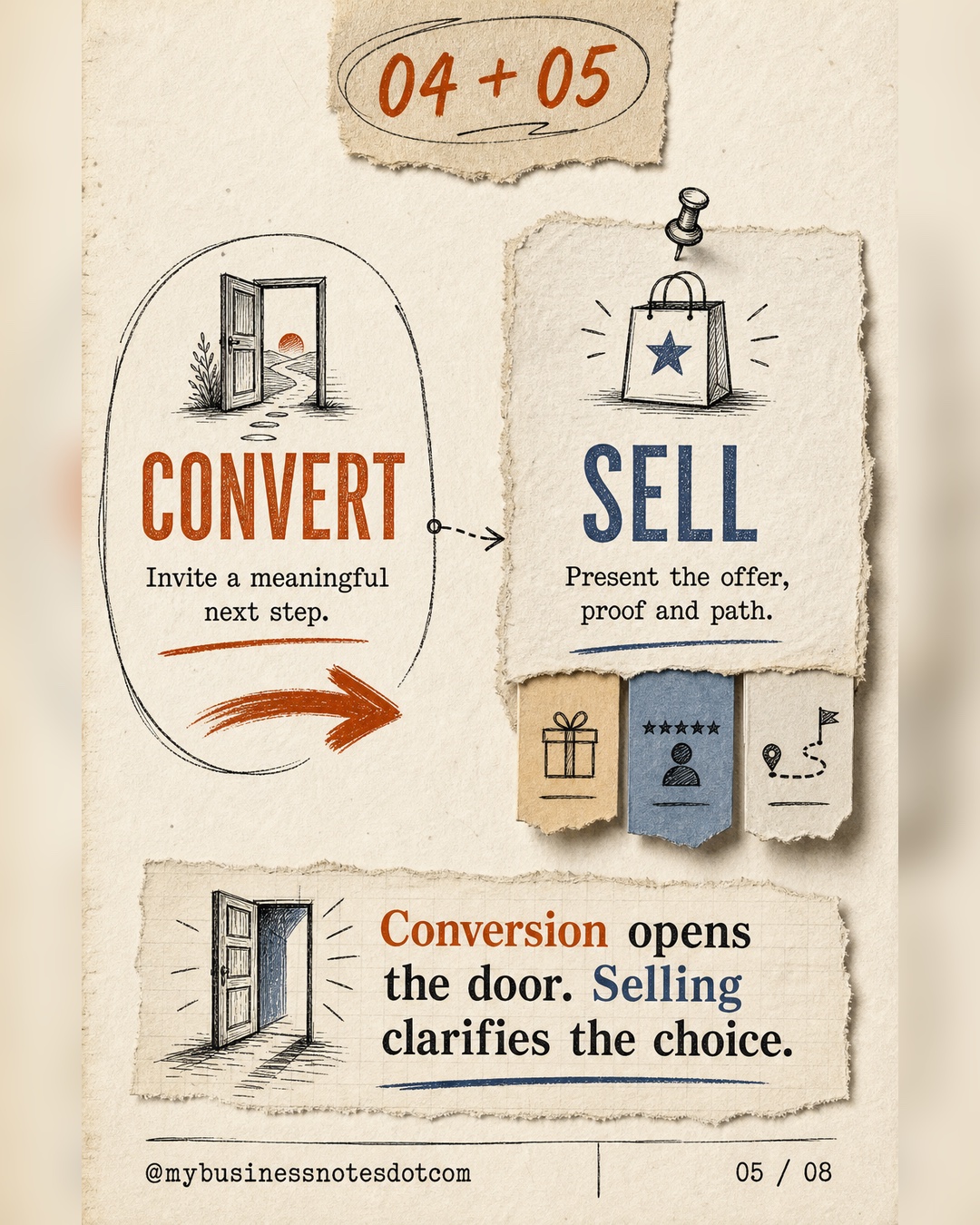
4. Convert: invite a meaningful next step
Convert content turns attention or understanding into a voluntary action: download a guide, subscribe, register, answer a diagnostic, request an assessment, or start a conversation. The next step should fit the reader’s current level of readiness.
Not every conversion is a sale. That distinction matters because an oversized commercial request can interrupt a useful relationship. Measure conversion rate, qualified completion, cost per action, and what happens after the action—not only form volume.
5. Sell: clarify the solution and path to purchase
Sell content presents the offer directly. It explains the problem solved, ideal fit, evidence, scope, objections, process, and path to purchase. Case studies, demonstrations, service pages, proposals, pricing explanations, and implementation FAQs belong here.
Helpful selling reduces uncertainty instead of manufacturing pressure. Evaluate qualified inquiries, opportunity progression, assisted conversions, sales-cycle movement, and revenue influence.
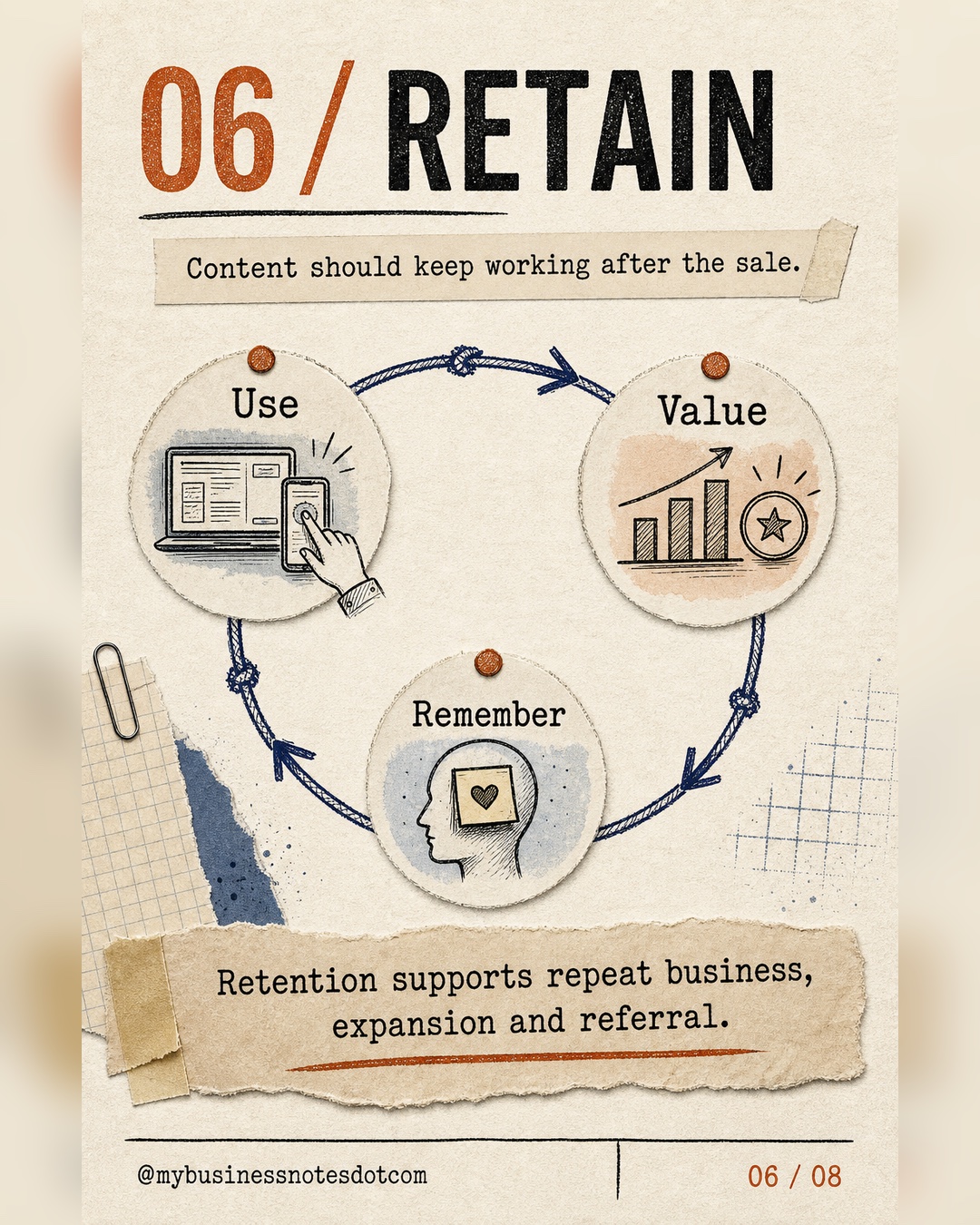
6. Retain: extend value after the sale
Retain content helps customers use the solution well, achieve value sooner, remember the brand, and discover relevant next steps. Onboarding resources, usage guidance, customer education, product updates, advanced practices, and community content can improve satisfaction, renewal, expansion, repeat purchase, and referral.
Acquisition-heavy calendars often neglect this function even though existing customers already have context and trust. Track activation, adoption, support demand, renewal, repeat purchase, expansion, and advocacy signals.
The customer journey is not a mandatory sequence
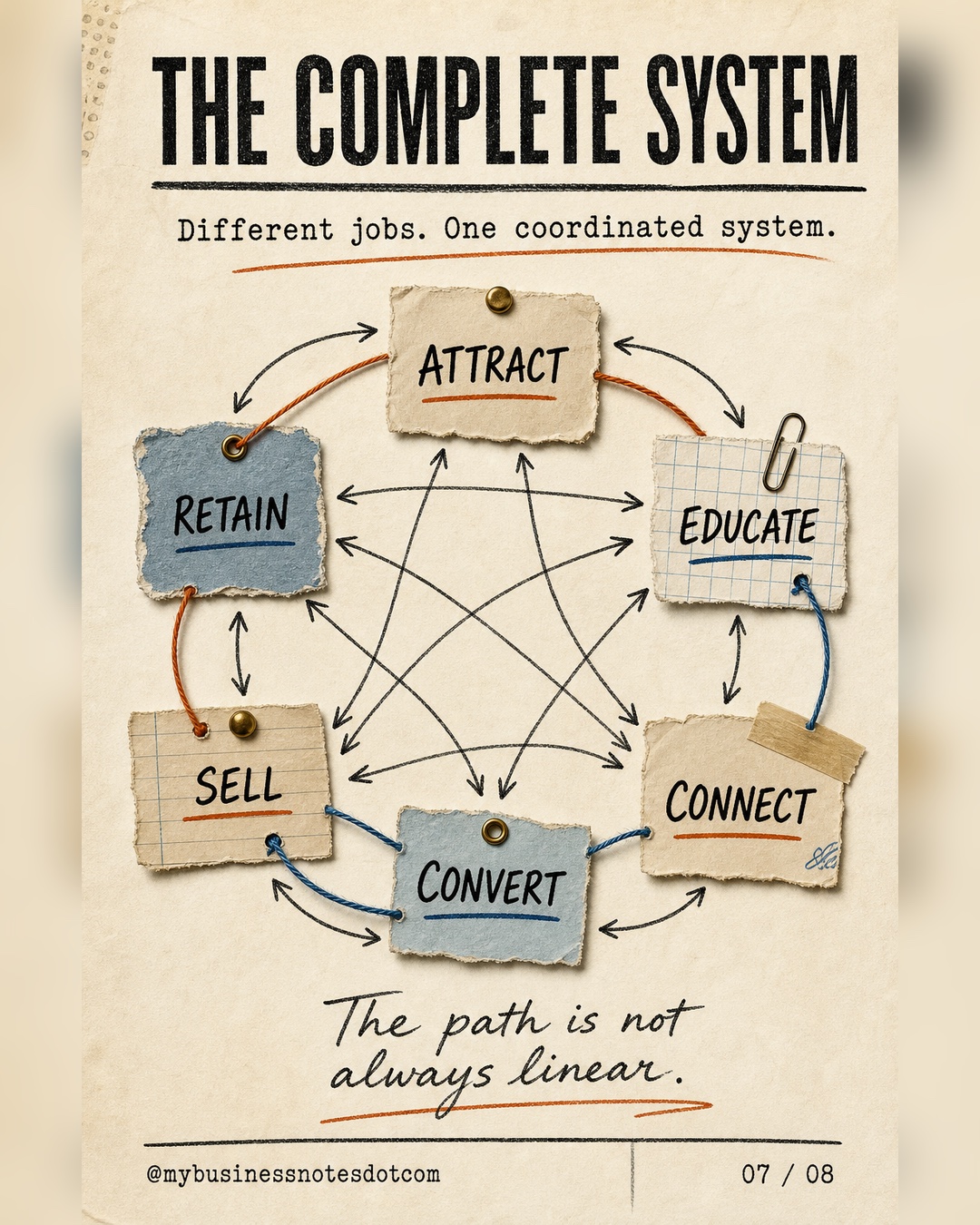
The six functions form a system, not a rigid funnel. Google’s research on the “messy middle” describes purchase decisions as repeated movement between exploration and evaluation. A person may discover a sales page first, return later for education, connect through a founder’s perspective, and purchase without consuming every intermediate asset. A customer may also re-enter the system through retention content and become a source of referrals.
Therefore, do not force every campaign into the same order. Instead, ensure that people can find the information and next step appropriate to their situation, and use internal links, calls to action, email sequences, and retargeting to help them move naturally.
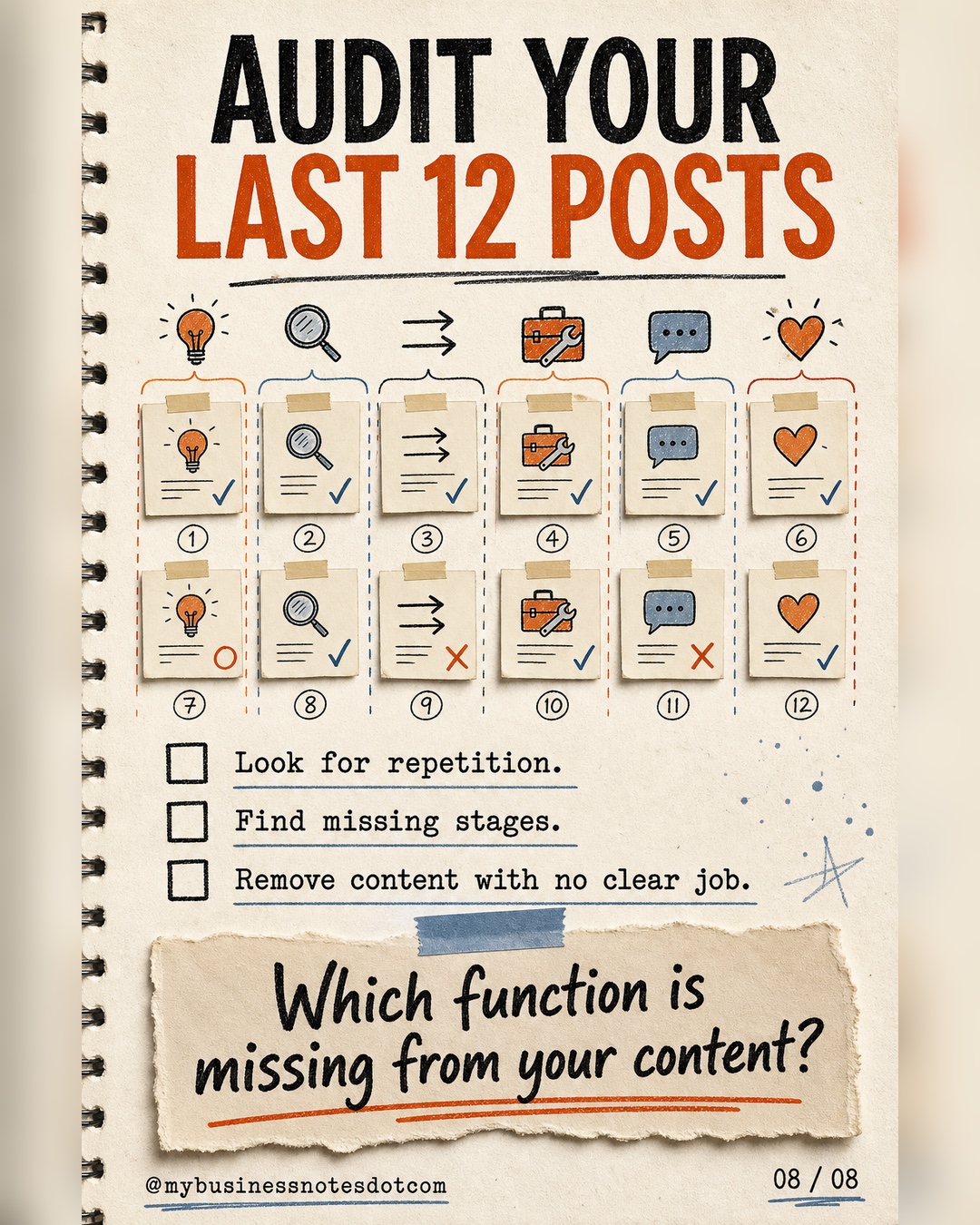
How to audit your last 12 posts
- List the posts. Include every channel you actively manage, not only the best-performing one.
- Assign one primary function. Label each post attract, educate, connect, convert, sell, or retain. If the team cannot agree, the original brief was probably unclear.
- Record the intended audience and next behavior. State whom the post serves and what should become easier after consuming it.
- Identify concentration and gaps. Look for repeated functions, missing functions, and posts with no defensible job.
- Check the connections. Verify whether attracting posts lead to deeper education, educational assets offer relevant next steps, and customer content supports ongoing value.
- Plan the correction. Add the most important missing function to the next production cycle. Do not pursue artificial balance if the business currently needs one function more than another.
Build a practical content-function matrix
Add five fields to every brief: primary function, audience situation, central question, intended next behavior, and success signal. This lightweight matrix gives writers, designers, social teams, and sales stakeholders a shared definition of the job.
For example, an article titled “How to compare CRM implementation models” may primarily educate. Its intended next behavior could be using a comparison checklist, while its success signal might be engaged reading plus downloads. A customer onboarding video may primarily retain, with activation as the next behavior and feature adoption as the signal. The format does not determine the function; the strategic intent does.
Common mistakes when designing the system
- Treating every post as a sales post. Constant offers weaken attention and learning when the audience still needs context.
- Optimizing only for reach. Visibility without relevance can grow numbers while contributing little to the business.
- Giving one post six equal jobs. A post can support several functions, but one primary role creates a clearer message and measurement plan.
- Ignoring existing customers. Content should continue after purchase to help people realize and extend value.
- Demanding equal volume for every function. Balance is contextual. A new brand may need more attraction and education; a mature customer base may justify more retention.
- Measuring every function with the same KPI. Reach, comprehension, trust, action, revenue, and retention require different evidence.
Frequently asked questions
Is a content calendar a content strategy?
No. A calendar organizes execution, while strategy defines the audience, goals, purpose, choices, and contribution expected from content. A calendar becomes strategically useful when it operationalizes those decisions.
Does every business need all six content functions?
Most businesses benefit from considering all six, but the required volume is not equal. Priorities should reflect the business model, customer journey, growth constraint, and maturity of the content operation.
Can one post serve more than one function?
Yes. A case study may educate, connect, and sell. Assigning one primary function still helps the team choose the strongest angle, call to action, and success measure.
What are examples of retention content?
Onboarding guides, implementation checklists, customer training, usage tips, advanced tutorials, product updates, community resources, and customer-only events can all support retention.
How often should we audit our content system?
A monthly review of the last 12 posts is a useful starting point for active channels. Larger operations can add a quarterly portfolio review tied to customer and commercial performance.
From publishing cadence to strategic coordination
A full calendar proves that production happened. A content system shows whether that production supports attention, understanding, relationship, action, purchase, and continued value. Keep the calendar—but make it accountable to a clearer system.
Start with a twelve-post audit. Label the primary function of each post, find the most consequential gap, and give the next piece of content one unmistakable job.
Download the content system carousel
Keep the eight-slide framework as a practical reference for planning and auditing your next content cycle.
International references