
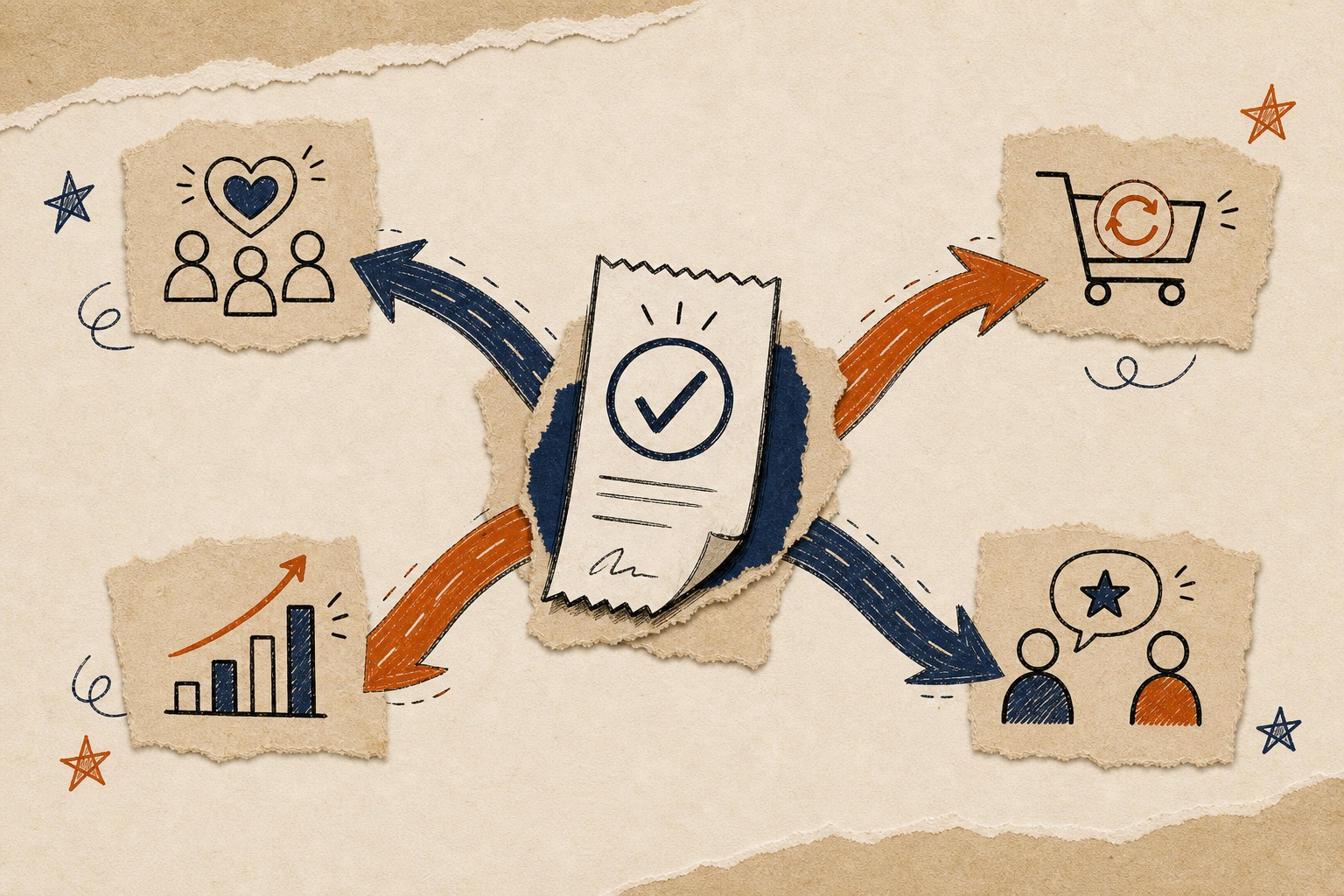
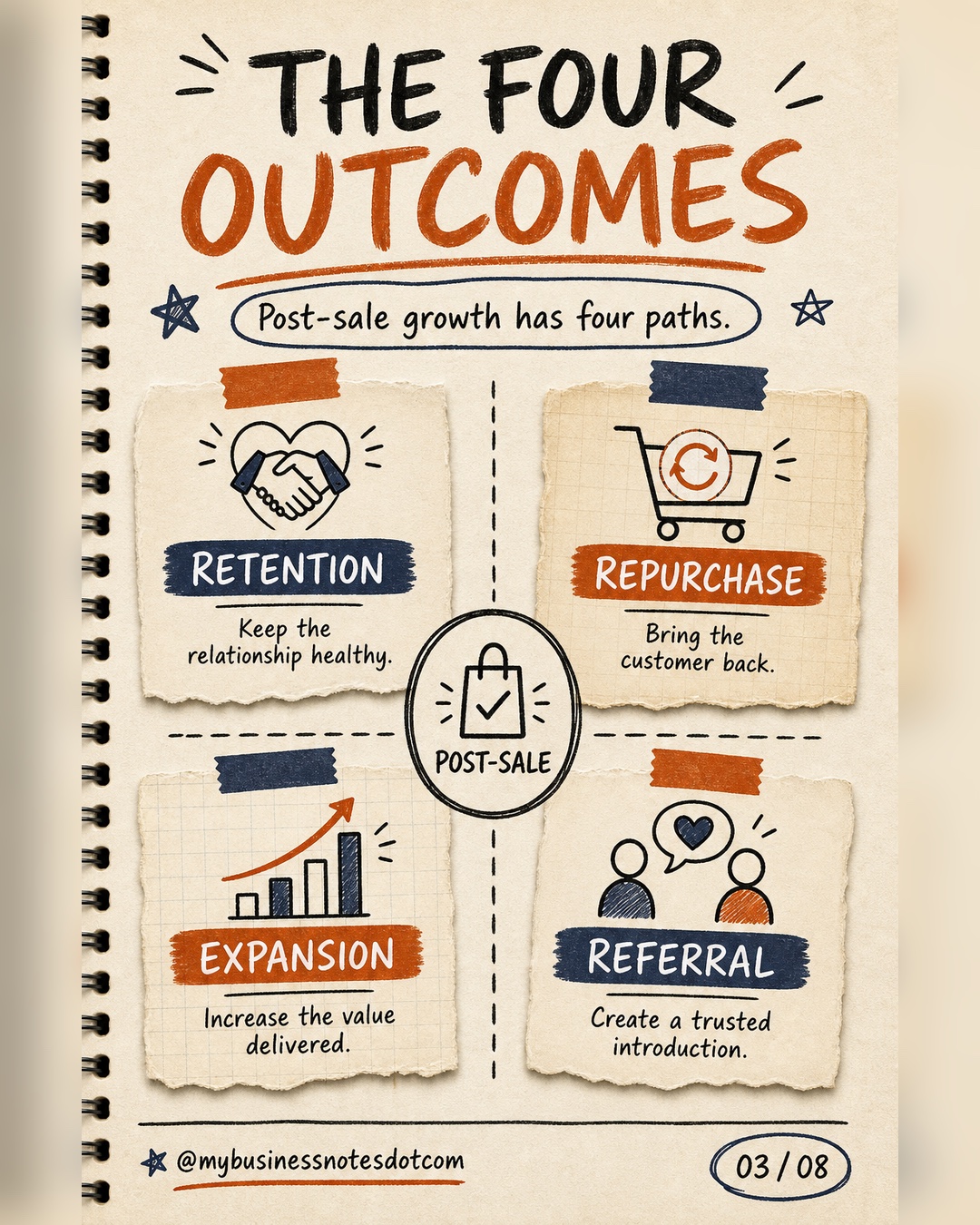
Post-sale management is the system that turns customer progress and customer signals into the next useful action after payment. Its purpose is not to create constant excuses to pitch. It is to protect realized value, reduce relationship risk, identify legitimate needs, and coordinate four possible growth paths: retention, repurchase, expansion, and referral.
What is post-sale management?
Post-sale management coordinates the customer relationship after a transaction. It covers onboarding, adoption, value realization, support, account review, renewal, relevant commercial opportunities, and advocacy. The central question changes from “How do we close this deal?” to “What must happen for this customer to receive, recognize, and extend the value they bought?”
This distinction matters because payment proves that a transaction occurred; it does not prove that the expected outcome was achieved. A customer may have purchased and still face implementation friction, partial adoption, a new constraint, or an unclear next step. Effective post-sale work makes these signals visible and assigns responsibility for acting on them.
Salesforce describes account management as an ongoing practice in which teams adapt to changing client needs, maintain strong relationships, and track retention as well as revenue from relevant upsells and cross-sells. Gartner likewise frames customer success around adoption, retention, expansion, and advocacy—not merely support after a problem appears.
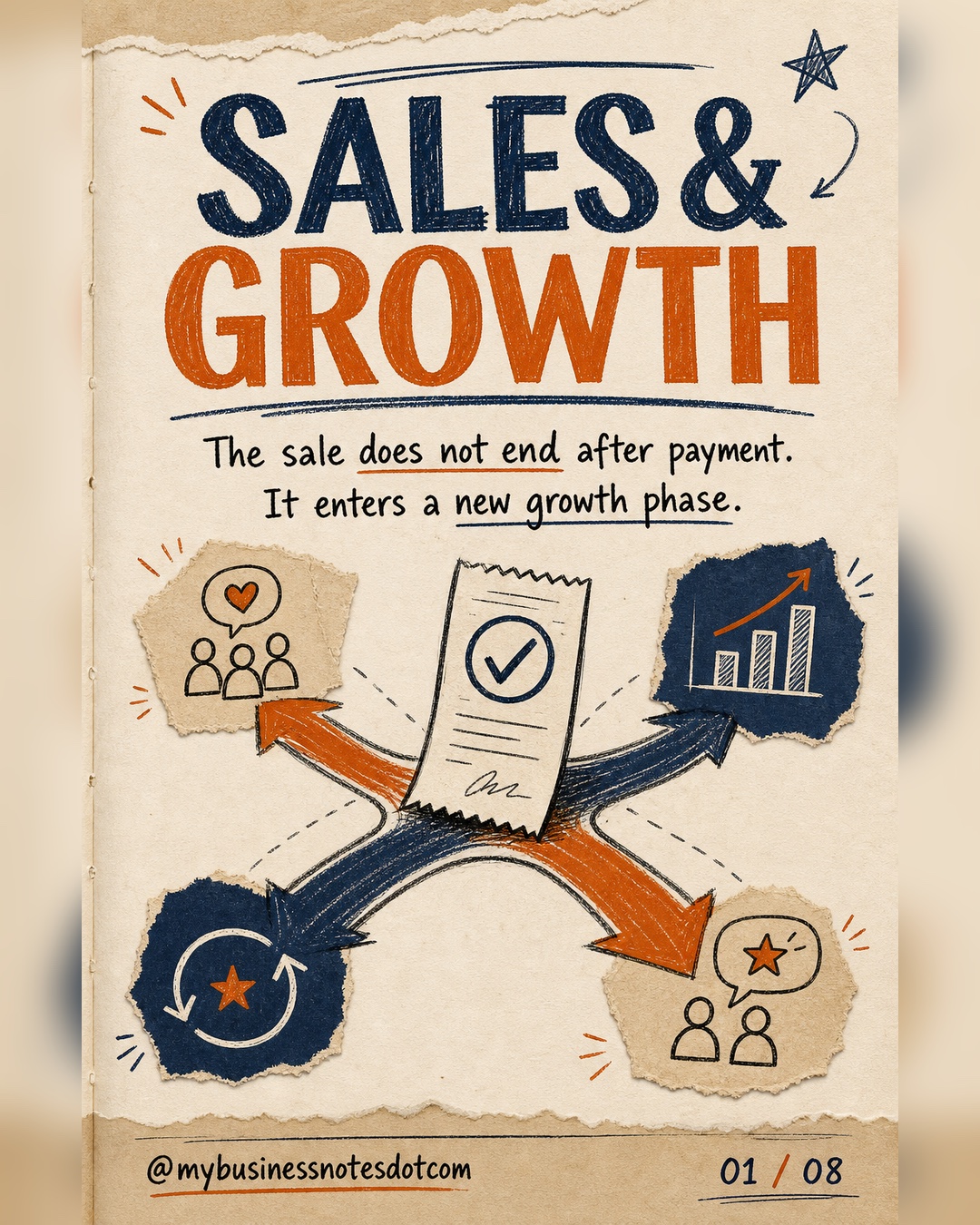
Why the sale does not end after payment
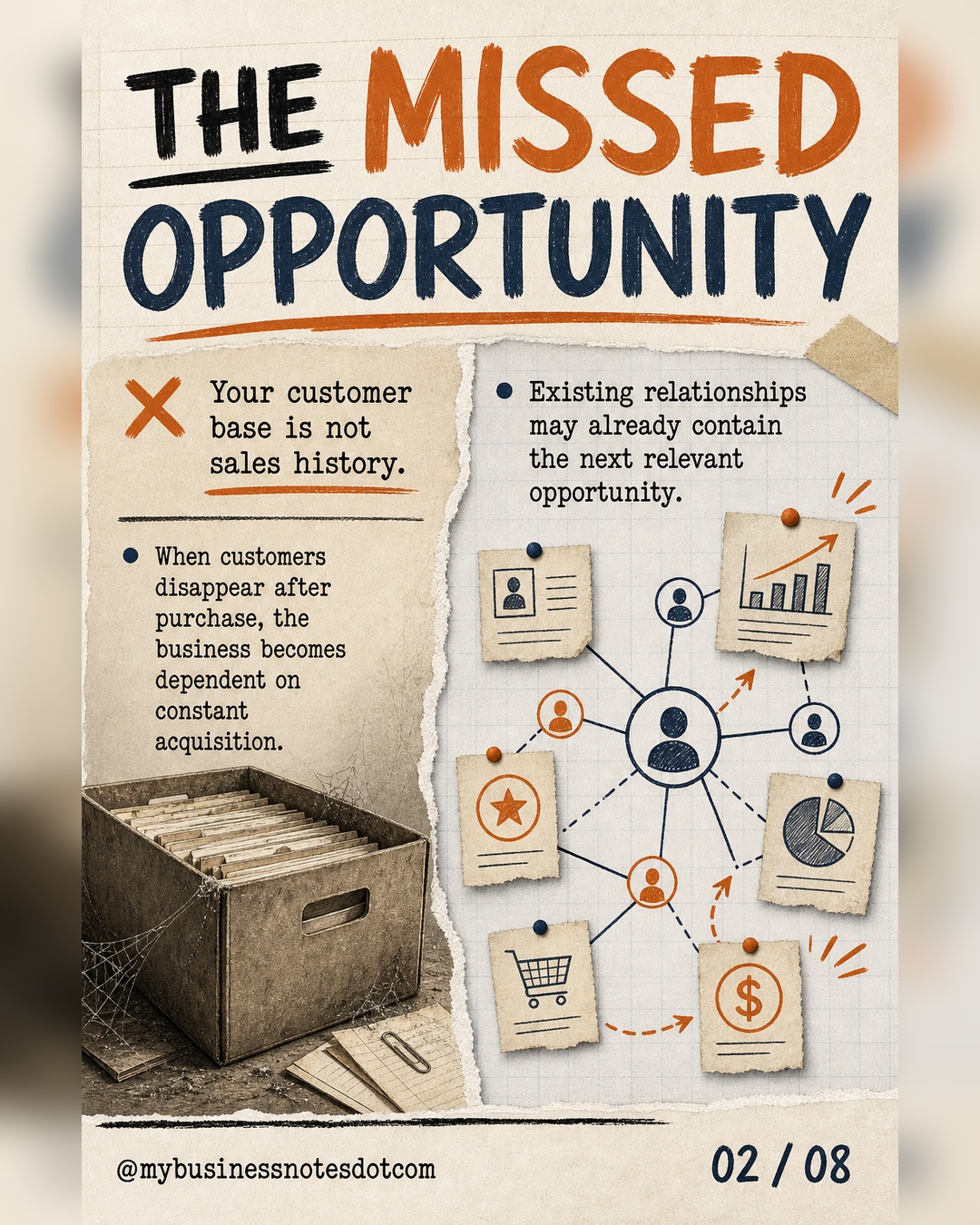
A business that treats customers as completed transactions loses the context accumulated during the sale. Expectations, constraints, stakeholders, success criteria, and promised outcomes can disappear between commercial, delivery, service, and success teams. The customer then has to reconstruct the story each time help is needed.
Post-sale management preserves that context and turns it into a continuous decision system. It helps the business distinguish among four very different situations:
- A relationship that needs protection.
- Value that should be repeated.
- A new or broader need that can be solved.
- A customer who recognizes enough value to introduce someone else.
The result is not “selling more at any cost.” The result is choosing the next action that fits the customer’s current situation.
The four post-sale growth paths
1. Retention: keep the relationship healthy
Retention is the foundation. It means helping the customer continue receiving sufficient value to justify the relationship. Signals include adoption, satisfaction, unresolved issues, stakeholder changes, usage trends, renewal readiness, and progress toward the original outcome.
Retention work may involve onboarding support, training, removing friction, resetting expectations, or reconnecting the solution with a changed business priority. HubSpot’s post-sale guidance emphasizes proactive communication, understanding customer needs, demonstrating value, and using health or usage signals to identify risk before it becomes churn.
The right measure depends on the model: renewal rate, repeat purchase rate, churn, adoption, time to value, issue resolution, customer health, or value achieved. The common principle is that retention is earned through usefulness—not assumed after payment.
2. Repurchase: repeat value already proven
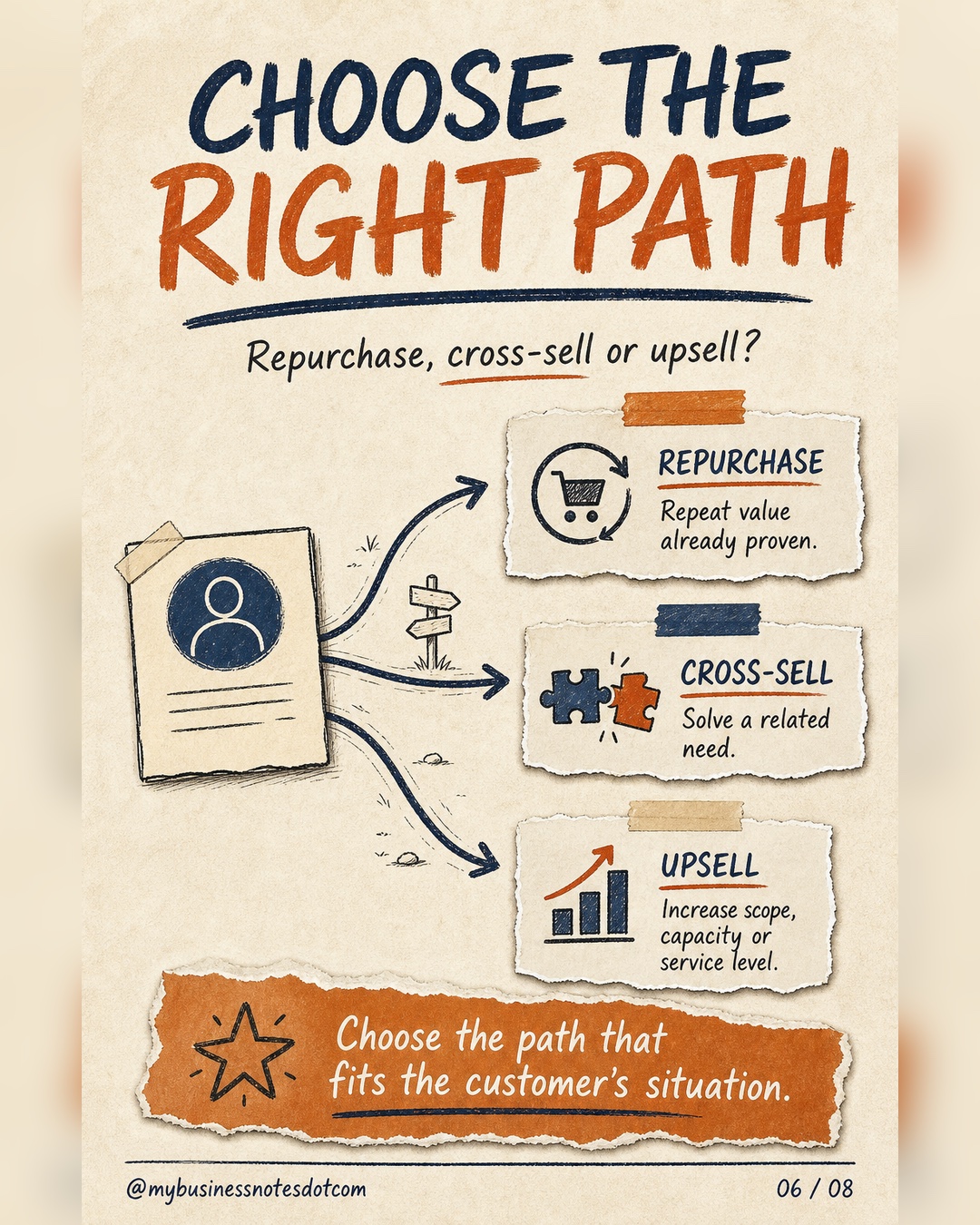
Repurchase occurs when the customer buys the same or a comparable solution again because the previous value remains relevant. This can be a replenishment, a new project cycle, a recurring service, another license period, or a repeat engagement.
The legitimate trigger is evidence that the need has returned or continued. Timing, consumption, seasonality, project completion, and prior satisfaction can all signal readiness. The conversation should reconnect the customer with an outcome already understood, while checking whether requirements have changed.
Repurchase is not automatic. A proven relationship reduces uncertainty, but teams still need to confirm fit, scope, timing, and value.
3. Expansion: increase useful value
Expansion increases the value delivered within an existing relationship. It normally appears as cross-sell or upsell, but the labels describe different decisions.
- Cross-sell adds a complementary solution for a related need.
- Upsell increases scope, capacity, sophistication, coverage, or service level within the existing solution.
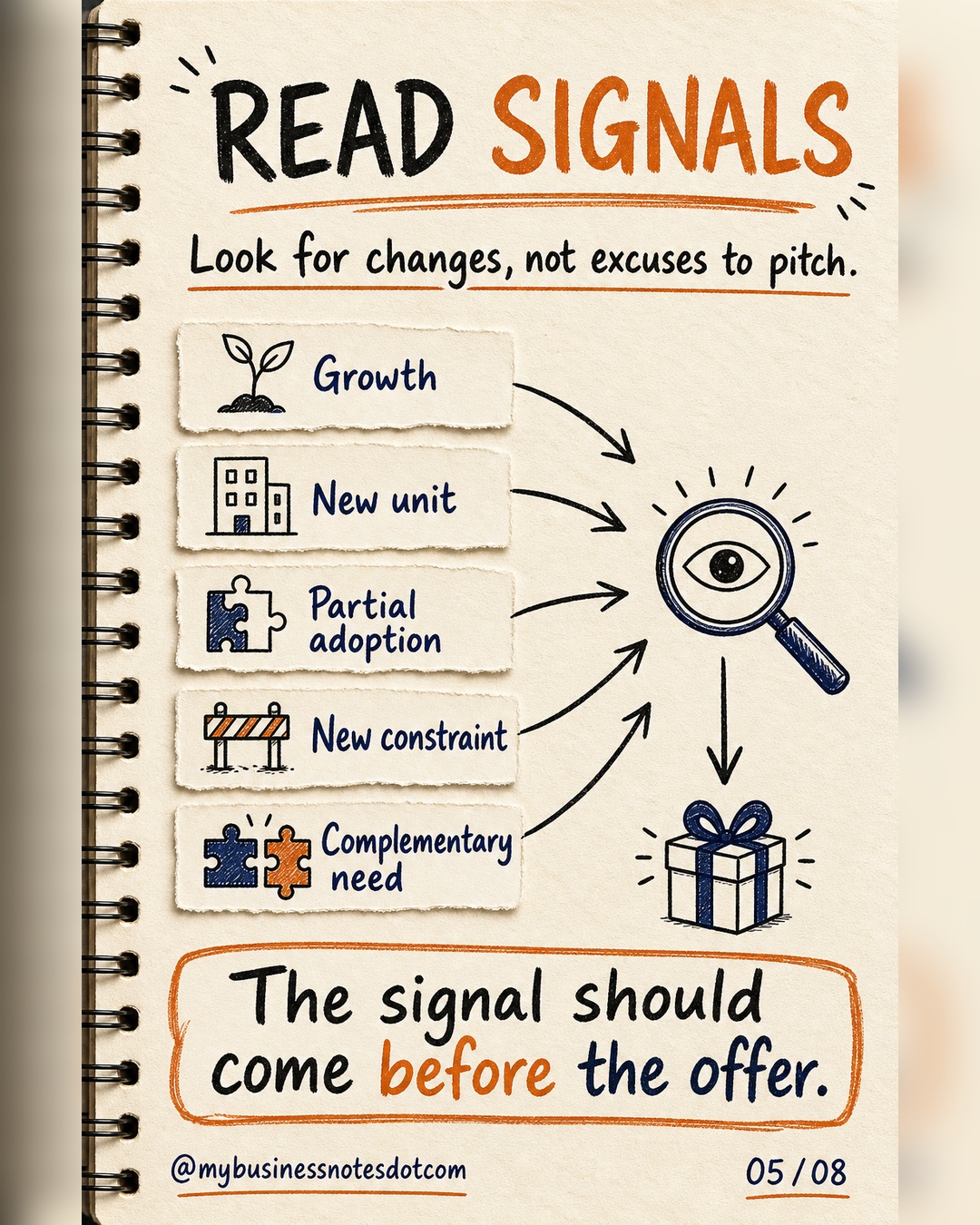
An expansion opportunity should originate in the customer’s situation: growth, a new unit, partial adoption, changing requirements, a complementary constraint, or demand for greater capacity. The signal should come before the offer. Otherwise, account management becomes a sequence of product pushes disconnected from customer progress.
Gartner’s account-management guidance recommends customer-centric plans that help customers derive more value and achieve their goals. That boundary is useful: expansion is defensible when the additional scope improves the customer’s result, not merely the seller’s number.
4. Referral: create a trusted introduction
Referral turns recognized value into a trusted introduction. Because a recommendation puts the customer’s reputation at stake, the request should follow evidence of satisfaction or success. Bain’s work on genuine referrals emphasizes authenticity: people recommend when they believe the experience will also be valuable and safe for the person they introduce.
Make the request specific and easy. Instead of “Do you know anyone?”, describe the situation or role the business can help and the form of introduction that would be useful. Provide a short message the customer can adapt, but never make advocacy feel like an obligation.
Segment customer attention instead of treating every account equally
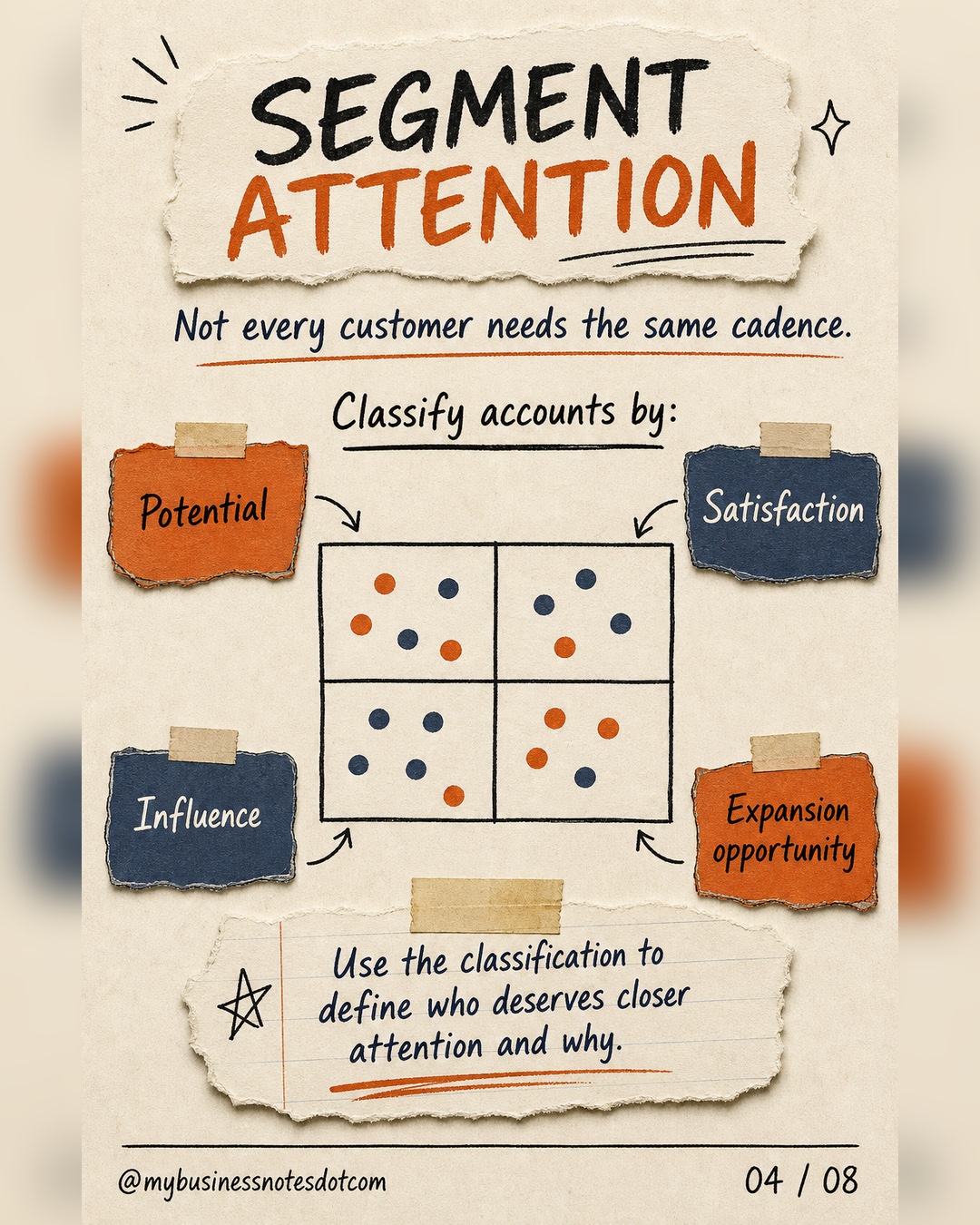
Equal attention sounds fair but is rarely operationally realistic. Accounts differ in potential, satisfaction, influence, complexity, risk, and expansion opportunity. Segmentation helps teams choose the right cadence and level of human involvement.
| Dimension | Question | Possible action |
|---|---|---|
| Potential | How much relevant value could this relationship support? | Increase planning depth for high-potential accounts. |
| Satisfaction | Does the customer recognize the promised value? | Resolve risk before introducing a new offer. |
| Influence | Can this customer shape adoption, reputation, or introductions? | Strengthen executive and champion relationships. |
| Expansion opportunity | Has a new legitimate need or constraint emerged? | Validate the signal before defining a solution. |
Segmentation should guide attention, not determine respect. Lower-priority accounts still need a reliable experience; they may simply receive a more scalable cadence, automated education, or trigger-based outreach.
Read customer signals before choosing an offer
Signals are changes that justify investigation. Useful examples include:
- Growth in users, locations, transactions, or demand.
- A new business unit, market, stakeholder, or use case.
- Strong adoption in one area and weak adoption in another.
- A new constraint involving capacity, compliance, time, or skills.
- A complementary need discovered during delivery or support.
- Positive value recognition, which may support renewal or referral.
- Declining engagement, open issues, or stakeholder departure, which may signal risk rather than growth.
A signal is not permission to pitch. It is permission to ask a better question. Confirm what changed, why it matters, what outcome is affected, and whether the customer wants help before selecting a commercial path.
Turn every conversation into a managed next action
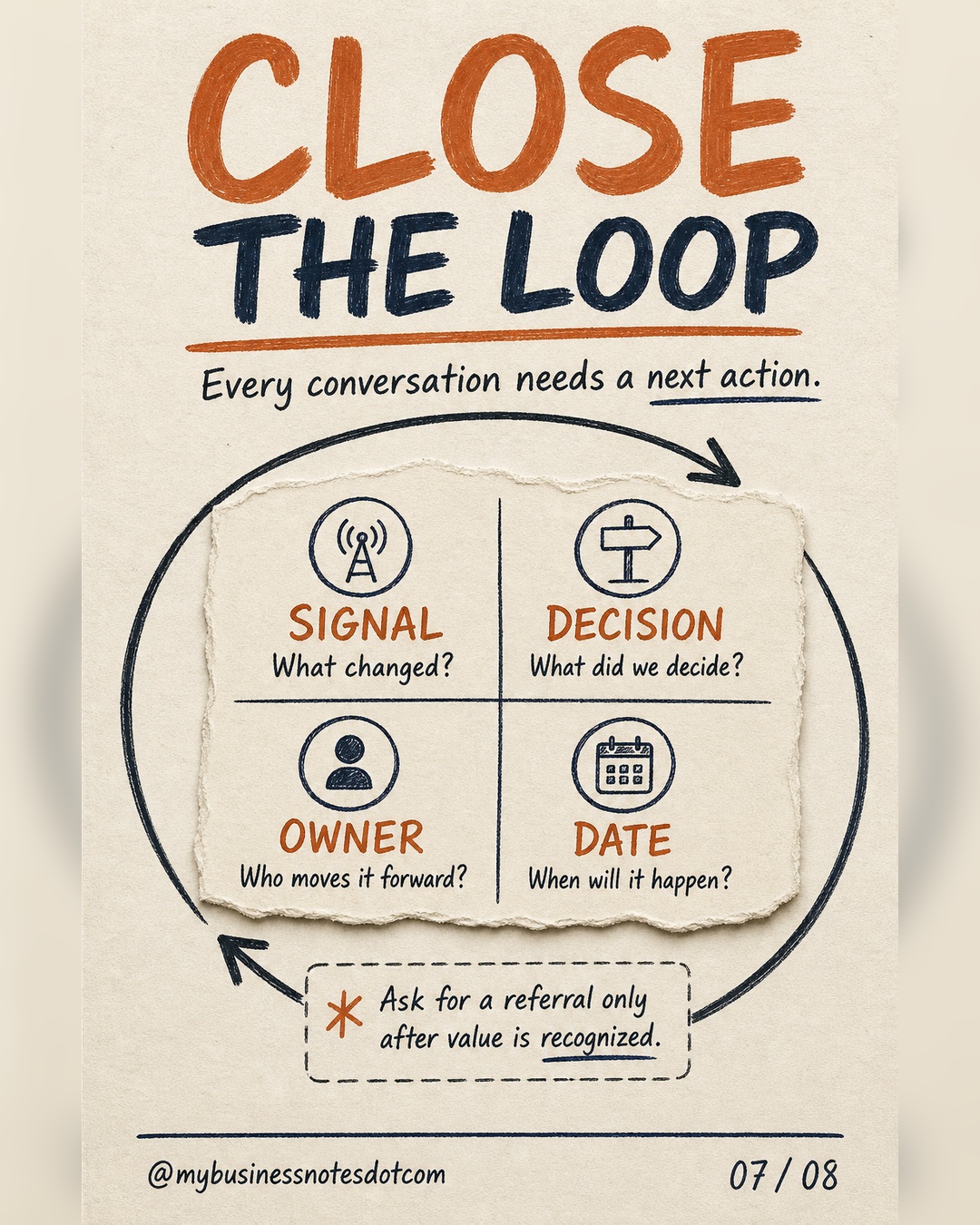
Post-sale systems fail when useful observations remain in someone’s memory. After every meaningful customer conversation, record four fields:
- Signal: What changed or became visible?
- Decision: What did the customer and team decide?
- Owner: Who is responsible for the next action?
- Date: When will the action happen or be reviewed?
Add context when necessary—expected value, risk, stakeholders, and evidence—but protect the simplicity of the four-field loop. A next action should be observable. “Follow up later” is not enough; “Customer-success lead will review adoption data with the operations sponsor on August 28” is manageable.
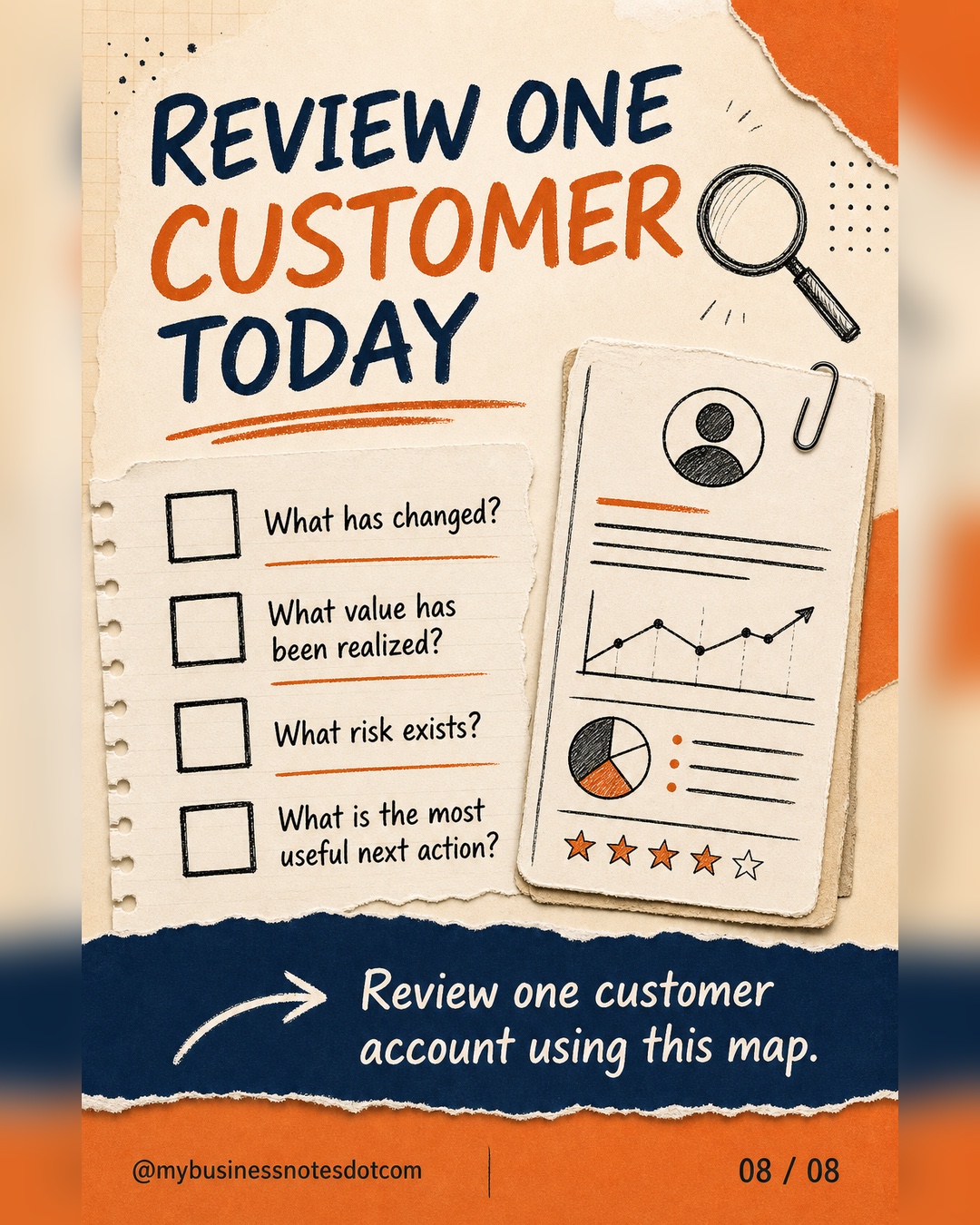
How to review one customer account today
- What has changed? Look at the customer’s business, stakeholders, behavior, adoption, and constraints.
- What value has been realized? Separate delivered activity from outcomes the customer can recognize.
- What risk exists? Identify unresolved friction, weak adoption, expectation gaps, or relationship dependence.
- What is the most useful next action? Choose protection, education, repurchase, expansion, referral, or no commercial action yet.
Then record the signal, decision, owner, and date. This short review converts account knowledge into coordinated action without manufacturing urgency.
Common post-sale management mistakes
- Contacting customers only at renewal. Value gaps and risks become harder to correct when discovered late.
- Using every conversation to sell. Constant pitching erodes the trust needed for honest customer signals.
- Offering expansion before value realization. More scope does not repair a weak outcome.
- Treating all accounts identically. Cadence and attention should reflect needs, risks, and potential.
- Keeping signals outside the system of record. Unrecorded context cannot support coordinated decisions.
- Requesting referrals too early. Advocacy should follow recognized value and a relevant, low-friction request.
Frequently asked questions
What is the difference between post-sale management and customer support?
Customer support primarily resolves questions or problems. Post-sale management is broader: it coordinates adoption, value realization, relationship health, retention, repurchase, expansion, and advocacy.
When should a company start post-sale management?
Before the sale closes. The handoff should preserve expected outcomes, stakeholders, constraints, promises, and the first value milestone so the post-sale team can begin with context.
What is the difference between cross-sell and upsell?
Cross-sell adds a complementary solution for a related need. Upsell increases the scope, capacity, sophistication, or service level of the current solution.
When is the right time to ask for a referral?
Ask after the customer recognizes meaningful value and when the desired introduction is relevant. Make the request specific, easy, and optional.
How often should customer accounts be reviewed?
Cadence depends on risk, potential, complexity, satisfaction, and the business model. High-priority or changing accounts may require frequent reviews; stable accounts can use a lighter or trigger-based cadence.
Payment begins a new commercial phase
The strongest post-sale systems do not search for reasons to sell. They search for evidence: value achieved, risk emerging, needs changing, or trust growing. That evidence determines whether the next useful path is retention, repurchase, expansion, referral, or simply better support.
Review one customer today. Ask what changed, what value was realized, what risk exists, and what action would genuinely help next.
Download the post-sale growth carousel
Keep the eight-slide framework as a reference for account reviews, customer signals, and next-action planning.
International references