

An executable plan connects a specific desired result to the relevant gap, the capabilities required to close it, a coherent portfolio of initiatives, clear ownership, and indicators that support learning. A goal alone describes a destination. Execution begins when every part of the plan explains logically what must change, why the chosen work should help, who moves it forward, and how evidence will guide the next decision.
What makes a plan executable?
A plan is executable when a team can trace a defensible line from the result it wants to the work it has chosen. Each initiative should exist because it addresses a relevant obstacle or builds a necessary capability. Each initiative should also have an accountable owner, a near-term milestone, a review rhythm, and evidence that distinguishes motion from progress.
This is different from producing a long task list. Tasks may be perfectly organized and still fail to change the outcome. The quality of execution depends on the connections among seven questions:
- What result should change?
- What currently prevents that result?
- What must the organization be capable of doing?
- Which initiatives will close the gap?
- Who owns the next movement?
- How often will evidence be reviewed?
- Are activities happening, and is the result improving?
McKinsey’s implementation guidance follows a compatible logic: diagnose readiness and capability gaps, design a portfolio and implementation plan, build the necessary skills, and sustain execution through performance management. The framework below turns that logic into a practical meeting sequence.
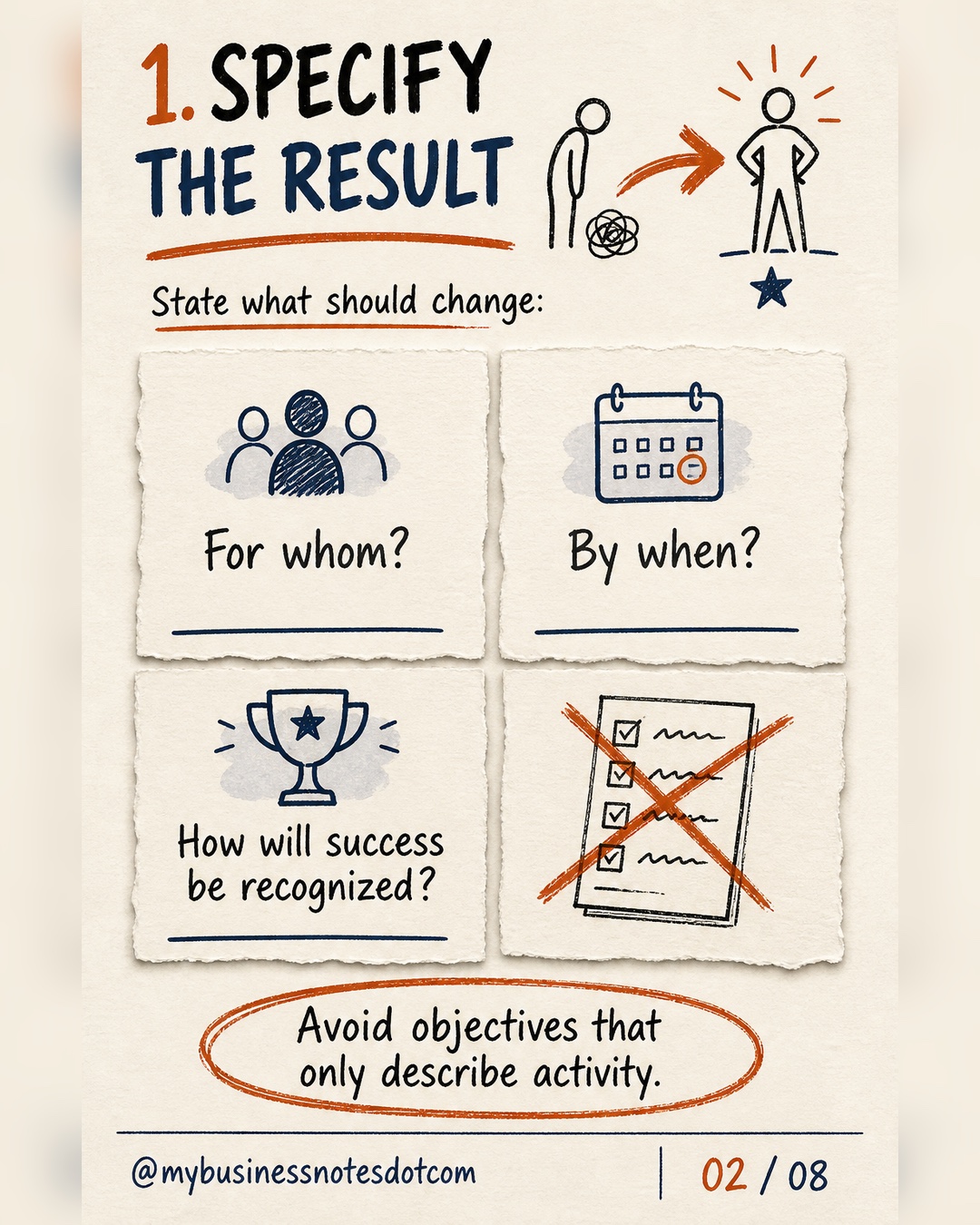
Step 1: specify the desired result
Start with the destination, not the list of activities. A usable result statement answers four questions:
- What should change? Name the outcome or condition, not the work performed.
- For whom? Identify the customer, team, process, market, or stakeholder affected.
- By when? Establish the time horizon for evaluation.
- How will success be recognized? Define observable evidence.
“Launch a training program” describes activity. “Reduce avoidable onboarding errors for new service teams by the end of the quarter, while maintaining cycle time” describes a result that can guide choices. Training may become one initiative, but it does not become the goal automatically.
A strong result can include boundaries. Constraints involving quality, risk, budget, customer experience, or capacity prevent a narrow metric from producing a harmful local optimization.
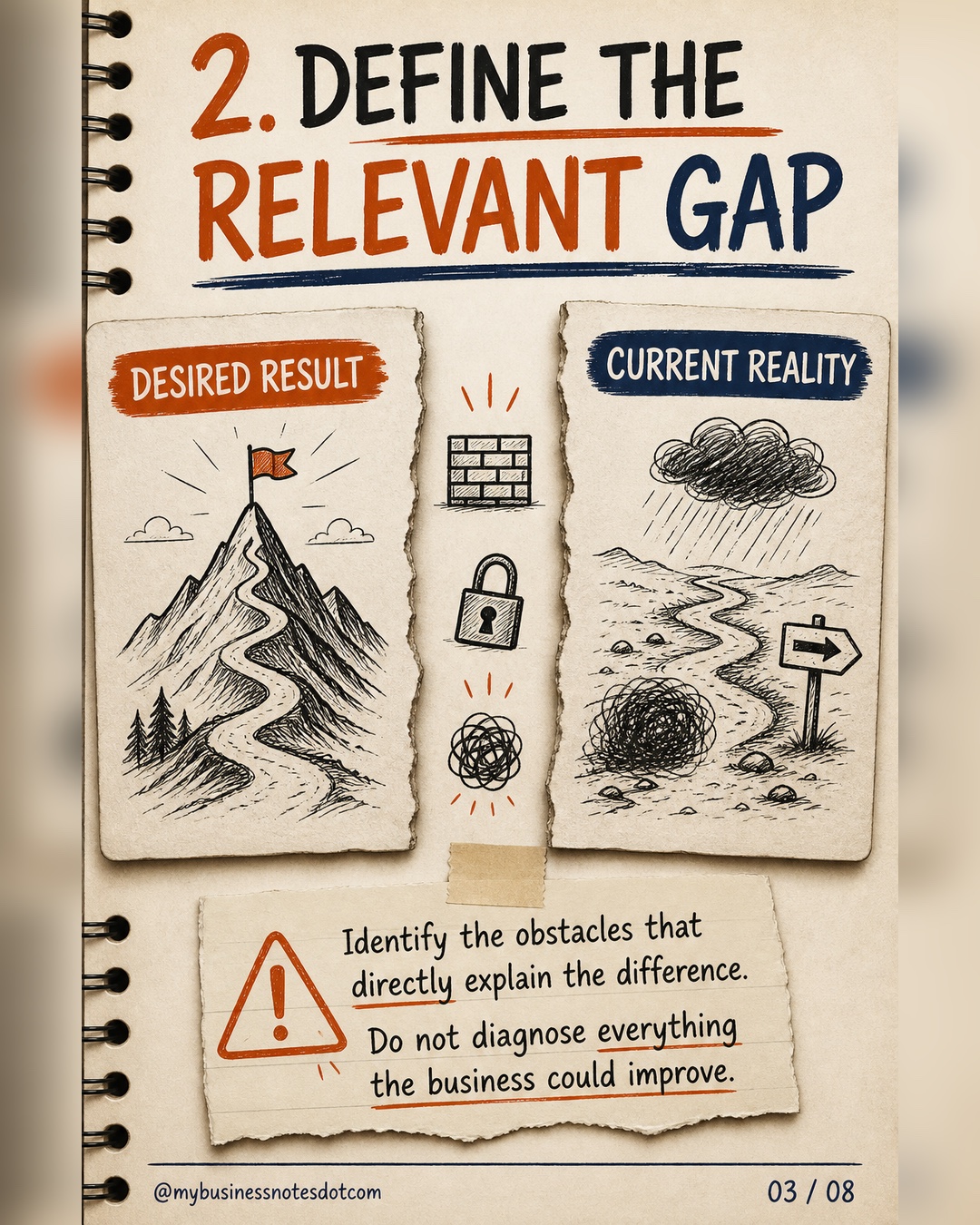
Step 2: define the relevant gap
The gap is the difference between the desired result and current reality that the plan must explain. Compare the two states and identify the obstacles directly responsible for the difference.
Avoid diagnosing everything the organization could improve. Strategic plans lose focus when every weakness becomes part of the problem. Ask instead:
- What evidence describes current performance?
- Where does the desired behavior or result break down?
- Which constraints have the strongest causal relationship with the gap?
- What is uncertain and must be tested rather than assumed?
For example, weak customer onboarding may be caused by unclear handoffs, missing customer data, inconsistent training, or product complexity. Each explanation implies different work. Jumping directly to a favored project hides that distinction.
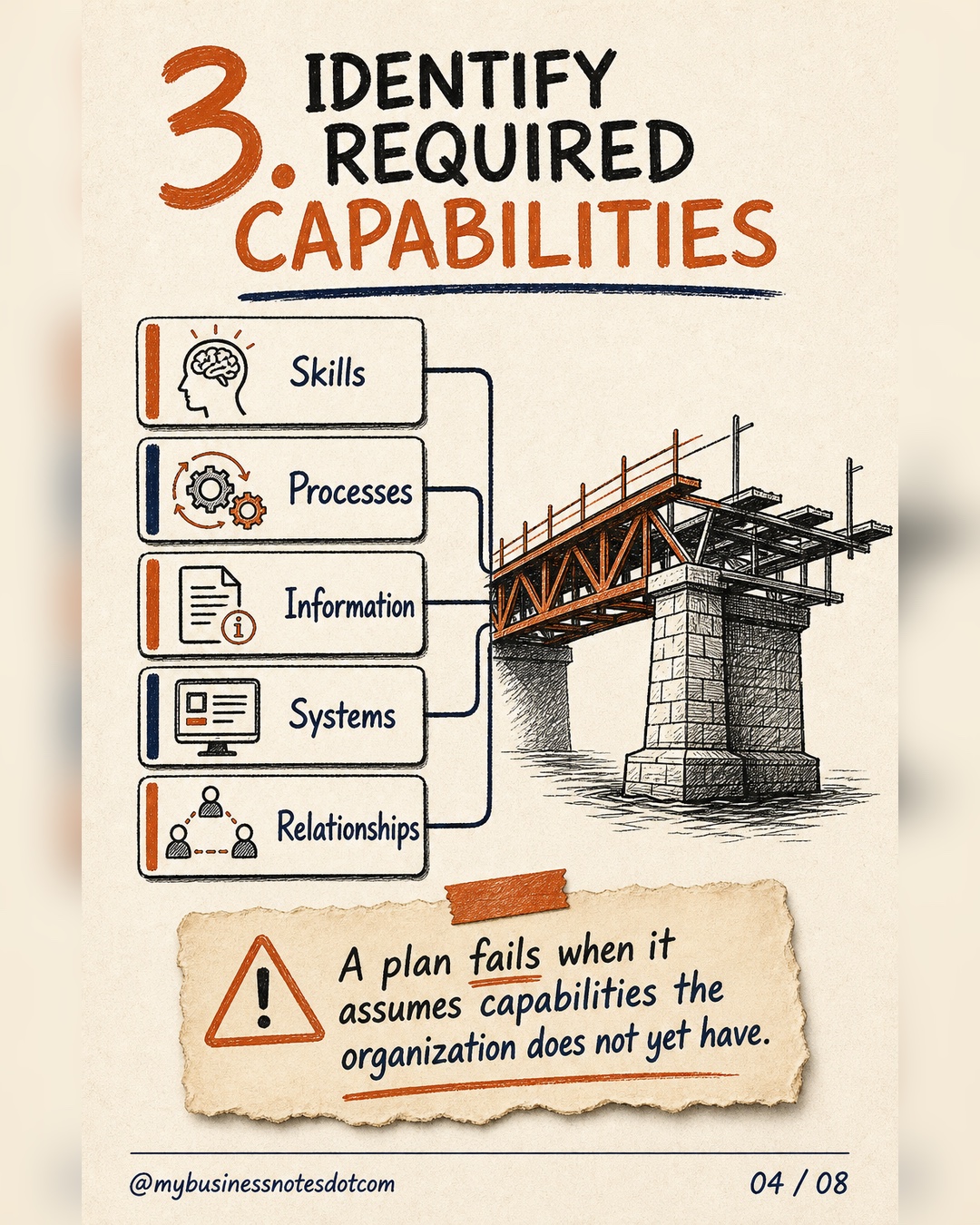
Step 3: identify required capabilities
A capability is something the organization must be able to do repeatedly. It may depend on skills, processes, information, systems, decision rights, or relationships. Initiatives often fail because the plan assumes capabilities that do not yet exist.
| Capability dimension | Diagnostic question |
|---|---|
| Skills | Do the people involved know how to perform the required work? |
| Processes | Is there a reliable sequence for coordinating the work? |
| Information | Are decisions supported by timely, trustworthy evidence? |
| Systems | Do tools and infrastructure enable the required scale and control? |
| Relationships | Do the necessary teams, partners, and stakeholders cooperate effectively? |
Separate “we need a tool” from “we need the capability the tool may enable.” Buying software is an initiative. Coordinating reliable decisions across teams is a capability. The distinction prevents the solution from being defined before the need.
Research on strategy execution also emphasizes capability building. McKinsey describes execution readiness, skill gaps, learning journeys, and implementation skills as central to sustaining impact—not as optional support added after initiatives are selected.
Step 4: build a coherent initiative portfolio
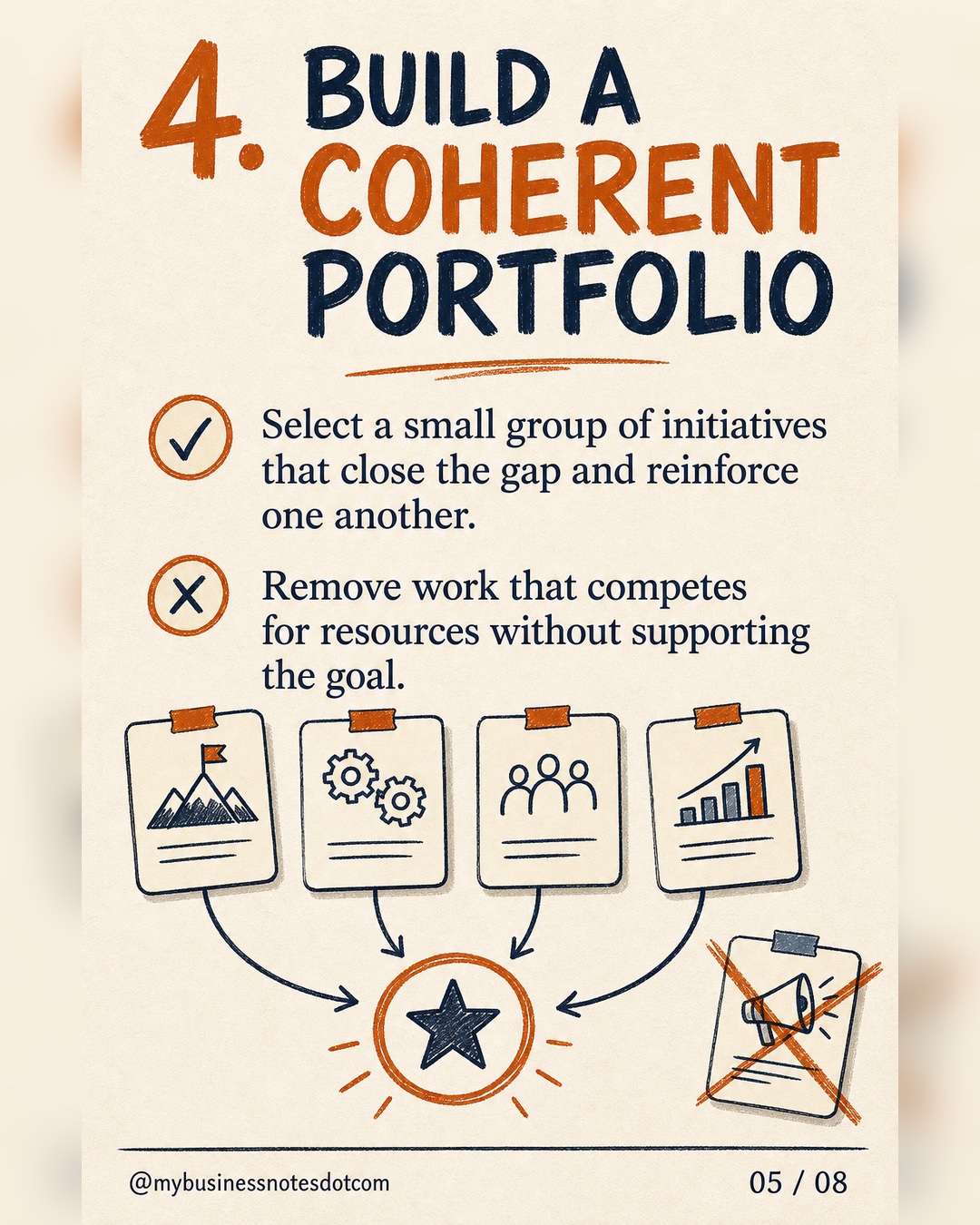
An initiative portfolio is the small group of projects, changes, and experiments selected to close the gap and build required capabilities. “Portfolio” matters because initiatives interact: they compete for resources, depend on one another, and can either reinforce or contradict the same result.
Evaluate each candidate with five questions:
- Which part of the relevant gap does this initiative address?
- Which required capability does it build or use?
- What evidence supports the proposed mechanism?
- What resources and dependencies does it require?
- What should stop, pause, or change to create capacity?
Remove work that cannot explain its contribution. This is not a judgment that the activity has no value; it means it may not belong in this plan. McKinsey’s portfolio guidance similarly stresses resource allocation, integrated planning, initiative comparison, and continuous evaluation rather than treating all projects as equally strategic.
Step 5: define ownership and execution rhythm
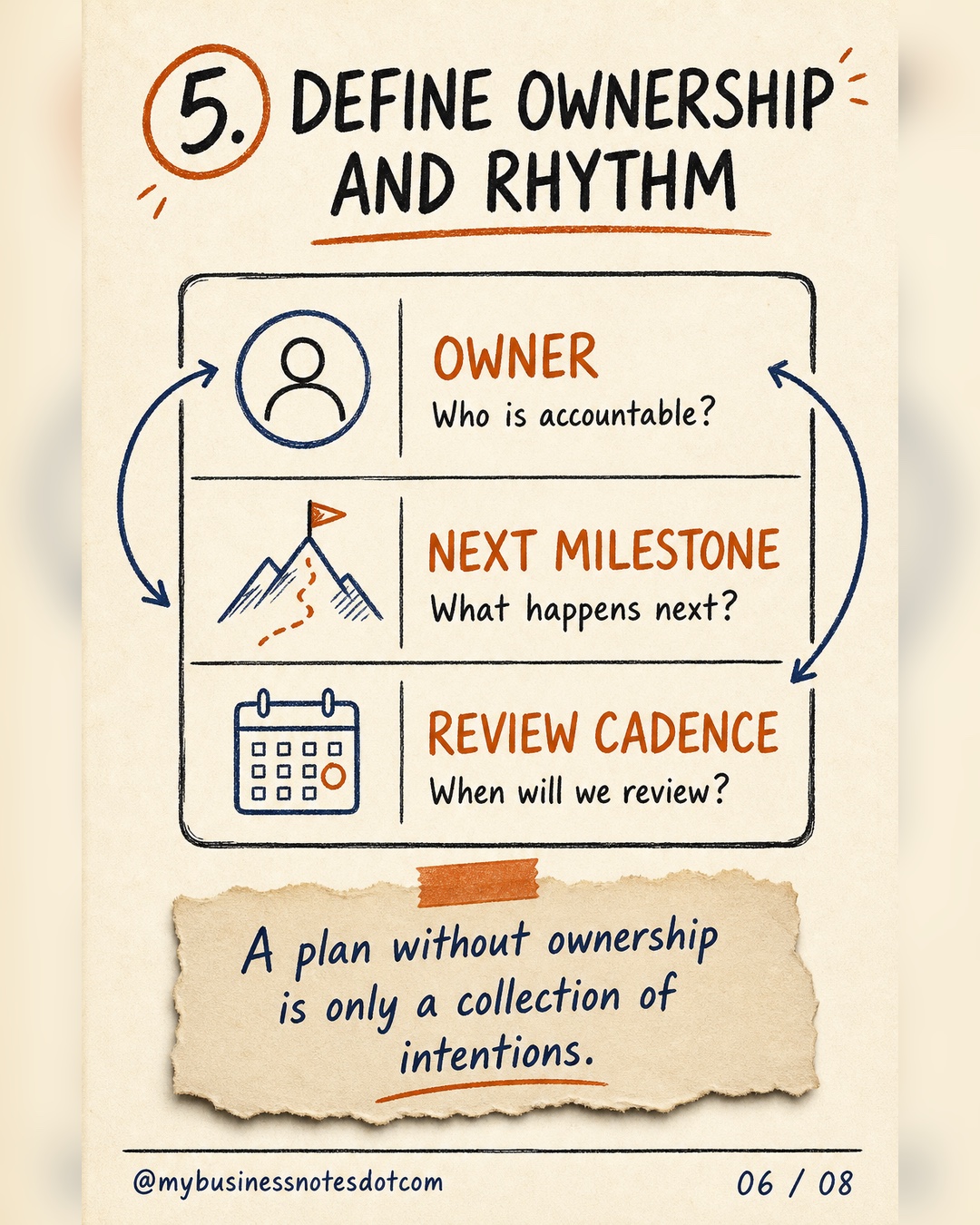
A plan becomes operational when every initiative has an owner, a next milestone, and a review cadence.
- Owner: one person accountable for moving the initiative and escalating constraints.
- Next milestone: the nearest meaningful evidence of progress, not merely a distant final deadline.
- Review cadence: the frequency at which the team examines activity, progress, risks, and decisions.
Ownership does not mean doing everything alone. It means ensuring that coordination and decisions do not become anonymous. A milestone should represent a useful state change: a validated prototype, an adopted process, a completed pilot, or evidence from customers—not only “project is 40% complete.”
Cadence should reflect uncertainty and speed. Fast-moving or high-risk initiatives require shorter feedback loops. Stable work may need less frequent review. McKinsey’s change guidance recommends monitoring initiatives through milestones and operational performance, then reviewing program health and impact at appropriate intervals.
Measure activity and progress separately
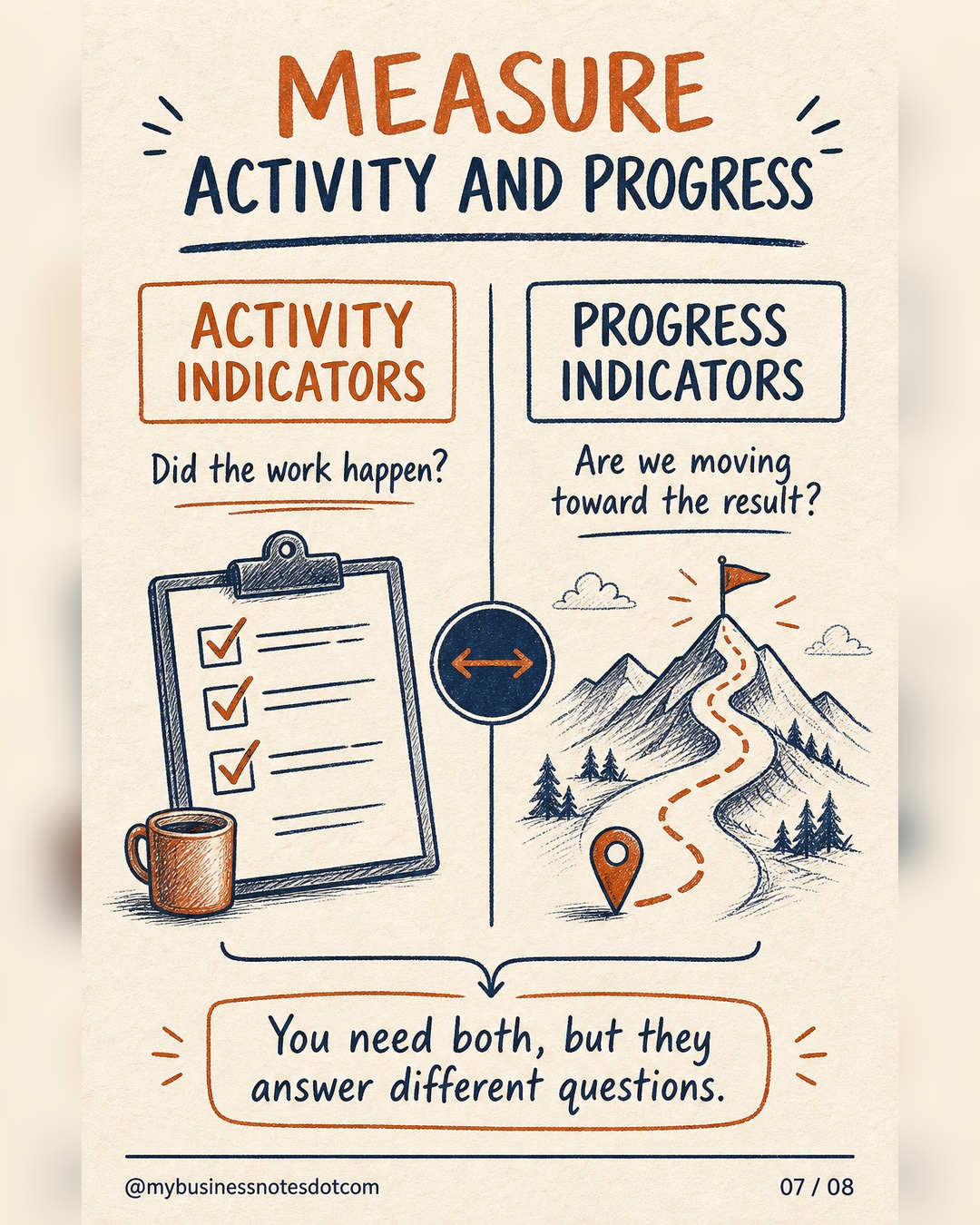
Activity indicators answer, “Did the work happen?” Progress indicators answer, “Are we moving toward the desired result?” Both are necessary because outcomes can take time, while activities alone can create a false sense of control.
| Activity indicators | Progress indicators |
|---|---|
| Training sessions completed | Error rate in real onboarding cases |
| Customer interviews conducted | Reduction in unresolved decision uncertainty |
| Process changes deployed | Cycle time, rework, or quality trend |
| Milestones delivered | Movement toward the target outcome |
Activity signals are often earlier and more controllable. Progress signals are closer to the intended value. If activity increases without progress, revisit the assumed mechanism, the relevant gap, or the capabilities. McKinsey’s strategic-planning guidance likewise recommends combining input measures with output measures because financial or final-result targets alone may reveal problems too late.
Close the loop with learning
The sequence is not a rigid waterfall. Execution generates evidence that may change every earlier decision. A pilot can reveal a different obstacle. A milestone can expose a missing capability. A progress indicator can show that the chosen initiative is ineffective.
Use each review to ask:
- What did we expect?
- What happened?
- What explains the difference?
- What should continue, change, stop, or be tested next?
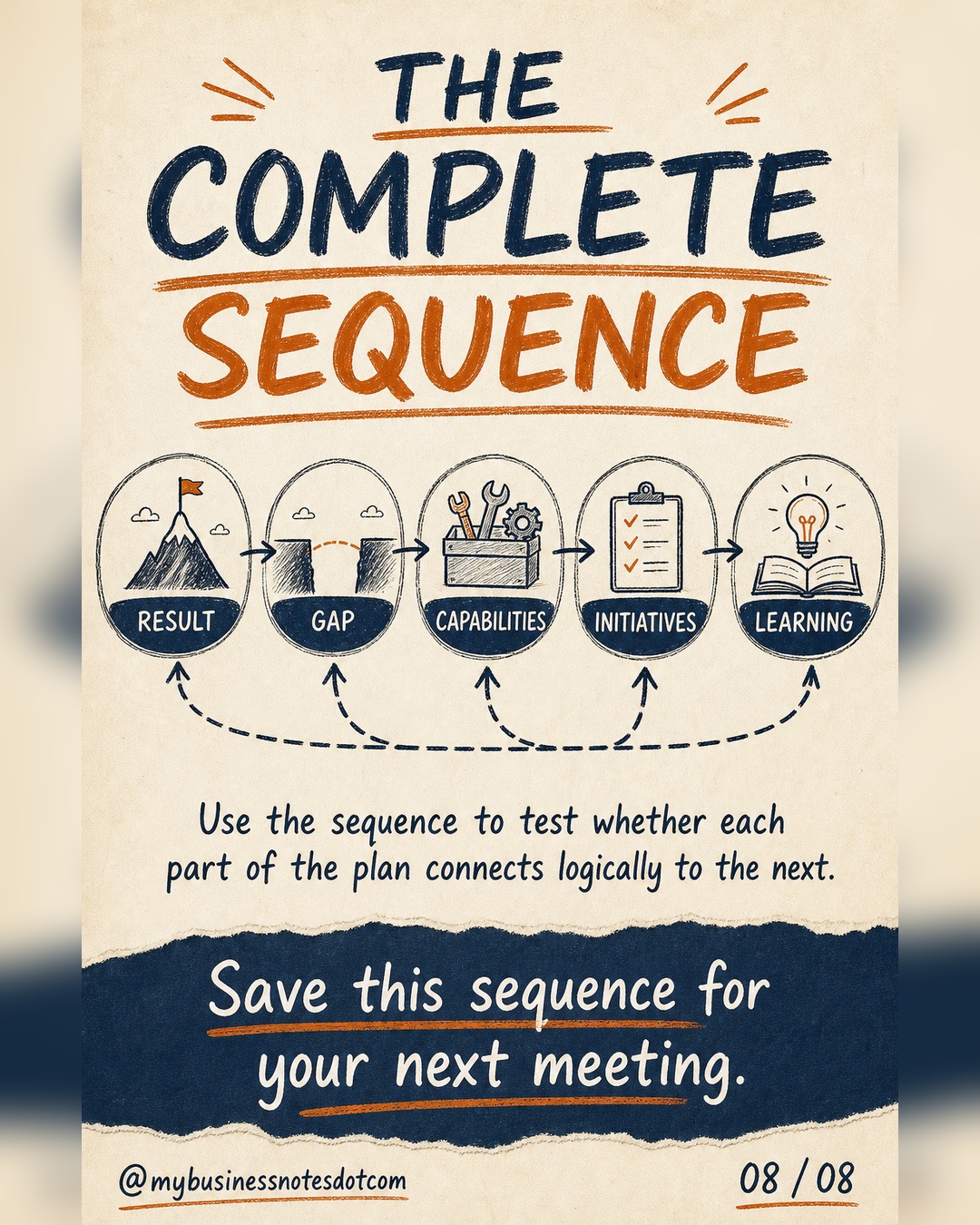
Learning becomes part of execution when decisions and assumptions are updated—not when observations are merely recorded. The complete logic is therefore cyclical: result → gap → capabilities → initiatives → ownership and rhythm → indicators → learning → revised plan.
A practical planning-meeting agenda
- Confirm the result. Rewrite activity-based objectives as observable outcomes.
- Review current evidence. Agree on the relevant gap and note unresolved assumptions.
- Map capabilities. Identify what must exist before initiatives can succeed.
- Choose the portfolio. Select reinforcing initiatives and remove distracting work.
- Assign execution. Name the owner, next milestone, and review cadence.
- Select indicators. Pair activity evidence with progress evidence.
- Record learning questions. State what the next cycle should confirm or challenge.
The output should fit on a page or a concise planning board. Supporting analyses can remain detailed, but the execution logic must be visible enough for the team to use repeatedly.
Common planning mistakes
- Beginning with projects. Preferred solutions replace diagnosis.
- Using activity as the goal. Completion can occur without meaningful change.
- Diagnosing the whole organization. The plan loses the relevant gap.
- Ignoring capability constraints. Initiatives assume skills or systems that do not exist.
- Funding disconnected initiatives. Resources spread across work that does not reinforce one result.
- Assigning teams but no accountable owner. Coordination becomes anonymous.
- Tracking only tasks or only outcomes. The team either mistakes motion for progress or learns too late.
- Treating the plan as fixed. Evidence is collected but never changes decisions.
Frequently asked questions
What is an executable plan?
An executable plan connects a specific result to a relevant gap, required capabilities, coherent initiatives, ownership, milestones, review cadence, and indicators that support decisions.
What is the difference between a goal and an initiative?
A goal describes the result that should change. An initiative is a coordinated body of work chosen because it should help produce that result.
Why identify capabilities before selecting projects?
Projects often fail when they assume skills, processes, information, systems, or relationships the organization does not yet possess. Capability analysis exposes those dependencies.
What is the difference between activity and progress indicators?
Activity indicators show whether planned work happened. Progress indicators show whether the organization is moving toward the desired result.
How often should a strategic plan be reviewed?
Review cadence depends on uncertainty, risk, and speed. High-uncertainty initiatives benefit from shorter learning cycles, while stable work can use a lighter rhythm.
Connect the plan before expanding it
An executable plan does not need to be large. It needs to be logically connected. Start with the desired result, isolate the relevant gap, identify required capabilities, choose a coherent initiative portfolio, assign ownership and rhythm, then measure both activity and progress.
Save the sequence for your next meeting—and use the evidence from execution to improve the plan rather than defend the original document.
Download the executable-plan carousel
Keep the eight-slide sequence as a practical reference for your next planning and execution meeting.
International references
- McKinsey & Company — Implementation and Execution Readiness
- McKinsey & Company — A Better Way to Lead Large-Scale Change
- McKinsey & Company — How Do We Manage the Change Journey?
- McKinsey & Company — How to Improve Strategic Planning
- Harvard Business Publishing — Reviewing Strategy-Execution Capabilities