

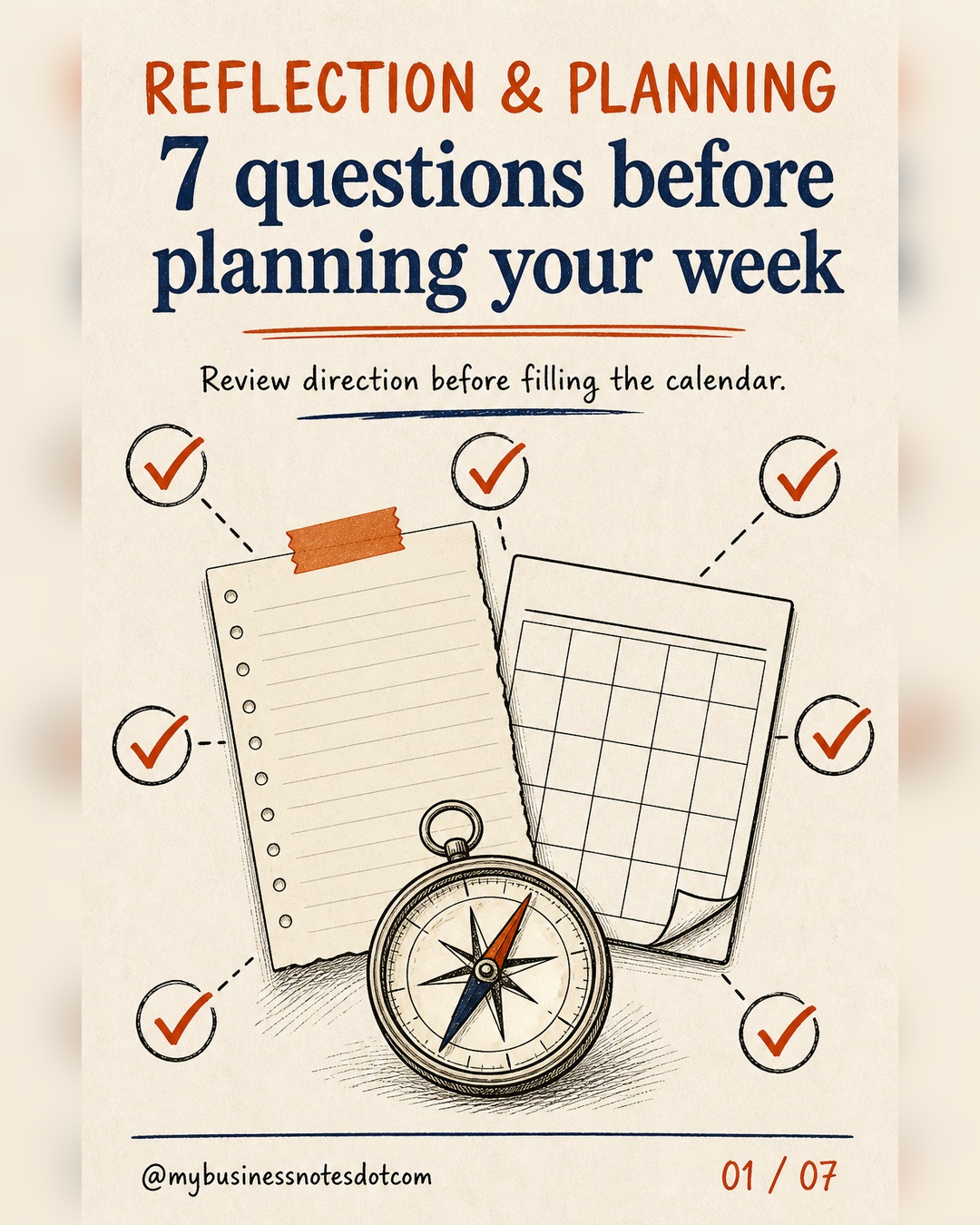
Weekly planning questions turn a list of tasks into explicit decisions about progress, constraints, and focus. A useful weekly plan begins with evidence and trade-offs, not with automatically copying unfinished work. This article presents seven questions that help a team coordinate action and learn from results.
Slide 1 of 7
What this framework helps you decide
a useful weekly plan begins with decisions about progress, constraints and focus, not with copying unfinished tasks
The value of a framework is not the appearance of certainty. It is the quality of the conversation it creates. Use the following sections to expose assumptions, focus attention, and convert an abstract intention into a decision that can be reviewed.
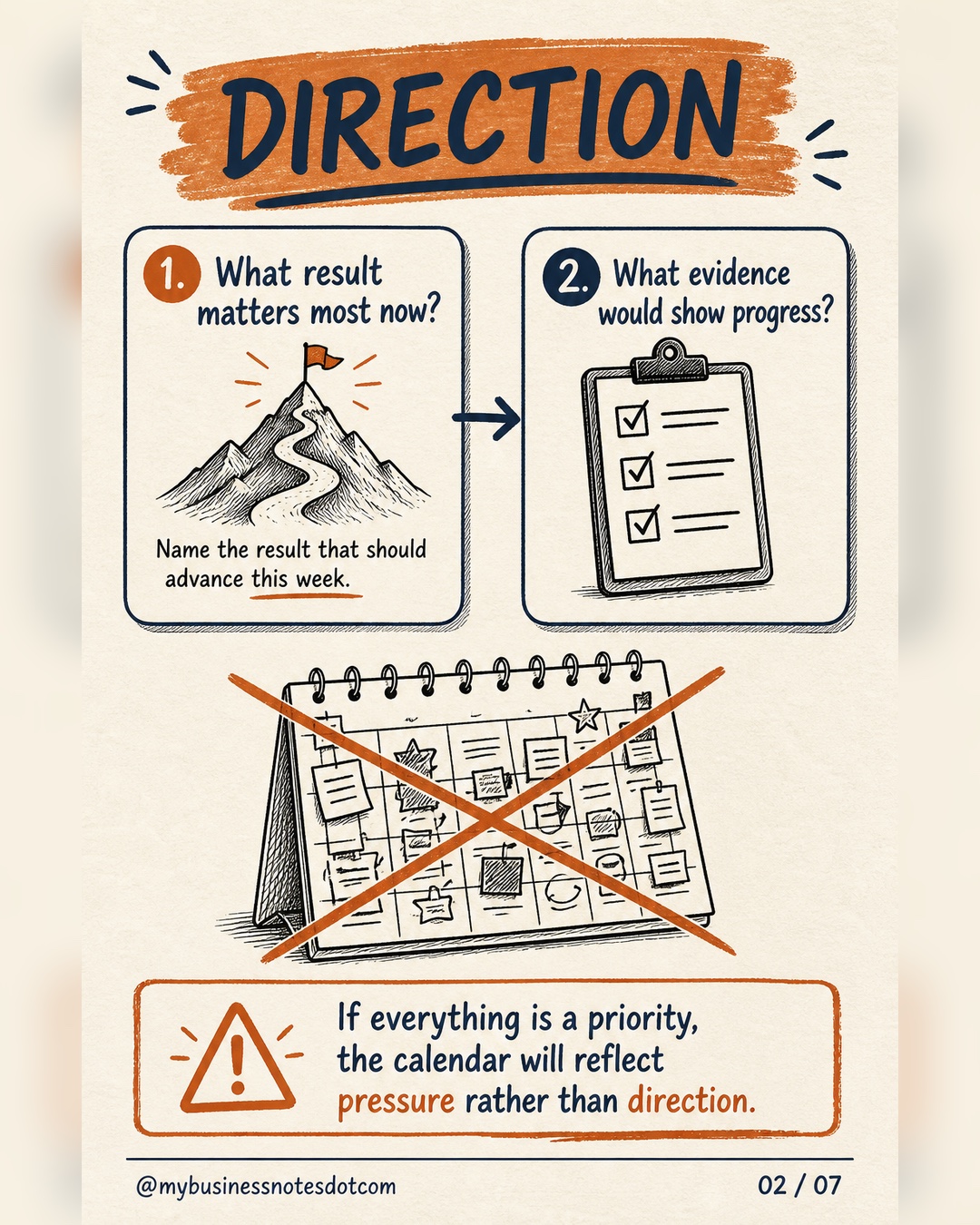
1. What result matters most now?
Name the result that should advance this week. If everything is a priority, the calendar will reflect pressure rather than direction.
Define one result that deserves to move during the week and express it as an observable change. This choice creates a reference point for the calendar: tasks are valuable when they contribute to the result, reduce uncertainty, or remove a constraint that blocks it.
2. What evidence would show progress?
Choose one or two signals that would demonstrate movement toward the priority. Include a leading indicator the team can observe during the week and, where relevant, a lagging outcome that confirms value later.
Agree on what the evidence means before work begins. A metric is useful when it can influence a decision: continue the approach, adjust an assumption, remove a blocker, or stop an activity that is not contributing.
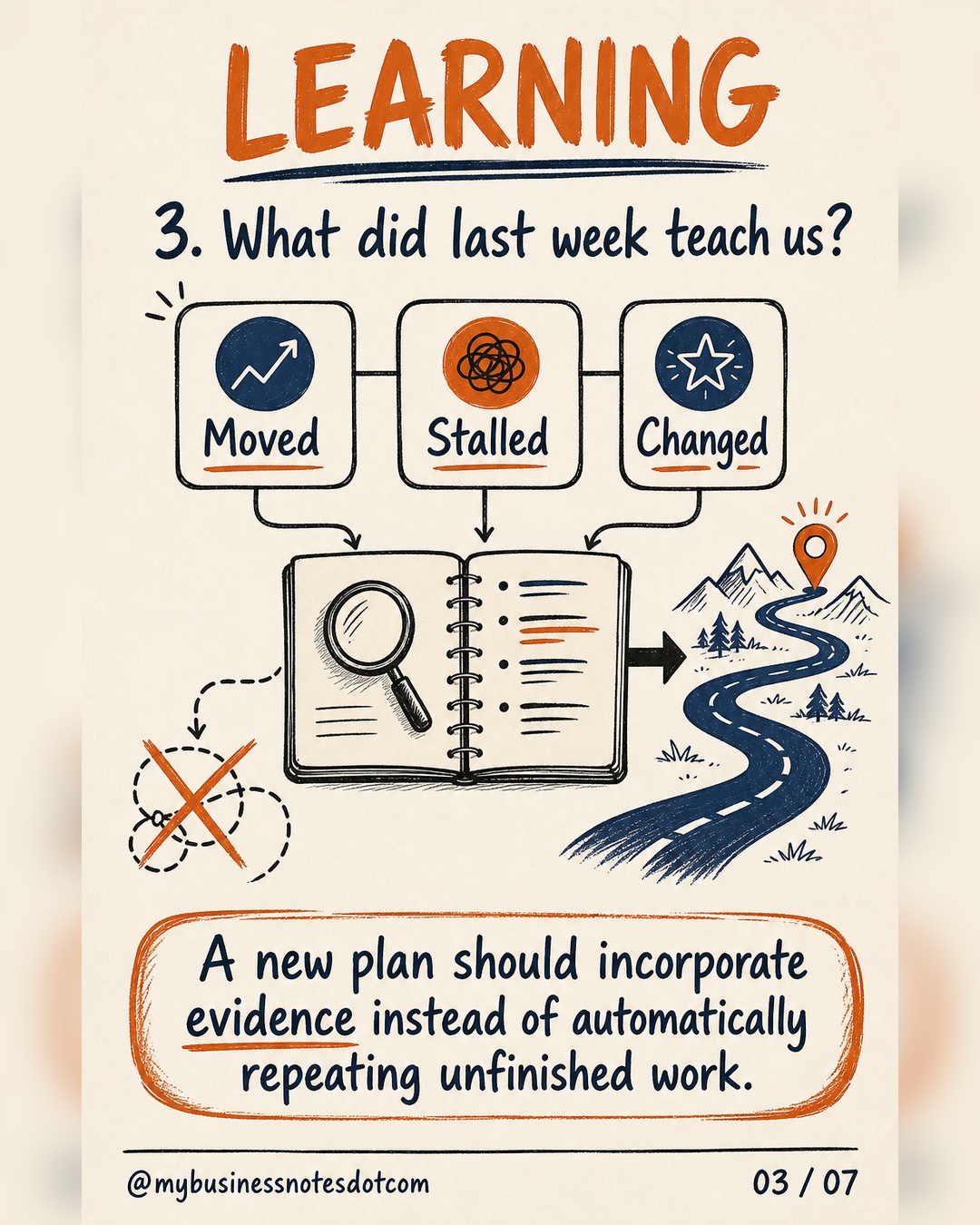
3. What did last week teach us?
Review what moved, stalled or changed. A new plan should incorporate evidence instead of automatically repeating unfinished work.
Review evidence from the previous week before building the next plan. Compare what was expected with what actually moved, stalled, or changed, then convert the difference into a practical lesson. Unfinished work should be reconsidered, not copied automatically.
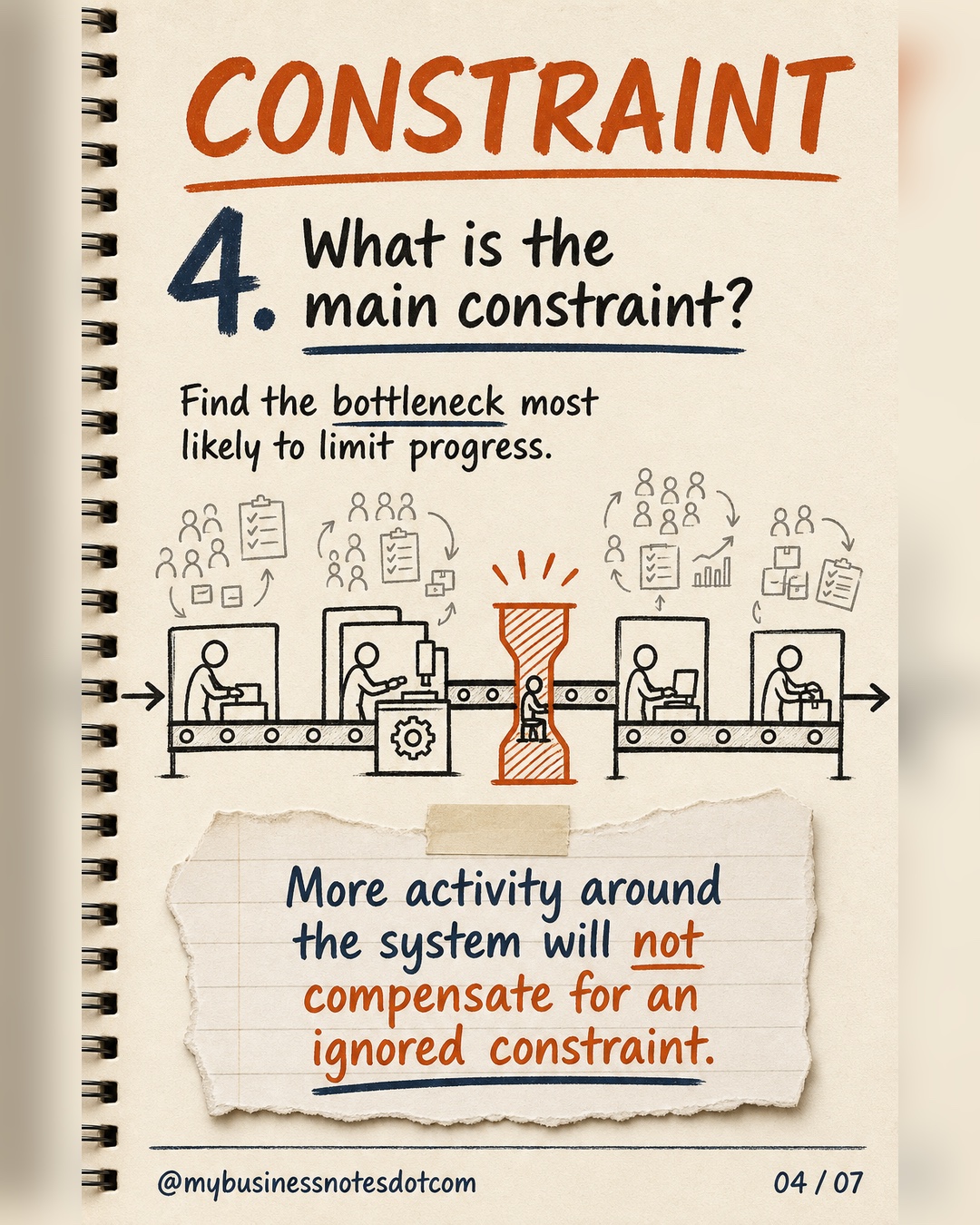
4. What is the main constraint?
Find the bottleneck most likely to limit progress. More activity around the system will not compensate for an ignored constraint.
Identify the bottleneck most likely to limit progress and address it before adding activity elsewhere. The constraint may be a decision, missing information, limited capacity, or a dependency. Naming it helps the team concentrate effort where it can unlock the system.
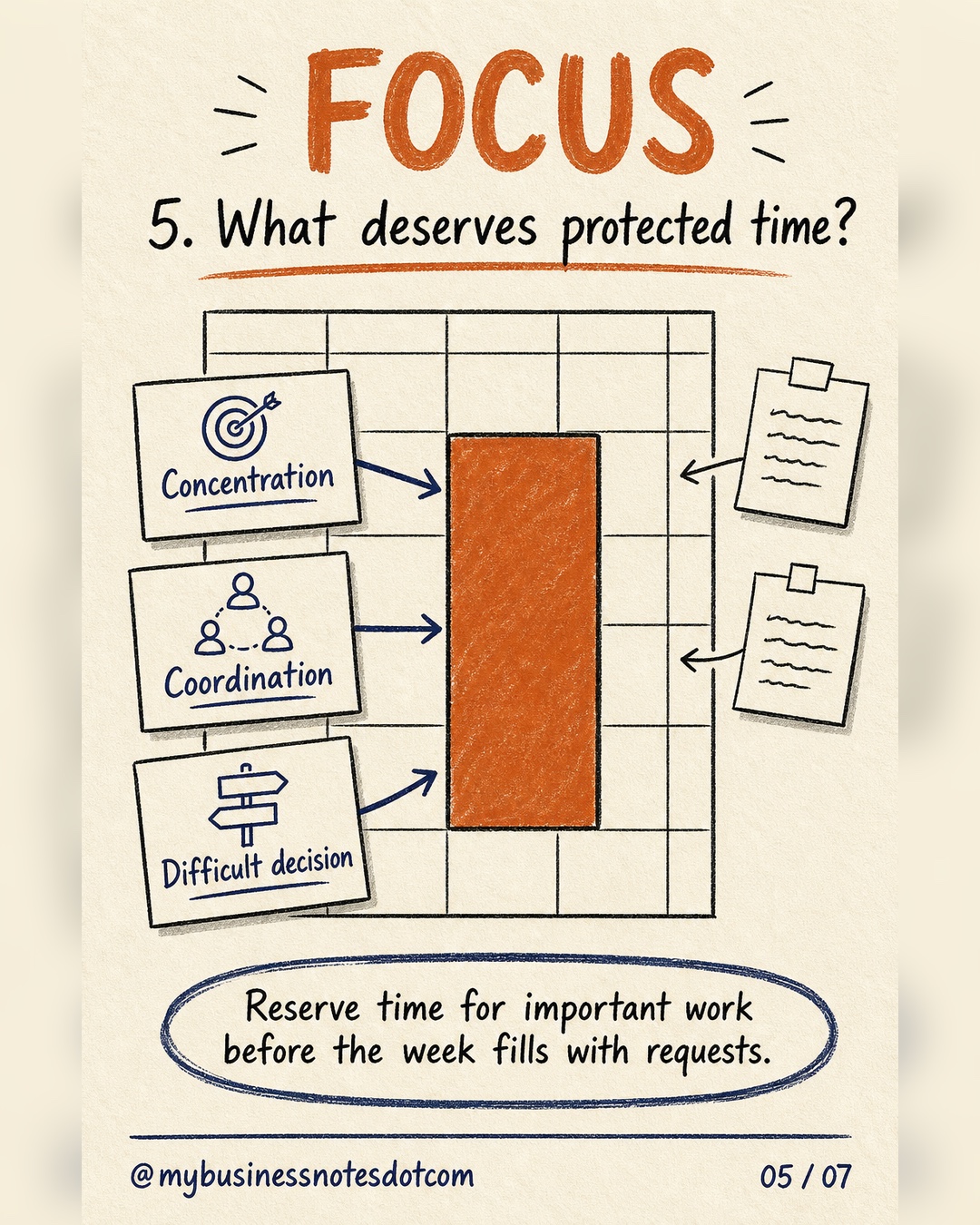
5. What deserves protected time?
Reserve time for the work that requires concentration, coordination or a difficult decision before the week fills with requests.
Reserve calendar space for the work that requires concentration, coordination, or a difficult conversation. Protected time should have a purpose and an owner, and routine requests should be arranged around it. Otherwise urgent work will consume the capacity needed for meaningful progress.
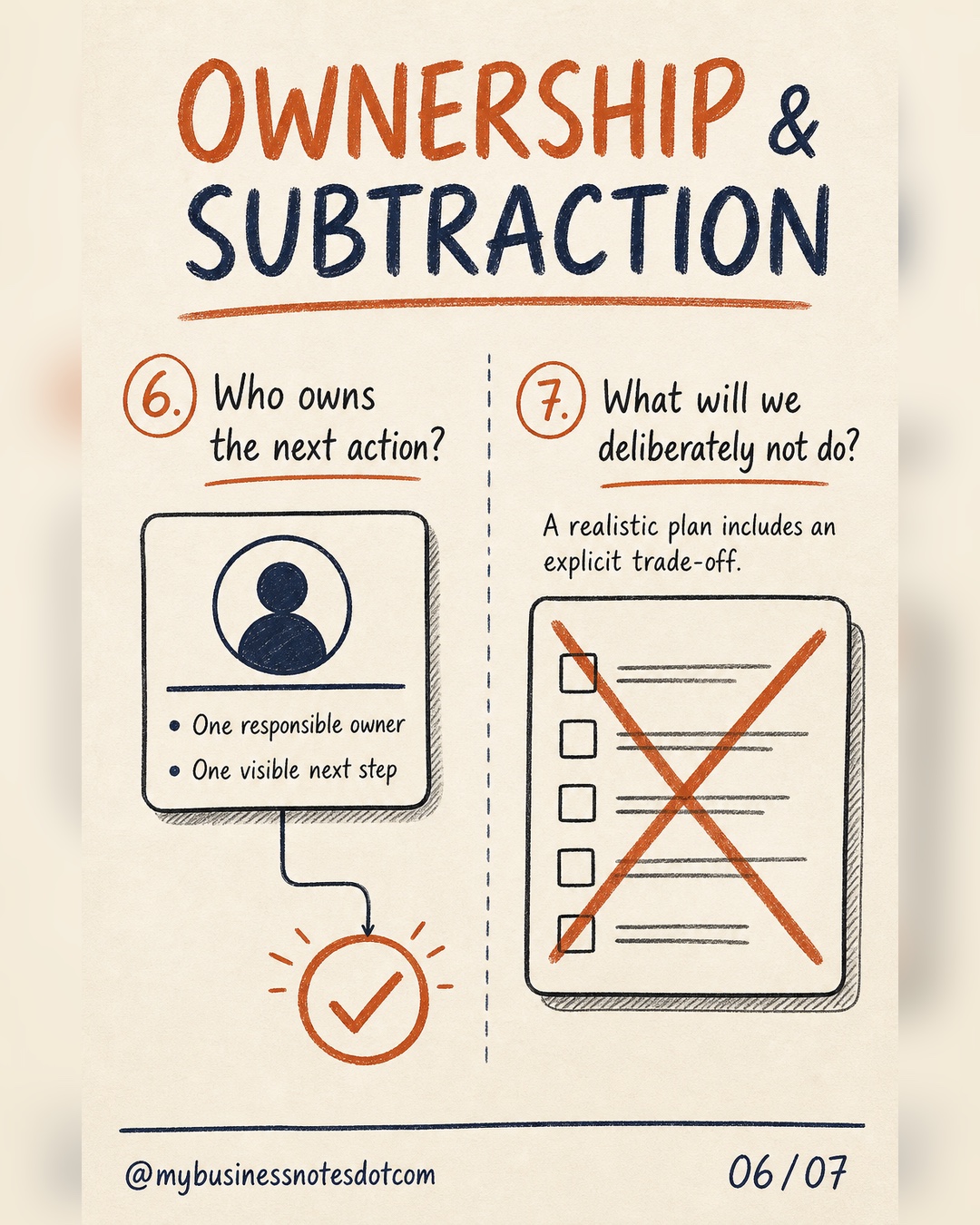
6. Who owns the next action?
Every important item needs one responsible owner and a visible next step.
Give every important next action one accountable owner, a clear output, and a review point. Shared contribution is welcome, but shared ownership often hides inaction. A named owner makes dependencies visible and allows the team to support progress without confusion.
7. What will we deliberately not do?
Name the requests, meetings, and lower-value tasks that will be postponed, delegated, or declined. A weekly priority becomes credible only when the team protects it from competing demands.
Record the trade-off and communicate it to the people affected. Deliberate subtraction creates the capacity for focused execution and reduces the likelihood that urgent but less important work quietly replaces the plan.
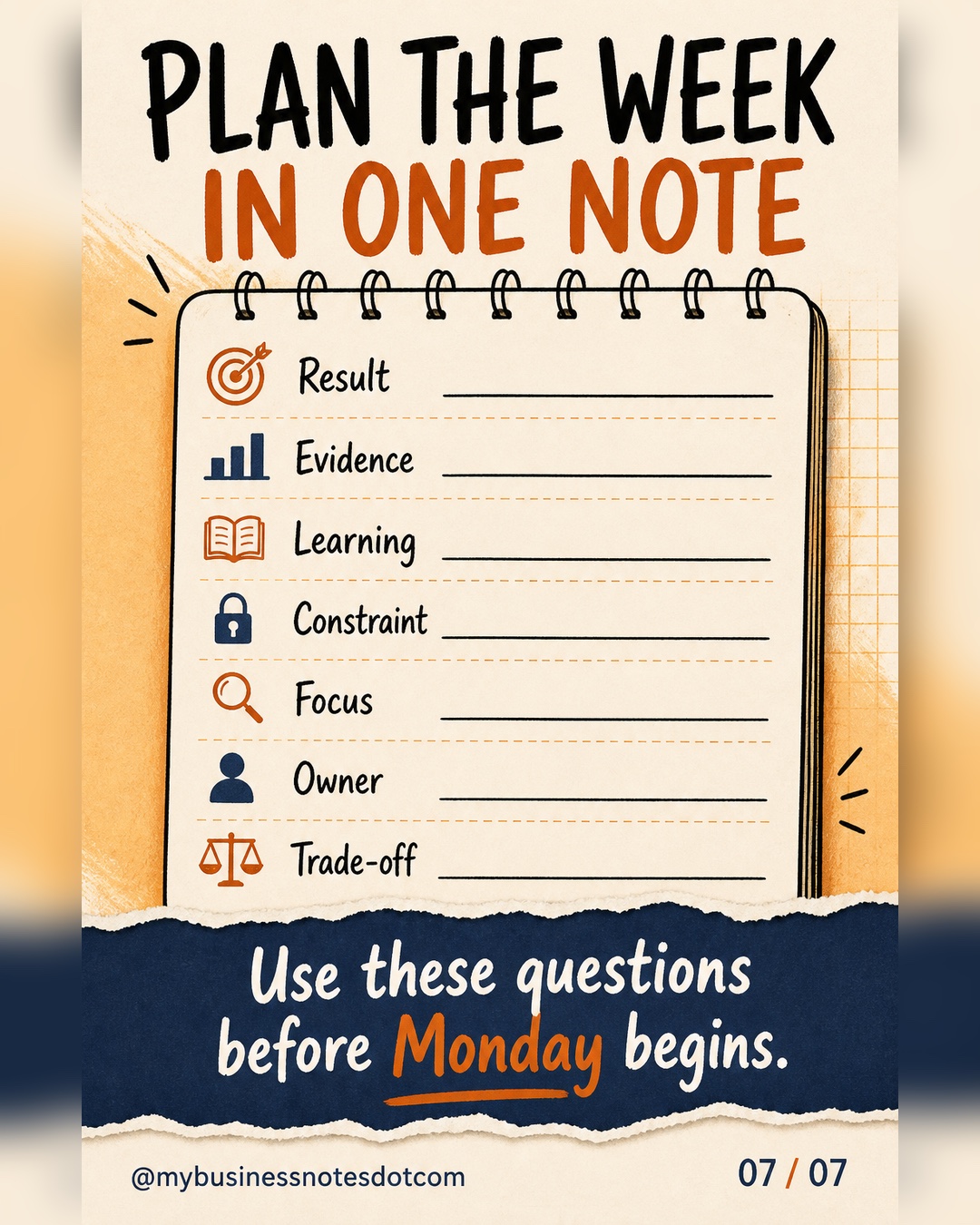
Plan the week in one note.
Result. Evidence. Learning. Constraint. Focus. Owner. Trade-off.
Summarise the plan in one short note containing the result, evidence, learning, constraint, protected focus, owner, and trade-off. If the note cannot explain why the week is organised this way, the plan probably contains activities without a sufficiently clear decision.
A practical example
A weekly plan should not be yesterday’s unfinished list copied into a new calendar. For example, a small team trying to improve lead quality may protect one block for reviewing qualification data, assign one owner to rewrite the form, and postpone a lower-value design update. The plan becomes a set of decisions rather than a storage place for requests.
The mistake to avoid
The most common mistake is filling available hours before naming the result. This rewards visible busyness and leaves concentrated work exposed to meetings and interruptions.
How to apply the framework
Begin with the business result and the customer or operational context. Work through the framework in sequence, but spend more time where uncertainty is highest. Record the decision, the reasoning behind it, and the signal that would cause the team to reconsider.
A useful review ends with subtraction as well as addition. Identify what will stop, what will receive protected attention, and who is accountable for the next visible step. Without those trade-offs, even a clear discussion can dissolve into more activity.
For related guidance, see How to prioritize ideas with an evaluation matrix and Strategy execution with the 4 Cs and 1 R.
Frequently asked questions
What are weekly planning questions?
Weekly planning questions are prompts used to turn priorities, evidence, constraints, ownership, and trade-offs into a focused plan for the week.
Why do weekly planning questions matter?
It matters because it connects activity to an explicit decision and makes progress easier to evaluate, explain and improve.
What is the most common mistake with weekly planning questions?
The most common mistake is filling available hours before naming the result. This rewards visible busyness and leaves concentrated work exposed to meetings and interruptions.
How do you start a weekly planning review?
Begin by naming the most important result, review the latest evidence, identify the main constraint, and agree on one owned next action and one deliberate trade-off.
Put the framework into practice
Use these questions before Monday begins. Use the carousel as a shared review tool, then capture the resulting priority, owner, next action, and evidence in the team’s working system.
Download the complete carousel
Keep the framework as a PDF for your next review.
International references
- Harvard Business Review — How to Focus on What’s Important, Not Just What’s Urgent
- Atlassian — Weekly Planning