
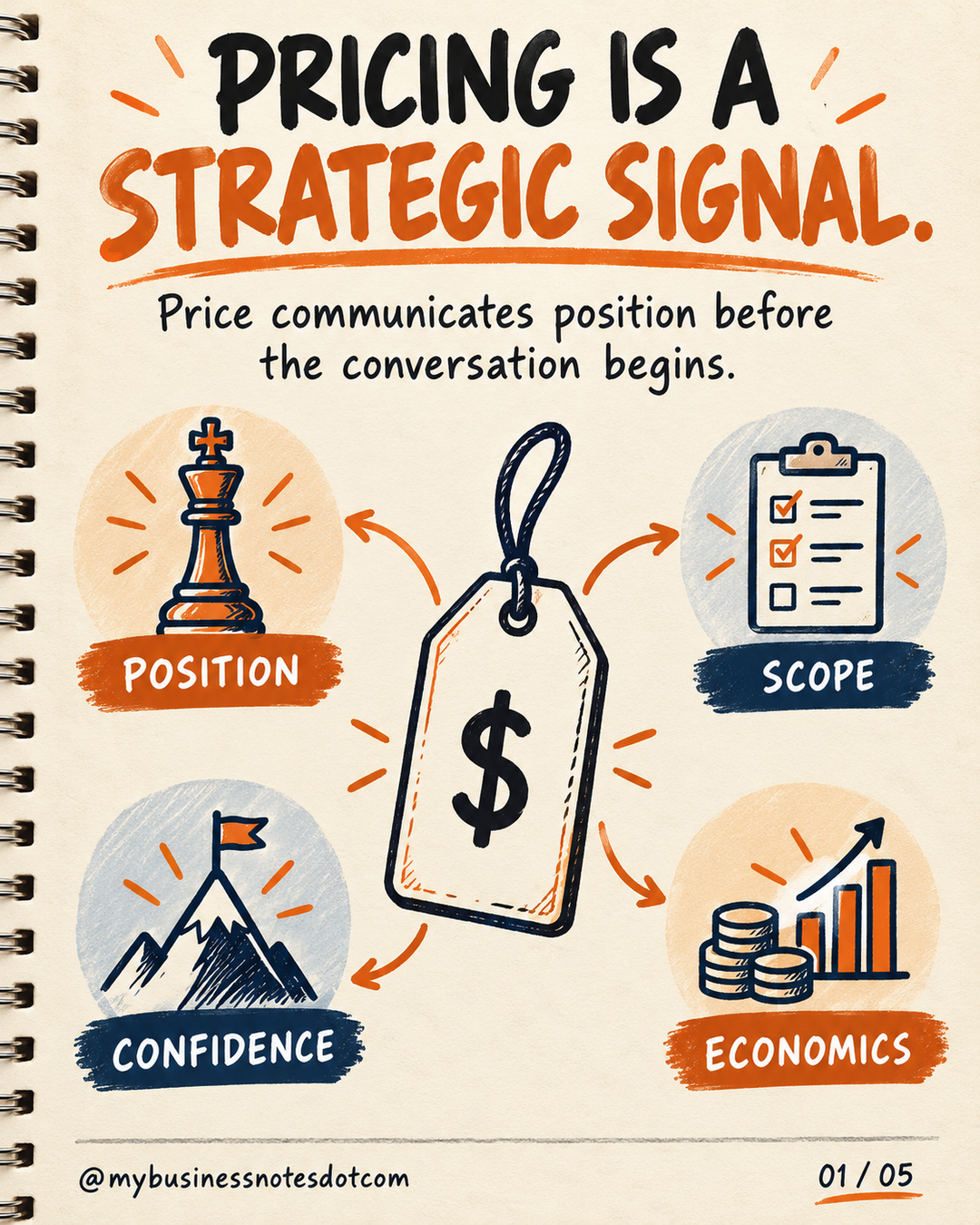
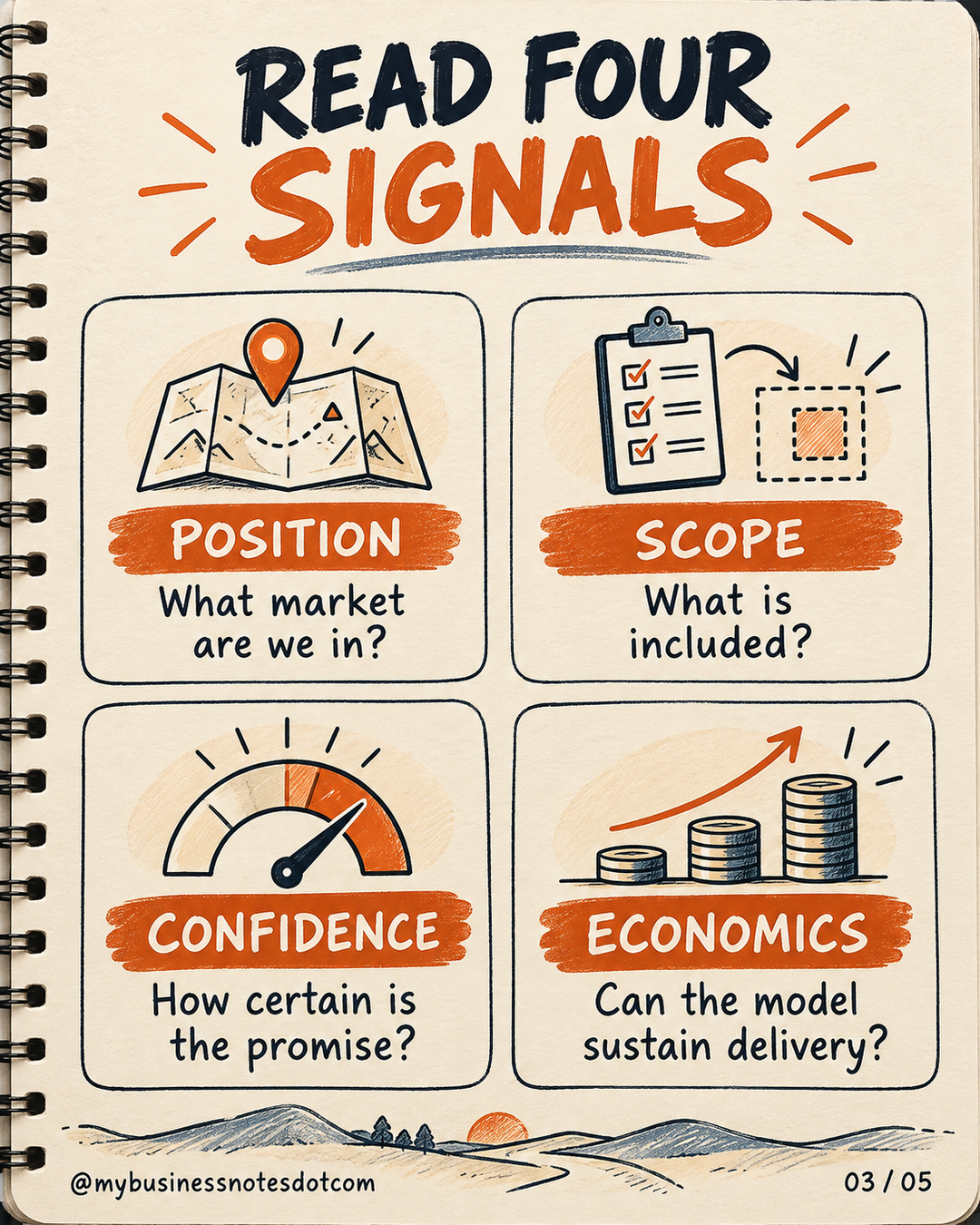
A pricing strategy connects what customers pay with the position, scope, evidence and delivery economics of an offer. Review those four elements together: a higher number alone does not create a stronger position or prove better quality.
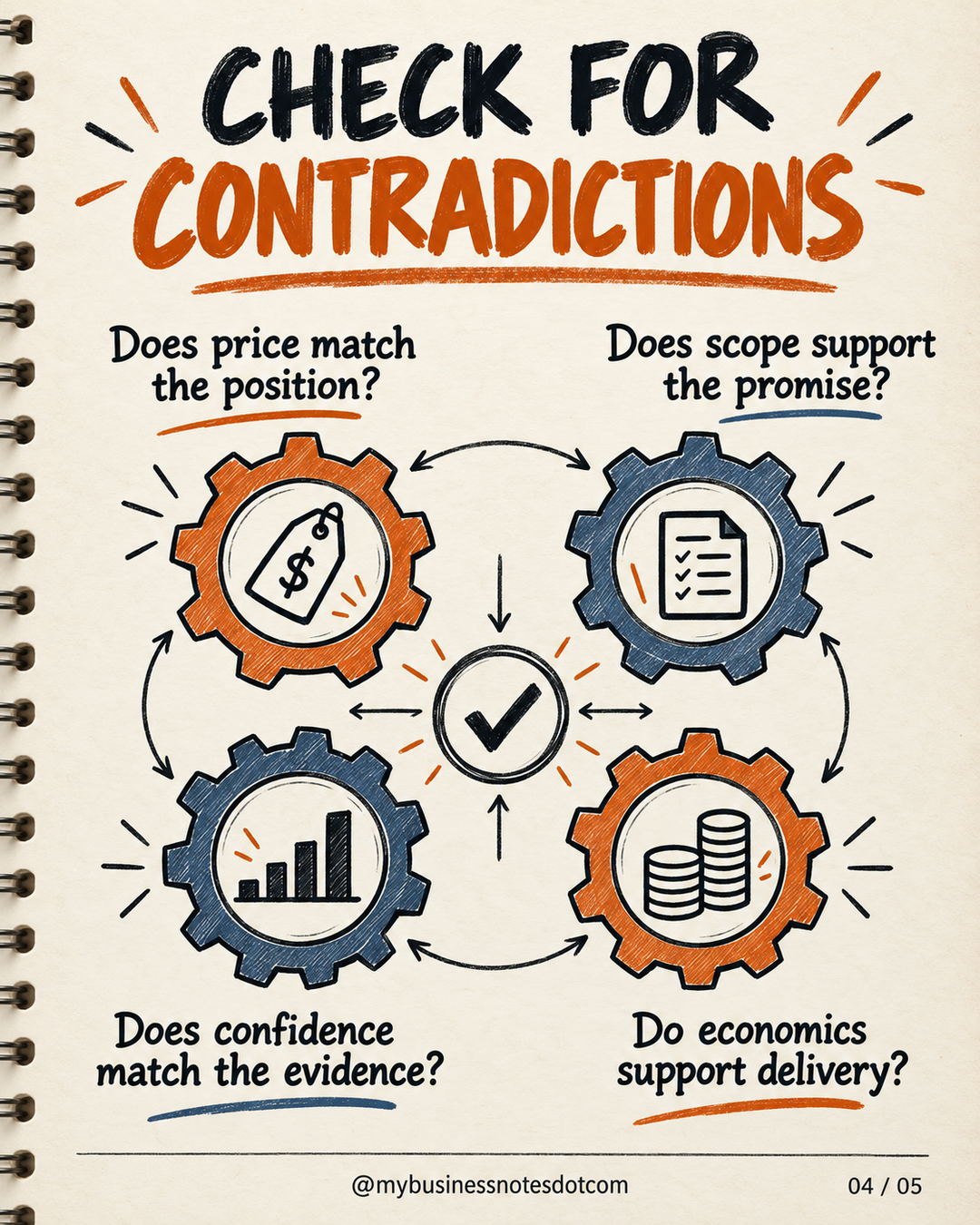
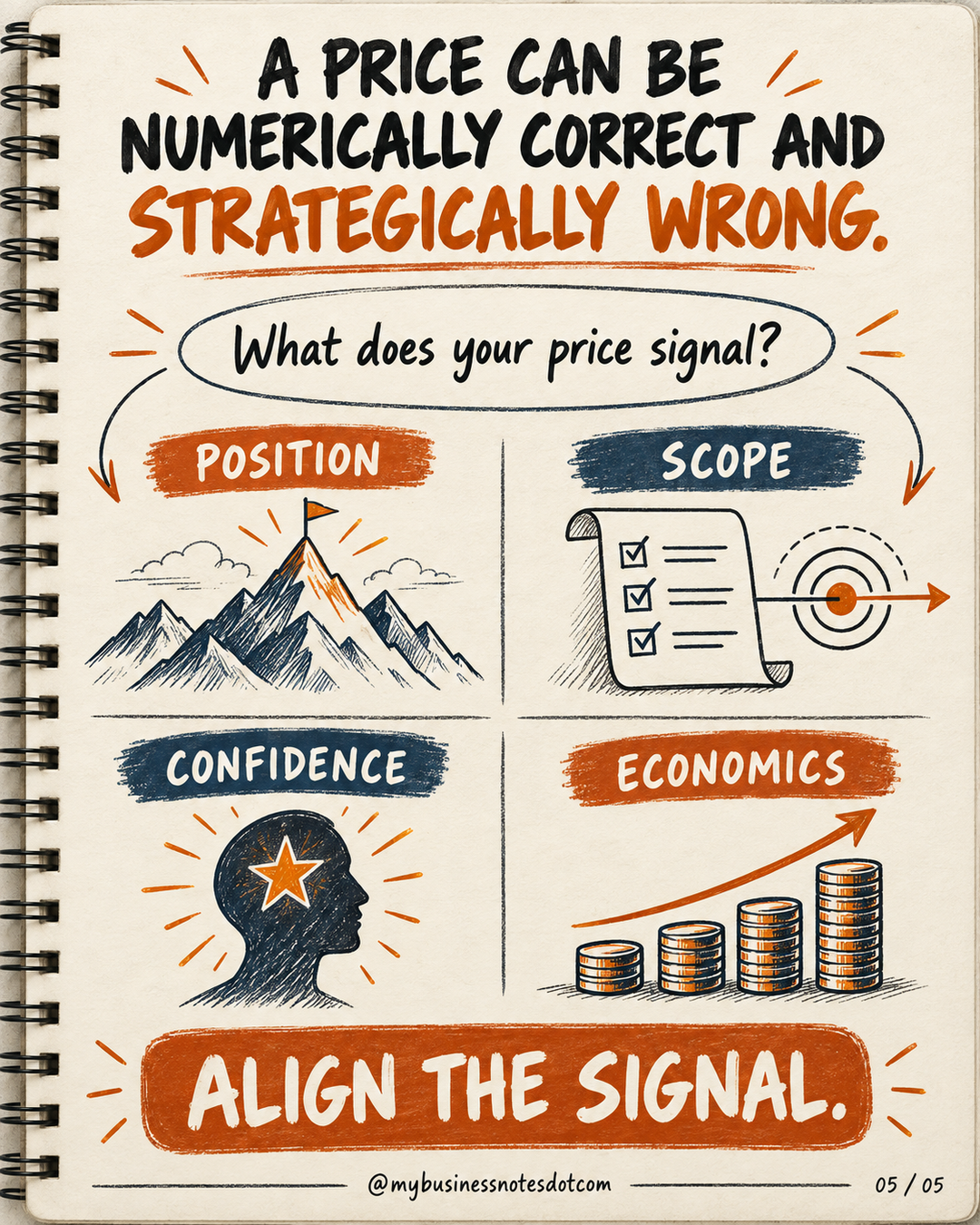
Slide 1 of 5
Why a price can be correct and still send the wrong signal
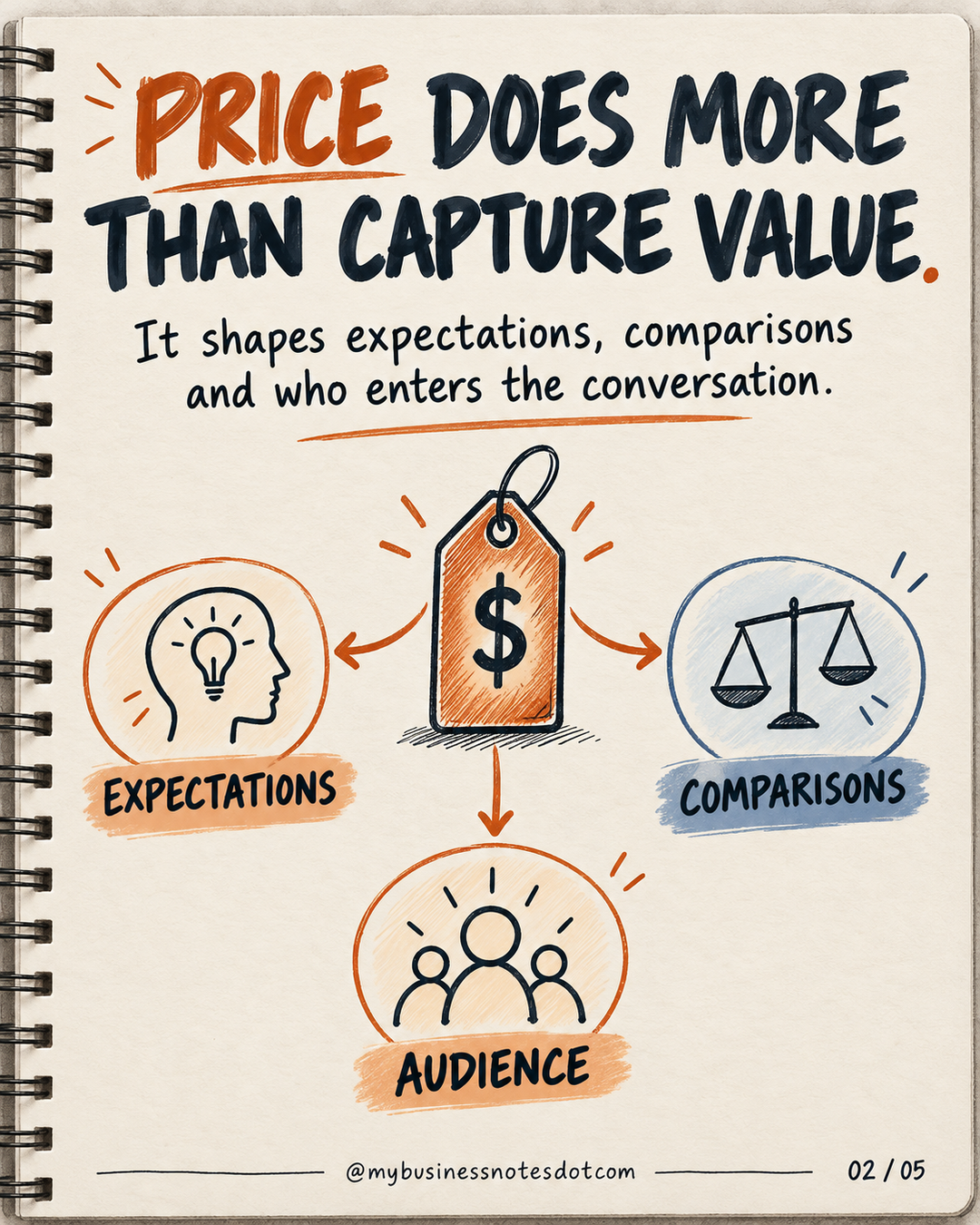
A calculation can cover costs while the offer remains hard to understand. A narrow service priced like a full engagement may create expectations it cannot meet. An extensive service sold cheaply may attract work that the delivery team cannot sustain.
Treat price as one part of the offer, not as a psychological shortcut. Harvard Business School's strategy guidance emphasizes distinctive activities and trade-offs. Apply that principle by checking whether your operating choices support the promise attached to the price.
Position: what comparison does the buyer make?
Identify the customer's real alternatives, including an internal solution or doing nothing. Do not assume the comparison is another supplier with the same job title. Jobs to Be Done focuses attention on the progress a person seeks in particular circumstances.
Ask what the buyer did last time and what the alternative required. GOV.UK's interview guidance recommends concrete stories and neutral questions. An answer helps you understand the comparison; it does not establish a market-wide willingness to pay.
Scope: what is the price actually buying?
Define outputs, responsibilities, timing, revisions and exclusions. Include the effort the customer must contribute. A lower-priced option can be coherent when it has a genuinely narrower job, rather than the same promises with hidden cuts.
For a hypothetical advisory service, a diagnostic workshop and an implementation engagement should not be compared as if they deliver the same change. State the boundary plainly so the buyer can decide which task needs to be done.
Confidence: what supports the promised outcome?
Replace vague premium claims with inspectable evidence. Show a realistic sample, a delivery method or a contextual result that supports the particular statement. Explain what it does not prove. A confident tone and a money-back promise do not replace substantiation.
The FTC's advertising guidance provides a US example of this evidence discipline. It is not a universal legal checklist. Check the rules relevant to your market, especially when publishing measurable performance or savings claims.
Economics: can you deliver this offer sustainably?
Map direct delivery costs, variable selling costs, expected rework and capacity. Keep contribution before fixed costs distinct from net profit. Then consider how the proposed price and demand would affect the whole operation.
Business Victoria's discount guidance warns that extra sales can come with reduced profit. Use your actual cost structure rather than assuming volume will compensate. This is general business planning, not a substitute for accounting advice on your specific figures.
Test the pricing strategy as a coherent offer
Write a one-page offer with one audience, clear scope, terms and a stated price. Use the Value Proposition Canvas to expose assumptions about jobs and benefits. Ask relevant buyers to explain what they think they would receive before collecting reactions to the number.
Avoid leading questions such as asking whether a premium offer deserves a premium price. Strategyzer distinguishes stated interest from behavior: a positive interview is not a purchase. Where appropriate, test a transparent, deliverable offer and observe qualified commitments.
Review fit, delivery effort and contribution alongside conversion. If one element is weak, change the underlying offer or its explanation before assuming that the number alone is the problem. The four-part review is an MBN working tool, not a validated pricing formula.
Frequently asked questions
What should a pricing strategy include?
Review customer alternatives, scope, supporting evidence and delivery economics. The right price depends on how those elements work together in the intended market.
Does a higher price prove better quality?
No. A price may shape expectations, but quality and results require appropriate evidence. Do not use the price itself to substantiate a performance promise.
Can customer interviews tell me the right price?
They can reveal comparisons, priorities and concerns. Statements about future purchases need further testing; they do not establish actual willingness to pay.
Download the complete carousel
Use the five-slide worksheet in your next working session.
Related reading: Turn learning into the next decision.
International references
- Business Victoria — Develop discount strategies
- Deepak Malhotra / Harvard Program on Negotiation — Four strategies for making concessions
- Harvard Business School ISC — Creating a Successful Strategy
- Strategyzer — Value Proposition Canvas
- Nabila Amarsy / Strategyzer — Ways to test your value proposition
- Alex Osterwalder / Strategyzer — Don’t believe your customers
- GOV.UK User research community — Using in-depth interviews
- Amy Schade / Nielsen Norman Group — Avoid leading questions
- Christensen Institute — Jobs to Be Done
- FTC — Advertising FAQs for small business