
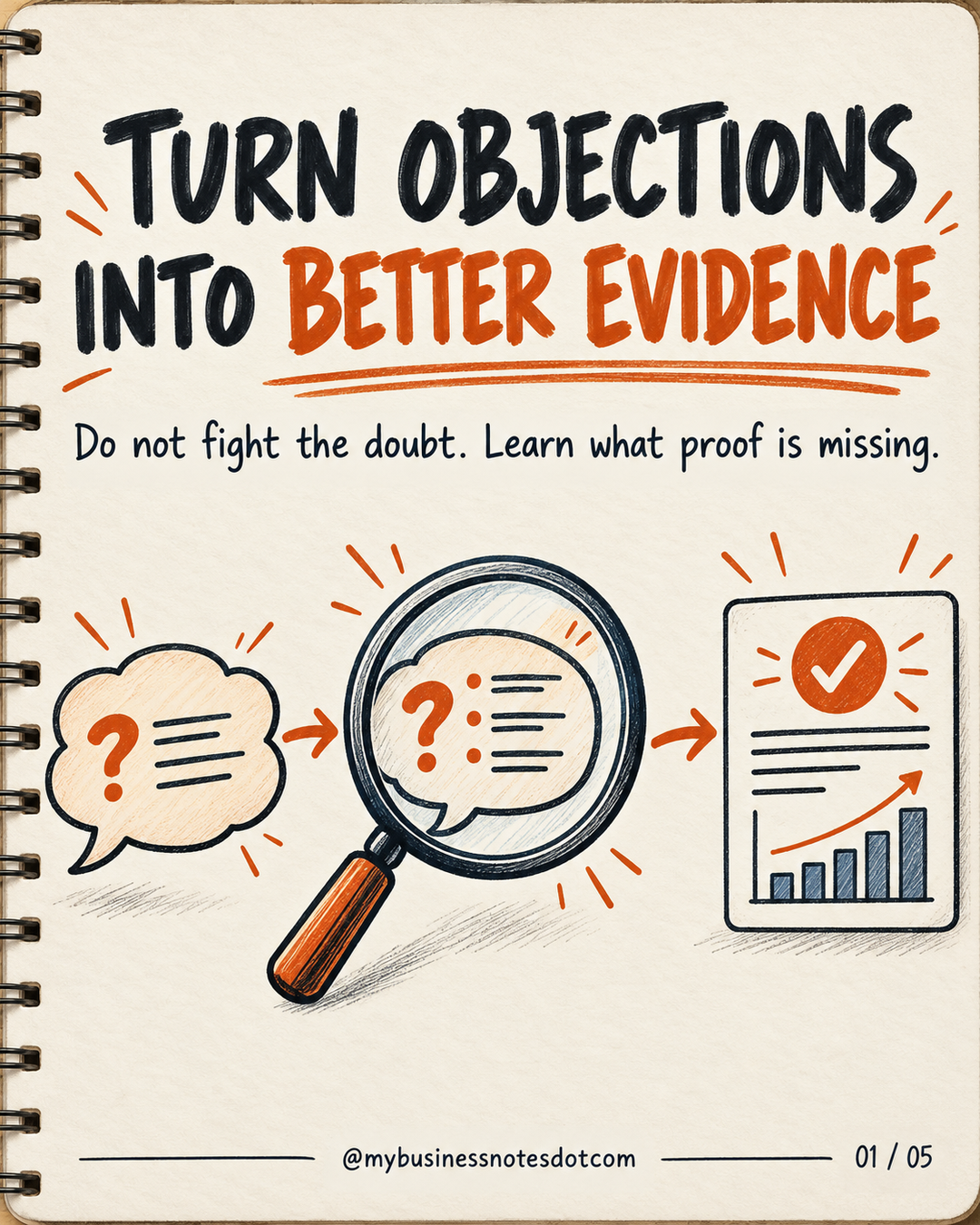
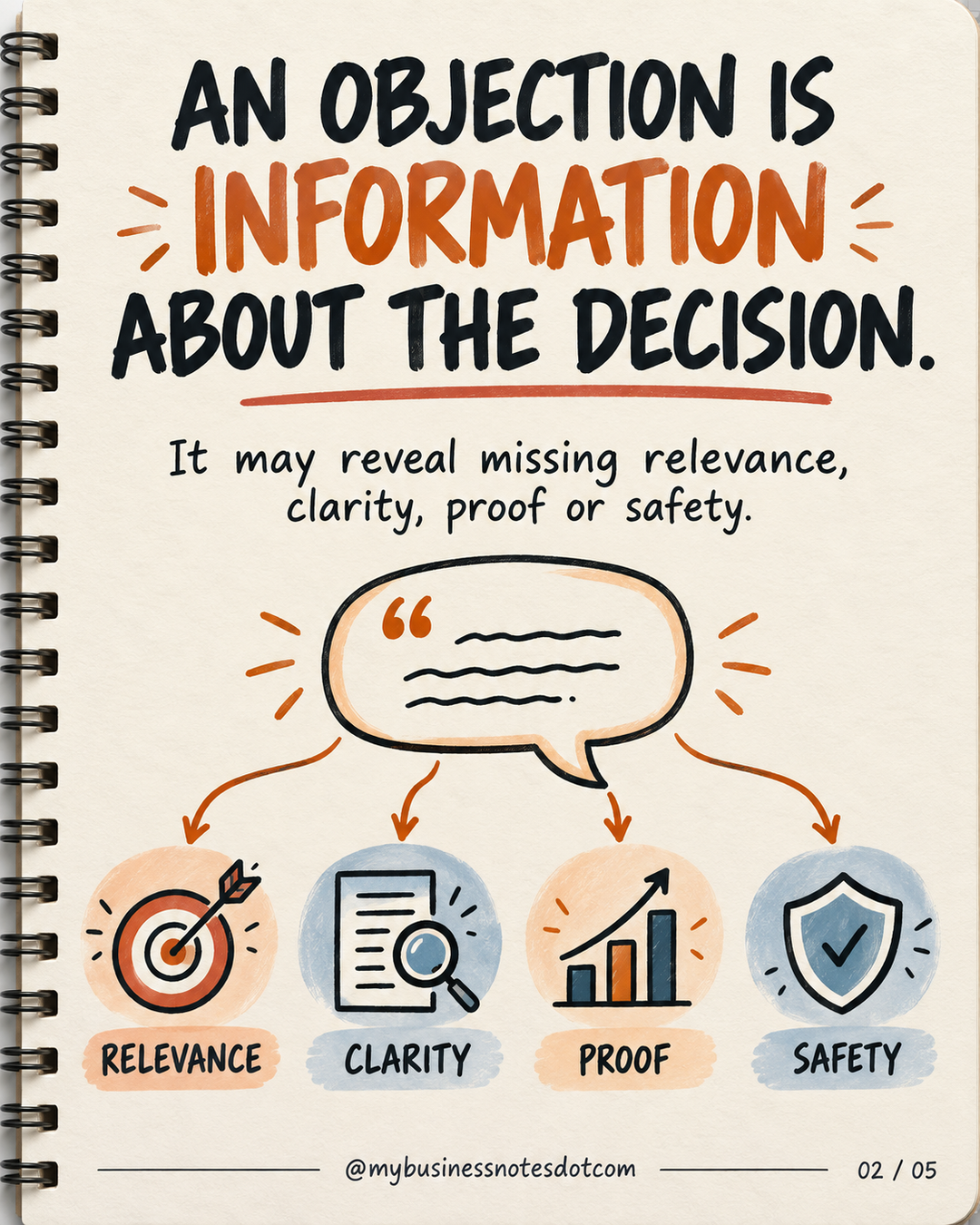
Sales objections are clues about unresolved relevance, clarity, proof or safety. Before preparing a rebuttal, establish what the buyer means and which evidence could help them make a responsible decision.
Slide 1 of 5
Why a rebuttal can miss the real concern
The phrase too expensive can describe several situations: insufficient value, an unavailable budget, a comparison with a narrower alternative or the risk of wasting money. One polished response cannot resolve all four.
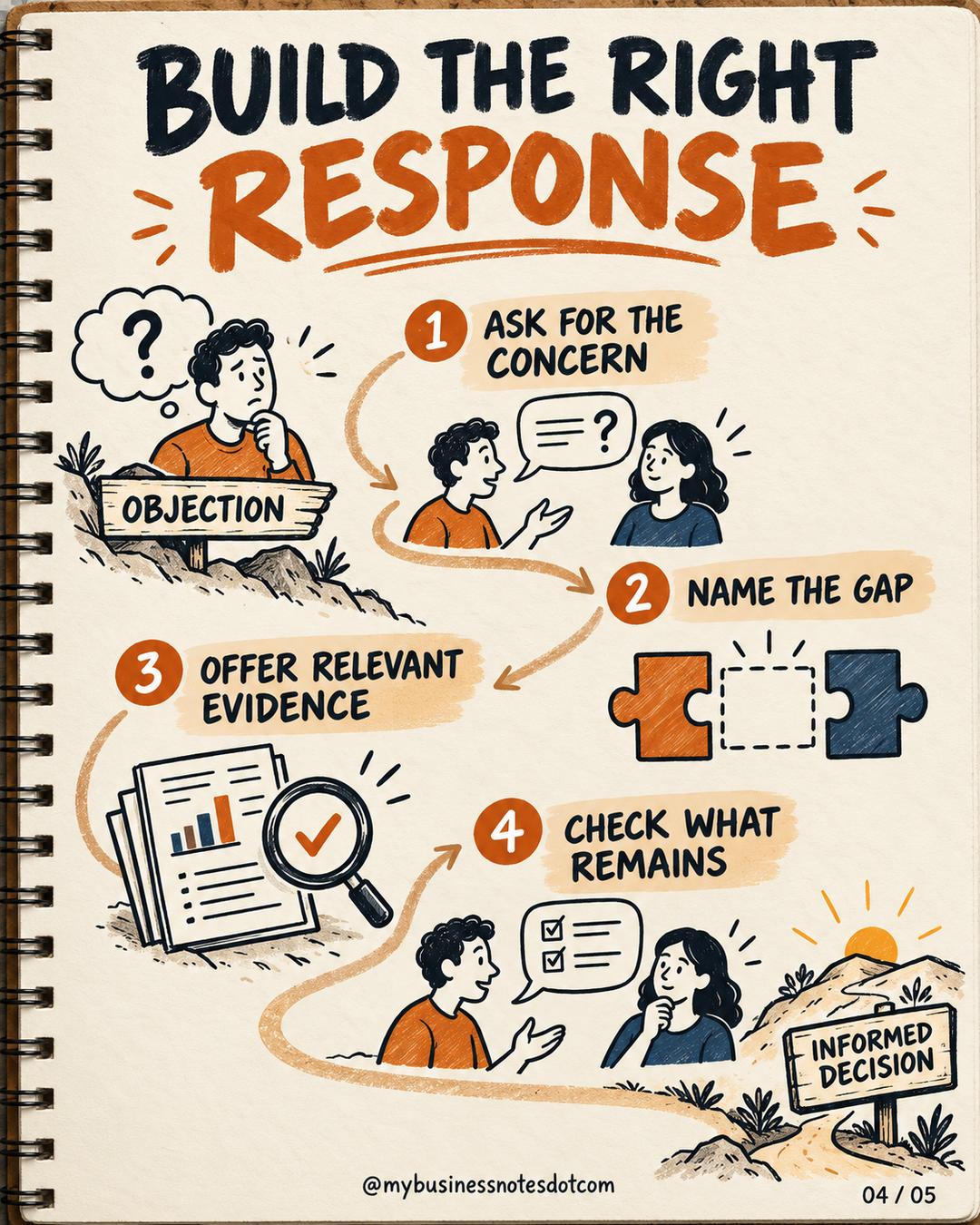
Begin with a neutral question about the concern. Ask what the buyer is comparing, which outcome matters and what would make the decision difficult internally. Avoid questions that assume agreement, such as asking whether a guarantee would remove all doubt.
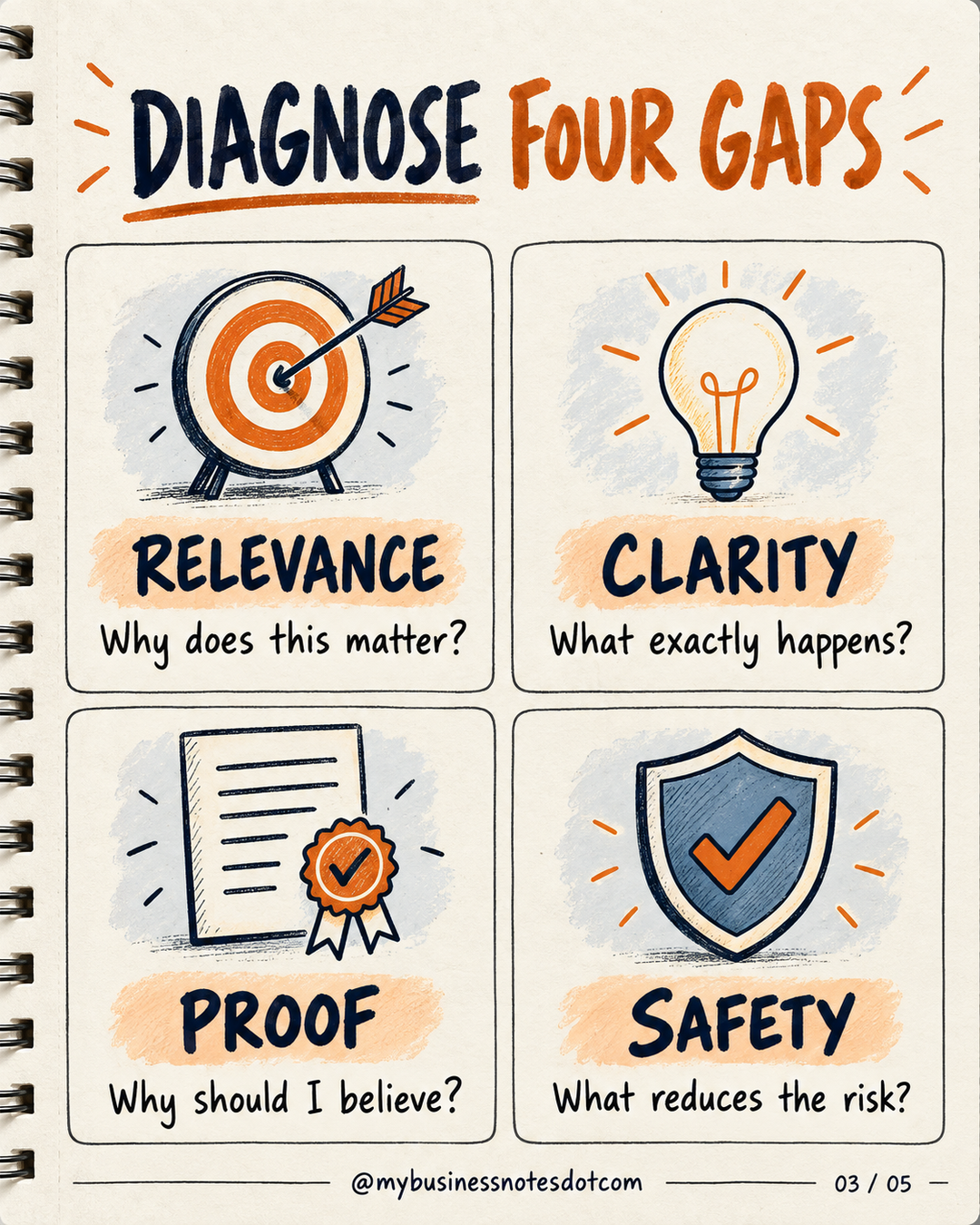
Relevance: is this the right problem to solve?
An offer can be credible and still address a low-priority problem. Explore the event that prompted the conversation and what the buyer is doing instead. Jobs to Be Done helps focus the discussion on sought progress in a specific circumstance.
Use the Value Proposition Canvas to capture your assumptions, then look for evidence against them. If the problem is not important enough to act on, stronger persuasion is not the appropriate response. Record the mismatch and reconsider the audience or offer.
Clarity: is the objection about an ambiguous offer?
Separate uncertainty about what is included from doubt about whether it works. Explain inputs, outputs, responsibilities and exclusions in language the buyer recognizes. A useful test is asking them to describe the proposed engagement in their own words.
Imagine a hypothetical reporting service where the buyer expects implementation but the provider sells recommendations. A scope diagram may resolve the misunderstanding. A testimonial would leave the mismatch intact and could make the eventual disappointment worse.
Proof: which claim needs support?
Ask which particular statement is difficult to believe. Then match evidence to that statement: a demonstration for a functional capability, a documented process for delivery or a contextual case record for a past result.
Do not use a satisfied customer's opinion as proof of an objectively measurable outcome. The FTC's US advertising guidance distinguishes claims from the evidence required to support them. Applicable rules vary, but the editorial discipline is useful: make the strength of the wording match the strength of the evidence.
Safety: what downside is the buyer evaluating?
The concern may involve switching costs, data access, team capacity or accountability if the project fails. Explain actual safeguards, decision points and responsibilities. Only offer a pilot, cancellation right or guarantee if you can honor its stated terms.
Trustworthy communication makes important conditions visible. Hiding limitations in a distant document does not improve the underlying offer. If a concern cannot be resolved, acknowledge it and allow the buyer to decline.
Build an objection-to-evidence review
Record the buyer's exact concern, situation, interpretation, response and subsequent behavior. Keep the original observation distinct from the team's explanation. GOV.UK's analysis method is helpful for this separation; neutral interviewing guidance reduces the risk of collecting convenient agreement.
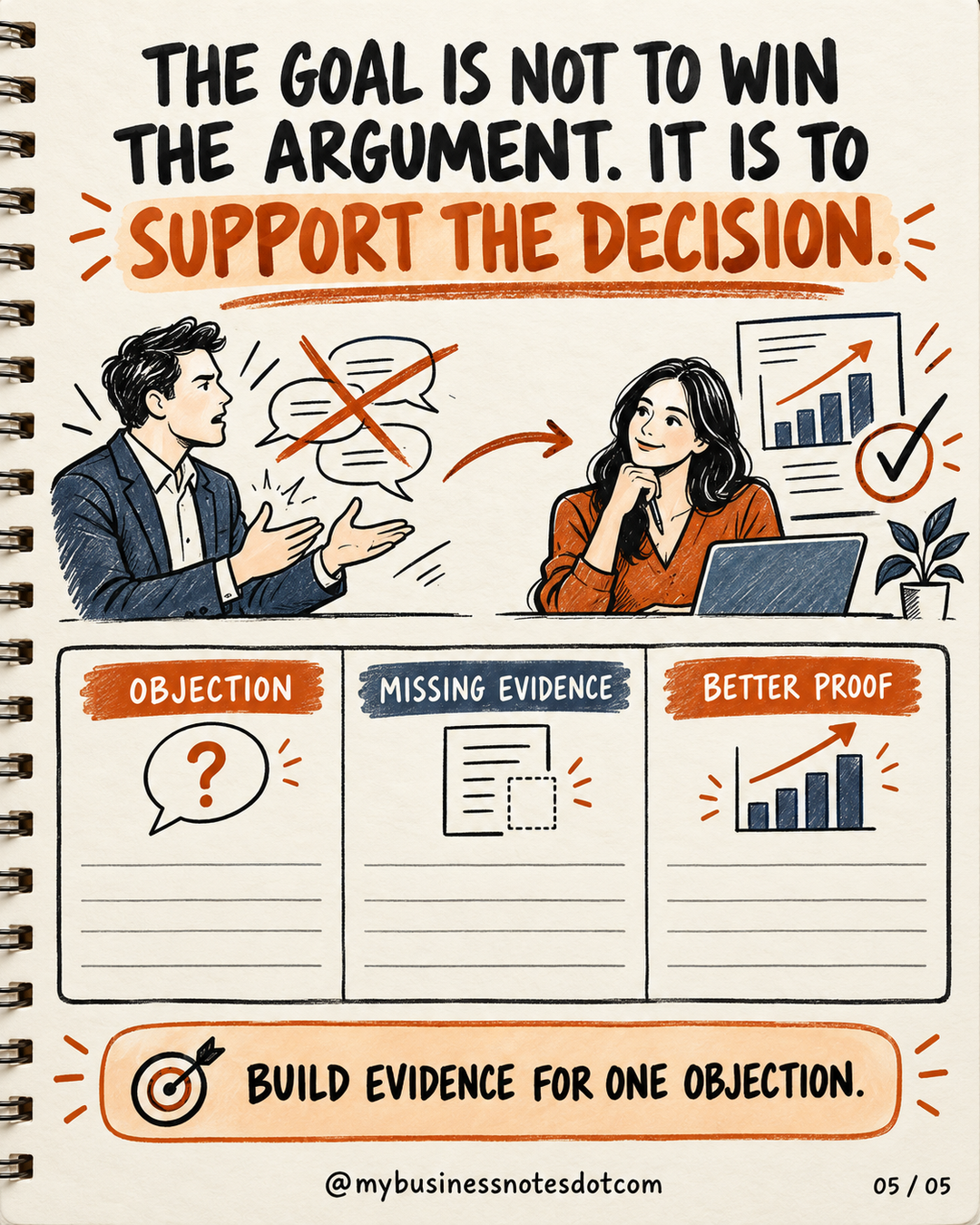
Review patterns by customer situation rather than treating every repeated phrase as the same problem. Select one unresolved question, prepare an appropriately bounded piece of evidence and test whether the buyer understands it.
A positive reaction is not the same as willingness to buy. Strategyzer's experimentation guidance distinguishes spoken interest from behavior. Track qualified next steps and fit, while respecting that an informed no can be a successful conversation.
Frequently asked questions
How should I respond to sales objections?
Clarify the concern neutrally, identify the unresolved question and provide evidence that addresses it. Do not assume every objection requires a rebuttal.
What if the buyer says the price is too high?
Explore the comparison, budget, expected outcome and perceived risk. A price objection alone does not identify which of those factors is responsible.
Can testimonials answer every objection?
No. Testimonials describe experiences or opinions. They do not replace a demonstration, clear scope or objective evidence for a measurable claim.
Download the complete carousel
Use the five-slide worksheet in your next working session.
Related reading: Turn learning into the next decision.
International references
- Strategyzer / Kurt Bostelaar — Customer interviews that produce insights
- Strategyzer / Alex Osterwalder — Don’t believe your customers
- Strategyzer / Nabila Amarsy — Ways to test your value proposition
- GOV.UK User research community — Using in-depth interviews
- Christensen Institute — Jobs to Be Done
- Nielsen Norman Group / Jakob Nielsen — Interviewing Users
- Nielsen Norman Group / Amy Schade — Avoid Leading Questions
- Strategyzer — Value Proposition Canvas
- Nielsen Norman Group / Kate Kaplan — Customer Journey Maps
- GOV.UK User research community — Analyse a research session
- Nielsen Norman Group / Aurora Harley — Trustworthy design
- FTC — Advertising substantiation policy
- FTC — Advertising FAQs for small business
- Nielsen Norman Group / Kate Moran — Technical jargon
- Strategyzer — Evidence strength