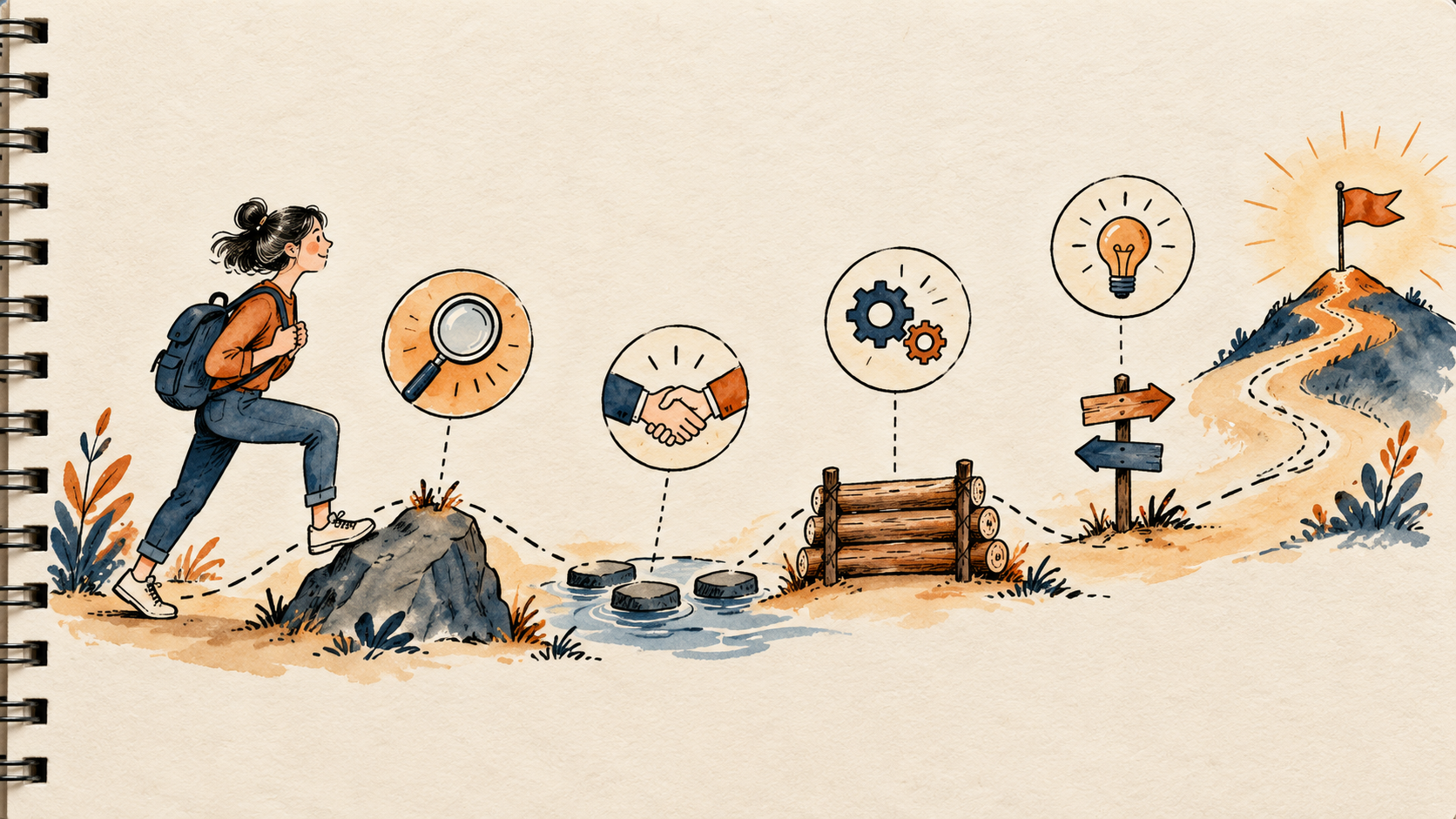
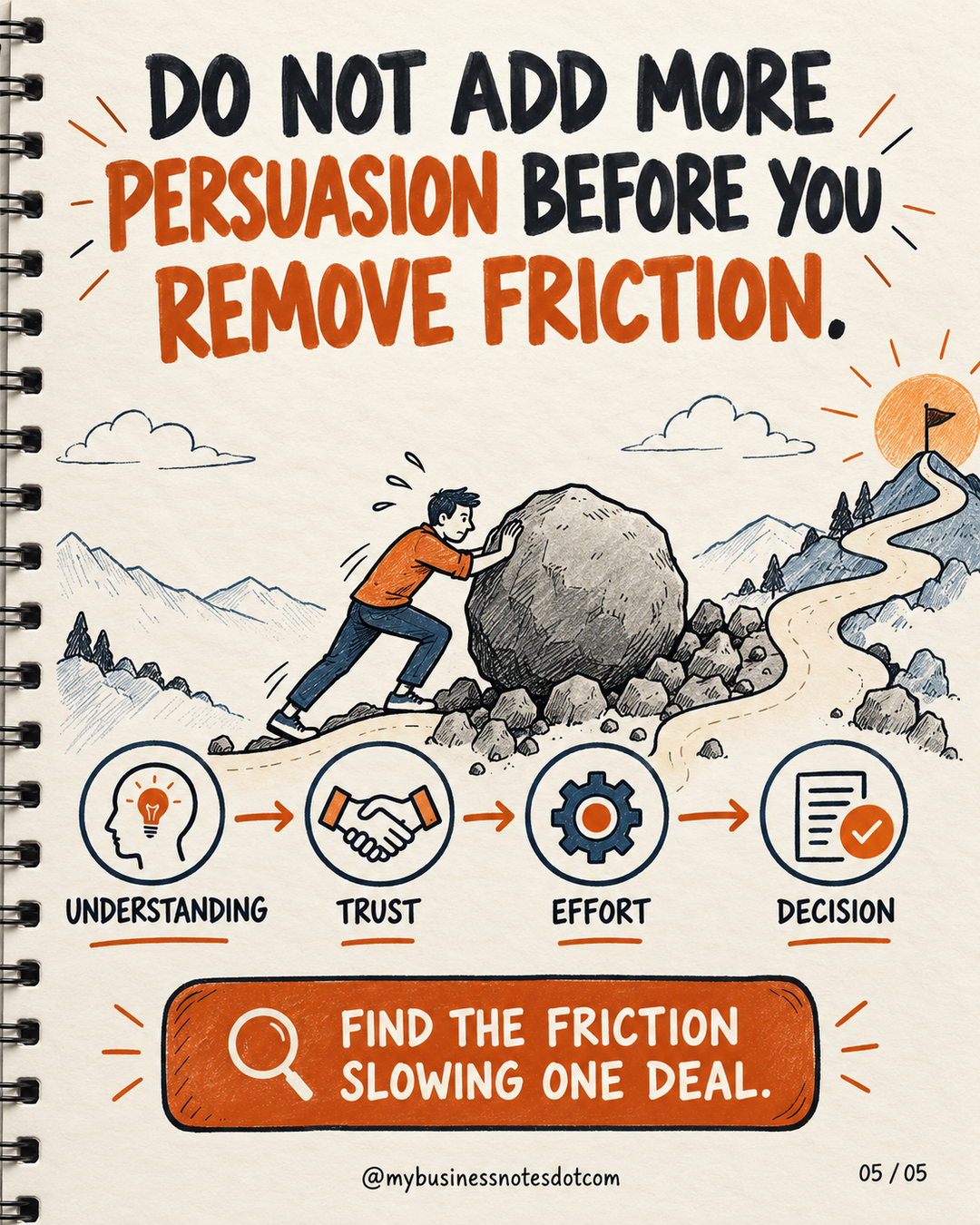
A commercial friction map identifies where a buyer struggles to understand, trust, adopt or decide on an offer. Start with evidence of a specific stalled step, then test the smallest change that could remove that obstacle.
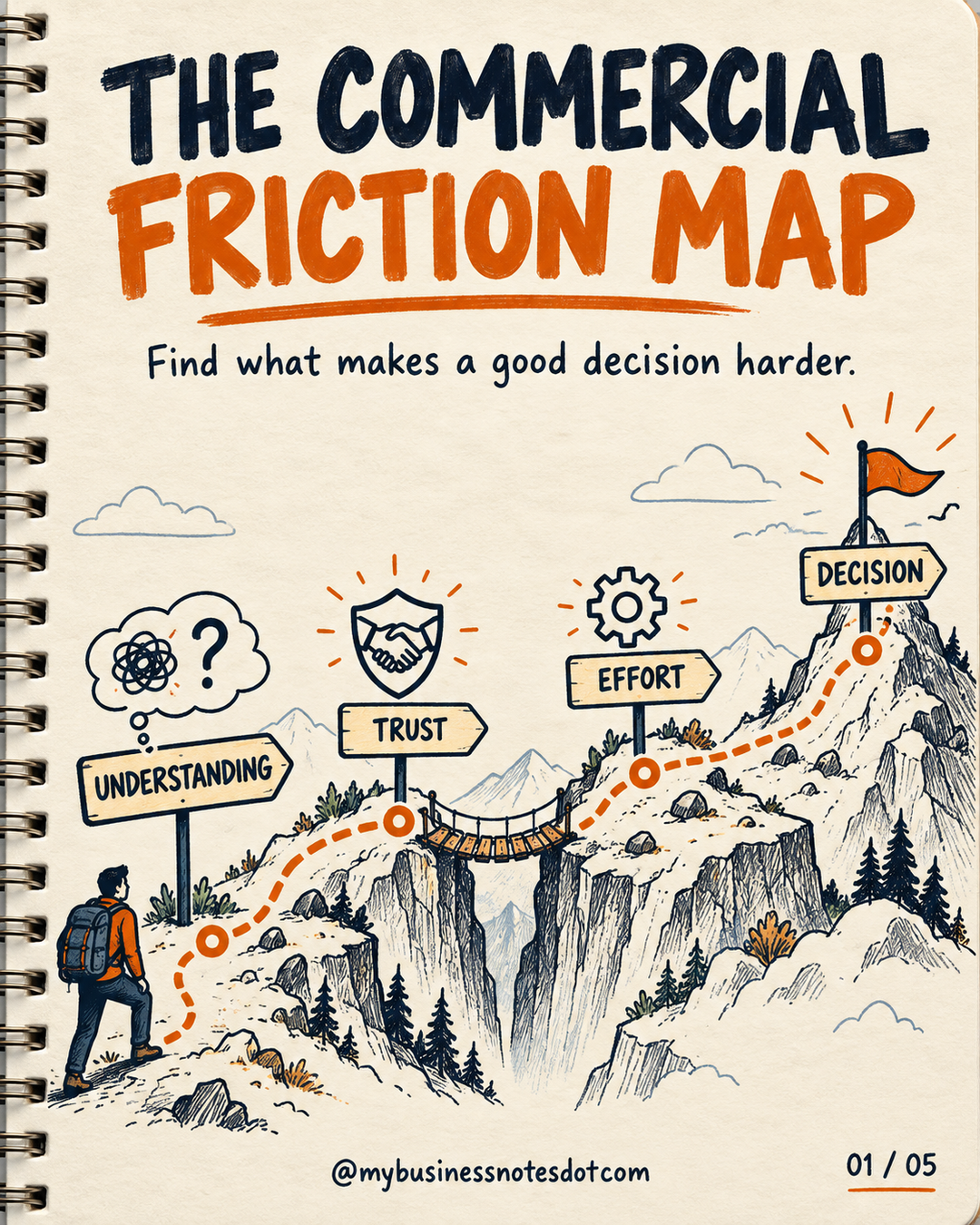
Slide 1 of 5
What does commercial friction look like?
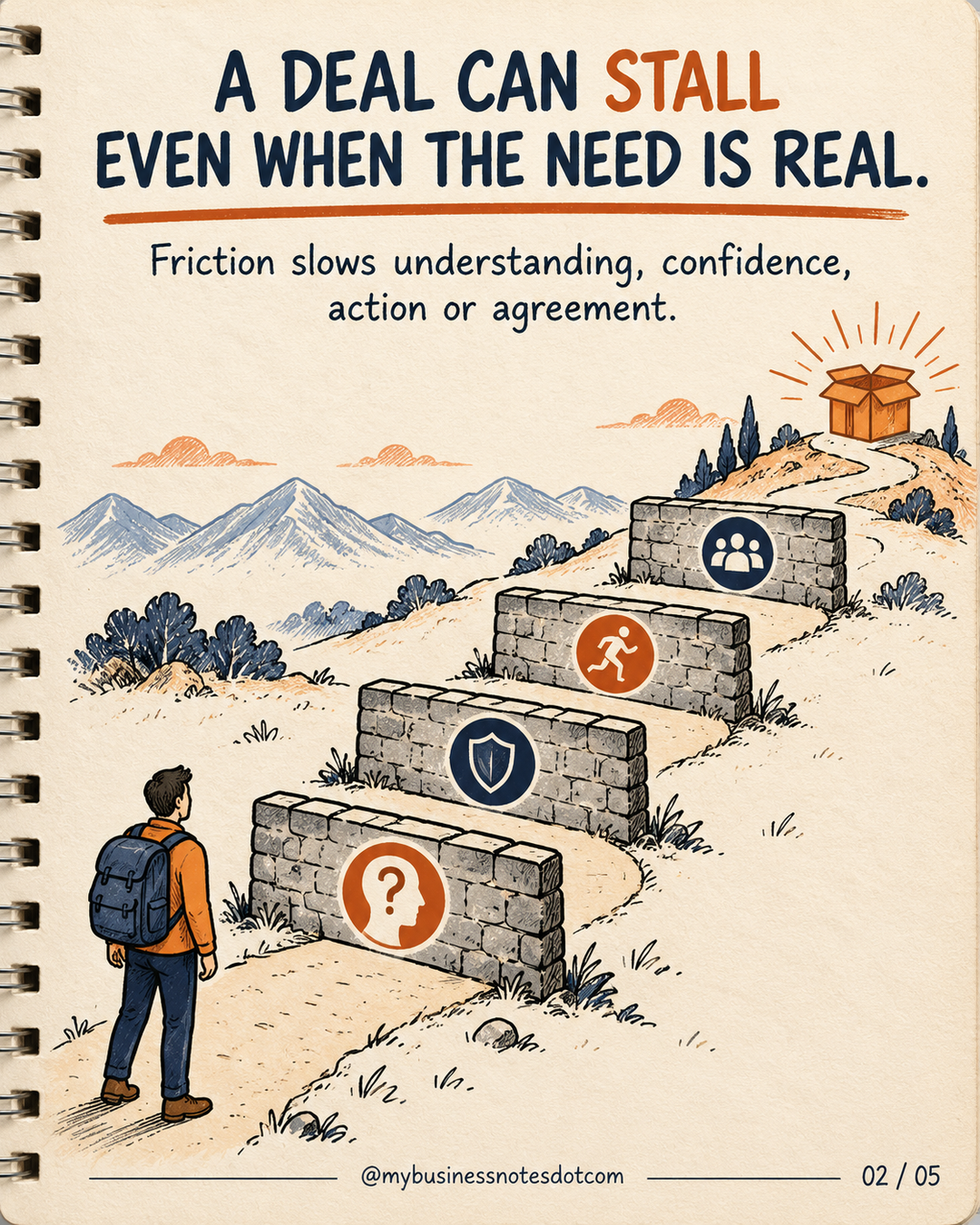
A proposal receives compliments but no next step. A product page gets visits but few qualified inquiries. A buyer asks the same question after several explanations. These are signals to investigate, not proof that your price or sales team is wrong.
Map one buying situation, one customer group and one stage. Mixing first-time visitors with procurement teams hides the differences you need to understand. Customer journey mapping offers a useful discipline: reconstruct the customer's actions and questions rather than drawing only your internal sales stages.
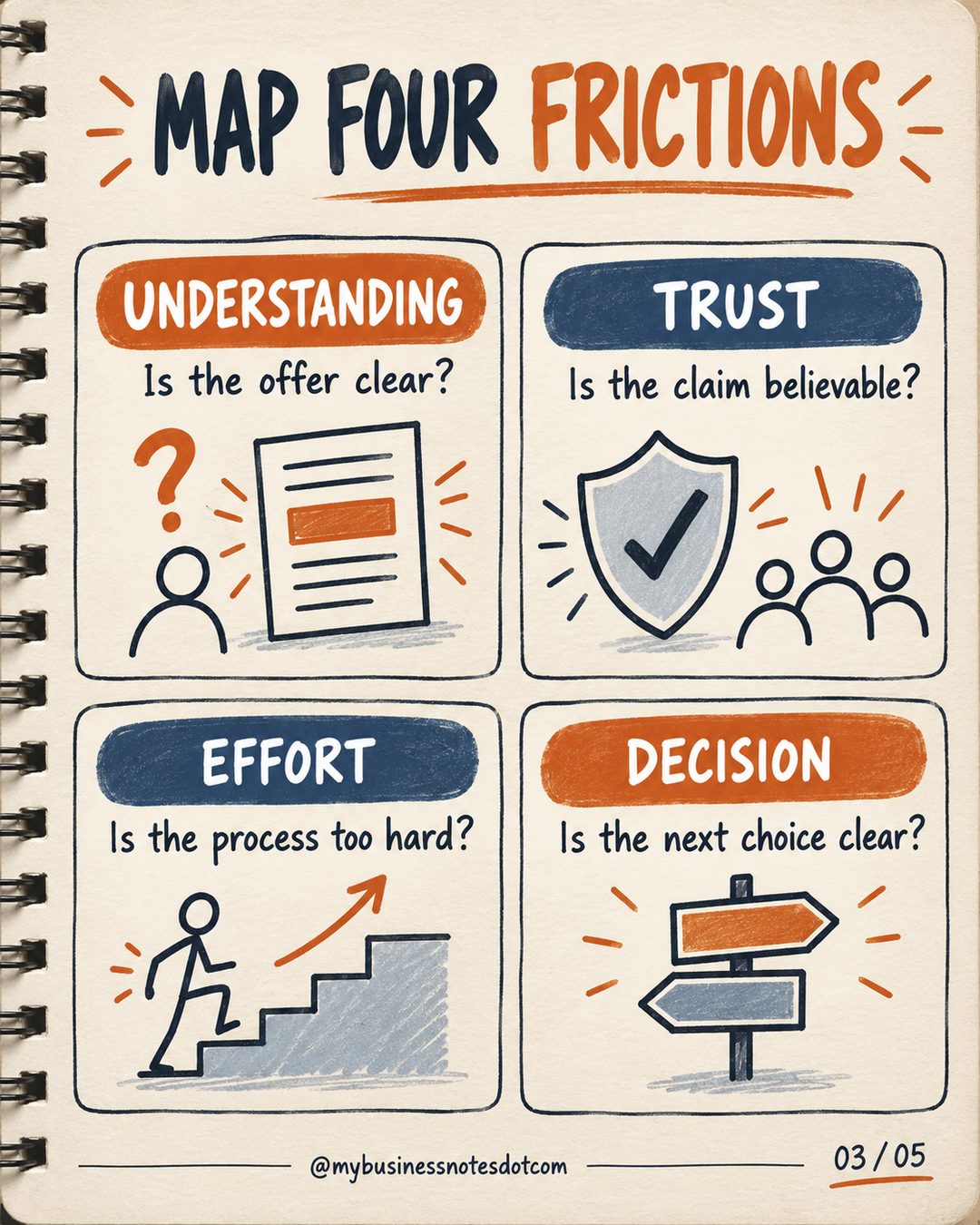
1. Understanding: can the buyer explain the change?
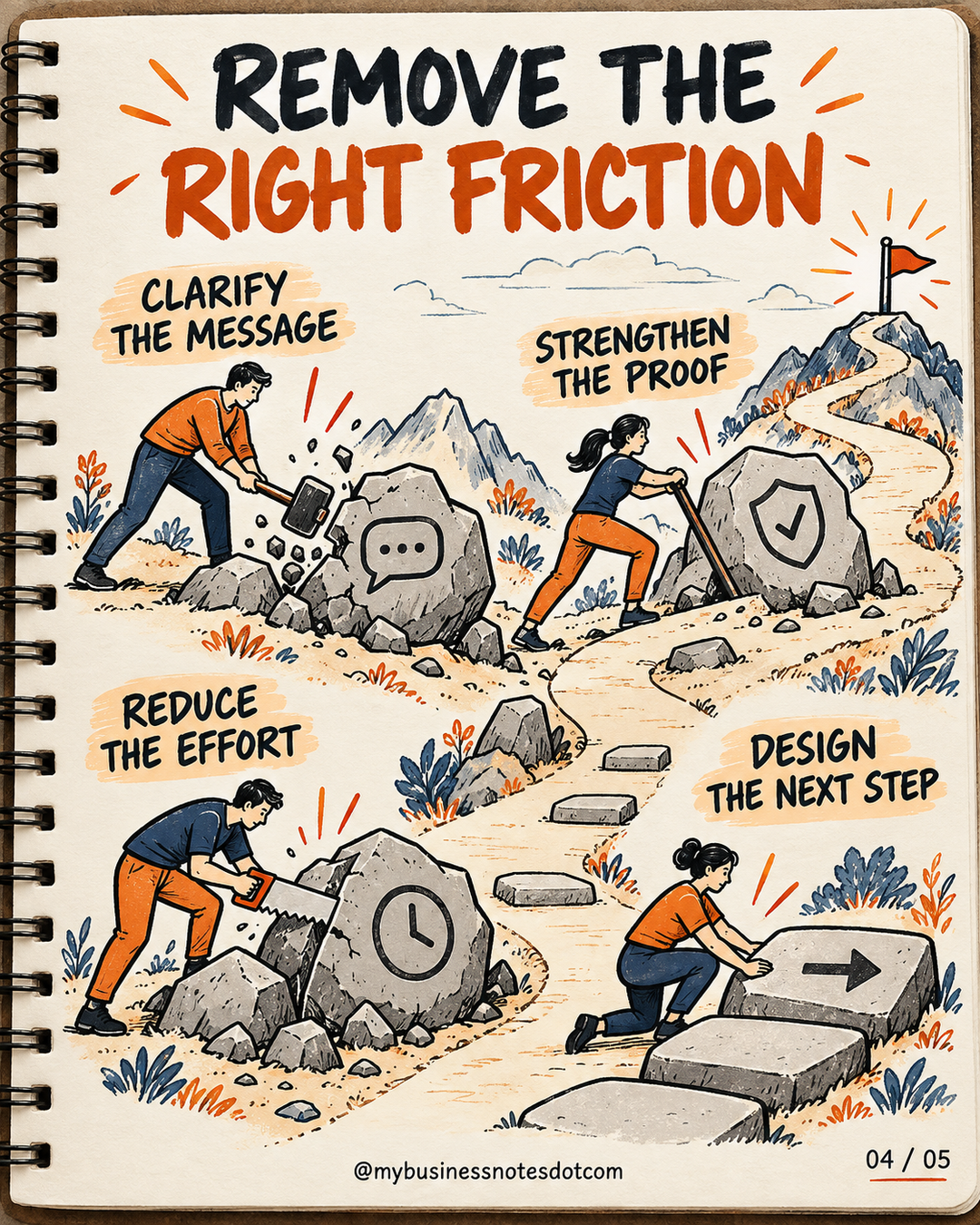
Ask a relevant person to describe what the offer does, who it serves and what would change after adoption. Listen before correcting them. Confusion about scope needs a clearer explanation; uncertainty about relevance may require a different offer.
The Value Proposition Canvas can organize jobs, pains and gains, but the completed canvas remains a hypothesis. Connect each statement to an actual circumstance. Jobs to Be Done is useful here because the progress someone seeks depends on the situation, not simply their demographic profile.
2. Trust: what remains unproven?
A polished page cannot establish that your particular promise is true. Separate doubts about competence, results, delivery and commercial terms. A sample output may answer a competence question; it cannot prove a guaranteed business outcome.
Nielsen Norman Group's research on trustworthy design highlights disclosure and current, complete information alongside presentation quality. Apply that guidance to make scope, conditions and evidence easier to inspect, not to decorate weak claims with badges.
3. Effort: what must the customer contribute?
List the work required before and after purchase: data preparation, team time, approvals, training and migration. Necessary effort should be explained honestly. Avoid moving it out of sight merely to improve an inquiry metric.
In a hypothetical consulting offer, buyers understand the result and believe the team, but cannot allocate staff to onboarding. Another case study will not solve that problem. A smaller initial scope or a clearer preparation checklist might. Test whether that actually makes the next step feasible.
4. Decision: what would enable a responsible next step?
Identify the approver, evaluation criteria, alternatives and timing constraints. A delayed decision may be reasonable. The objective is an informed choice, including a no, rather than overcoming every hesitation.
Ask about the last comparable purchase rather than whether someone would buy someday. Interview accounts can reveal uncertainty, but recall and politeness limit them. Compare what people say with observed behavior and relevant transaction records.
How to run a commercial friction map review
Create four columns: observed signal, possible barrier, evidence needed and next test. Keep observation separate from interpretation, following GOV.UK's research analysis guidance. Assign an owner and a review date to one priority obstacle.
For example, test a scope explanation with relevant buyers before redesigning the whole funnel. Check comprehension and qualified progression, and watch for poorer fit or increased support demands. A movement in conversion alone does not establish the cause.
This four-part map is an MBN working tool, not a validated diagnostic scale. Use it to make questions more precise. Its value depends on what you observe and change, not on giving every column a confident score.
Frequently asked questions
What is a commercial friction map?
It is a practical map of understanding, trust, effort and decision obstacles in a specific buying situation. It helps a team choose what to investigate and test.
Should every buying obstacle be removed?
No. Eligibility checks, informed consent and realistic preparation can protect both sides. Remove avoidable confusion without concealing necessary effort or risk.
Which barrier should we address first?
Start with a repeated obstacle supported by relevant observations and linked to a meaningful customer step. Treat the explanation as a hypothesis until tested.
Download the complete carousel
Use the five-slide worksheet in your next working session.
Related reading: Turn learning into the next decision.
International references
- Strategyzer / Kurt Bostelaar — Customer interviews that produce insights
- Strategyzer / Alex Osterwalder — Don’t believe your customers
- Strategyzer / Nabila Amarsy — Ways to test your value proposition
- GOV.UK User research community — Using in-depth interviews
- Christensen Institute — Jobs to Be Done
- Nielsen Norman Group / Jakob Nielsen — Interviewing Users
- Nielsen Norman Group / Amy Schade — Avoid Leading Questions
- Strategyzer — Value Proposition Canvas
- Nielsen Norman Group / Kate Kaplan — Customer Journey Maps
- GOV.UK User research community — Analyse a research session
- Nielsen Norman Group / Aurora Harley — Trustworthy design
- FTC — Advertising substantiation policy
- FTC — Advertising FAQs for small business
- Nielsen Norman Group / Kate Moran — Technical jargon
- Strategyzer — Evidence strength