

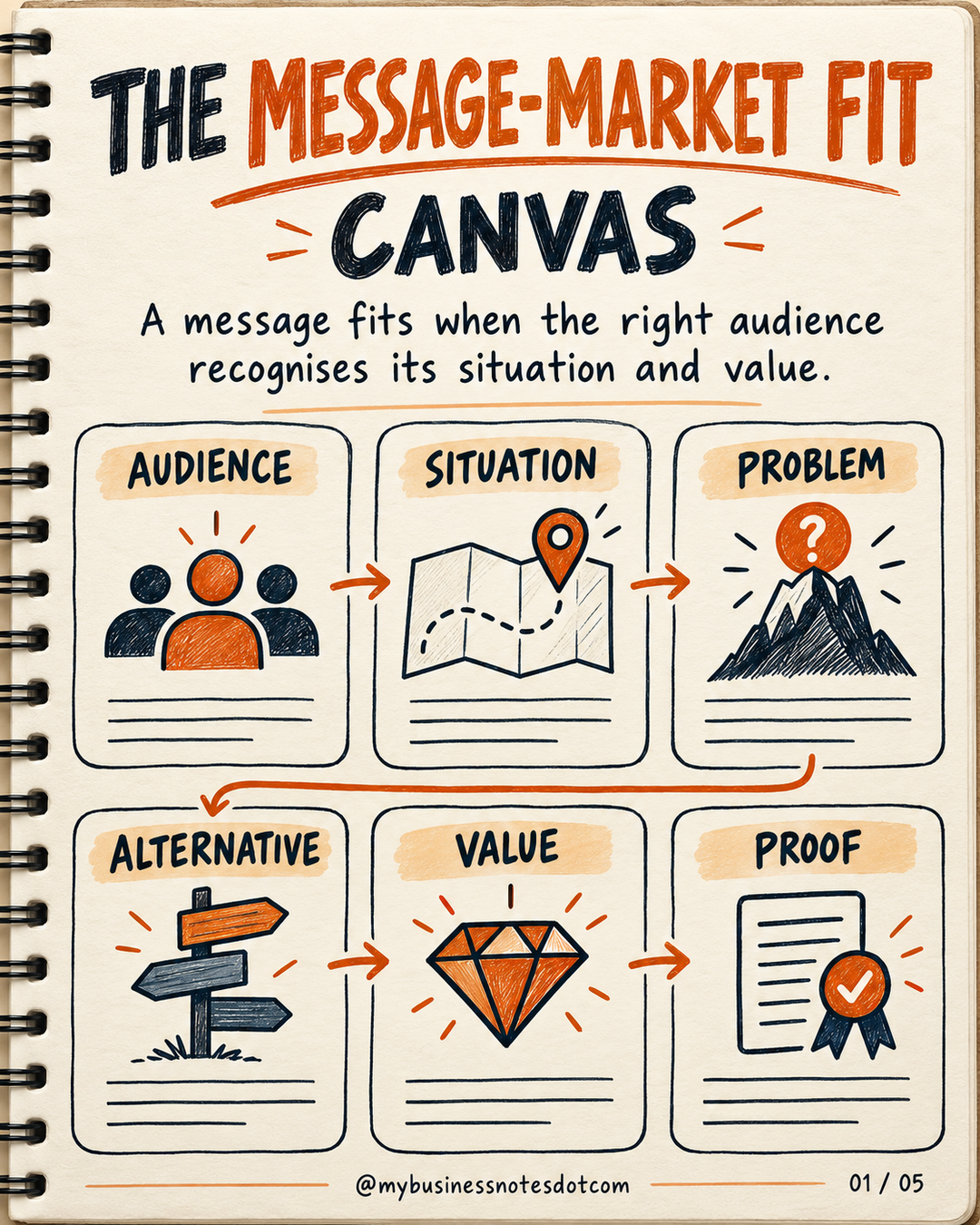
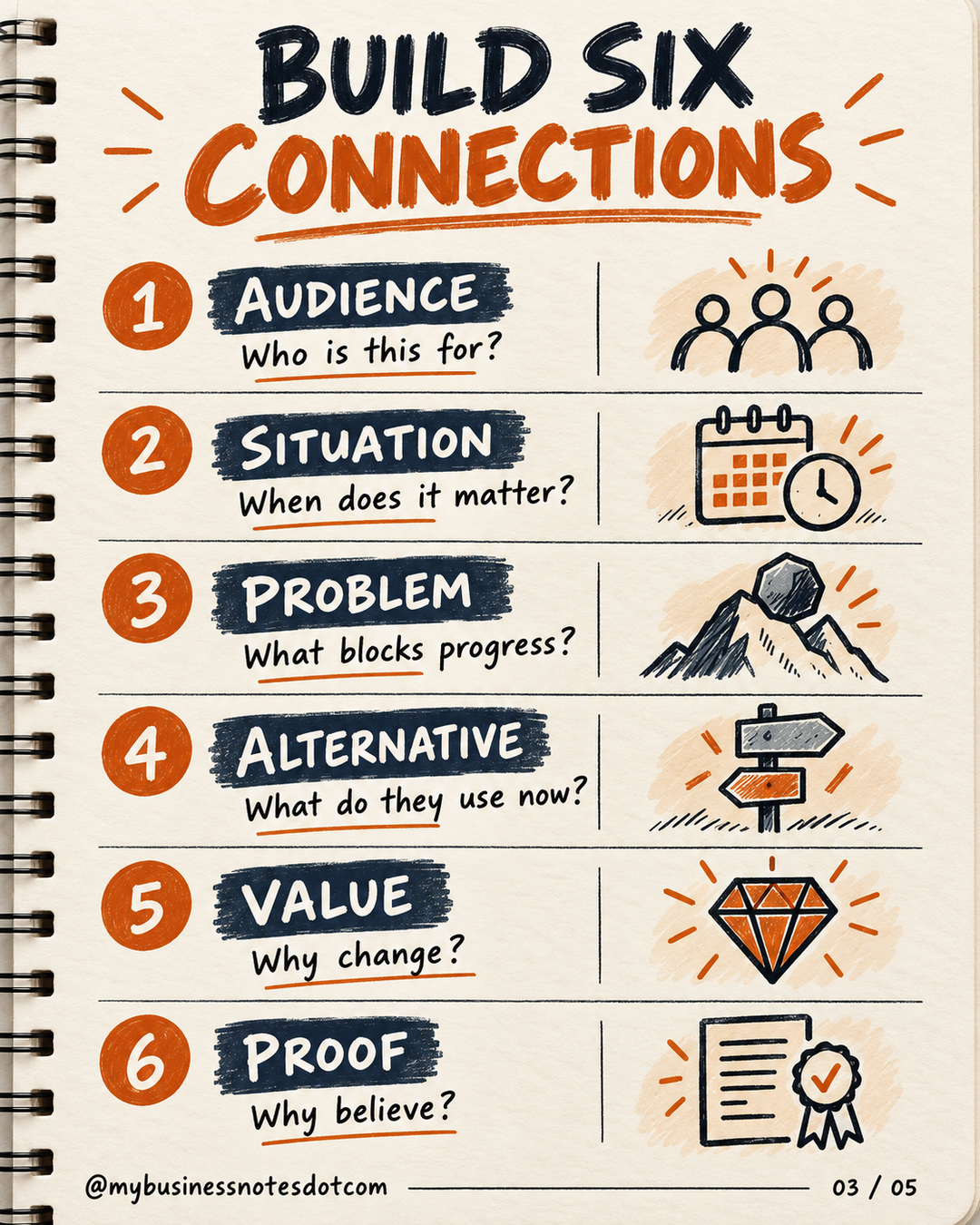
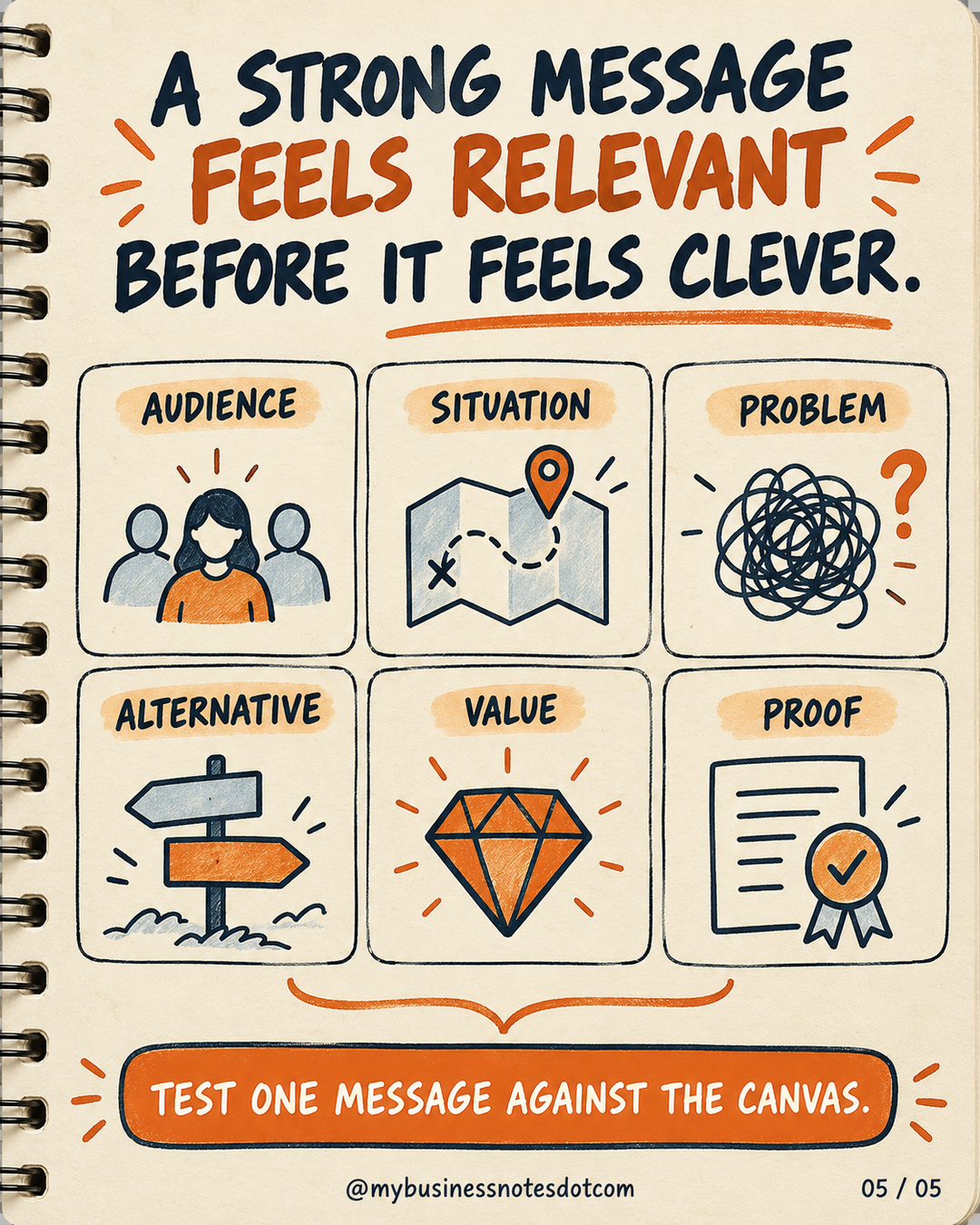
Message-market fit means that a message makes a relevant offer understandable and meaningful to a specific audience in a specific situation. Use six connected prompts—audience, situation, problem, alternative, value and proof—to form a testable message, not a claim that the market has already validated it.

Slide 1 of 5
Start with the decision the message supports
A message for someone first recognizing a problem serves a different task from a proposal for someone choosing a supplier. Define the reader, the situation and the useful next step before polishing headlines. Otherwise, several attractive sentences may compete to answer different questions.
The MBN canvas is an editorial tool. It does not replace customer research, positioning or an offer that works. A better sentence cannot compensate for a product that does not solve the problem it promises to address.
Connect audience, situation and problem
Describe who faces the situation, what changed and what consequence matters. Use language from relevant research without copying an isolated quote as if it represented the entire market. Neutral interviews can help, provided their limits are acknowledged.
A vague audience such as ‘business leaders’ may hide incompatible needs. Narrow the first test to a situation you can recognize. That makes it easier to learn whether the message is clear, whether the problem matters and whether the offer is relevant.
Name the alternative before claiming value
What would the person do instead? Continuing with a spreadsheet, hiring someone or postponing the decision may be more relevant than buying a named rival. Jobs to Be Done helps examine the progress sought in those circumstances.
Relate your value to that comparison. The Value Proposition Canvas distinguishes customer jobs, pains and gains from what an offer provides. Treat the match as a hypothesis until customer evidence supports it, rather than equating a completed canvas with market fit.
Make proof answer the specific claim
A broad testimonial may not support a precise claim about implementation time. Choose evidence that matches the statement and disclose relevant conditions. Use an authorized example, a clear demonstration or a transparent process explanation when those are appropriate.
Do not invent numbers or imply that one customer outcome is typical. Strategyzer’s distinction between verbal response and customer action helps keep proof proportional. A friendly reaction to a headline is useful feedback, not evidence of willingness to buy.
Example: replacing a vague growth promise
Imagine a provider saying, ‘Unlock exceptional growth with our innovative platform.’ It tests a more concrete explanation of a defined handover problem, who it serves, how it differs from the current workaround and what the customer will see in a demonstration. This is an illustrative scenario, not a reported conversion improvement.
The team first checks what relevant readers think the offer does. It then examines qualified next steps and the questions people ask. More clicks from irrelevant visitors would not establish better message-market fit.
Test one uncertainty at a time
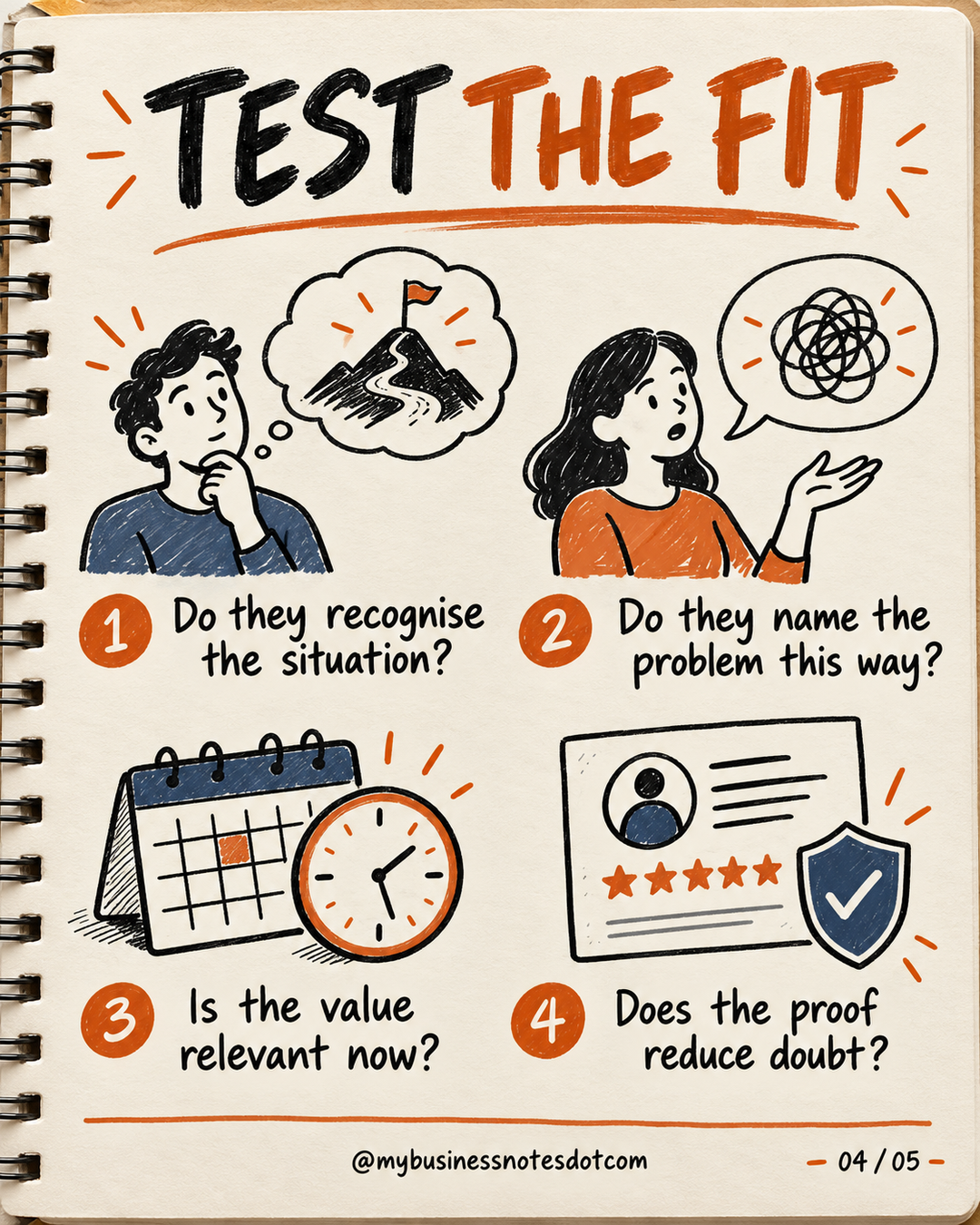
Separate comprehension from persuasion. Ask people to explain the offer in their own words before asking whether it sounds attractive. Leading questions can train participants to agree, as Nielsen Norman Group explains.
When running a behavioural comparison, define the audience, exposure conditions, success measure and quality guardrail in advance. Do not attribute a change to wording if several other factors changed simultaneously. Keep the message connected to what the business can substantiate and deliver; that is more useful than optimizing a headline in isolation.
Frequently asked questions
Is message-market fit the same as product-market fit?
No. A message can be understood while the offer remains unsuitable. Messaging tests do not establish sustained product demand.
Should clicks be the main success measure?
Not alone. Check relevant comprehension, qualified actions and downstream outcomes appropriate to the message’s purpose.
Can one message serve every audience?
Sometimes, but different situations may require different context and proof. Test the relevant distinctions rather than assuming universal fit.
Download the complete carousel
Use the five-slide worksheet in your next working session.
Related reading: Turn learning into the next decision.
International references
- Strategyzer / Kurt Bostelaar — Customer interviews that produce insights
- Strategyzer / Nabila Amarsy — Ways to test your value proposition
- Strategyzer / Nabila Amarsy — Roadmap to test your value proposition
- Strategyzer / Alex Osterwalder — Start with critical hypotheses
- Christensen Institute — Jobs to Be Done
- Strategyzer — Value Proposition Canvas
- Harvard Business School ISC — Creating a Successful Strategy
- Harvard Business School ISC — Fit Across the Value Chain
- Atlassian — Project Trade-Off Analysis
- April Dunford — Market category as context
- April Dunford — Positioning in the Age of AI