
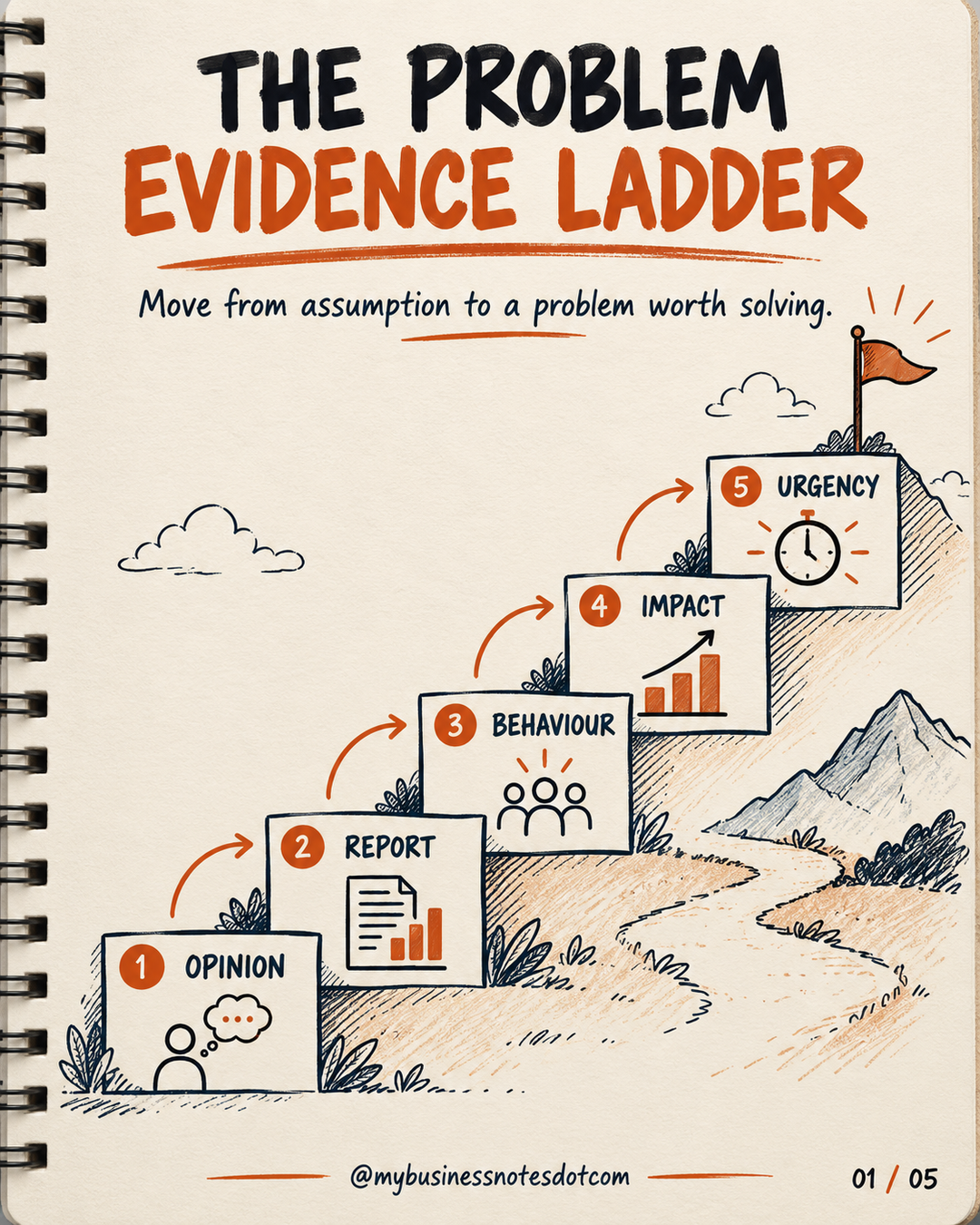
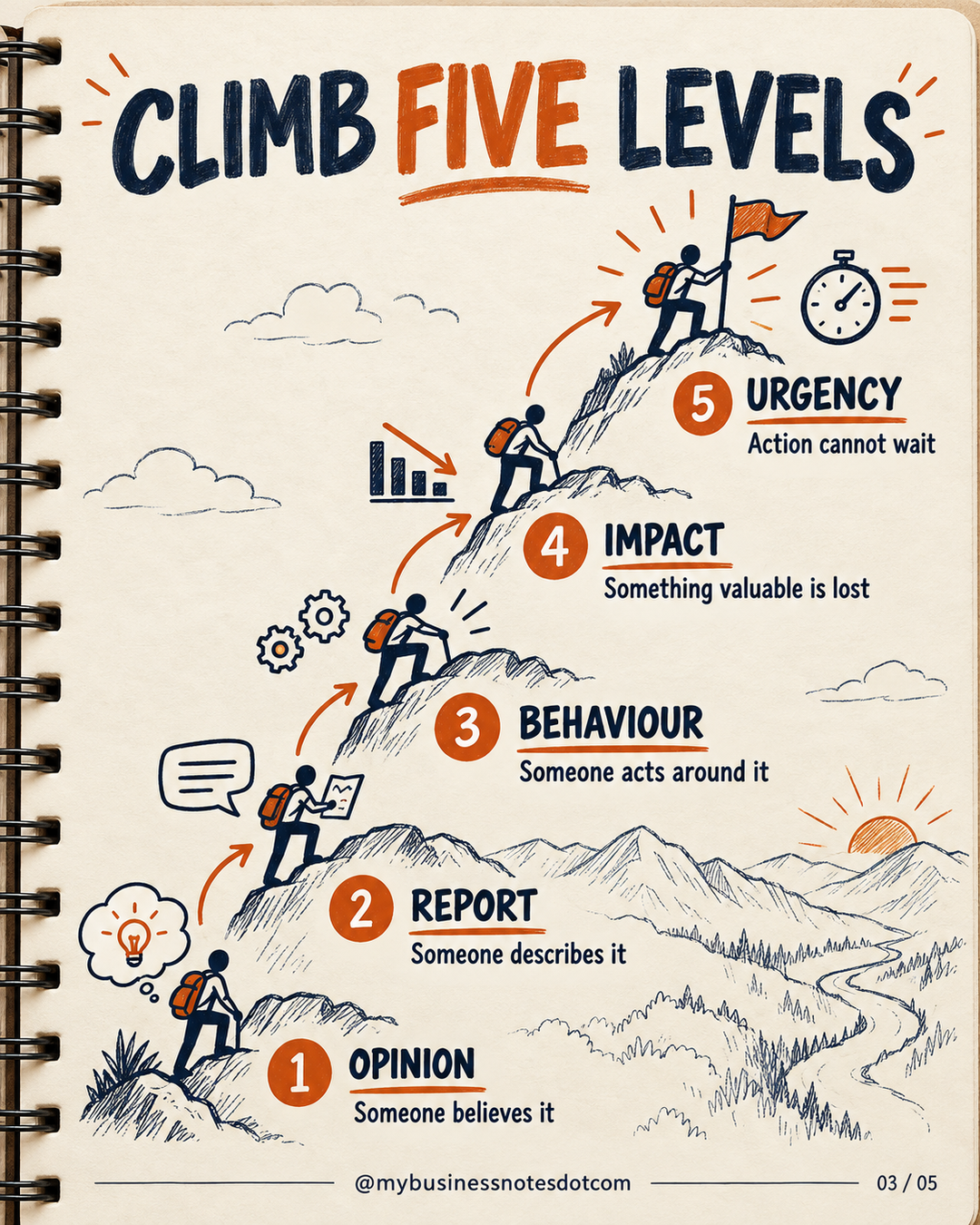
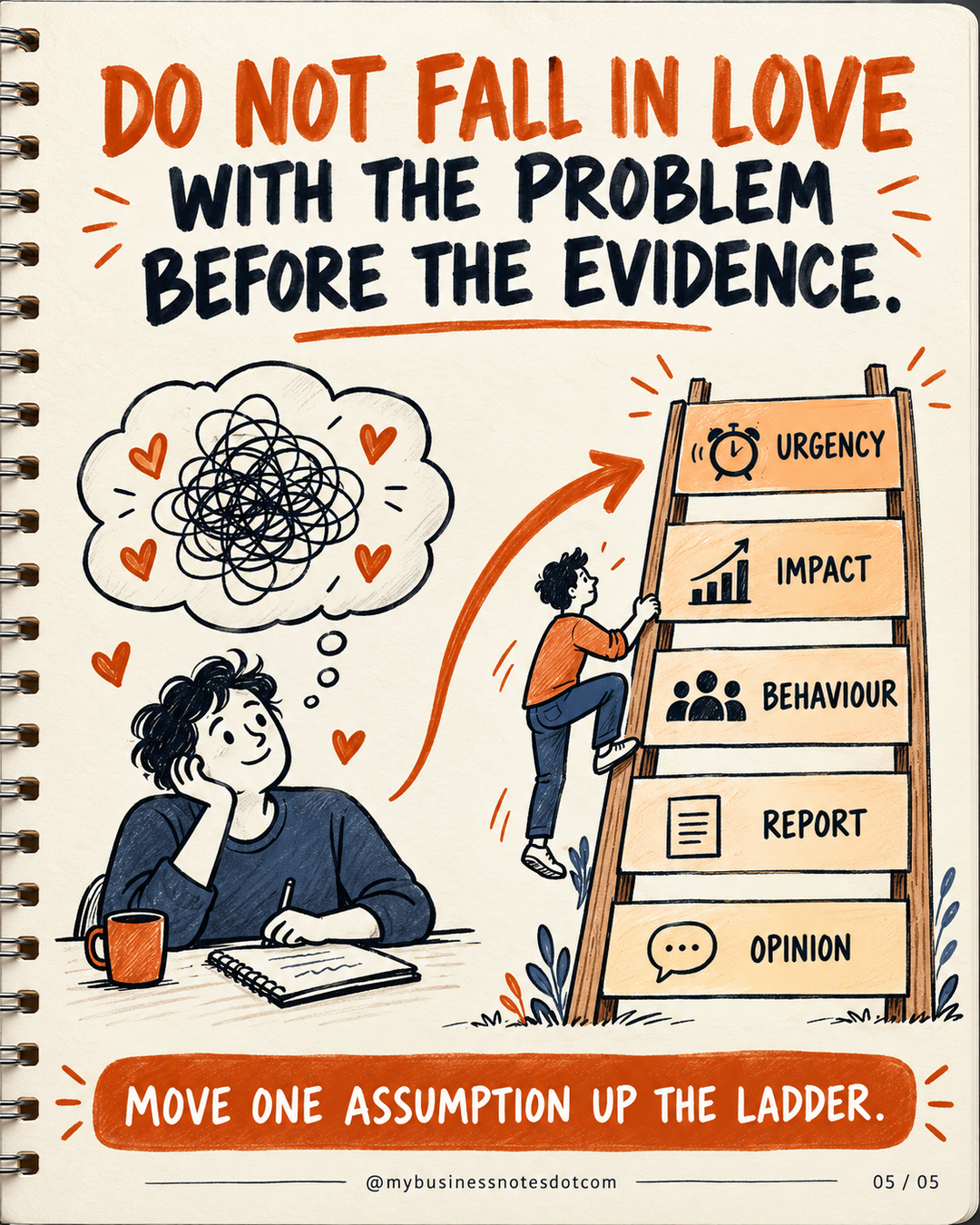
Problem evidence is information that helps you judge whether a specific customer faces a meaningful problem. A useful evidence ladder distinguishes opinion, reported experience, observed behaviour, impact and urgency. It helps choose the next test; it does not turn five boxes into proof of demand.
Slide 1 of 5
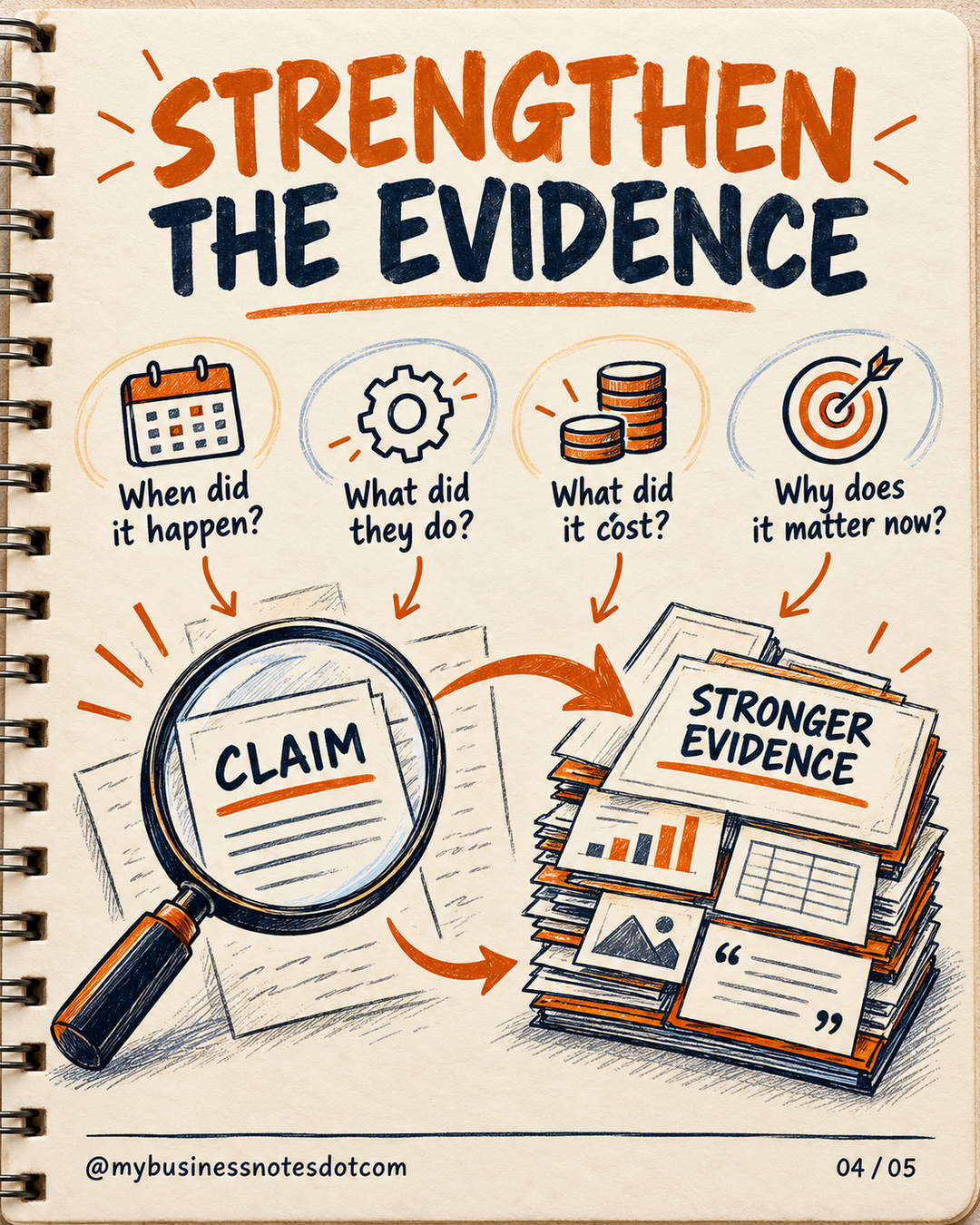
Start with the claim you need to test
A customer saying an idea is interesting answers a different question from a customer changing a process to solve a problem. Write the claim precisely: who experiences what, in which circumstances, with what consequence? Without that context, a folder of enthusiastic comments can support almost any proposal.
The five-part MBN ladder is a discussion aid, not an established measurement scale. Evidence strength depends on the question. Observing a workaround may support the existence of friction without showing that the person will pay for your solution.
Distinguish an opinion from a report
An opinion expresses a preference or belief. A report describes an event the person remembers. Both can inform discovery, but neither should be rewritten as direct observation. Ask for a recent example and reconstruct what happened before offering your explanation.
Nielsen Norman Group warns that recalled experiences can be incomplete or rationalized. That is a reason to triangulate, not to dismiss customers. Compare the account with a current process, a permitted artefact or another relevant record. Keep uncertainty visible.
Look for behaviour and consequences
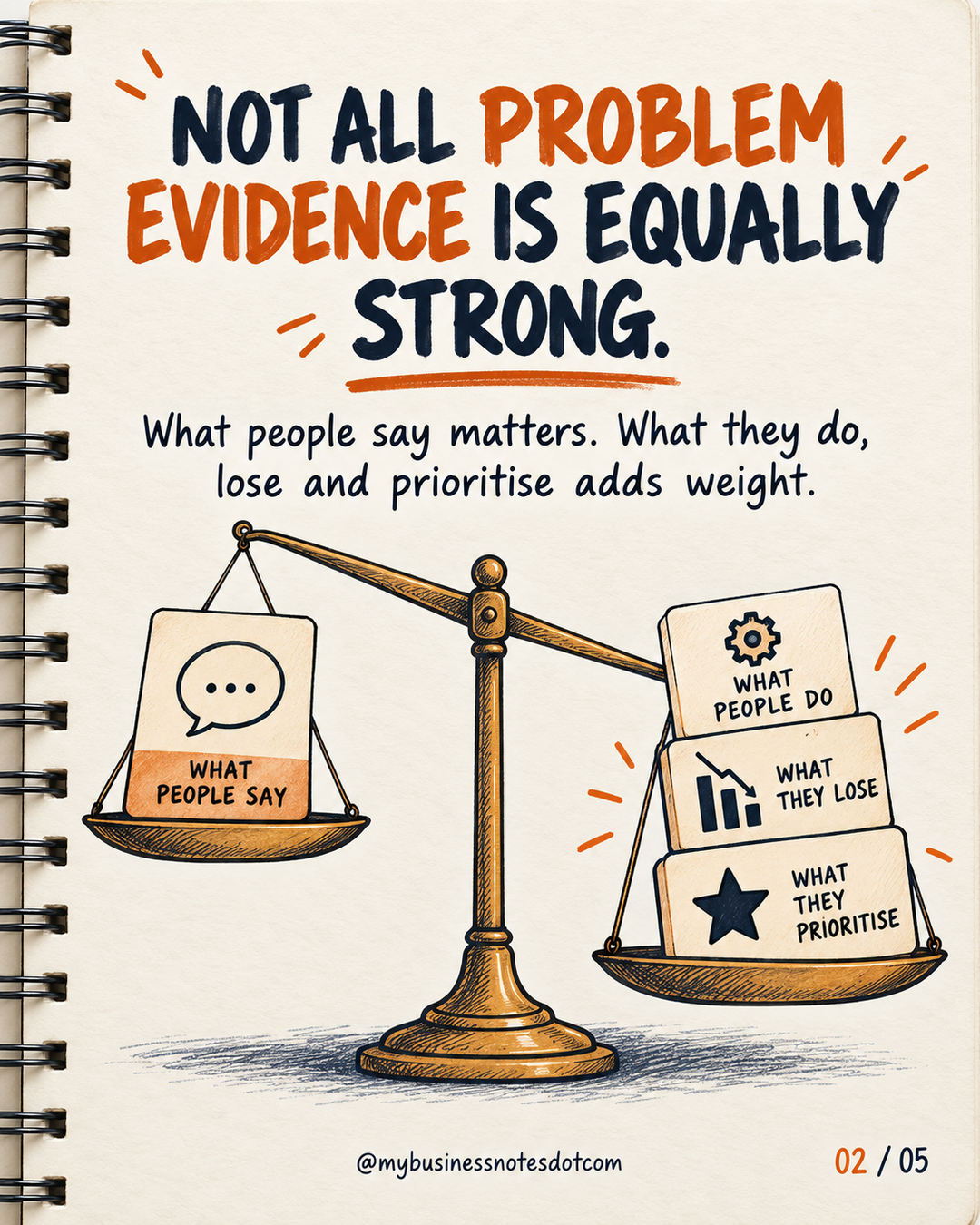
A workaround, repeated manual task or committed budget can reveal more than general agreement. Ask what the person actually did, what alternatives they tried and what happened as a result. Strategyzer distinguishes verbal evidence from tests that ask customers to take action.
Then inspect impact. A disliked task may have little consequence; a quiet recurring failure may delay an important decision. Record time, rework or another relevant effect only when supported by a clear source. Do not convert one account into a market-wide estimate.
Assess urgency without manufacturing it
Find out why the problem needs attention now, if it does. A deadline, a new responsibility or a change in volume can alter the decision. If no trigger exists, the problem may be real but not a near-term buying priority.
Jobs to Be Done focuses attention on the circumstances in which people seek progress. Use that lens to understand timing, rather than treating reluctance as an objection to overcome. Urgency should come from the customer’s situation, not a sales countdown.
Example: a reporting tool with the wrong hypothesis
Imagine a team hearing that managers dislike monthly reporting. It assumes they need automatic charts. Interviews reveal that gathering figures is quick but resolving conflicting definitions takes days. This is a hypothetical example.
The next test should examine shared definitions and approvals. A prototype that produces more charts would not resolve that uncertainty. The team can test a clearer decision process before making a product commitment, while keeping willingness to pay as a separate open question.
Choose the next piece of evidence
Write one sentence for what the current evidence supports and another for what it does not. Then choose a proportionate test, an owner and a decision rule. A small exploratory interview can be appropriate early; a larger irreversible commitment needs stronger and more relevant support.
Keep contrary cases beside supporting cases. Move forward when the evidence is sufficient for the next decision, not because the ladder is visually complete. For interview technique, see our guide to customer interviews without leading participants.
Frequently asked questions
Does observed behaviour prove demand?
No. It may establish that a problem or workaround exists. Demand for a particular solution requires further evidence.
Must every problem be urgent?
No. Urgency affects timing and prioritization, not whether the problem exists.
Can interviews be strong evidence?
Yes, for questions about context and experience, with attention to recall and sampling limits. They do not establish future purchasing behaviour on their own.
Download the complete carousel
Use the five-slide worksheet in your next working session.
Related reading: Turn learning into the next decision.
International references
- Strategyzer / Kurt Bostelaar — Customer interviews that produce insights
- Strategyzer / Alex Osterwalder — Don’t believe your customers
- Strategyzer / Nabila Amarsy — Ways to test your value proposition
- Strategyzer / Nabila Amarsy — Roadmap to test your value proposition
- Strategyzer / Alex Osterwalder — Start with critical hypotheses
- GOV.UK User research community — Using in-depth interviews
- Christensen Institute — Jobs to Be Done
- Nielsen Norman Group / Jakob Nielsen — Interviewing Users
- Nielsen Norman Group / Amy Schade — Avoid Leading Questions
- Strategyzer — Value Proposition Canvas