

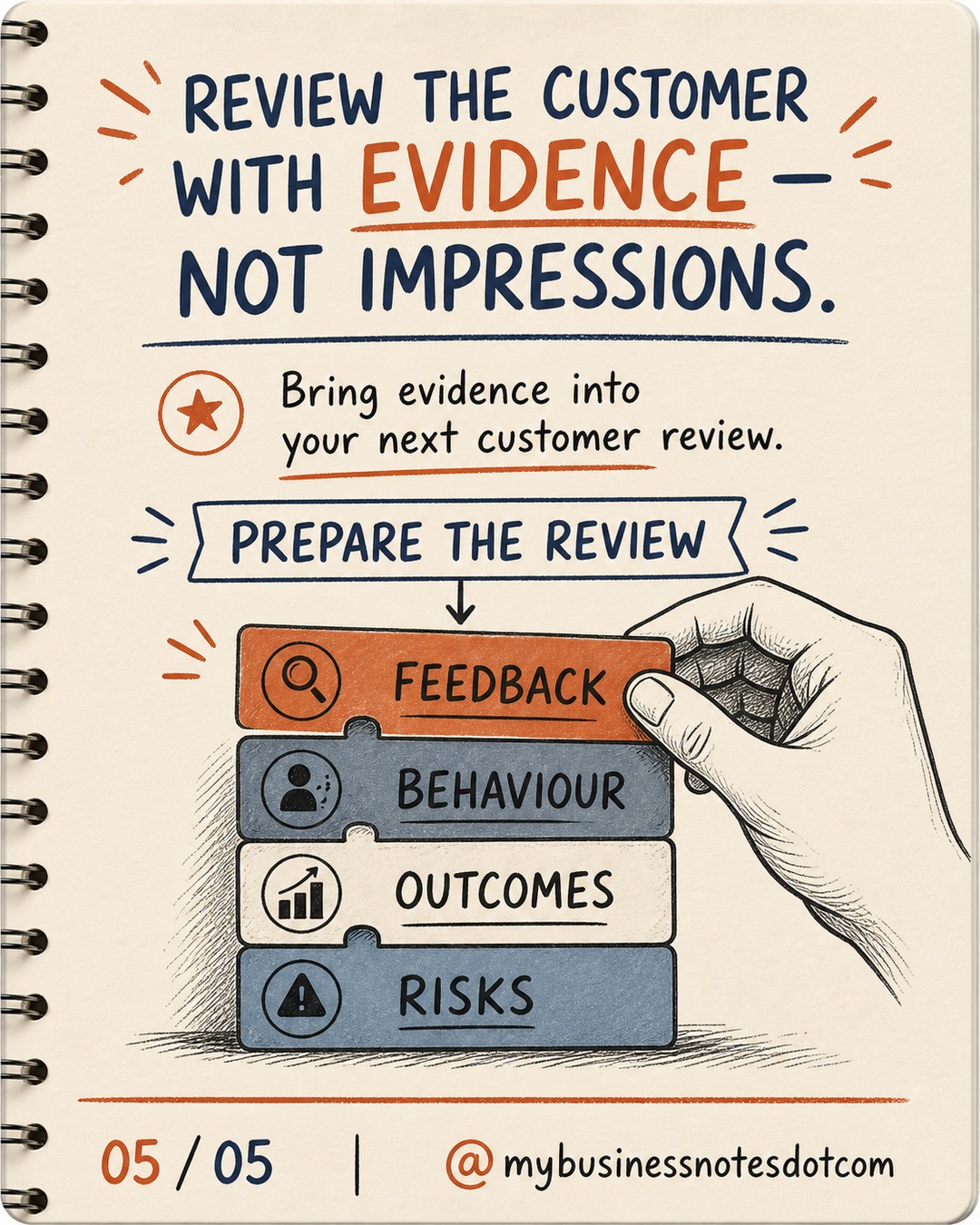
A customer evidence review brings feedback, behaviour, outcomes and risks into one conversation. It replaces account stories built from memory with a disciplined view of visible value, incomplete progress and the next useful action. This guide expands the five-slide business note into a practical review with criteria, safeguards and next steps.
Slide 1 of 5
Prepare four evidence groups
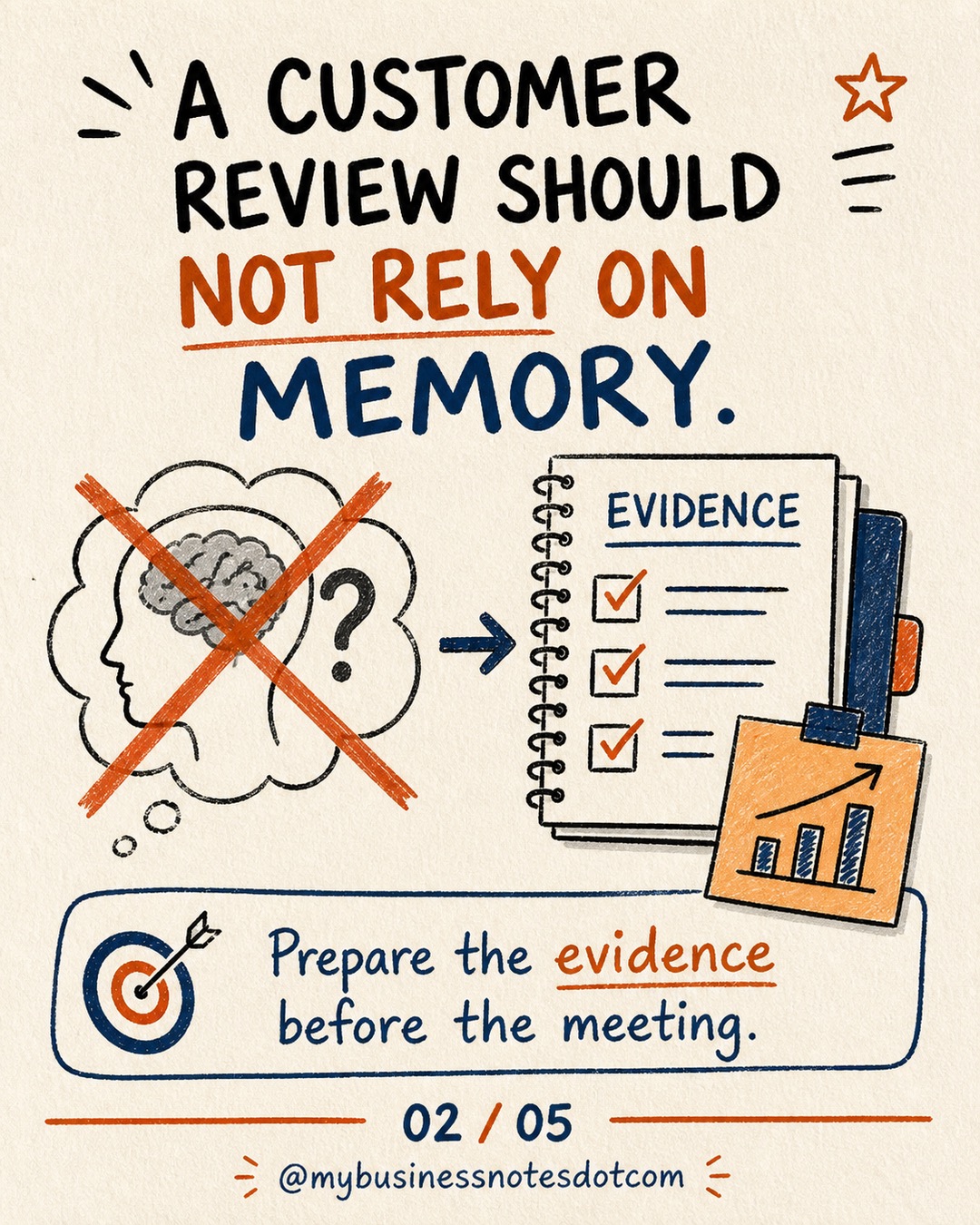
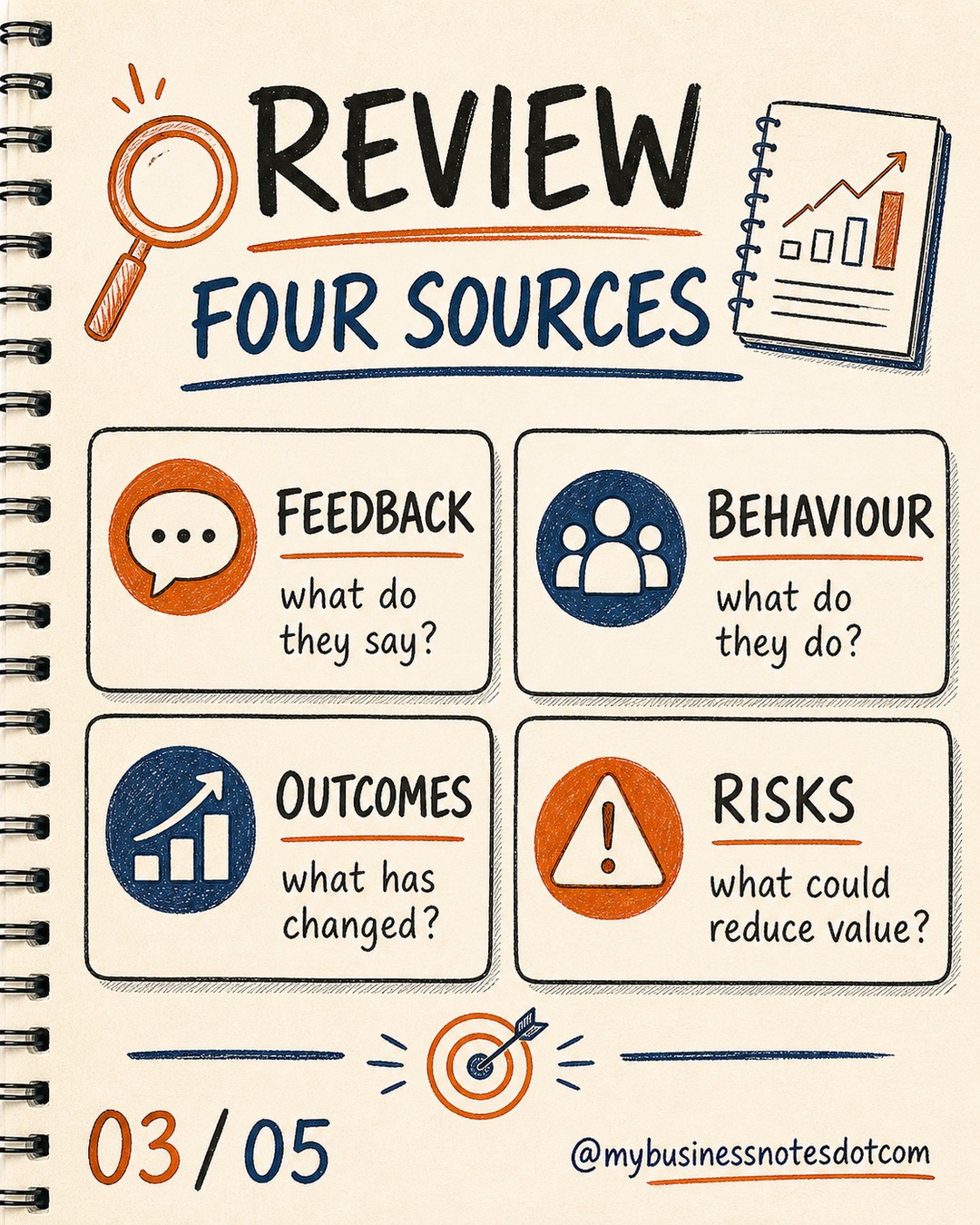
Gather what the customer said, what they did, which outcomes changed and which risks or constraints are visible. Label the source and date. A single comment, usage metric or commercial signal should not be treated as the whole relationship.
Separate facts from interpretation
Record observations first, then hypotheses. âUsage fell 18%â is evidence; âthe customer no longer sees valueâ is an interpretation that needs testing. This distinction reduces confident but unsupported account narratives.
Ask progress-oriented questions
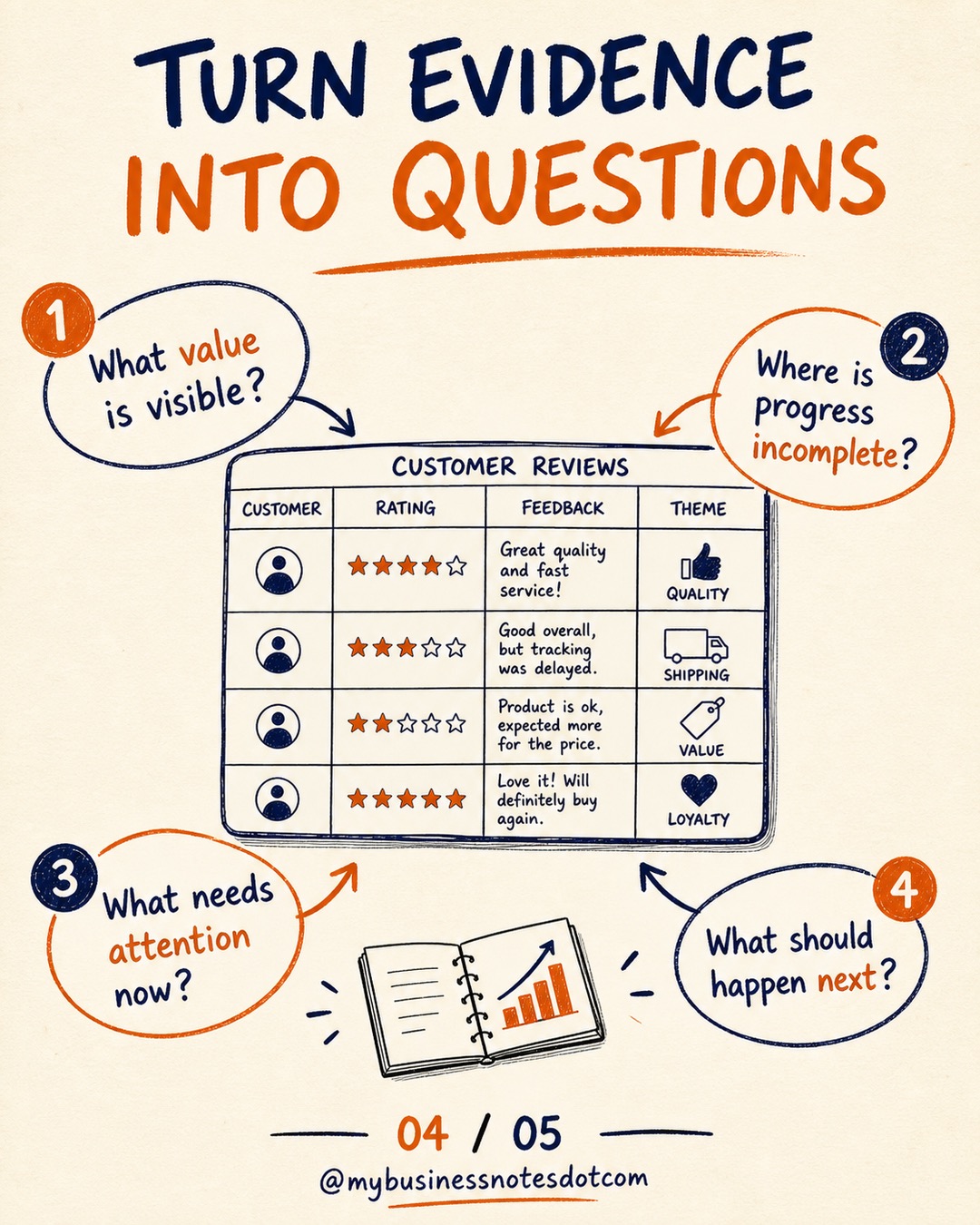
What progress is visible? Where is value incomplete? What has the customerâs attention now? Which stakeholder or capability is missing? What is the smallest next step that would create evidence? These questions keep the review focused on customer movement.
Make risks explicit
Review adoption, outcome, relationship, commercial and delivery risk. Name the evidence supporting each risk and what would disconfirm it. Escalate only when the impact, likelihood and required support are clear.
End with one owned next step
Agree on an action, owner, customer relevance and review date. The next step may be a discovery conversation, enablement, product correction or expectation reset. Avoid producing a long task list that obscures the most important uncertainty.
Frequently asked questions
What is a customer evidence review?
A structured review of customer feedback, behaviour, outcomes and risks used to guide action.
How often should it happen?
Use a cadence that matches customer value, risk and the speed at which evidence changes.
Is product usage enough evidence?
No. Combine behaviour with outcomes, feedback and relevant commercial or operational context.
Who should participate?
Include the account owner and people who can interpret or act on the most important evidence.
Put it into practice
Use the framework on one current decision. Record the evidence, owner, next action and review date before expanding the scope.
Download the complete carousel
Keep the five-slide framework as a PDF for your next working session.
International references
- McKinsey & Company â The B2B omnichannel opportunity
- Think with Google â The messy middle of the purchase journey
- Nielsen Norman Group â Recognition rather than recall
- Google re:Work â Understand team effectiveness
- Atlassian â Roles and responsibilities
- Harvard Business Review â The discipline of business experimentation
- Christensen Institute â Jobs to Be Done Theory
- Strategyzer â The Value Proposition Canvas
- GOV.UK Service Manual â Understand users and their needs
- Salesforce â Customer success
- Lean Enterprise Institute â What is lean thinking?
- MIT Sloan Management Review â Why companies fail at digital transformation