

A growth quality review asks whether expansion is making the business stronger. It examines acquisition efficiency, conversion, retention, margin and operational capacity before the team celebrates a headline number or sets the next target. This guide expands the five-slide business note into a practical review with evidence, safeguards and next steps.
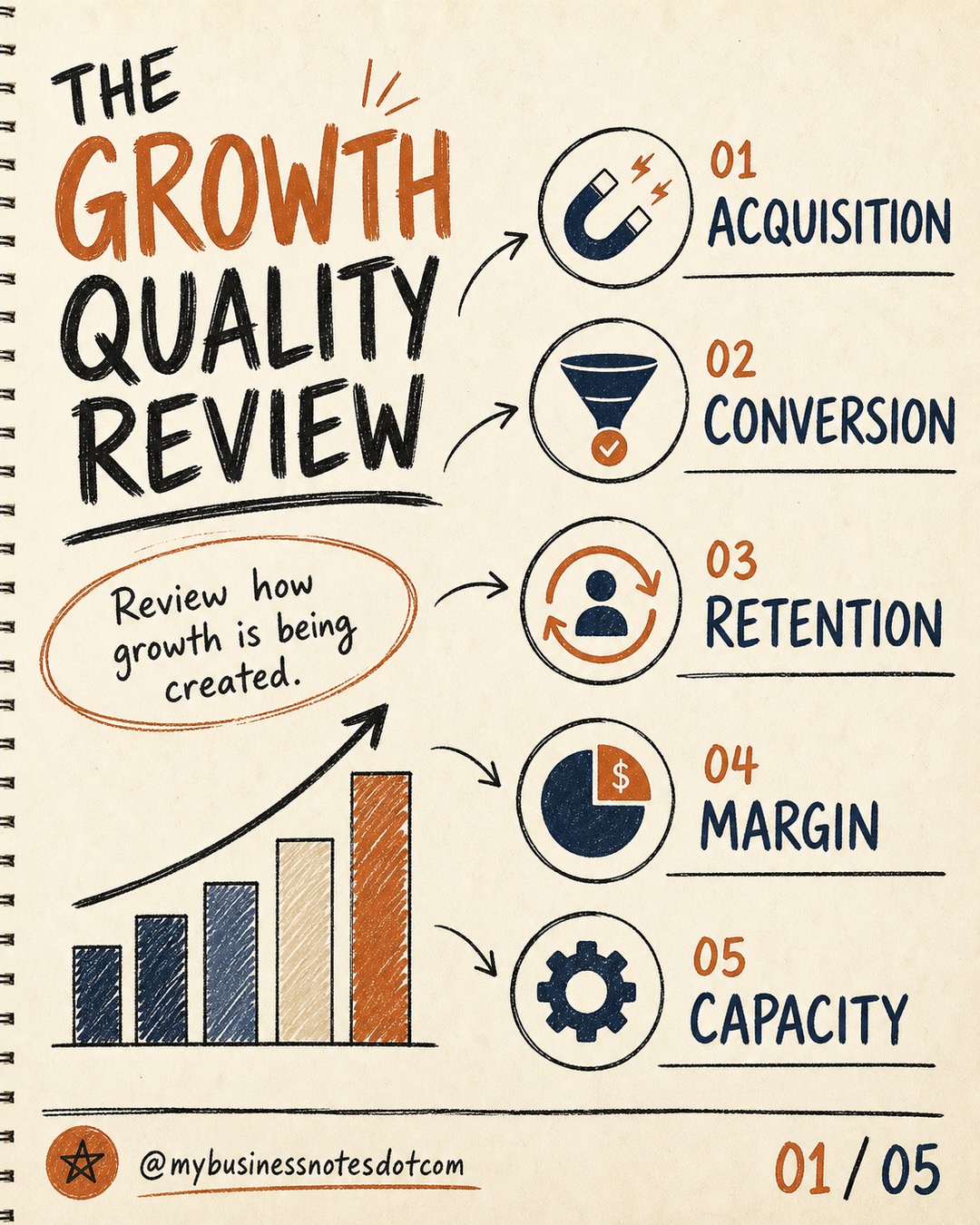

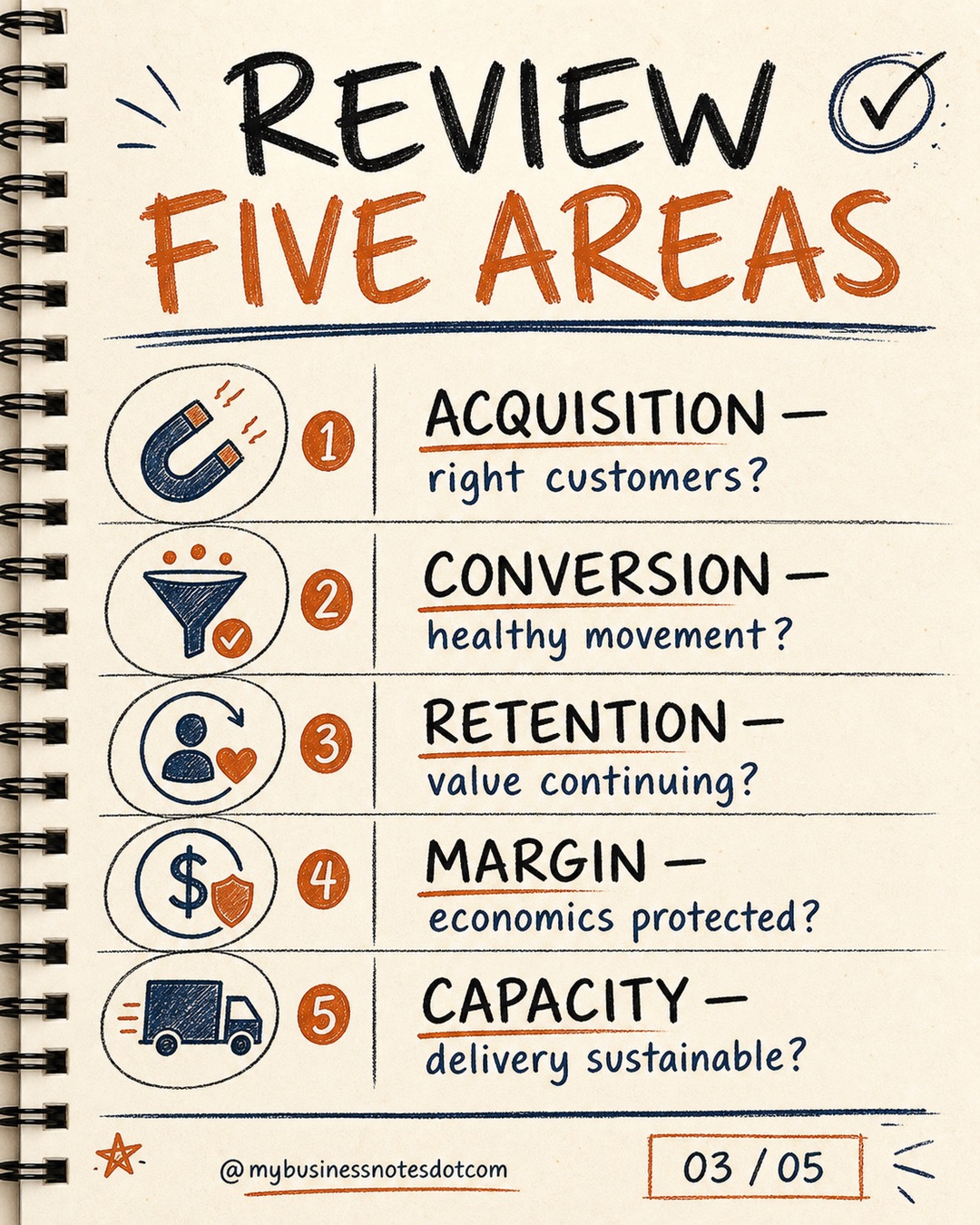
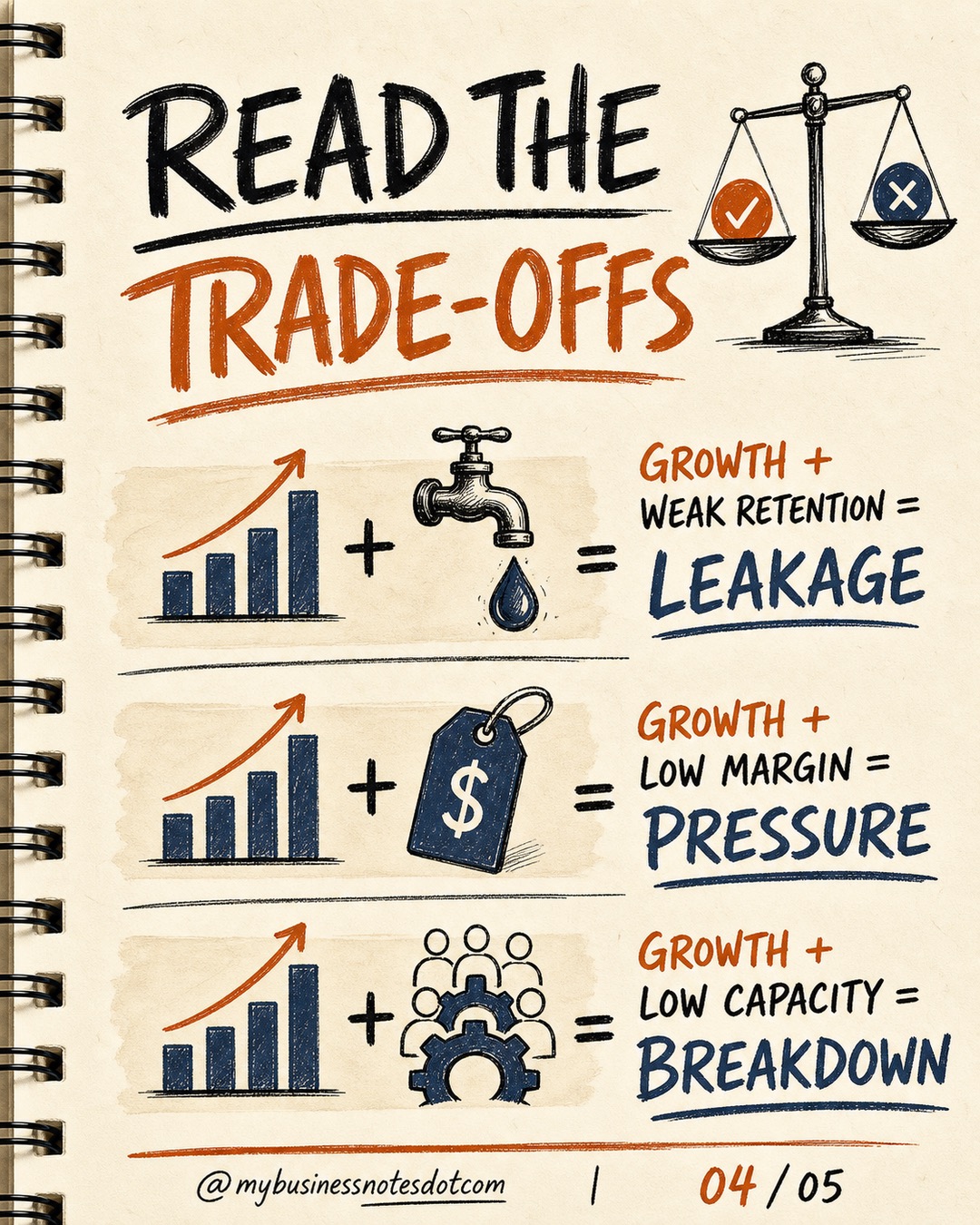
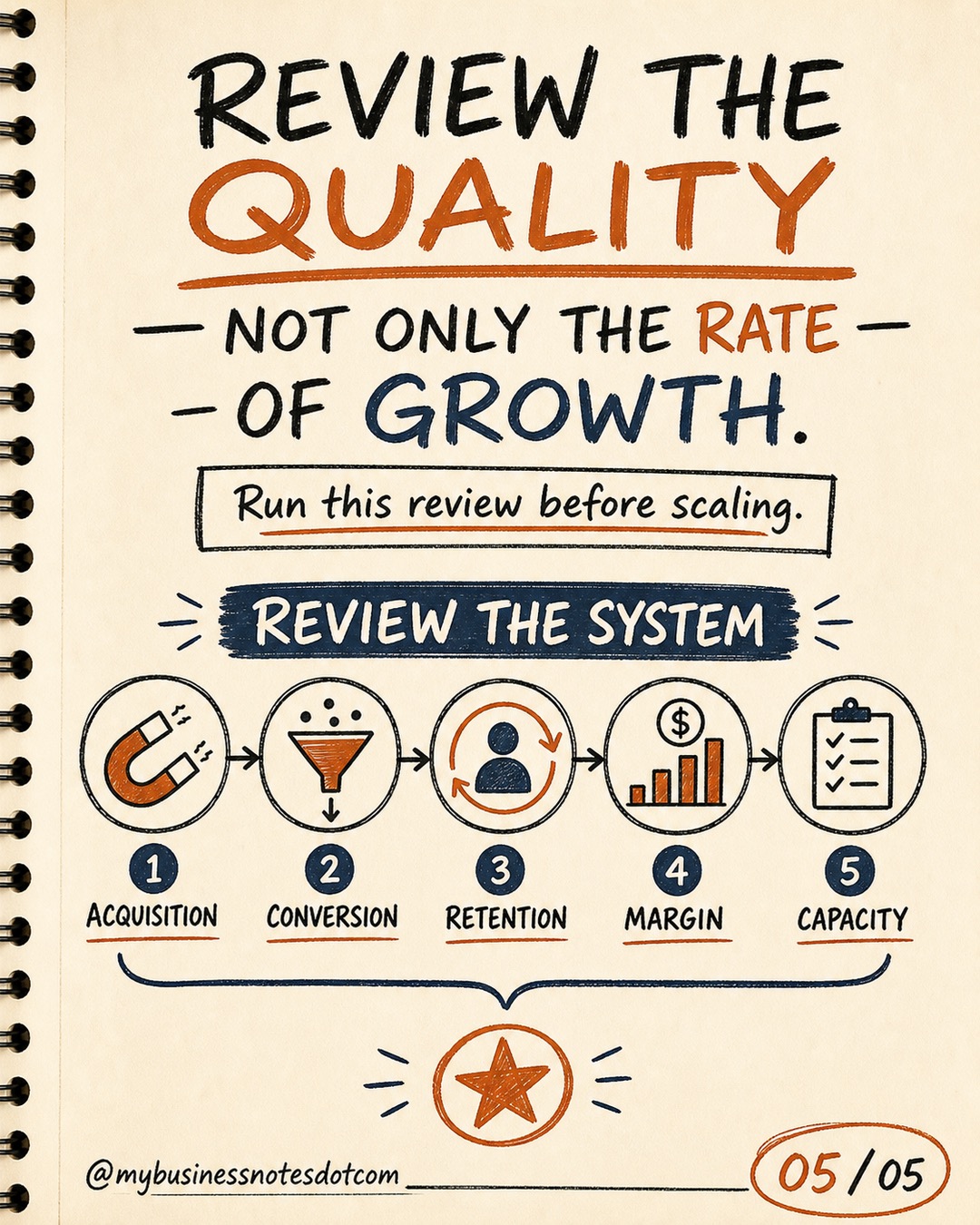
Slide 1 of 5
Look beyond growth rate
Revenue or customer growth can coexist with weaker economics, poor fit or operational strain. Compare the headline result with the resources, risks and future obligations created to produce it.
Review acquisition and conversion
Examine which customers entered, why they progressed, how long conversion took and what acquisition cost excludes. Segment averages so one efficient source does not hide another that brings volume without fit.
Review retention and value
Track whether new cohorts adopt, achieve outcomes, remain and expand under comparable conditions. Early revenue is not durable growth when customers leave before acquisition and delivery investment is recovered.
Review margin and capacity
Include discounts, onboarding, support, implementation, infrastructure and management attention. Identify bottlenecks and single points of failure. A profitable offer can still be unsafe to scale when delivery depends on heroics.
Choose the next constraint-aware target
Select a target that improves both volume and system quality. Name assumptions, leading indicators and stop conditions. Growth becomes more resilient when the team can slow, learn and redirect before weaknesses become expensive.
Frequently asked questions
What is growth quality?
The durability, efficiency and operational health of growth, not only its headline rate.
Can fast growth be unhealthy?
Yes. It may hide weak retention, low margin, poor fit or capacity risk.
Which metrics belong in the review?
Use acquisition efficiency, conversion, retention, customer value, margin and capacity evidence.
How often should growth quality be reviewed?
At a cadence that allows action before the next major spending or capacity commitment.
Put it into practice
Apply the framework to one current customer or decision. Record the evidence, owner, next action and review date.
Download the complete carousel
Keep the five-slide framework as a PDF for your next working session.
International references
- McKinsey & Company â The net revenue retention advantage
- McKinsey & Company â The new B2B growth equation
- McKinsey & Company â Insights to impact
- Salesforce Help â Customer Success Score overview
- Salesforce Help â Customer Health Score
- Salesforce Trailhead â Customer success strategies
- Gartner â Metrics to prove customer success value
- Bain & Company â The powerful economics of customer loyalty
- Bain & Company â Converting loyalty into economic advantage
- Christensen Institute â Jobs to Be Done Theory
- Strategyzer â The Value Proposition Canvas
- Harvard Business Review â The discipline of business experimentation