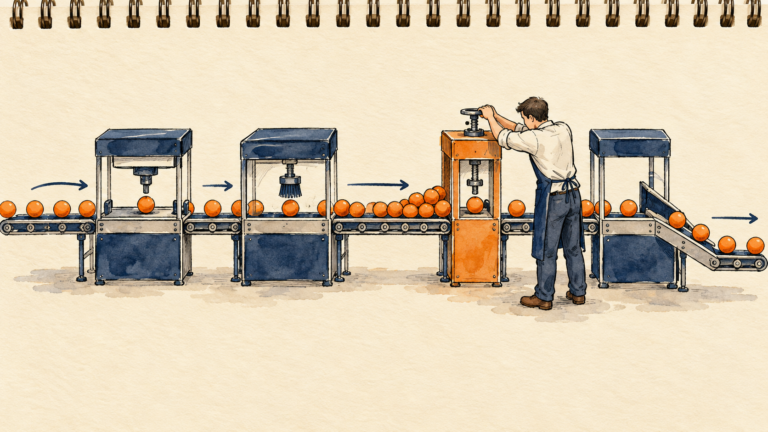

Business resilience is the ability to sustain important work, adapt and recover when conditions change. Start with critical dependencies, examine the consequences of disruption, then choose proportionate buffers, response arrangements and a learning loop. Resilience is designed into operations, not added as a slogan.
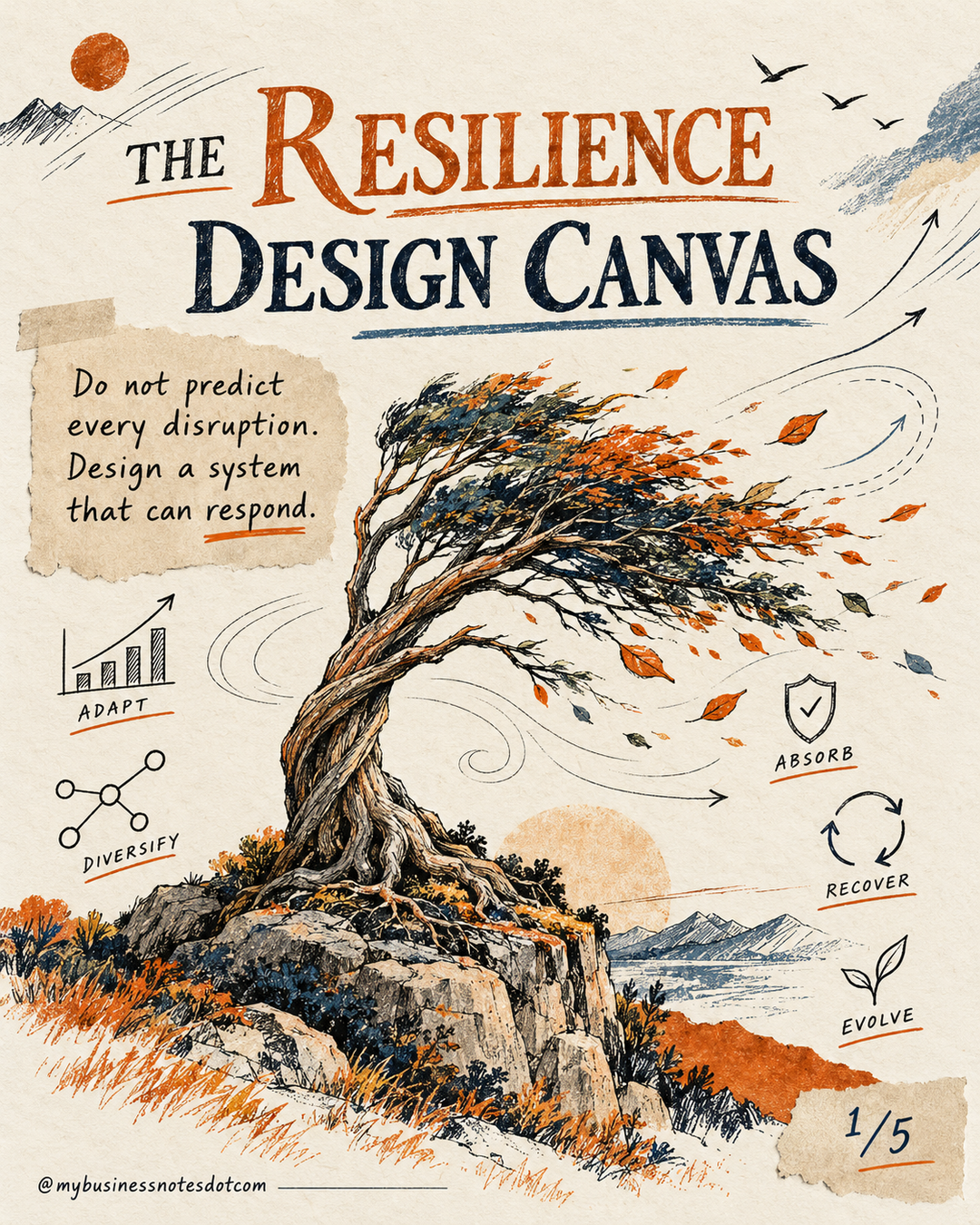
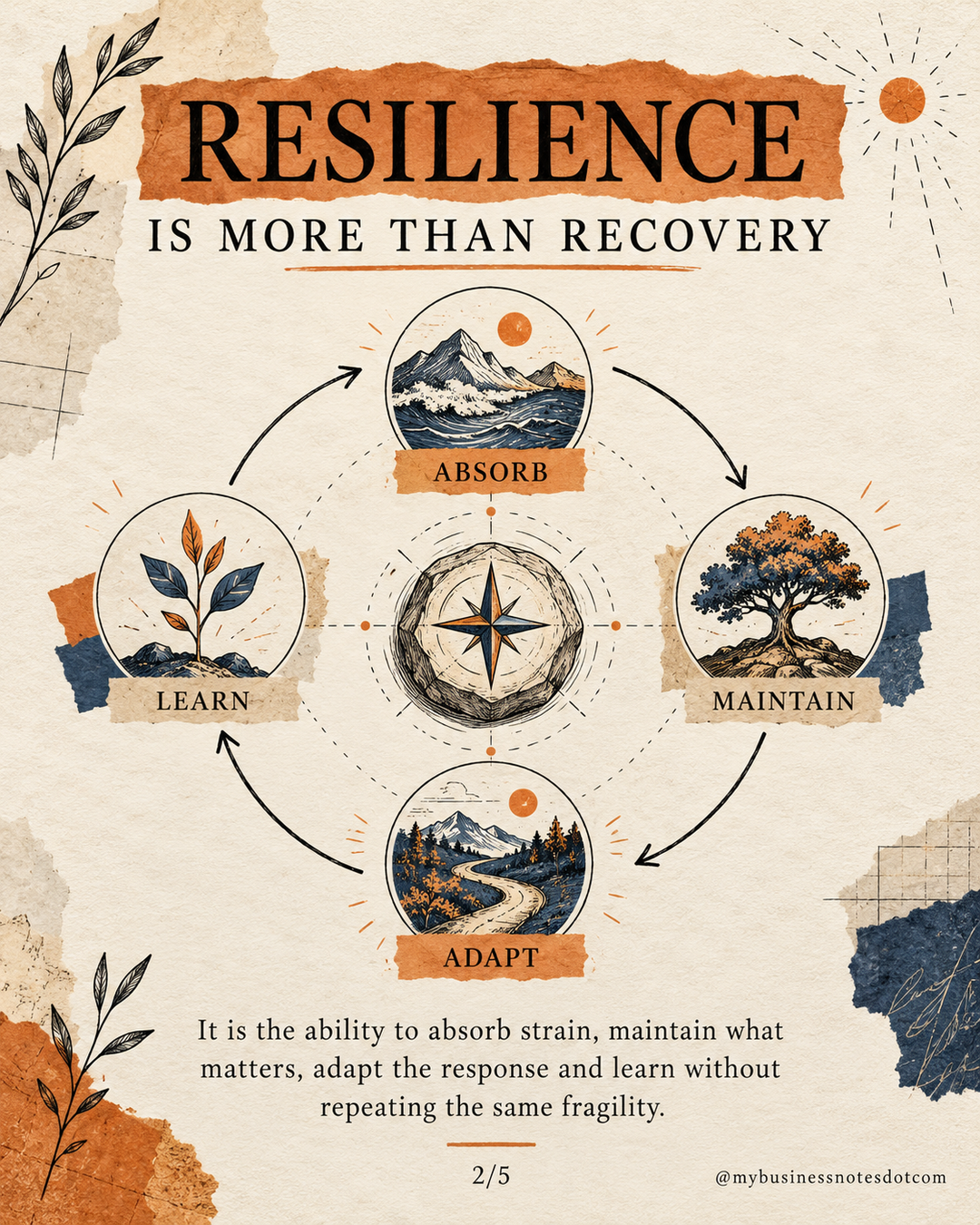
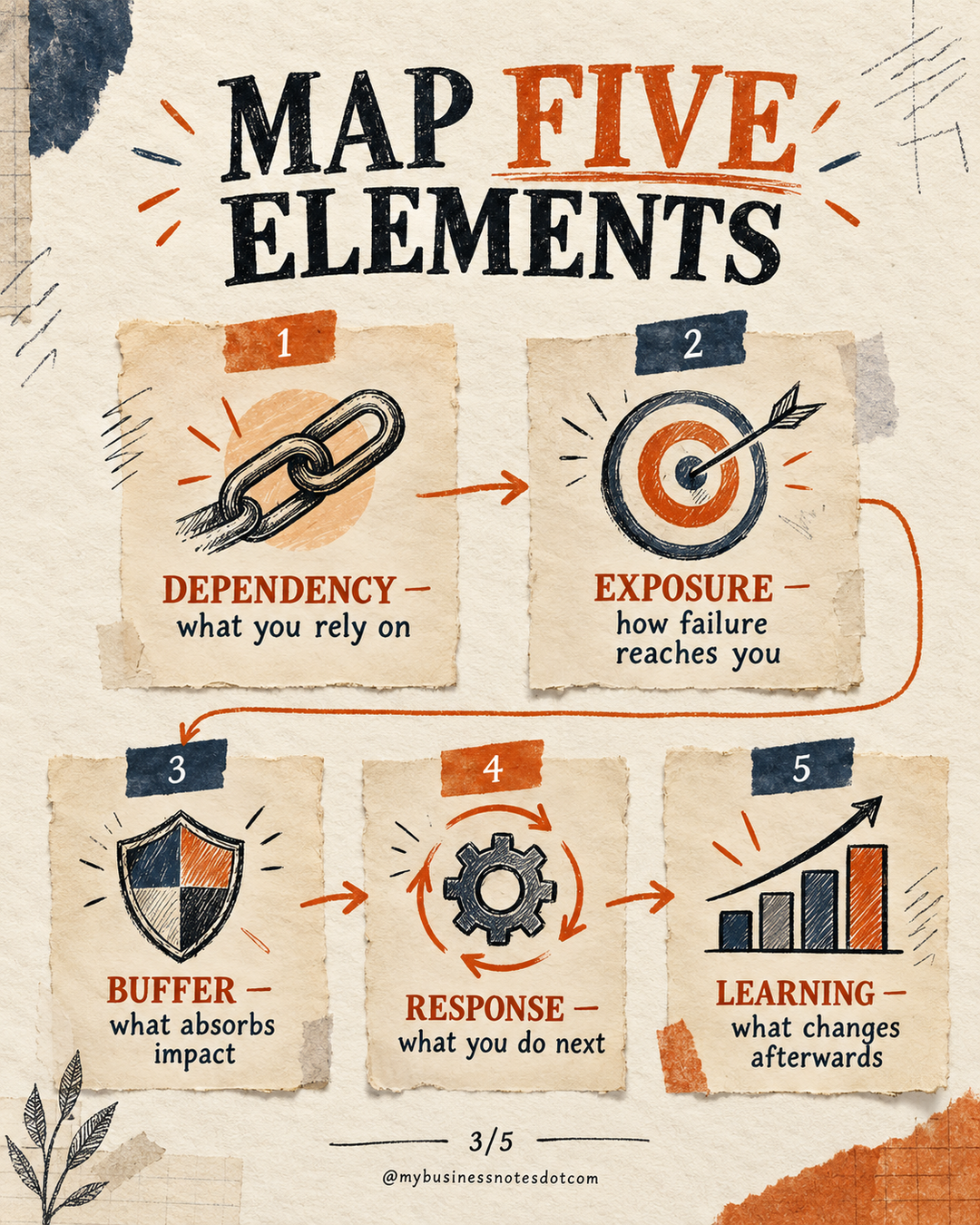
Slide 1 of 5
What business resilience protects
A resilient operation does not preserve every activity at any cost. It protects a defined service or outcome and makes explicit what can temporarily slow down. Decide what customers and colleagues must still be able to do during disruption.
The Orange Book connects contingency and continuity arrangements with resilience and recovery. Its public-sector framework offers useful principles, not a ready-made operating plan for every business. Document the scope and seek specialist input where safety, regulated services or contractual obligations are involved.
1. Map the dependency behind the promise
List the people, systems, suppliers, permissions and information required to deliver the priority service. Ask what would stop if one dependency disappeared tomorrow. Include knowledge held by a single person, not just technology.
For an illustrative small agency, access to client assets may depend on one employee’s account. The vulnerability is not solved by buying another laptop. Harvard Business School’s emphasis on connected activities helps reveal how an apparently minor dependency supports the customer promise.
2. Assess exposure without false precision
Describe a plausible disruption, its consequences and the time available to respond. Separate evidence from assumptions using analysis guidance: an observed outage is a fact; a claim that every supplier will fail together needs support.
A pre-mortem can widen the discussion before commitments grow. Strategyzer’s critical-hypothesis approach also helps identify what to investigate first. Neither exercise produces a reliable probability merely because participants agree. Record uncertainty instead of disguising it with an unsupported risk score.
3. Choose a buffer with a clear trade-off
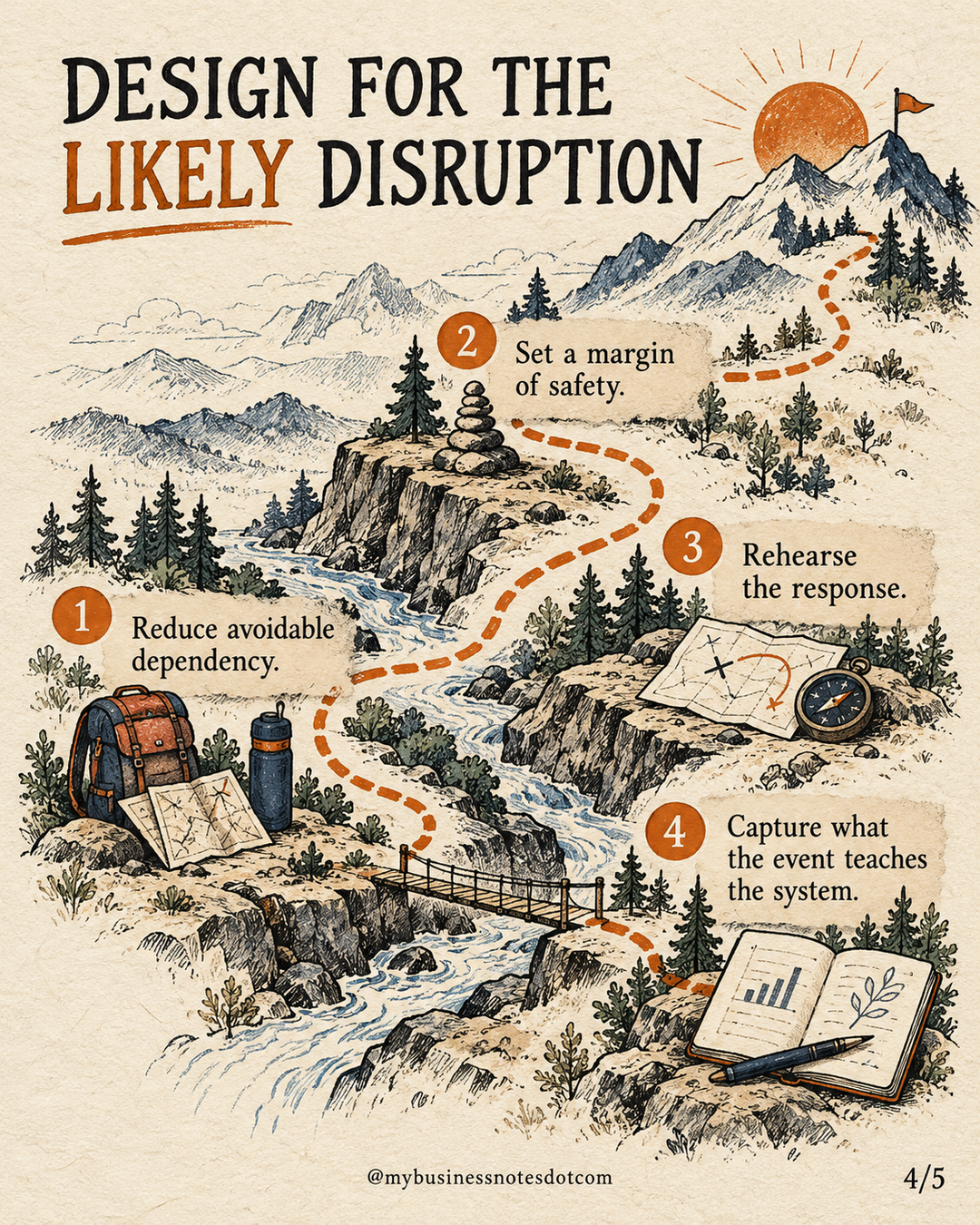
Buffers can include documented handovers, alternative providers, recoverable backups or available response time. Each has a maintenance cost. Ask which exposure it reduces and how you will know the arrangement still works.
Use capacity-planning to account for training, testing and incident work. A backup owner who has no access or rehearsal is only a name on a chart. Make the trade-off between efficiency and protection visible rather than prescribing a universal amount of spare capacity.
4. Rehearse the response before relying on it
Walk through a realistic scenario: who notices the disruption, who decides, what gets restored first and how affected people are informed? Test access and handovers in a controlled way that does not endanger live customers.
Amazon’s distinction between reversible and less reversible decisions is useful when choosing an exercise boundary. A limited rehearsal should have a stop condition and recovery route. Do not interpret faster decision-making as permission to skip approvals for consequential operational changes.
5. Turn the exercise into a learning loop
Use a retrospective to capture where instructions, authority or information were unclear. Give improvement actions an owner and review date. PDCA helps connect the exercise with a small change and a later check, rather than another document that nobody revisits.
Return to the canvas when the business changes suppliers, grows a service or loses a key capability. The objective is not to eliminate uncertainty. It is to know which work matters, where it is exposed and what the team can actually do when an important assumption fails.
Frequently asked questions
Is business resilience the same as business continuity?
They overlap. Continuity arrangements help sustain and restore important activities; resilience also involves adaptation, dependencies and learning as conditions change.
Does every dependency need a backup?
No. Prioritize by consequence, recovery needs and the cost of protection. Some exposures can be accepted explicitly; others require tested alternatives or specialist controls.
How can a small team begin?
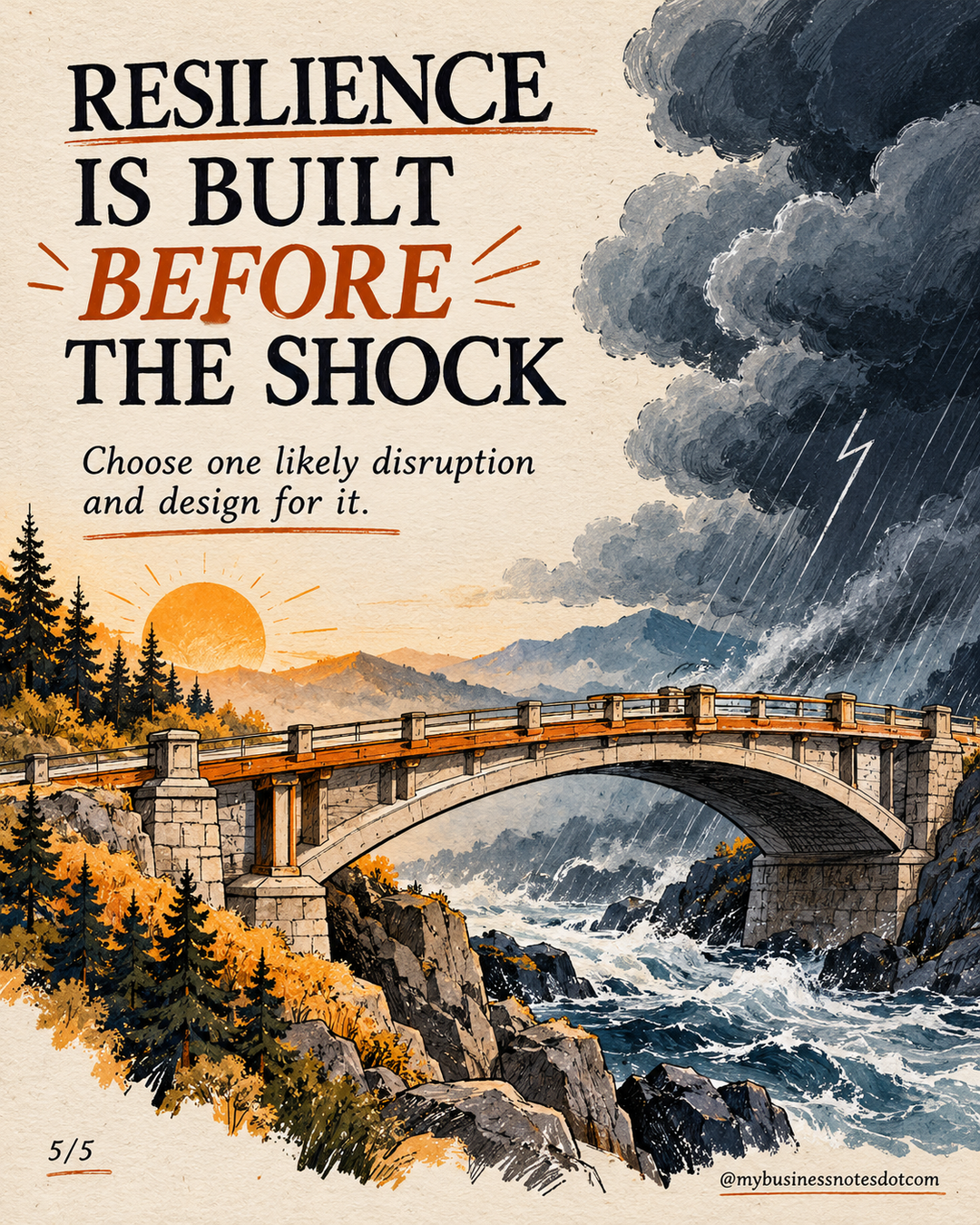
Choose one essential service, map its most fragile dependency, name a response owner and rehearse one safe scenario. Improve the arrangement from what the exercise reveals.
Download the complete carousel
Use the five-slide worksheet in your next working session.
Related reading: Turn learning into the next decision.
International references
- Atlassian — Pre-mortem
- Jeff Bezos / Amazon — 2016 Letter to Shareholders
- Alexander Osterwalder / Strategyzer — Test the most critical hypotheses first
- Harvard Business School ISC — Creating a Successful Strategy
- Lean Enterprise Institute — PDCA
- GOV.UK User research community — Analyse a research session
- Atlassian — Capacity planning
- Atlassian — Project trade-offs
- HM Treasury / Government Finance Function — The Orange Book
- Atlassian — Sprint retrospective