

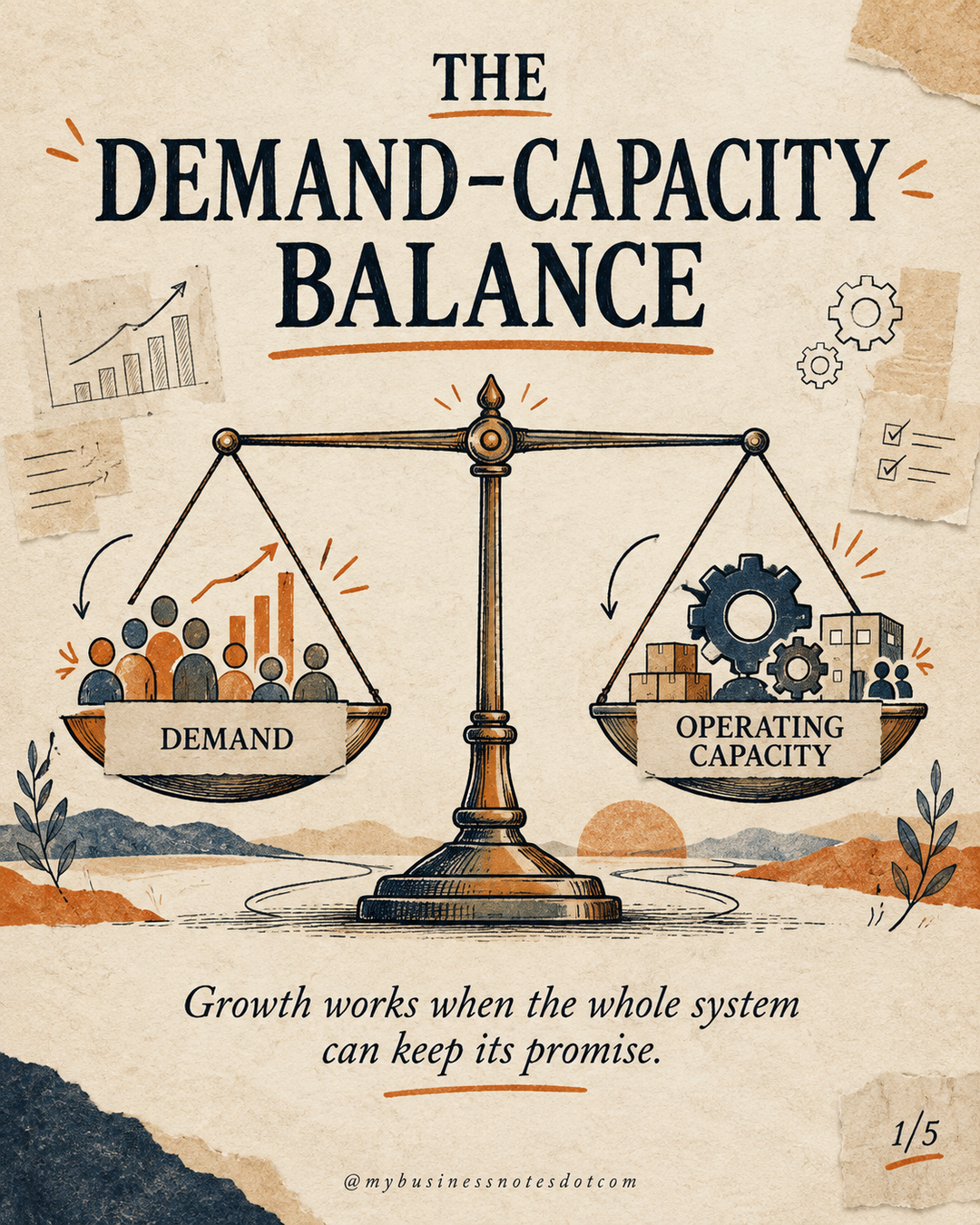
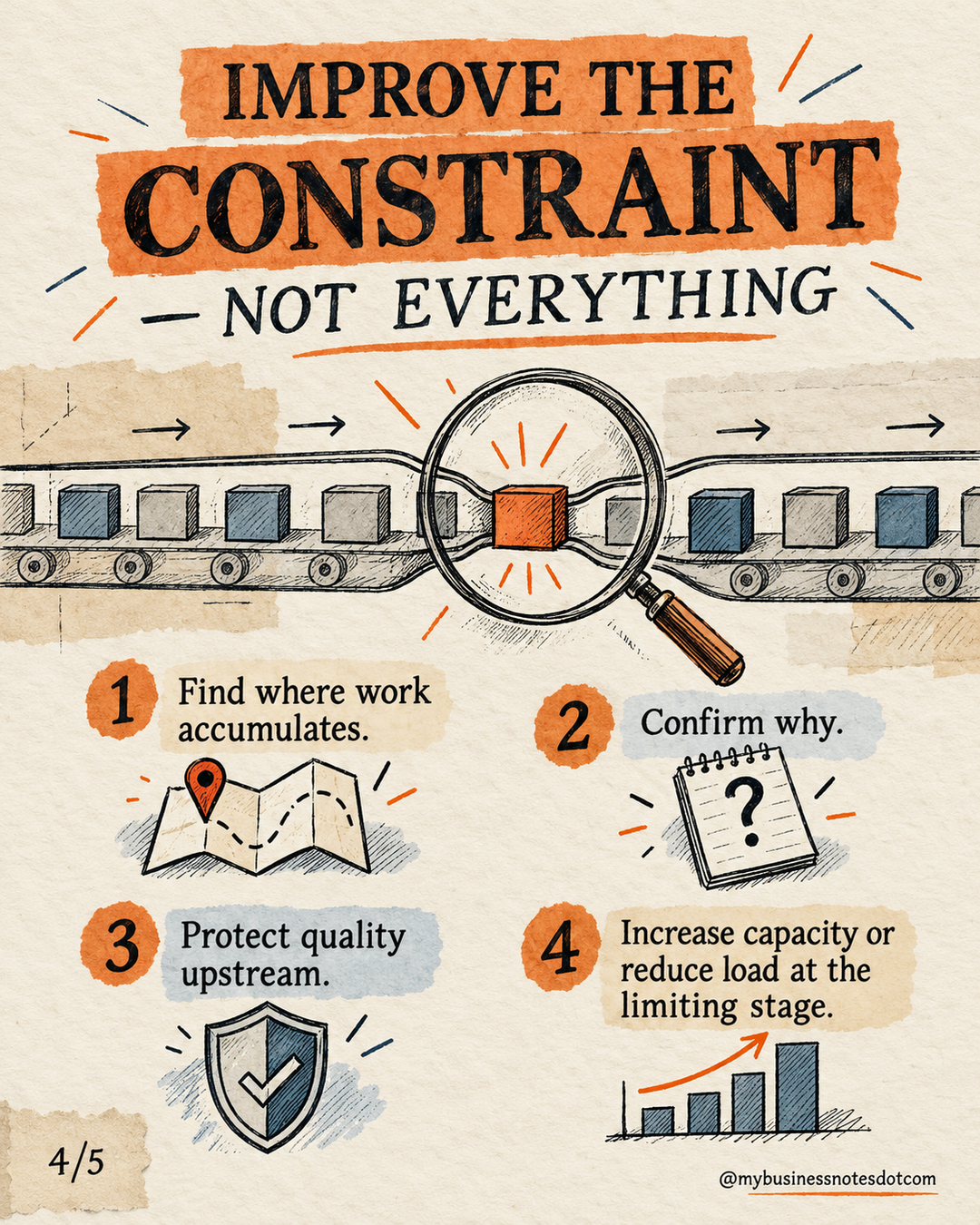
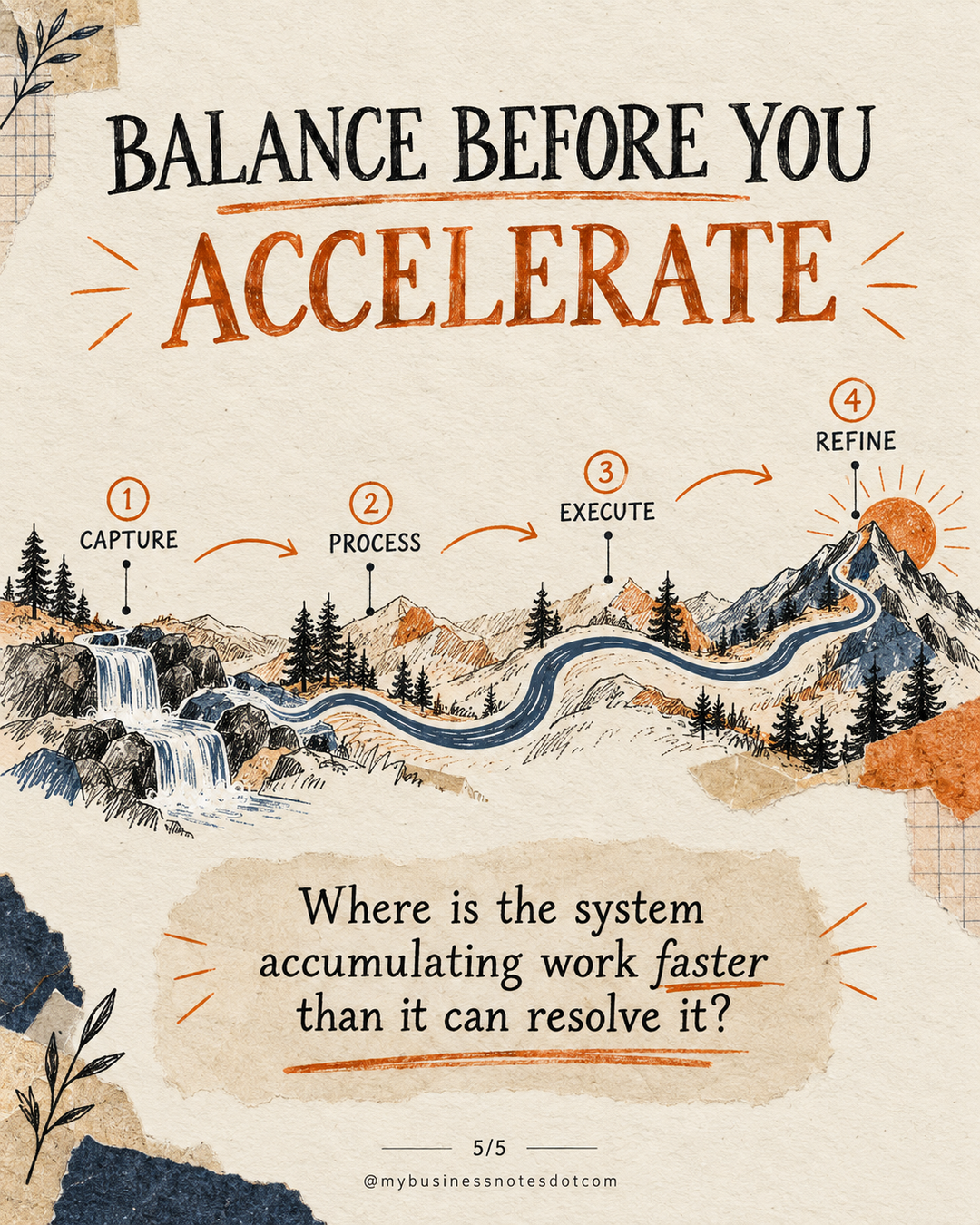
Demand-capacity balance means matching the work entering a business with its ability to decide, deliver and support it. Map the flow, investigate the point where work accumulates and improve that constraint before increasing demand everywhere.
Slide 1 of 5
Growth is more than an acquisition target
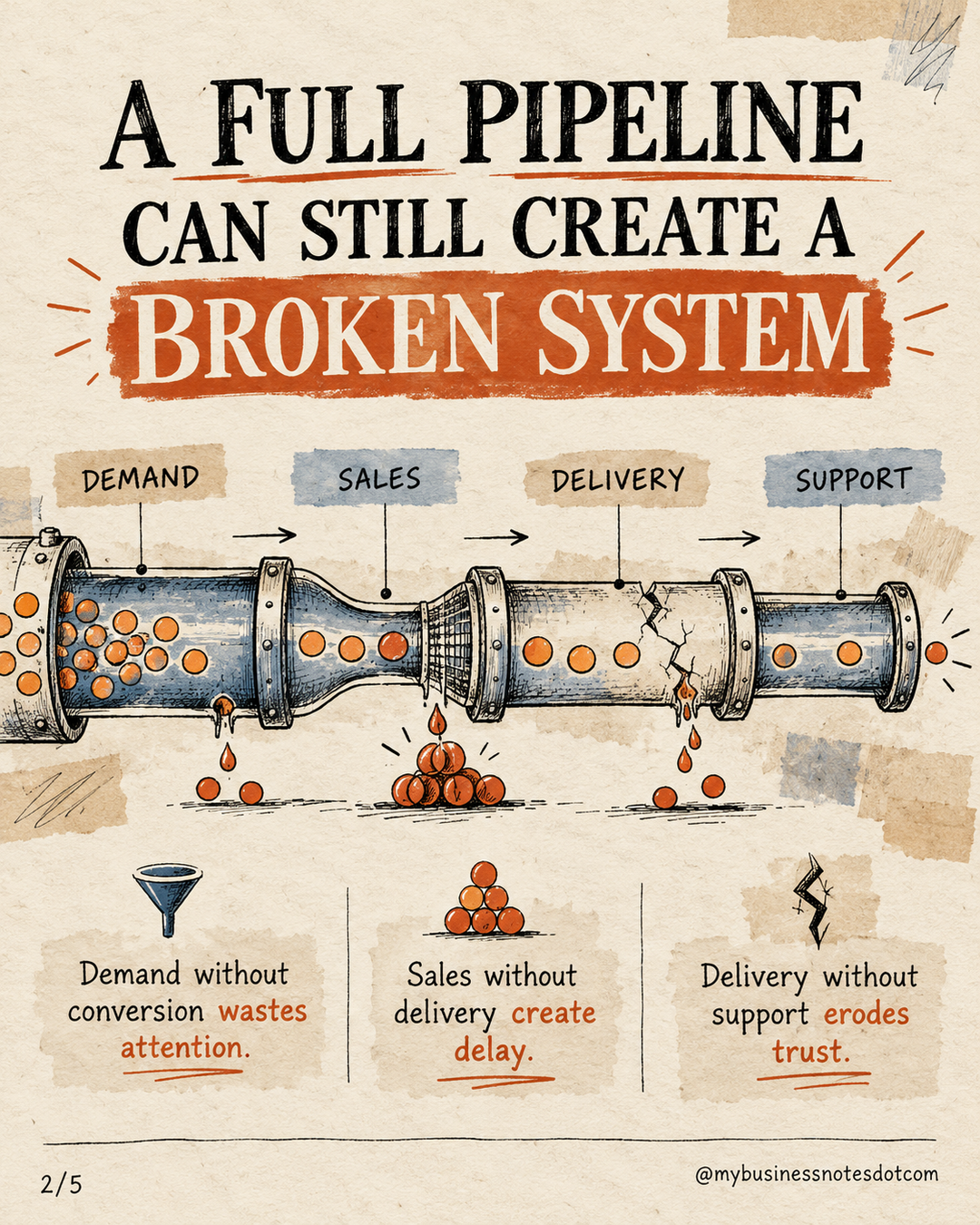
More inquiries can be useful, but their value depends on what happens next. A business may attract interest faster than it can assess fit, prepare proposals or deliver responsibly. A fuller pipeline does not automatically mean healthier growth.
Harvard Business School's strategy guidance connects activities rather than treating them as isolated targets. Apply that principle by reviewing the whole path from customer need to a delivered outcome and continuing use.
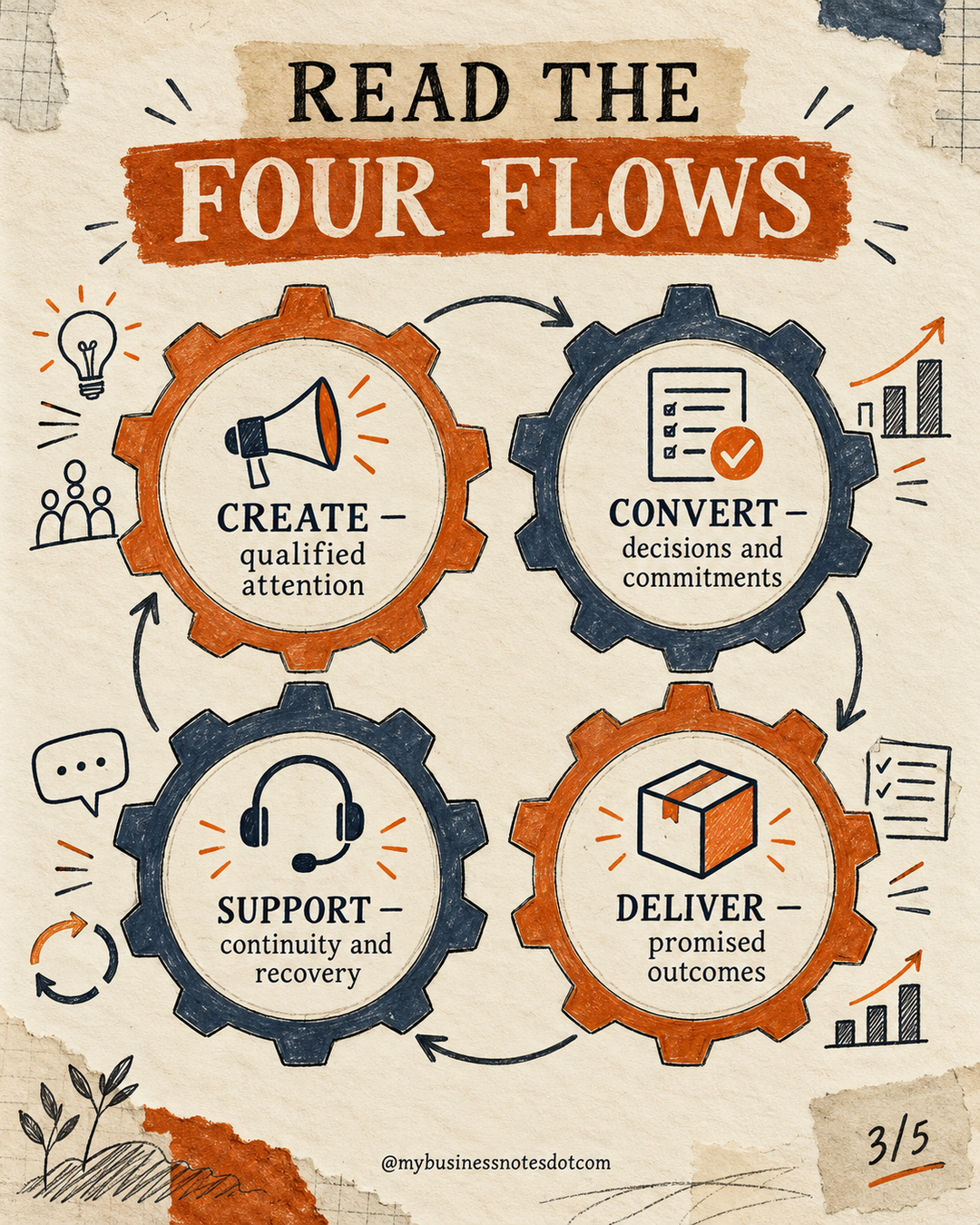
Map four connected stages
Use four working stages: create demand, convert decisions, deliver outcomes and support continuity. Define entry and exit conditions for each. These are MBN planning categories, not a universal model that every business must adopt.
Clarify the customer job and offer with the Value Proposition Canvas, then compare customer situations consistently. Nielsen Norman Group's comparison guidance helps make differences visible when one broad category hides several types of work.
Read arrivals, completions and waiting work together
Choose a consistent time period and unit of work. Record what entered, what finished and what remains waiting. Separate new opportunities from existing delivery obligations; otherwise a single total can disguise where pressure is building.
For a hypothetical team, 12 qualified requests arrive in a week and eight are resolved. The unresolved count rises by four only if there are no other entries, exits or reclassifications. This arithmetic identifies a flow issue; it does not prove why the mismatch occurred.
Investigate the constraint instead of blaming the stage
Ask what the waiting items need: information, approval, specialist work or a decision to decline. Use concrete examples and neutral questions, as GOV.UK recommends. Nielsen Norman Group's guidance on leading questions is relevant when a team is already convinced that another department is responsible.
Keep the observation separate from the explanation. GOV.UK's analysis method supports that discipline. Work waiting at proposal preparation might reflect unclear scope upstream, not simply slow proposal writers.
Choose a coherent intervention
Atlassian's capacity-planning method includes recurring and unplanned work in the baseline. Use it to compare the actual resource need with the available capability. Then discuss scope, time, cost, quality and risk using explicit trade-offs.
Possible responses include better qualification, clearer inputs, fewer simultaneous starts or different sequencing. Increasing advertising may be appropriate after the system can absorb the resulting work, but should not be the automatic response to every growth target.
Check customer consequences too. Do not reduce waiting time by removing necessary checks or concealing a longer delivery period. A faster handoff that transfers confusion downstream is not a system improvement.
Test demand-capacity balance over time
Use PDCA to test one change with a defined review point. Examine completion, waiting time, customer fit and rework together. A shorter queue caused by fewer arrivals is different from a genuine increase in delivery capability.
Strategyzer distinguishes what people say from what they do. Apply that caution to both market demand and internal promises about capacity. Review the actual work and commitments before concluding that the constraint has moved.
The purpose is not to make every stage equally busy. It is to keep promises the business can fulfill while learning where additional demand or capacity would be useful.
Frequently asked questions
What is demand-capacity balance?
It is the relationship between incoming work and the business's ability to assess, deliver and support it. It should be reviewed across connected stages.
Which stage should be improved first?
Investigate the point limiting meaningful completion. A visible queue is evidence to explore, not proof that the team at that stage is the root cause.
Should demand always be reduced when delivery is busy?
No. Consider qualification, scope, sequencing and viable capacity changes. Keep customer promises realistic while testing the appropriate response.
Download the complete carousel
Use the five-slide worksheet in your next working session.
Related reading: Turn learning into the next decision.
International references
- Harvard Business School ISC — Creating a Successful Strategy
- Lean Enterprise Institute — PDCA
- Strategyzer — Value Proposition Canvas
- Nabila Amarsy / Strategyzer — Ways to test your value proposition
- GOV.UK User research community — Analyse a research session
- GOV.UK User research community — Using in-depth interviews
- Atlassian — Capacity planning
- Kate Moran and Taylor Dykes / Nielsen Norman Group — Comparison tables
- Atlassian — Project trade-offs
- Amy Schade / Nielsen Norman Group — Avoid leading questions