
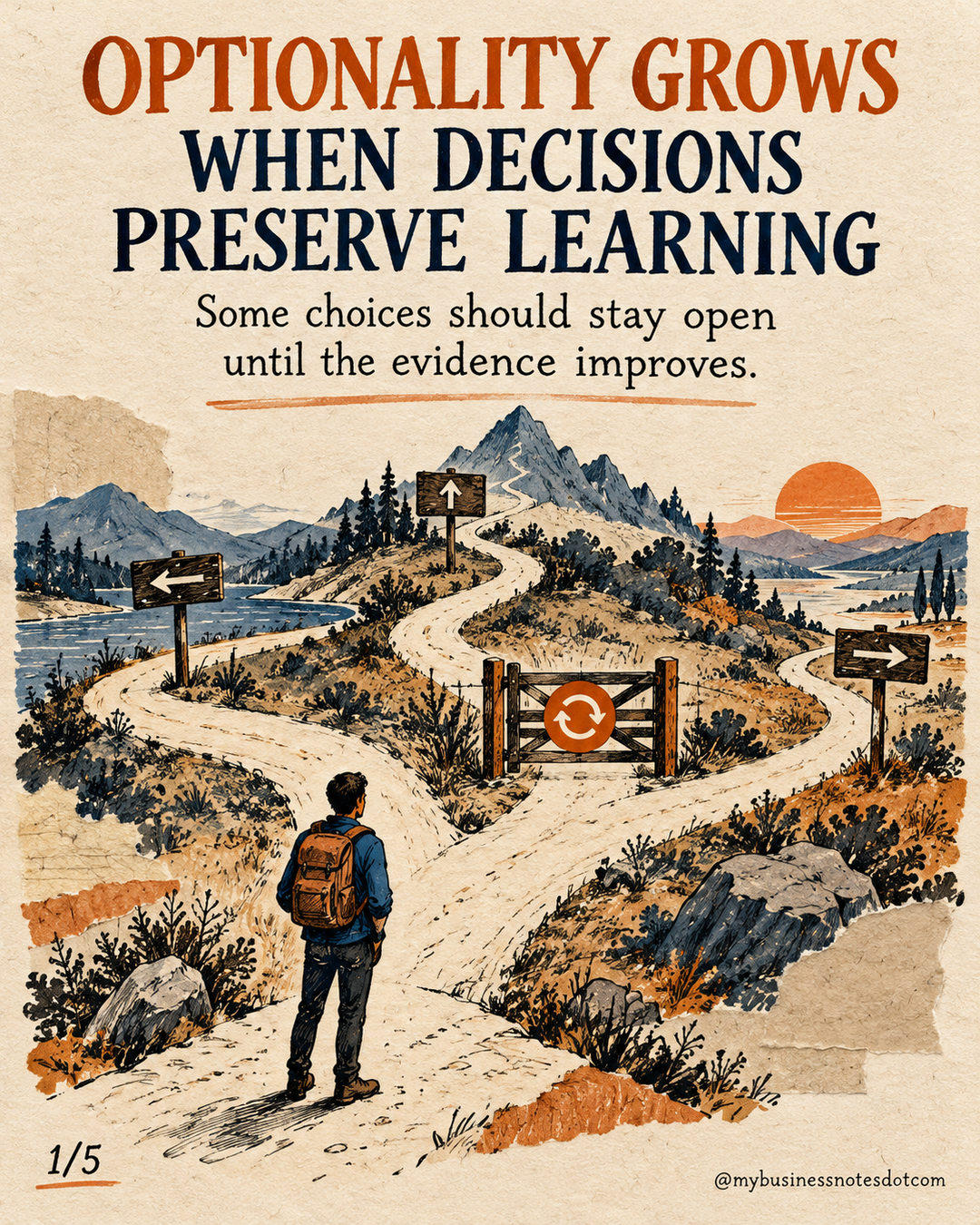
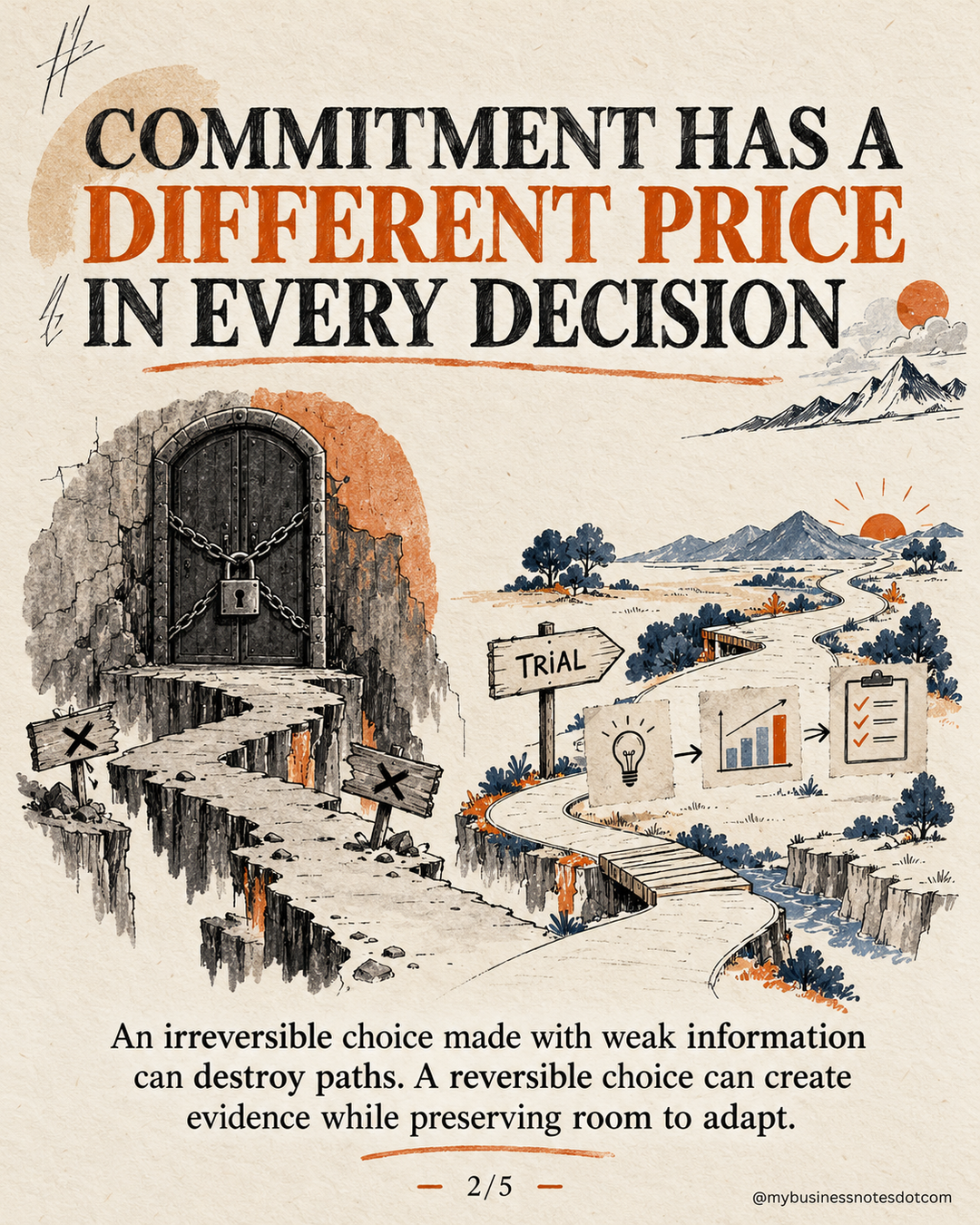
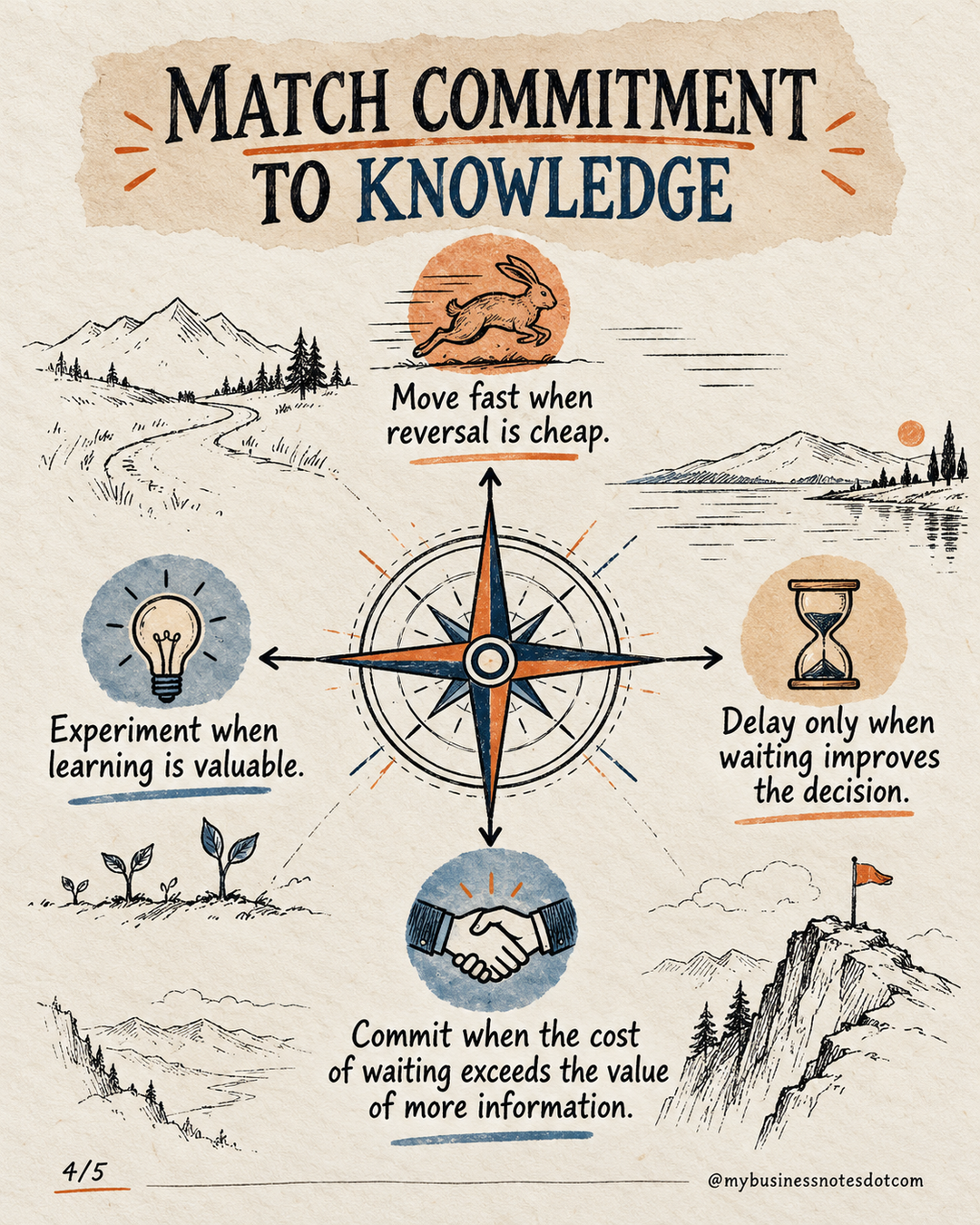
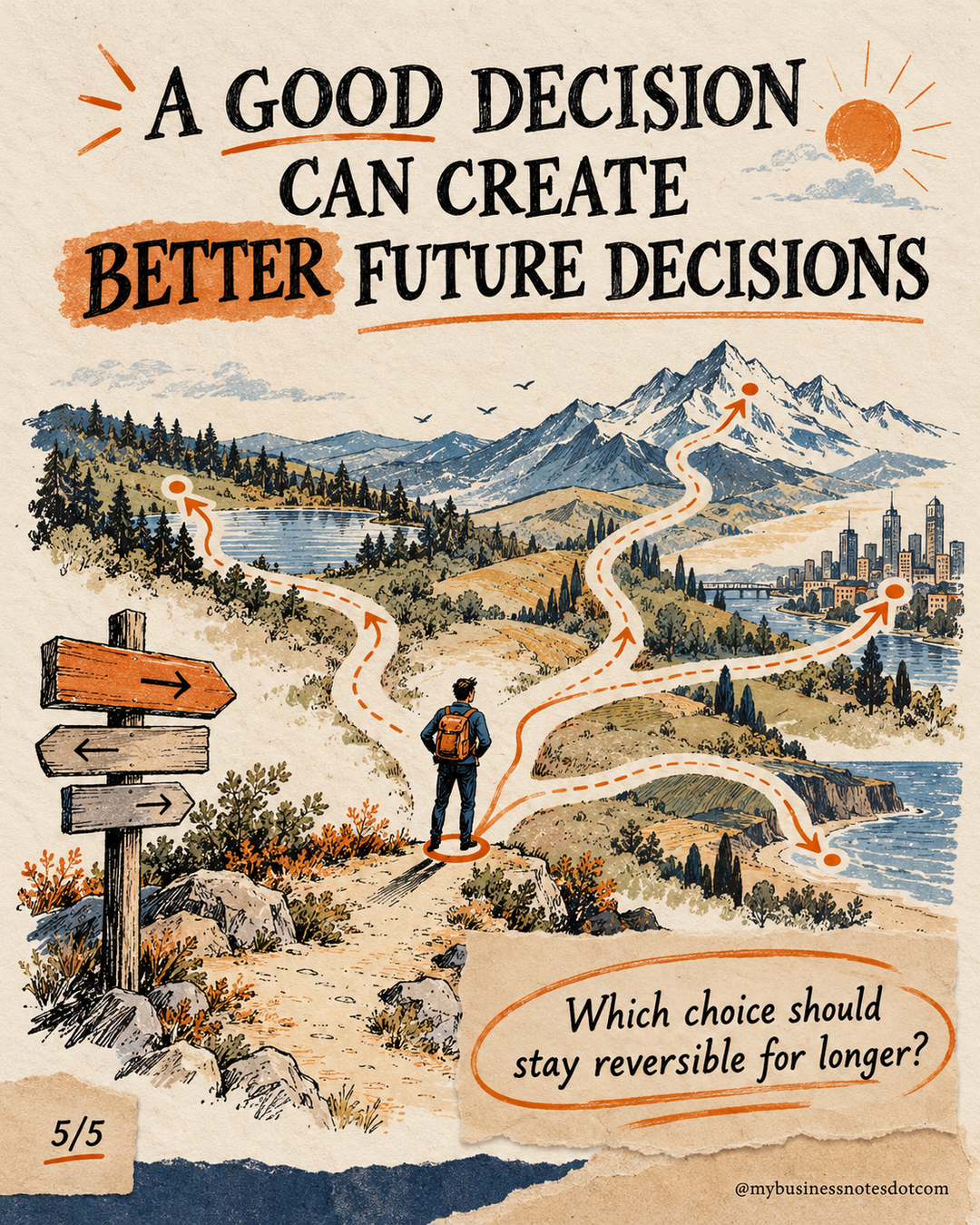
Reversible decisions are choices you can undo at an acceptable cost. They can support faster learning, but reversibility is not binary: assess money, time, customer impact and lost alternatives. Preserve an option when its learning value justifies the cost of keeping it open.
Slide 1 of 5
Why reversible decisions need a boundary
Amazon’s 2016 shareholder letter distinguishes reversible choices from decisions requiring more deliberation. That is a management perspective, not proof that speed always improves outcomes. The useful question is how much commitment this particular choice creates.
A short pilot may be reversible financially yet difficult to reverse for customers who depend on its promise. Record who bears the downside. Avoid calling a decision low-risk solely because the internal team can change the setting or cancel a purchase.
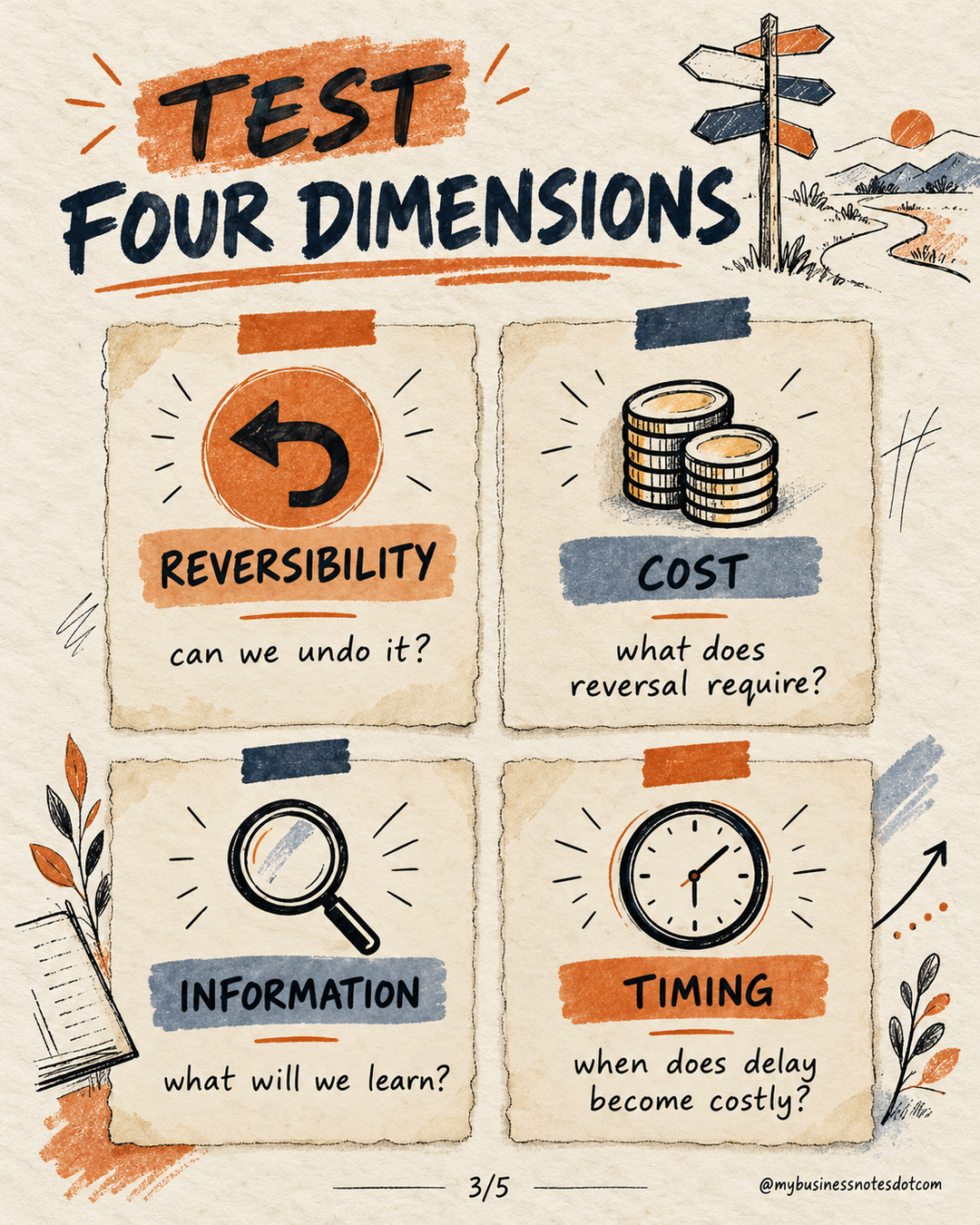
1. What would reversal actually require?
List the actions needed to return to an acceptable state: migrate information, retrain users, unwind a contract, restore access or repair a customer expectation. Include effort and dependencies, not just a cancellation fee.
The Orange Book treats responses as choices with costs, constraints and accountable owners. Apply that discipline before starting. A pre-mortem can expose an overlooked reversal problem while scope is still adjustable. Write a stop condition and identify who has authority to use it.
2. What can this choice teach us?
An option has practical value when it leaves room for a meaningful next decision. Specify the uncertainty you want to reduce and the observation that would change your view. ‘We will learn something’ is too weak to justify a pilot.
Strategyzer recommends beginning with critical hypotheses. For an illustrative onboarding redesign, test whether customers can complete the essential task before building every supporting feature. Use analysis guidance to distinguish the recorded behavior from the team’s explanation of why it happened.
3. What does waiting cost?
Keeping choices open can consume attention, duplicate work and delay a useful commitment. Estimate the operational consequences of waiting without inventing precision. Ask whether the next period is likely to produce information you could use.
Use capacity-planning to include the cost of parallel options. Make the trade-off visible: two pilots can require the same specialist at the same time. Harvard Business School’s emphasis on coherent activities is a reminder that a collection of options is not a substitute for a direction.
4. What is the smallest informative commitment?
Choose a bounded action with an owner, time limit, evidence source and review point. That may be a limited rollout, a prototype or a deliberate decision to commit now. Not every problem benefits from another experiment.
PDCA provides a simple sequence for testing an improvement and checking its effects. Define safeguards before exposure grows. A pilot that cannot answer the important question, or that hides material terms from participants, is not made useful by being small.
Review the option rather than renewing it automatically
At the review, compare what was expected with what was observed. Use a retrospective to inspect the process and separate a weak hypothesis from poor execution. Decide to expand, revise, stop or commit, and explain the evidence behind that choice.
Watch for indefinite pilots. If the team repeatedly postpones a decision without gaining decision-relevant information, preserving the option may have become avoidance. The goal is not maximum flexibility forever; it is an appropriate level of commitment for the evidence, consequences and cost of delay.
Frequently asked questions
Are reversible decisions always low-risk?
No. A technically reversible change can still create customer harm, reputational damage or expensive operational work. Assess consequences for everyone affected.
When should a team keep options open?
Keep options open when new information could change the decision and the expected learning justifies the cost of waiting or running parallel paths.
When should a pilot end?
Set a review date and evidence requirement before starting. At that point, choose whether to expand, revise, stop or commit instead of renewing the pilot by default.
Download the complete carousel
Use the five-slide worksheet in your next working session.
Related reading: Turn learning into the next decision.
International references
- Atlassian — Pre-mortem
- Jeff Bezos / Amazon — 2016 Letter to Shareholders
- Alexander Osterwalder / Strategyzer — Test the most critical hypotheses first
- Harvard Business School ISC — Creating a Successful Strategy
- Lean Enterprise Institute — PDCA
- GOV.UK User research community — Analyse a research session
- Atlassian — Capacity planning
- Atlassian — Project trade-offs
- HM Treasury / Government Finance Function — The Orange Book
- Atlassian — Sprint retrospective