

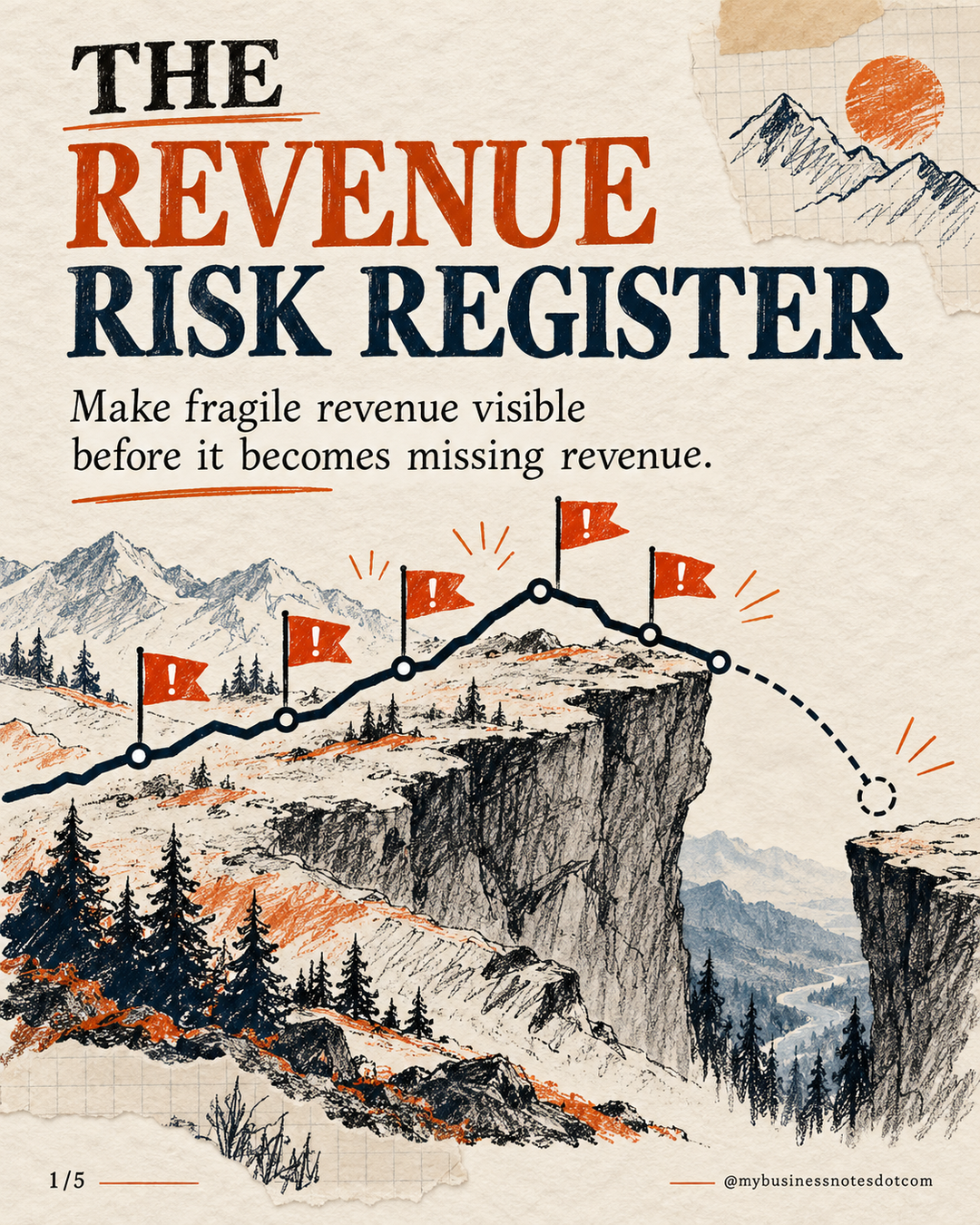
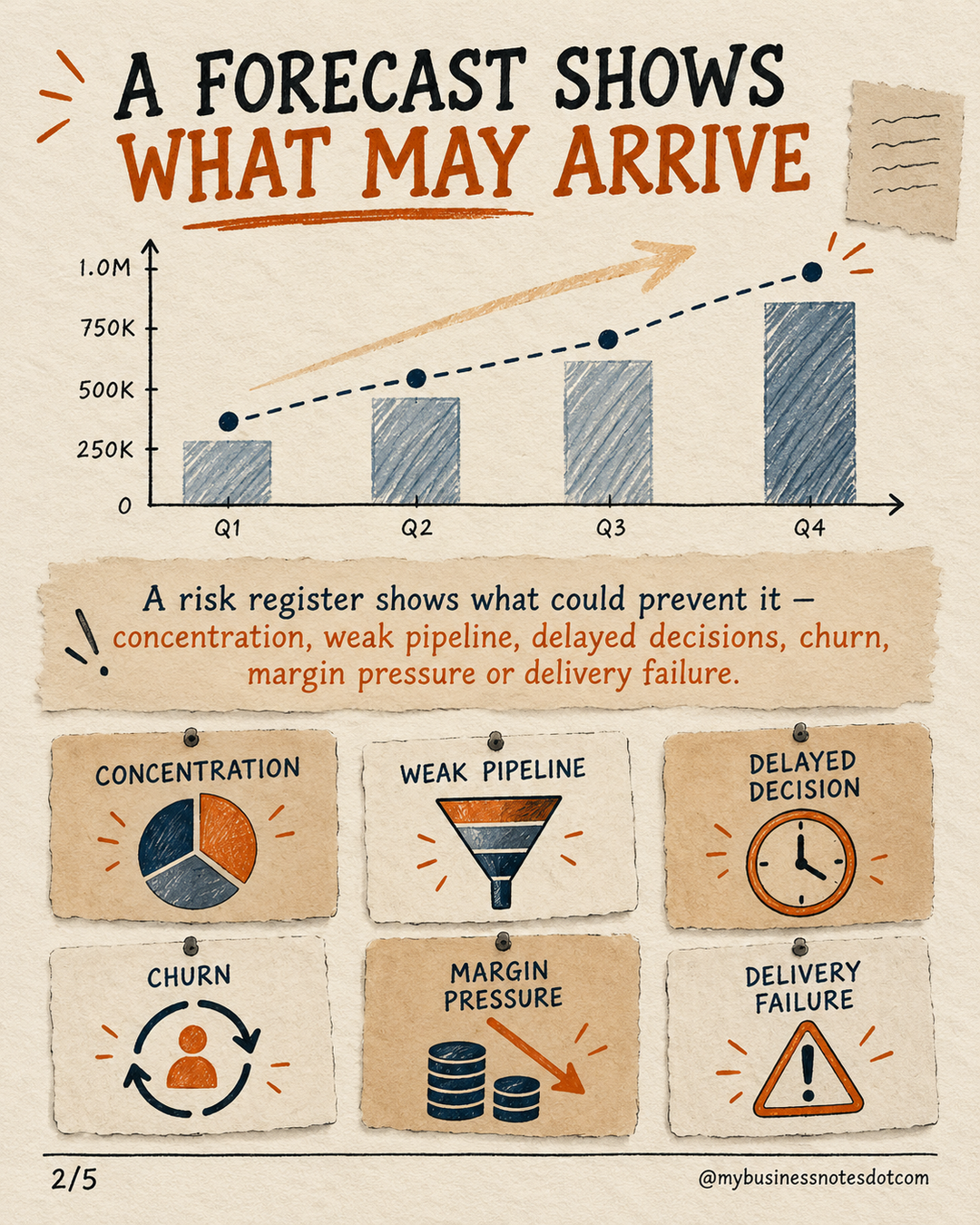
A revenue risk register records what could disrupt expected revenue, how plausible and consequential it is, what would signal change and who will respond. Use it alongside the forecast, not as a substitute for evidence or a promise of certainty.
Slide 1 of 5
Start with the objective and the uncertainty
Define the revenue objective, period and assumptions. Distinguish a risk that may occur from an issue already happening. A forecast based on a major renewal needs a different discussion from a missed payment that has already become overdue.
HM Treasury's Orange Book treats risk management as part of planning and decision-making. Its primary context is UK government, so the register below is an adapted small-business tool, not a claim of compliance with a public-sector framework.
Write the risk as a plausible cause and consequence
Avoid vague labels such as market risk. Explain what might happen, why and which part of the forecast it would affect. Useful categories can include demand, decision delays, delivery limitations and customer continuity.
Harvard Business School's strategy guidance helps connect these risks to activity choices. The Value Proposition Canvas can expose assumptions about the customer need. Neither source establishes the probability of your particular risk; that requires relevant evidence and judgment.
Assess likelihood and impact without false precision
Choose a consistent time horizon and explain the basis of each assessment. If evidence supports only a broad category, do not disguise it with an exact percentage. Keep uncertainty visible and review consequential low-frequency risks separately.
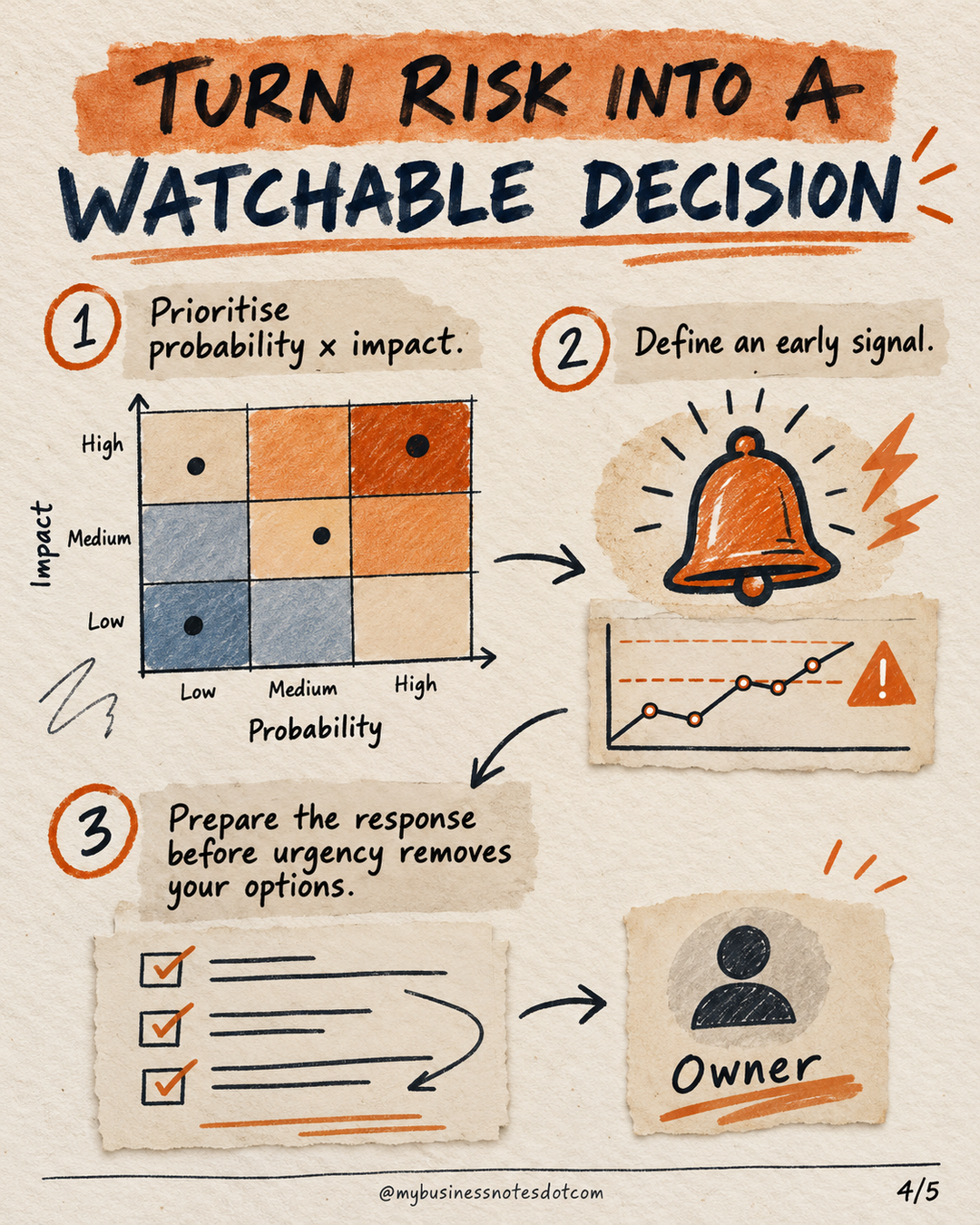
A simple rating can help organize discussion, but multiplying ordinal scores does not create a calibrated financial model. Do not add overlapping revenue exposures as if they were independent. Seek qualified support for material financial or regulatory decisions.
Define the early signal before choosing the response
Identify an observable change, its source and a threshold for review. Ask neutral questions about recent events, following GOV.UK's interview guidance and Nielsen Norman Group's advice on leading questions. Keep observations separate from interpretations using GOV.UK's analysis method.
In a hypothetical service business, several renewals depend on one delivery specialist. A growing review queue may be an early signal, but it does not prove customers will leave. Atlassian's capacity-planning guidance helps investigate the actual availability behind the concern.
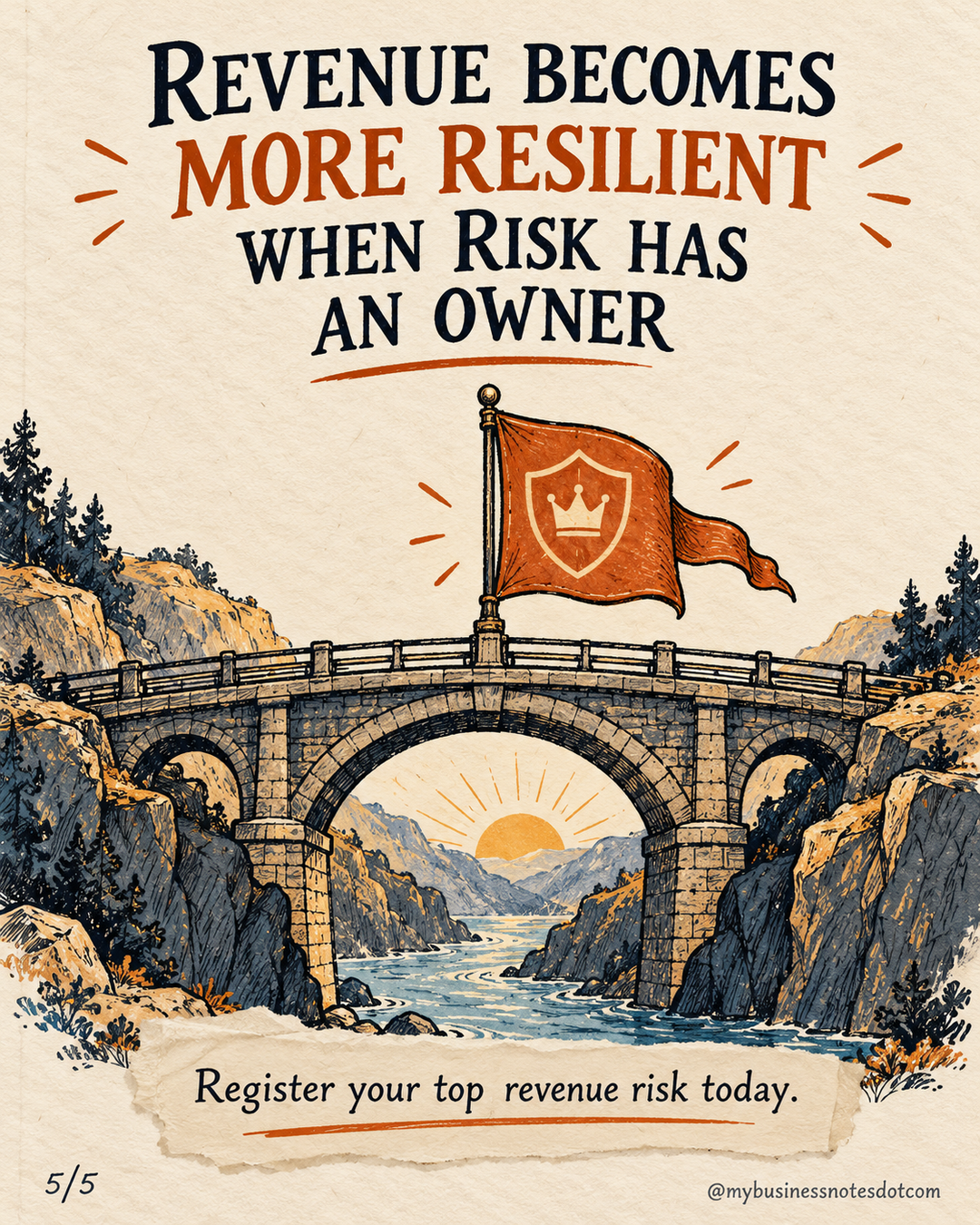
Assign a response and an accountable owner
Record what could reduce likelihood, limit impact or preserve an alternative. Name the owner, authority, resources and escalation point. A contact name without the ability to act is not a complete response.
Atlassian's trade-off method helps discuss the cost and consequences of alternatives. Compare options consistently rather than choosing the most reassuring label. Nielsen Norman Group's comparison guidance offers a useful presentation principle, though it is not a risk-assessment standard.
For the renewal example, responses might include cross-training, documented review criteria and a realistic delivery schedule. Do not claim the risk is controlled until the proposed measures exist and their effectiveness has been examined.
Keep the revenue risk register in the decision cycle
Review it when assumptions, commitments or signals change. Strategyzer's testing guidance distinguishes stated intentions from behavior; a customer saying renewal is likely is not equivalent to a signed renewal. Update confidence when better evidence arrives.
Use PDCA to test and review a response before relying on it. Retain the original assessment and explain important changes so the register does not become a rewritten history of what everyone supposedly knew.
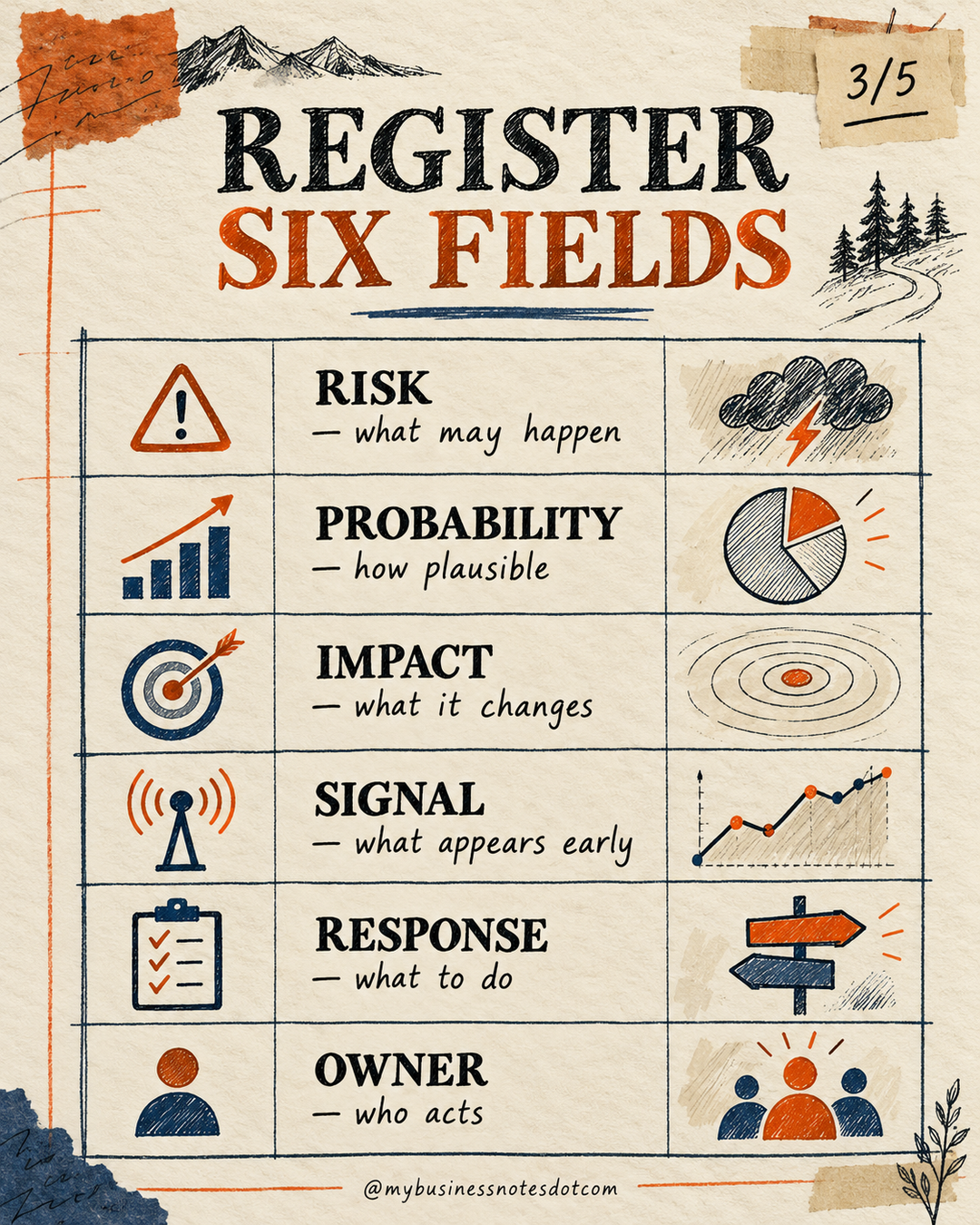
Start with six fields: risk, likelihood, impact, early signal, response and owner. Add evidence, review dates and decision records as needed. A short register used in real decisions is more valuable than a detailed list that nobody revisits.
Frequently asked questions
What belongs in a revenue risk register?
Record each risk, its likelihood and impact, an early signal, a response and an accountable owner. Attach the evidence, assumptions and review period.
Is a risk register the same as a revenue forecast?
No. The forecast describes expected outcomes under assumptions. The register identifies uncertainties and responses that may affect those outcomes.
Should every risk receive an exact probability?
No. Use a level of precision supported by the evidence. Explain uncertainty and avoid treating simple qualitative ratings as calibrated probabilities.
Download the complete carousel
Use the five-slide worksheet in your next working session.
Related reading: Turn learning into the next decision.
International references
- Harvard Business School ISC — Creating a Successful Strategy
- Lean Enterprise Institute — PDCA
- Strategyzer — Value Proposition Canvas
- Nabila Amarsy / Strategyzer — Ways to test your value proposition
- GOV.UK User research community — Analyse a research session
- GOV.UK User research community — Using in-depth interviews
- Atlassian — Capacity planning
- Kate Moran and Taylor Dykes / Nielsen Norman Group — Comparison tables
- Atlassian — Project trade-offs
- Amy Schade / Nielsen Norman Group — Avoid leading questions
- HM Treasury / Government Finance Function — The Orange Book