
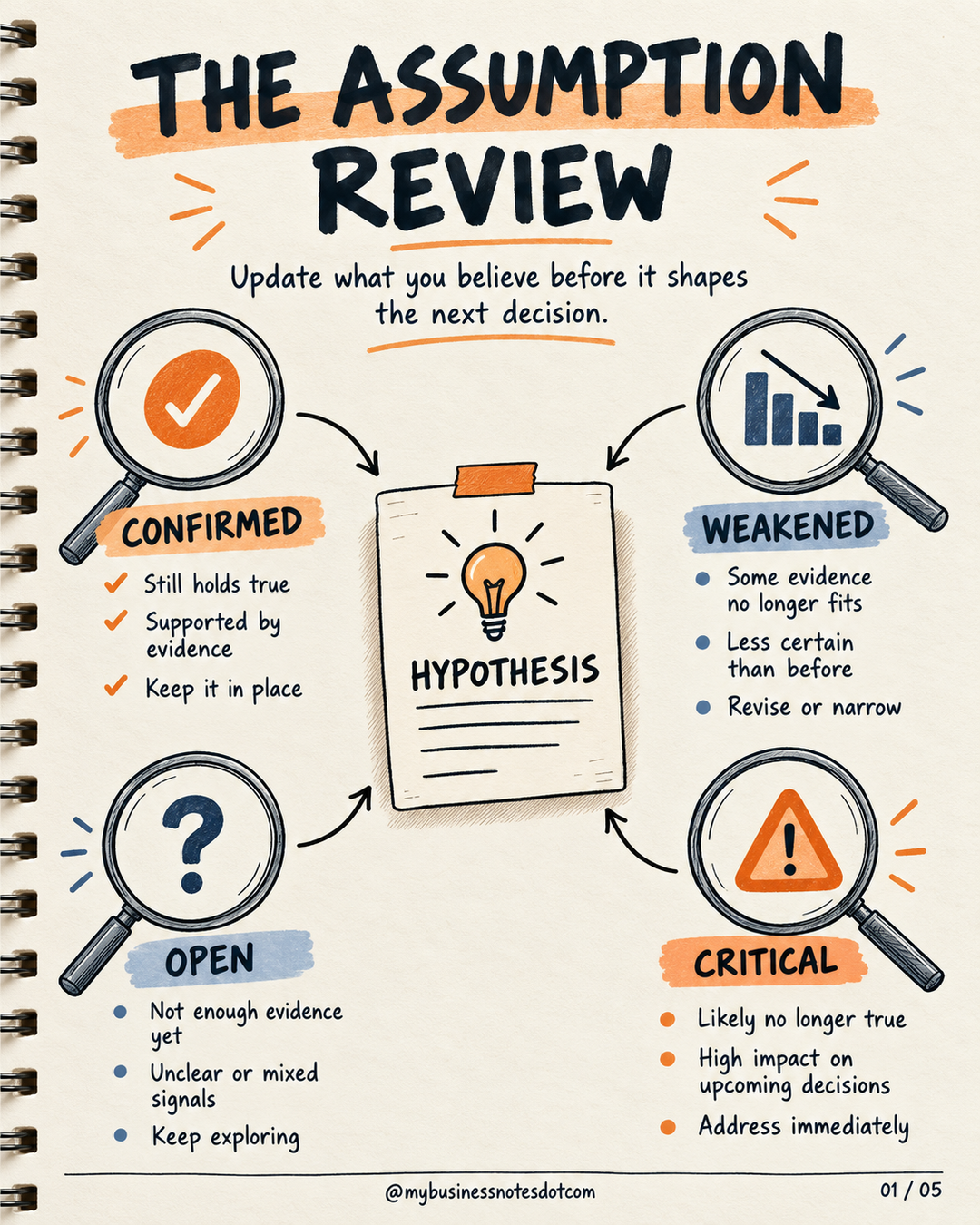
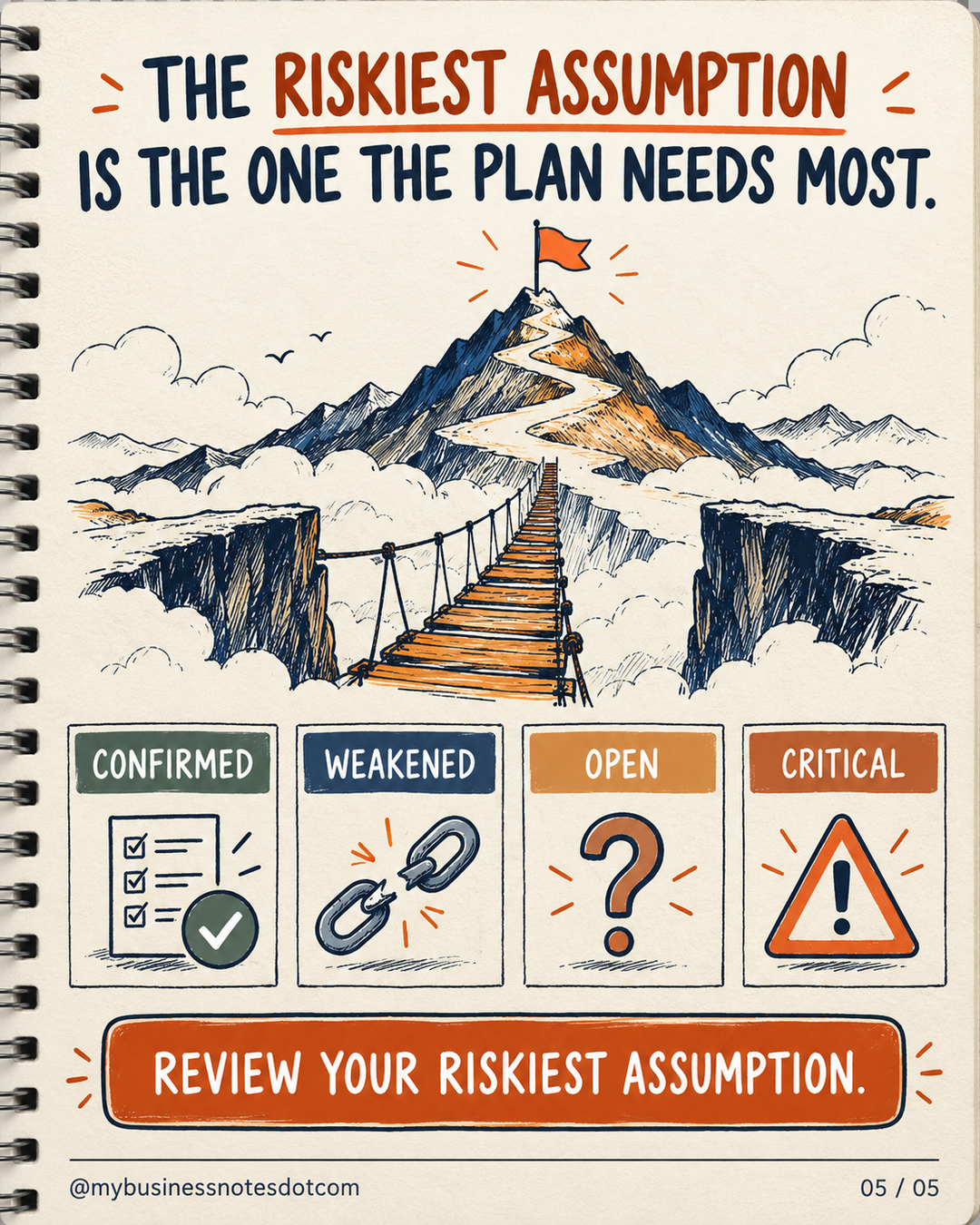
An assumption review checks the claims a decision depends on against current evidence. Separate claims that remain supported, have weakened or are still open, then flag the ones whose failure would change the decision. Criticality is a risk dimension, not a substitute for confidence.
Slide 1 of 5
Make the hidden claims explicit
A launch plan may depend on customers recognizing the problem, accepting the proposed workflow and paying enough to cover delivery. Those are separate assumptions. Approval of the plan does not confirm any of them.
Strategyzer recommends identifying critical hypotheses before choosing experiments. Start with what must be true, then ask how you would recognize a contradiction. A claim that cannot be challenged is too vague to guide useful research.
Classify evidence without overstating certainty
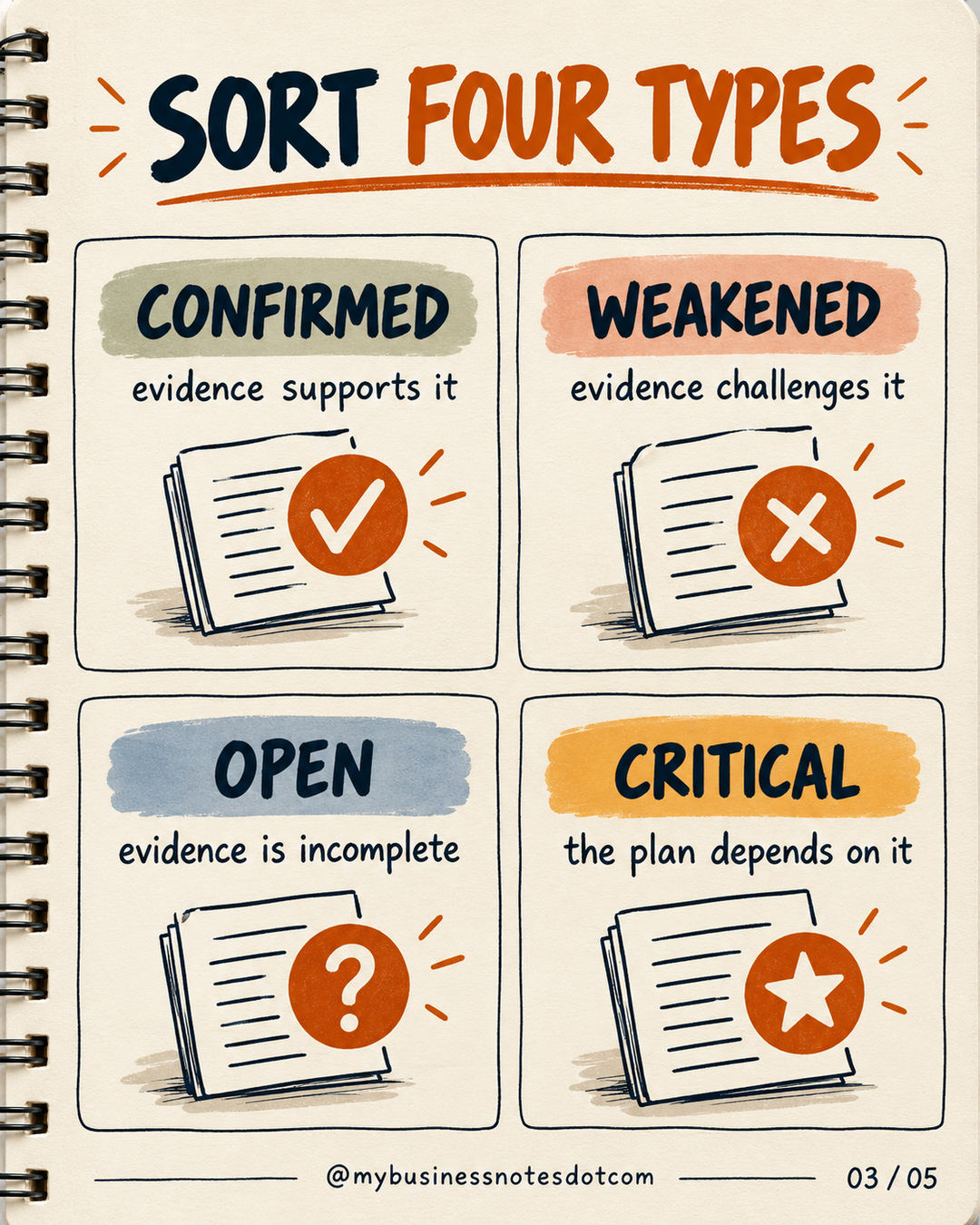
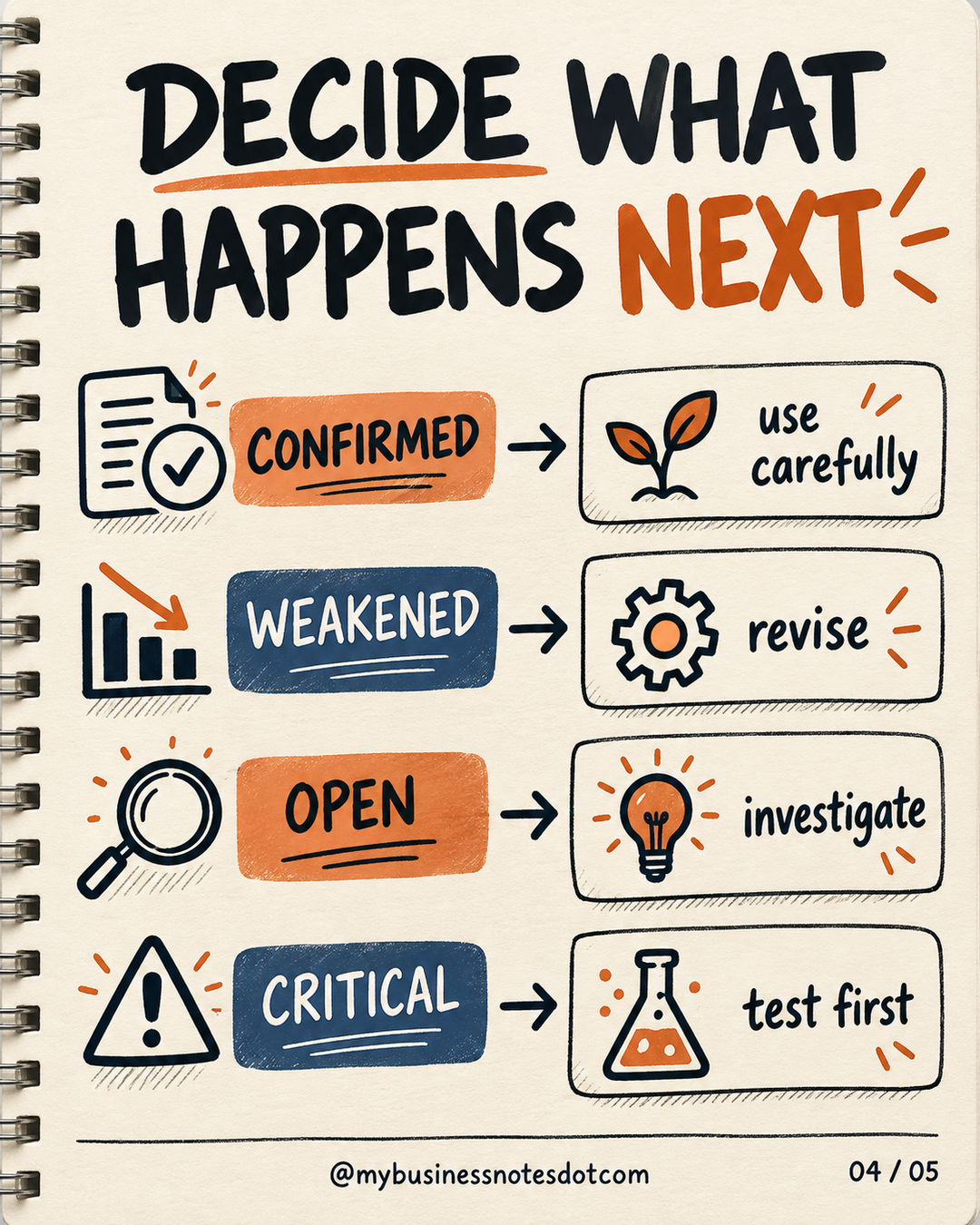
In the carousel, ‘confirmed’ means supported sufficiently for the present decision—not permanently proven. ‘Weakened’ means new information has reduced confidence. ‘Open’ means relevant evidence is missing or inconclusive. Retain the date and scope of the evidence.
Flag a claim as critical separately when its failure would materially change the choice. A critical claim may be well supported or almost untested. Keeping impact separate from confidence prevents a tidy status label from concealing the biggest risk.
Check whether the evidence answers the claim
Interviews can clarify circumstances but cannot establish a future purchase by themselves. A demonstration can reveal comprehension without establishing routine use. Match the method to the question rather than declaring all positive feedback equivalent.
Nielsen Norman Group discusses the limits of remembered and predicted behaviour. Strategyzer likewise distinguishes what customers say from what they do. Use several appropriate sources where the stakes justify it, and keep the test’s limitations in the review.
Inspect the oldest important belief
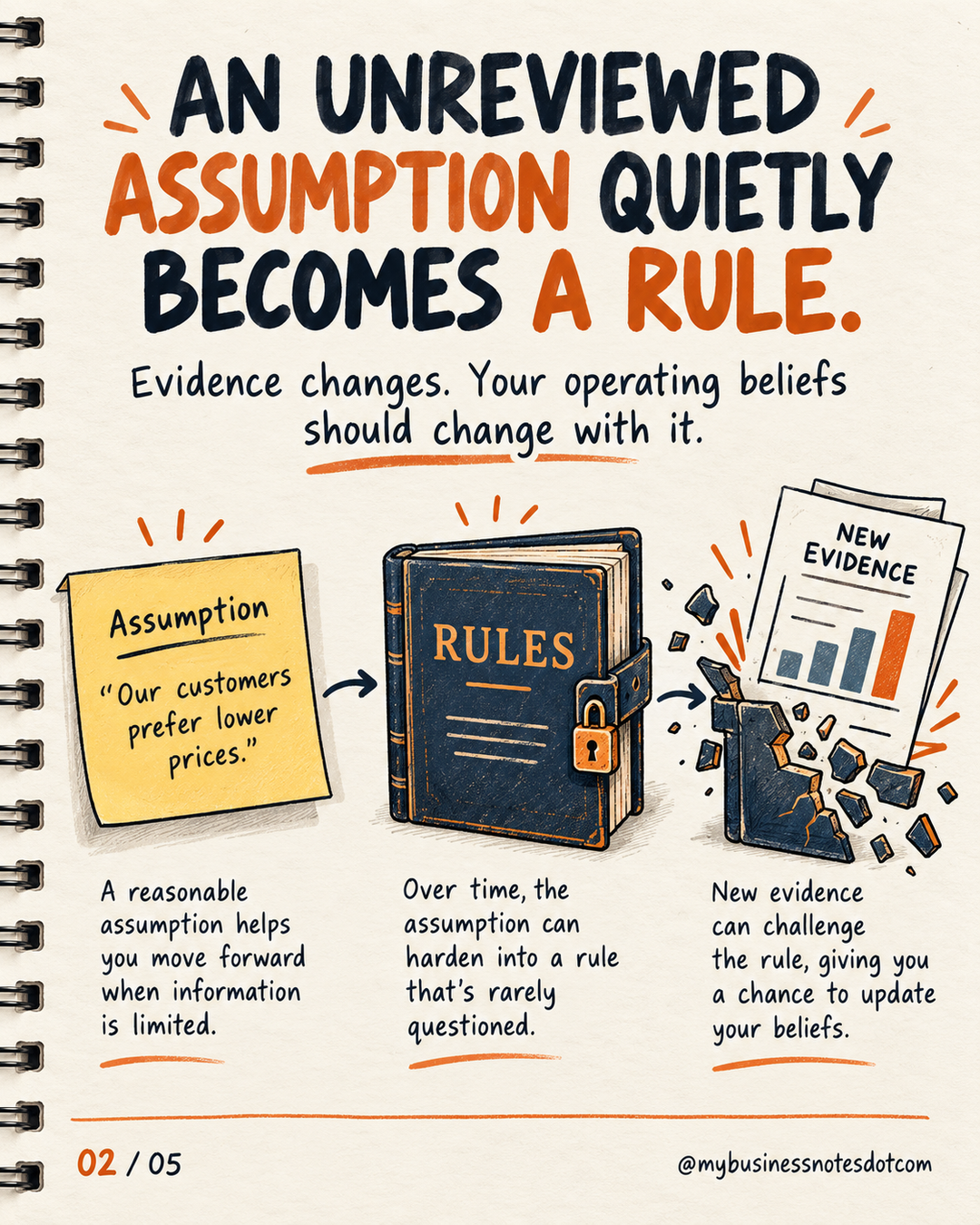
Teams often test new ideas while leaving a familiar assumption untouched. Ask what has changed in the customer’s situation, alternatives, delivery capacity or economics since the claim was first recorded. Age alone does not invalidate evidence, but changed conditions can limit its relevance.
Review the source rather than the confidence of the person repeating it. Where accounts conflict, investigate differences in segment, timing or method. A disagreement may expose two distinct situations rather than one side being wrong.
Example: demand exists, delivery does not yet work
Imagine a service with several paid pilots but unpredictable implementation effort. The team has evidence for some willingness to pay while the delivery-cost assumption remains weak. This hypothetical example shows why one positive signal cannot validate the whole model.
Instead of accelerating acquisition, it runs a bounded delivery test with clear cost and quality measures. The review records what would justify expansion, what would require redesign and who will make that decision.
Leave the review with a next action
For every critical open or weakened assumption, choose a test, a smaller commitment or a pause. Name the owner, the evidence required and the review date. Some uncertainty can be accepted explicitly when the cost of learning exceeds the immediate risk.
Keep the history. A record of why confidence changed makes the next review more useful and reduces hindsight storytelling. The purpose is not to eliminate uncertainty; it is to make the uncertainty behind a commitment visible and manageable.
Frequently asked questions
Does confirmed mean proven forever?
No. It means sufficiently supported for a defined decision and context. New evidence can change the assessment.
Is every open assumption critical?
No. Criticality depends on what would change if the claim were false, not just on the amount of evidence available.
How often should assumptions be reviewed?
Review before consequential commitments and when relevant conditions or evidence change; choose a regular cadence that fits the work.
Download the complete carousel
Use the five-slide worksheet in your next working session.
Related reading: Turn learning into the next decision.
International references
- Strategyzer / Kurt Bostelaar — Customer interviews that produce insights
- Strategyzer / Alex Osterwalder — Don’t believe your customers
- Strategyzer / Nabila Amarsy — Ways to test your value proposition
- Strategyzer / Nabila Amarsy — Roadmap to test your value proposition
- Strategyzer / Alex Osterwalder — Start with critical hypotheses
- GOV.UK User research community — Using in-depth interviews
- Christensen Institute — Jobs to Be Done
- Nielsen Norman Group / Jakob Nielsen — Interviewing Users
- Nielsen Norman Group / Amy Schade — Avoid Leading Questions
- Strategyzer — Value Proposition Canvas