
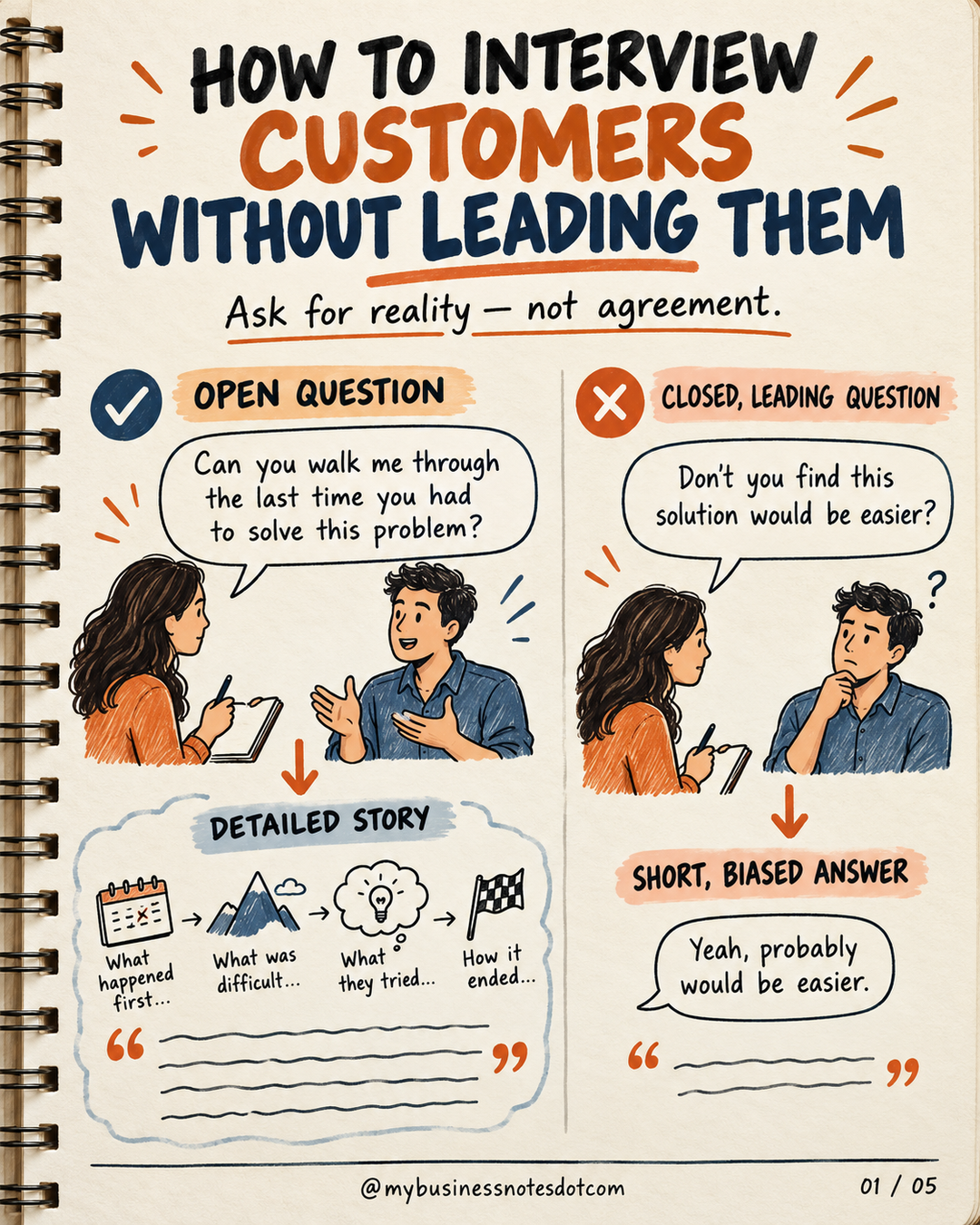
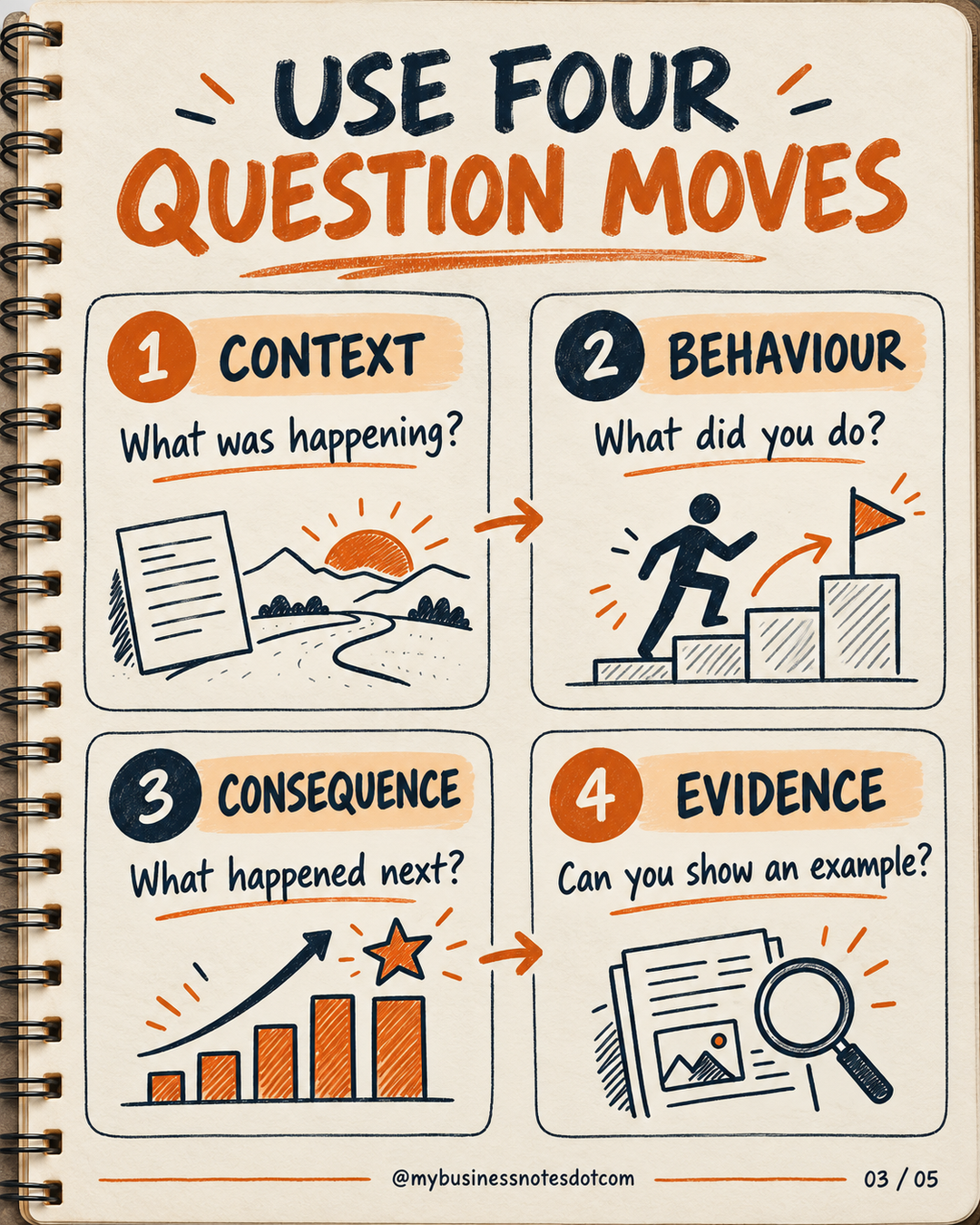
Good customer interviews explore what happened without planting the answer. Ask about a concrete situation, the person’s actions, the consequences and any evidence they can safely share. The goal is to improve understanding, not to collect agreement with an idea you already want to build.
Slide 1 of 5
Define the uncertainty before writing questions
Decide which decision the research will inform. ‘Do customers like our idea?’ invites reassurance; ‘How do teams handle an incomplete handover today?’ opens a specific area for learning. Recruit people with relevant experience rather than whoever is easiest to reach.
Explain the purpose, ask permission to record and avoid collecting information you do not need. GOV.UK’s interview guidance recommends a logical discussion guide and open, neutral questions. Treat the guide as a route through the topic, not a questionnaire you must rush to finish.
Ask for context, then reconstruct behaviour
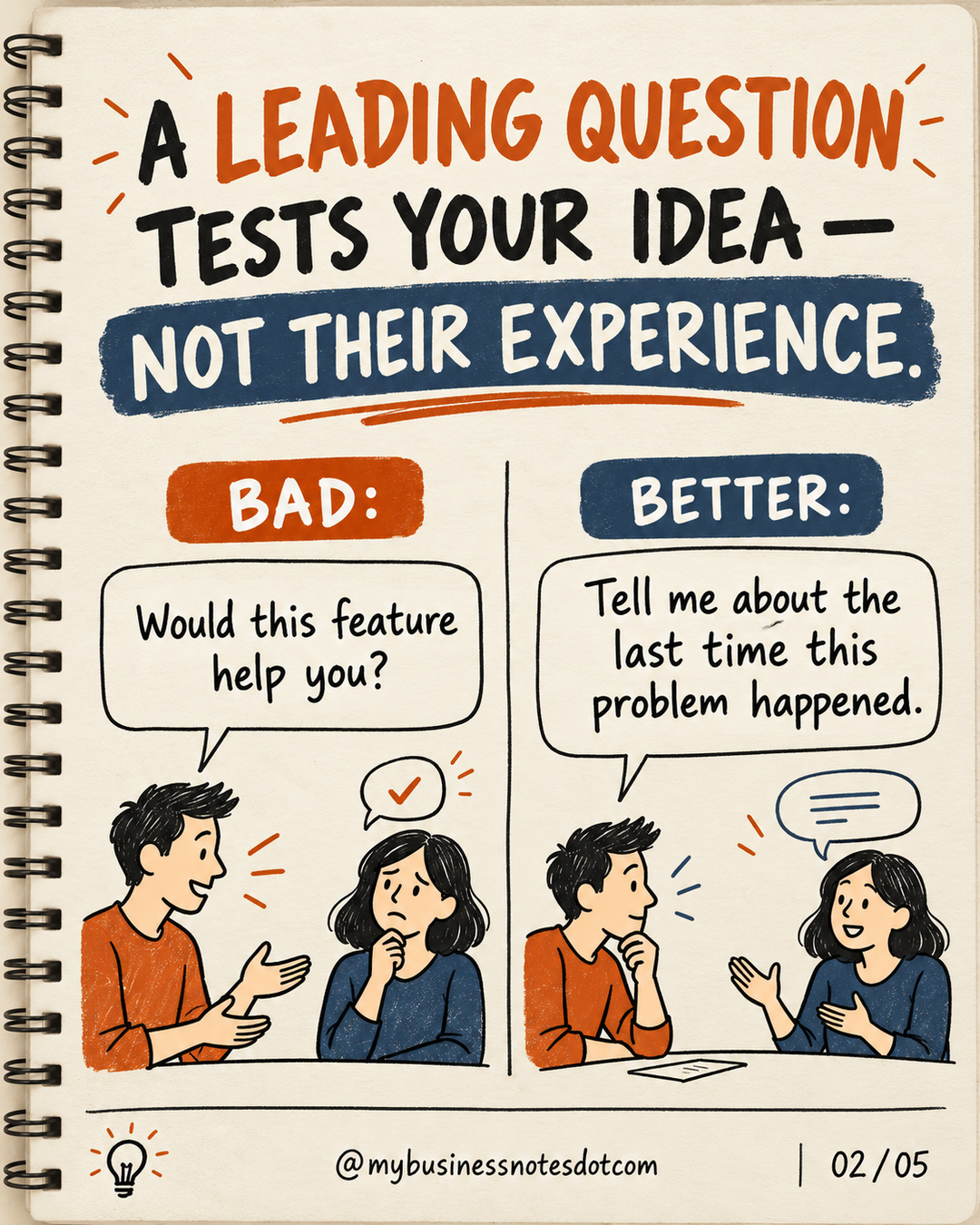
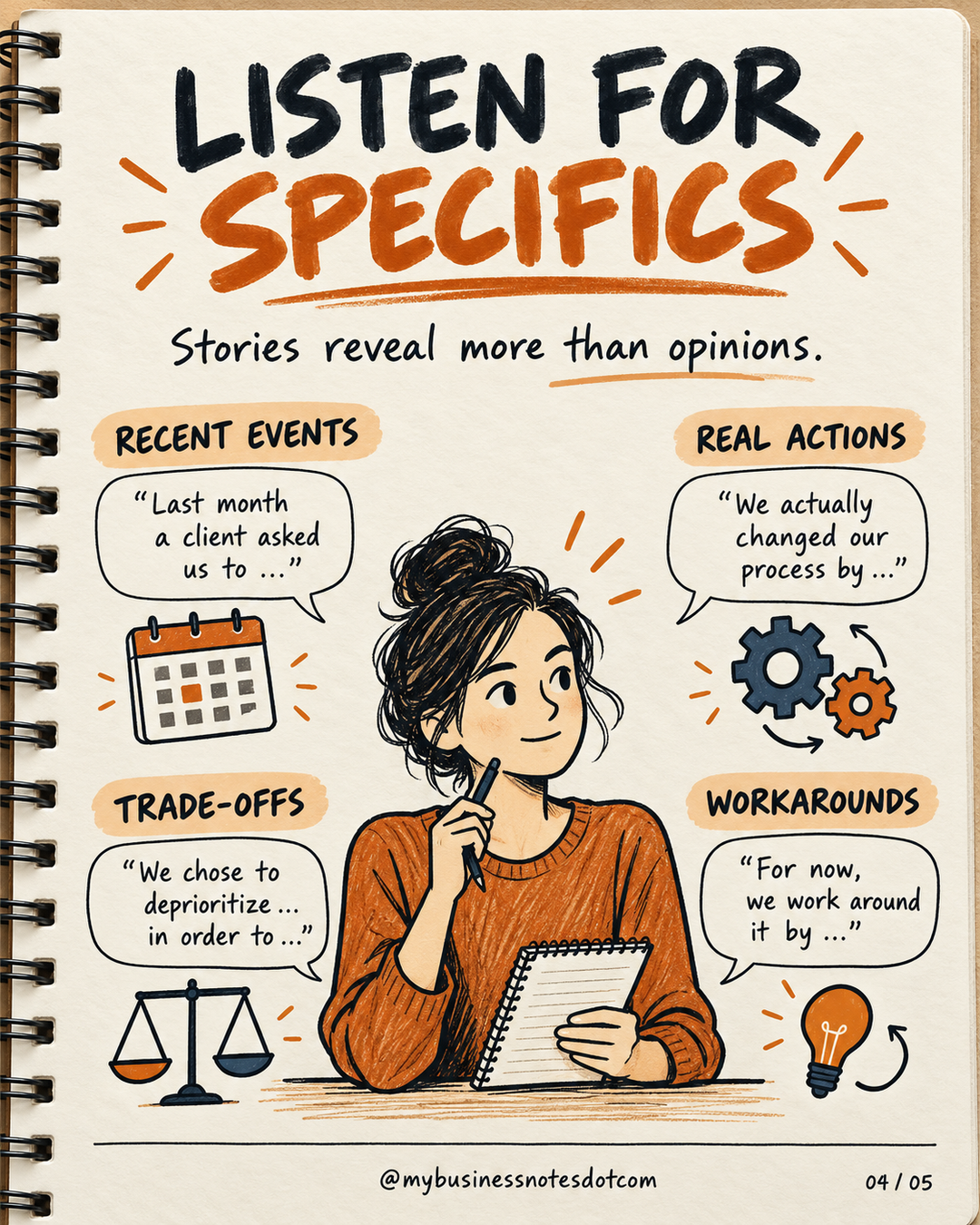
Begin with a recent event: ‘Tell me about the last time this happened.’ Ask what preceded it, who was involved and what the person did next. Follow the sequence before asking for an explanation.
Past accounts are useful but imperfect. Nielsen Norman Group warns that memory can be incomplete or rationalized. If appropriate, ask the participant to walk through a current process or describe an artefact without exposing confidential details. Do not present remembered behaviour as direct observation.
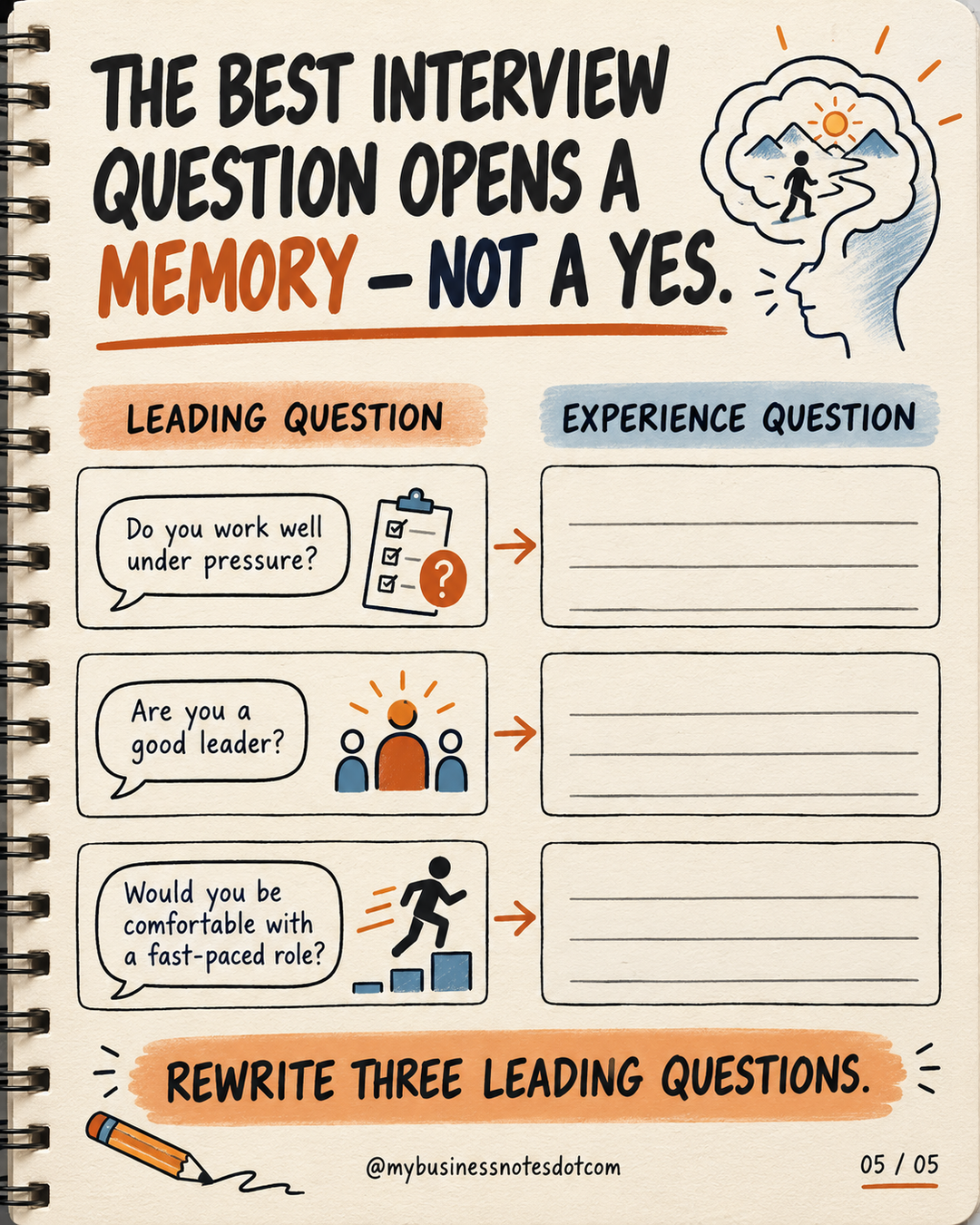
Remove the answer hidden in the question
‘How frustrating was the delay?’ assumes frustration. Ask instead, ‘What happened while you were waiting?’ ‘Would our dashboard solve that?’ introduces the proposed solution before you understand the problem. Ask what they tried, what they used and why they chose it.
Neutrality also includes your reactions. Praising answers that support the idea can teach a participant what you want to hear. Use simple follow-ups—‘Can you give an example?’ or ‘What happened next?’—and leave space for an answer that contradicts your assumptions.
Explore consequences without exaggerating them
A complaint is not automatically an important problem. Ask what the event changed: lost time, extra work, a delayed decision or nothing consequential. Then ask how they responded. An inconvenient step people tolerate may differ from a problem they actively spend effort to resolve.
Strategyzer distinguishes what people say from what they do and recommends further tests for critical assumptions. Interview findings can guide those tests. They cannot, by themselves, prove willingness to pay or the future success of a product.
Separate observations from interpretations
After each conversation, record the evidence before writing the finding. Keep quotations accurate, label paraphrases and distinguish what you saw from what someone recalled. Compare relevant accounts while retaining differences instead of averaging away the context.
Look deliberately for contradictory cases. Strategyzer describes structured customer-profile interviews that let people challenge assumptions; that can help comparison, but showing your categories too early may constrain what emerges. For exploratory work, begin with the person’s own account before introducing prompts or ranking exercises.
Example: from a leading question to a useful test
Imagine a team planning a reporting dashboard. Instead of asking, ‘Would automatic reporting save you hours?’, it asks a participant to describe the last reporting cycle. The person explains that collecting figures was quick; agreeing on definitions caused the delay. This is a hypothetical illustration, not a research finding.
The next test should investigate definitions and agreement, not automatically validate a dashboard. Finish the interview by asking what you missed, then turn the findings into an explicit decision or research question. An interview is useful when it changes what you need to learn—not when the notes contain more compliments.
Frequently asked questions
How many customer interviews are enough?
There is no universal number. Recruit relevant participants, inspect differences and decide whether the evidence is sufficient for the specific decision and its risk.
Can we show our idea during the interview?
Yes, when testing the idea is the research purpose. Keep that part separate from open exploration so exposure to the solution does not contaminate the earlier account.
Should we record every interview?
Only with informed permission and a clear need. Use secure, proportionate handling and avoid collecting sensitive information unnecessarily.
Download the complete carousel
Use the five-slide worksheet in your next working session.
International references
- Strategyzer / Kurt Bostelaar — Customer interviews that produce insights
- Strategyzer / Alex Osterwalder — Don’t believe your customers
- Strategyzer / Nabila Amarsy — Ways to test your value proposition
- Strategyzer / Nabila Amarsy — Roadmap to test your value proposition
- Strategyzer / Alex Osterwalder — Start with critical hypotheses
- GOV.UK User research community — Using in-depth interviews
- Christensen Institute — Jobs to Be Done
- Nielsen Norman Group / Jakob Nielsen — Interviewing Users
- Nielsen Norman Group / Amy Schade — Avoid Leading Questions
- Strategyzer — Value Proposition Canvas
- April Dunford — The job of a market category
- Nielsen Norman Group / Megan Chan — Mental Models
- Nielsen Norman Group / Kate Kaplan — Customer Journey Maps
- GOV.UK User research community — Analyse a research session