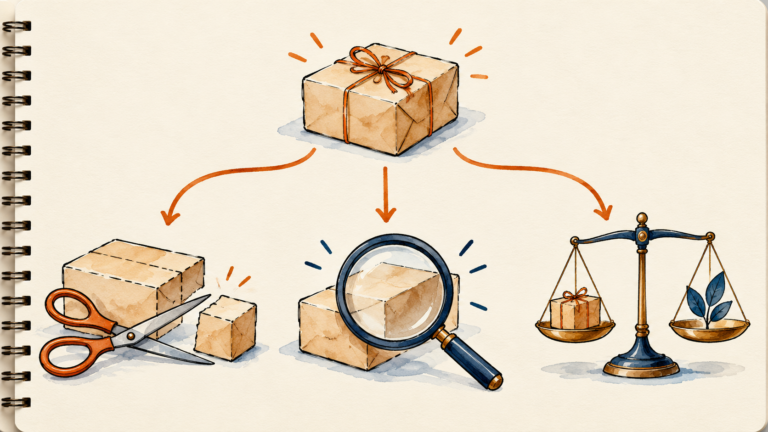

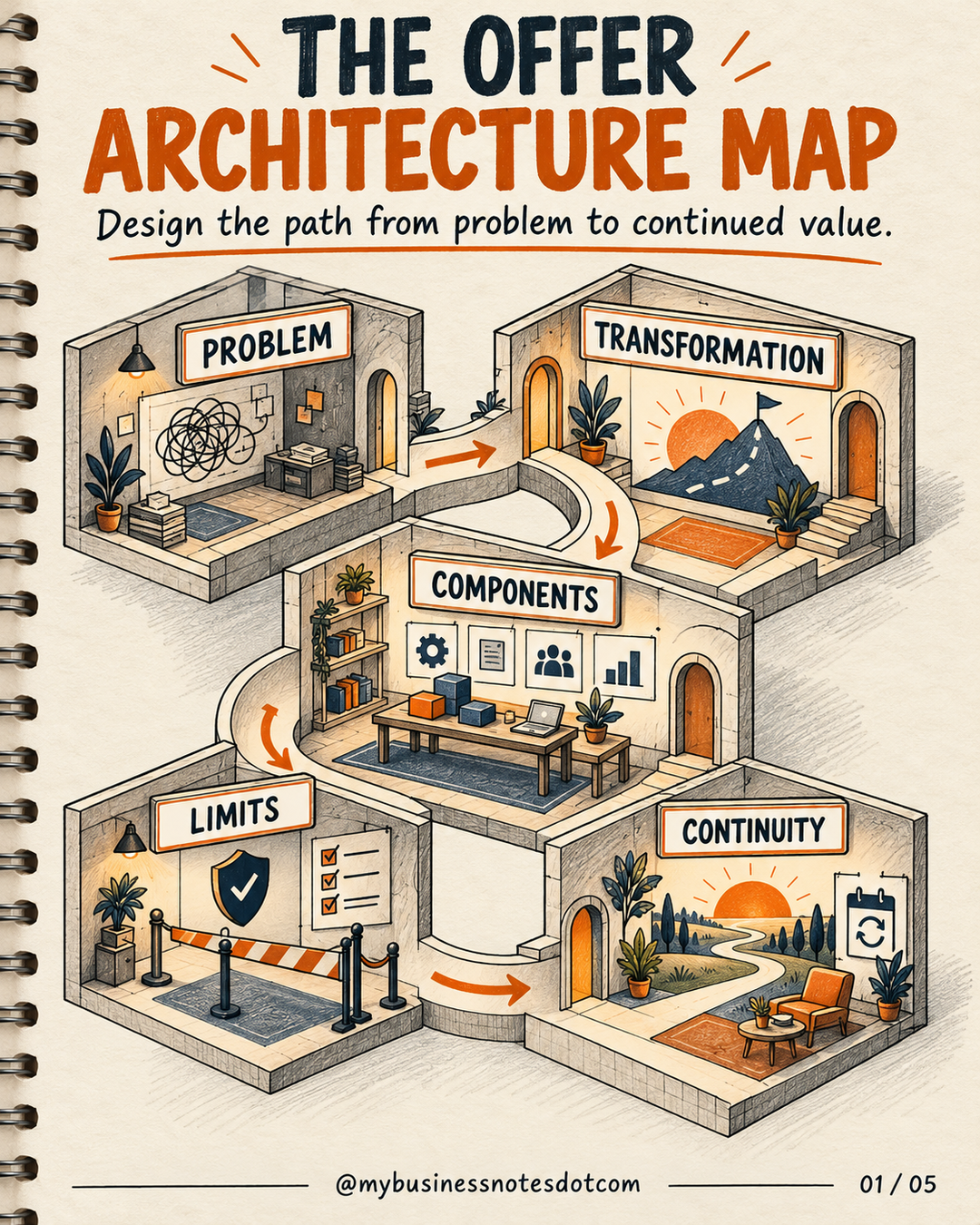
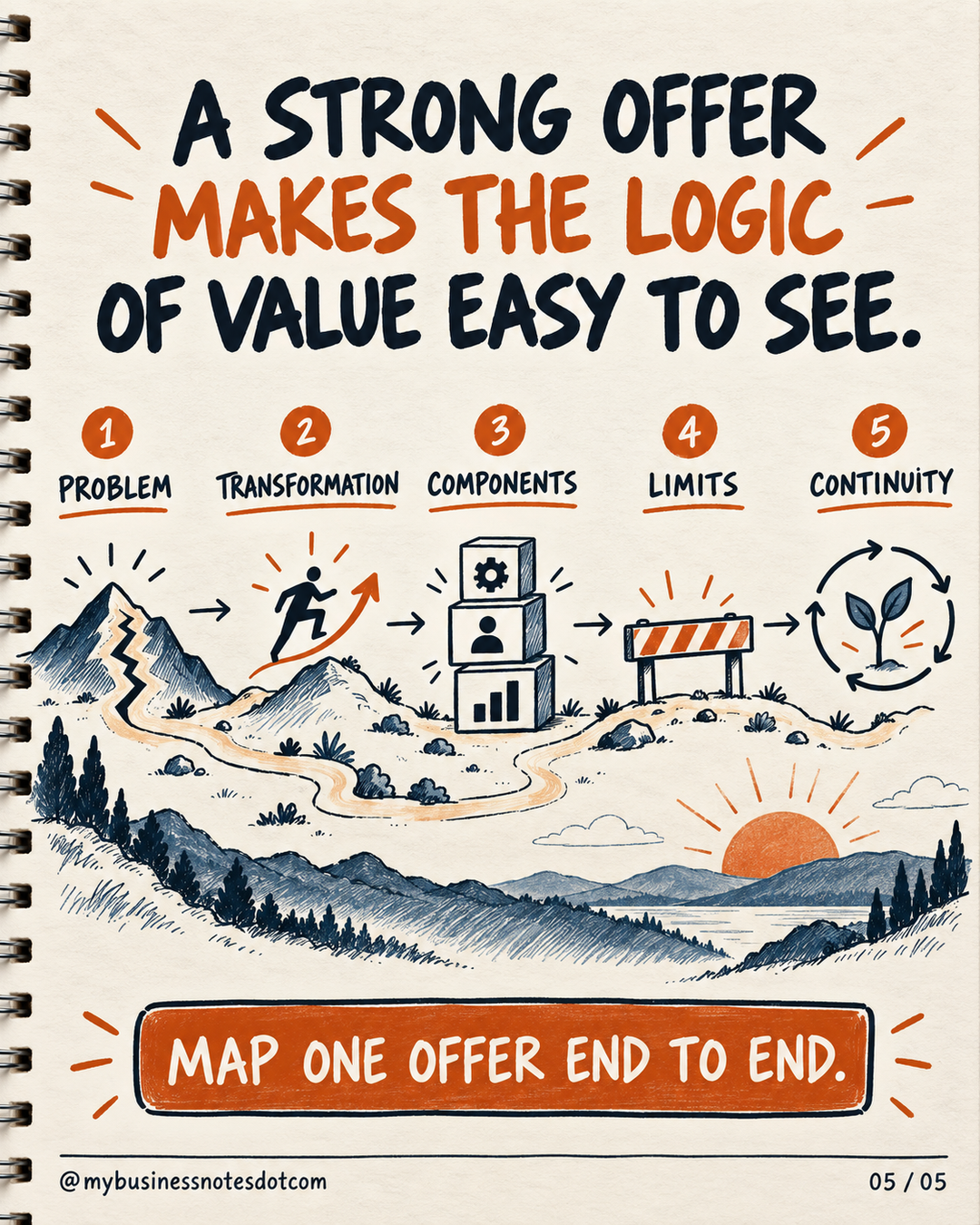
An offer architecture map links the customer's problem to the intended change, delivery components, boundaries and continuity. It shows why each part exists and exposes promises that the operating model cannot yet support.
Slide 1 of 5
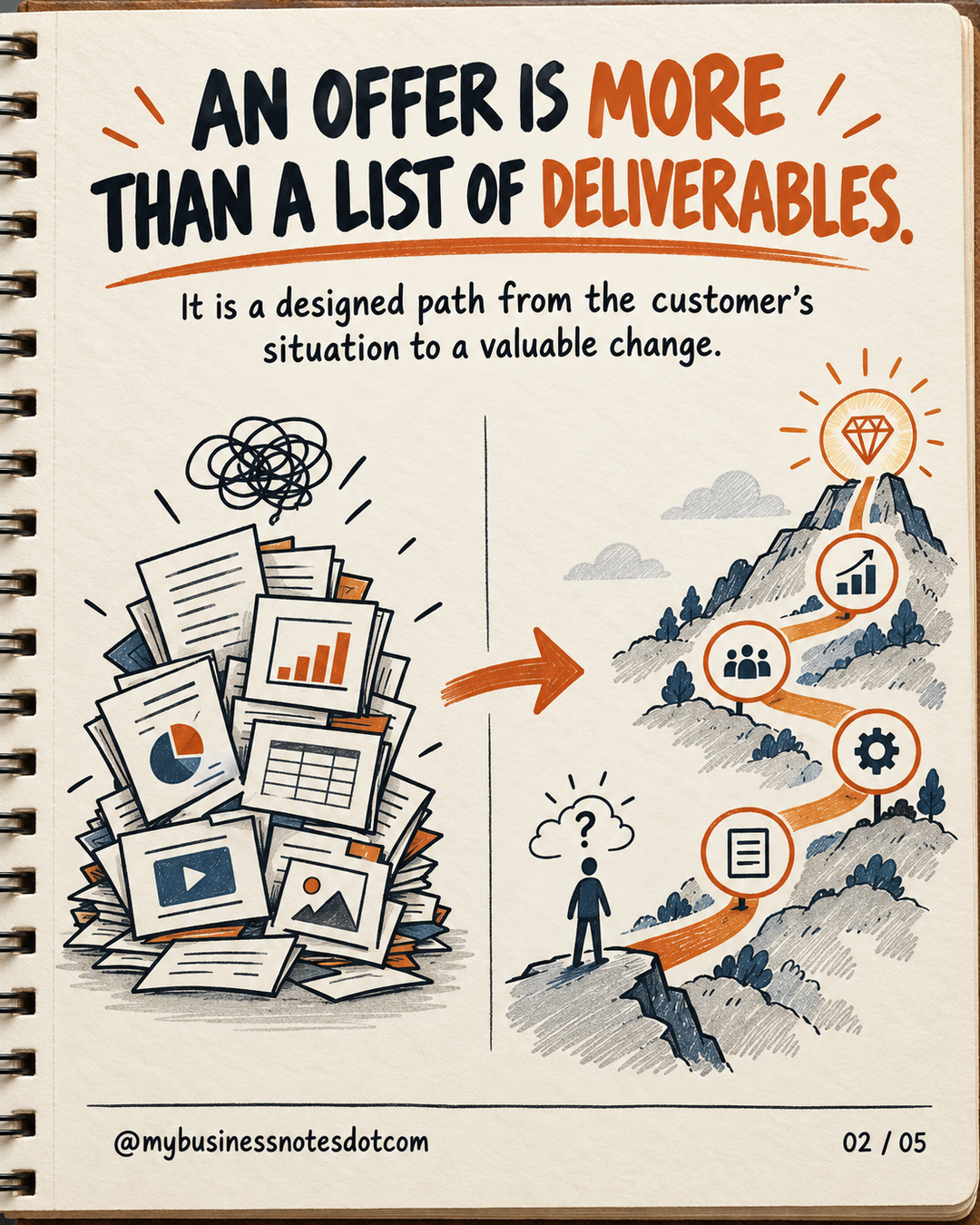
Why a deliverables list is not an offer design
A proposal can contain workshops, reports and dashboards without explaining how they help the customer. The buyer is then left to assemble the logic. Begin with a specific situation and work toward a plausible change, rather than starting with everything your team can produce.
Harvard Business School's strategy guidance connects a value proposition with distinctive activities and trade-offs. This is a useful design principle: the offer should reflect how the business actually works, not just how it wants to sound.
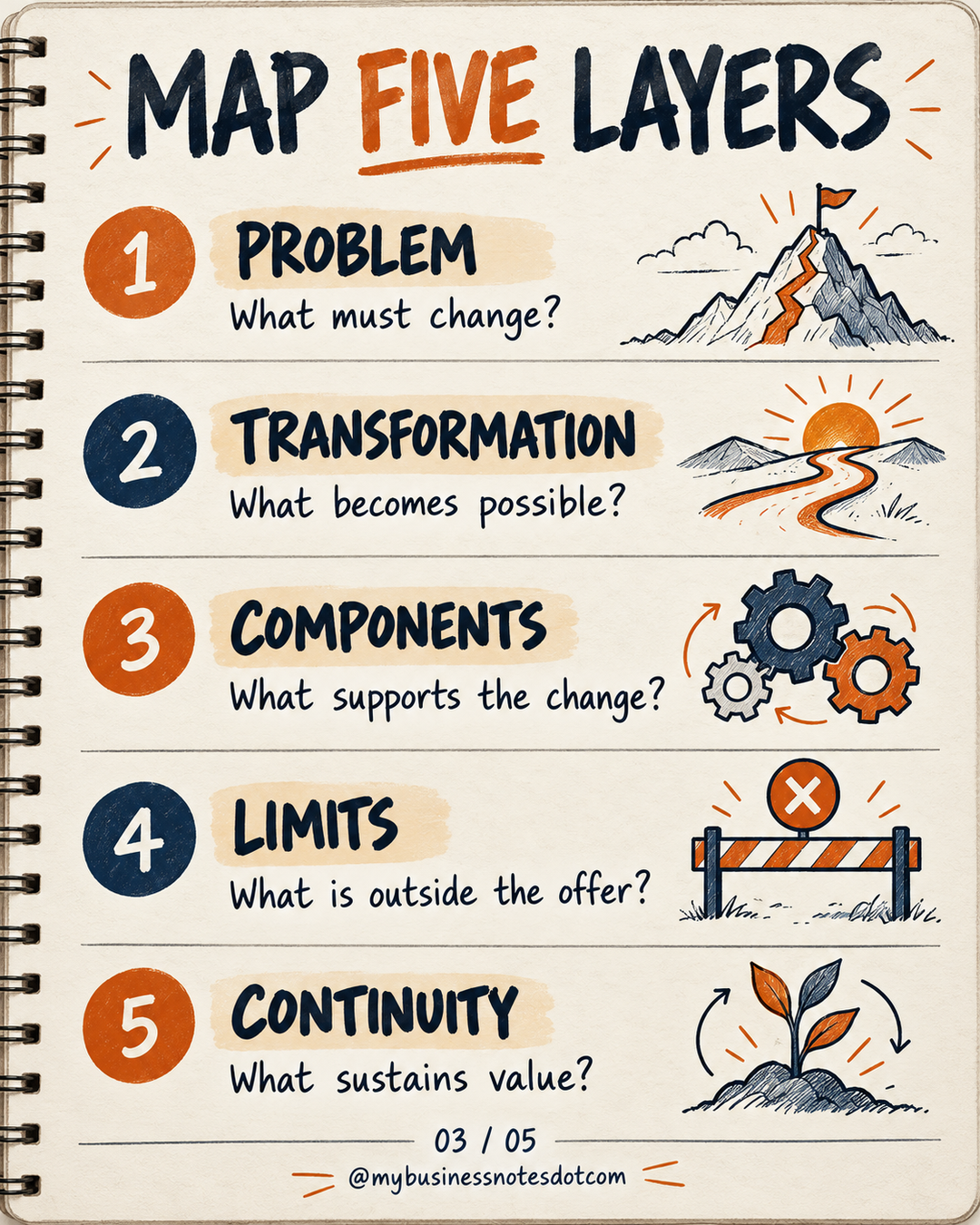
Problem: define the job and its circumstances
Identify who experiences the problem, what triggers it and what alternative they use. Jobs to Be Done helps frame the progress sought in context. The Value Proposition Canvas can organize jobs, pains and gains before you test the proposed connections.
Ask about recent examples through neutral interviews. GOV.UK recommends concrete stories, and Nielsen Norman Group warns that leading questions can shape the answer. Preserve uncertainty when the evidence is incomplete instead of turning every customer comment into a requirement.
Transformation: separate the output from the outcome
Describe the intended change in plain language. Distinguish what you can deliver directly from what depends on the customer's actions or external conditions. A completed report is an output; a better commercial decision is a use that needs additional conditions.
For a hypothetical sales-planning offer, the promise might be an agreed account-priority plan and a review process. Do not promise a revenue increase solely because those artifacts are delivered. The FTC's US advertising guidance illustrates why objective outcome claims need appropriate support.
Components: give every deliverable a clear job
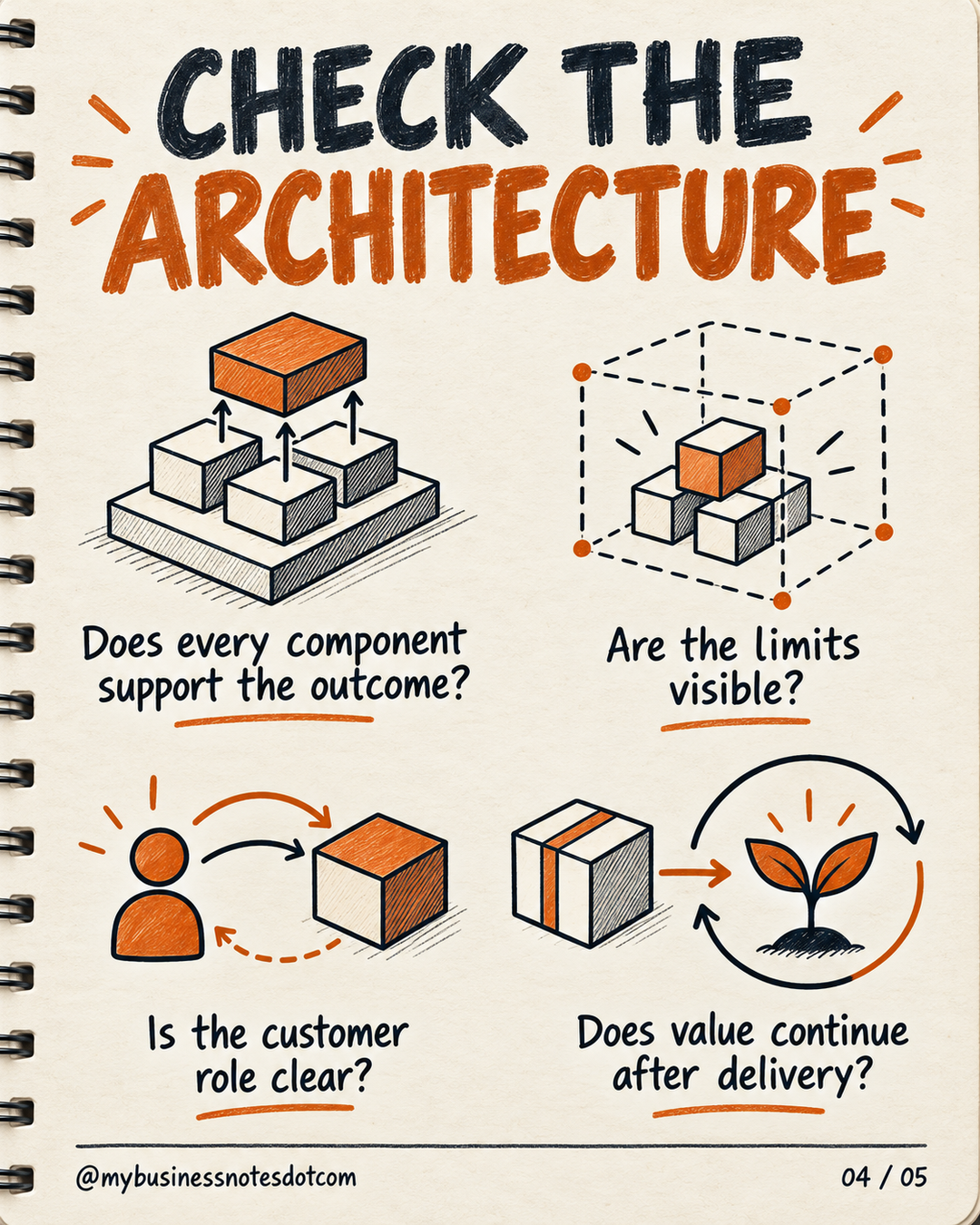
Map each component to the problem it addresses, the input it needs and the next step it enables. Remove redundant work only after checking whether another component depends on it. More items do not automatically mean more value.
A workshop might establish priorities, a template might capture evidence and a review meeting might turn observations into decisions. Explain these connections to the buyer. Test whether the customer can use the components under realistic conditions, not just whether they like the proposal.
Limits: show the boundaries of the exchange
Name exclusions, responsibilities, capacity, revisions and material terms. State the price in relation to that defined scope. An alternative package should change the work or service conditions meaningfully rather than merely changing the label.
Business Victoria's guidance on discounting and bundles highlights the need to preserve profitability and customer benefit. Program on Negotiation's concession guidance also helps when adapting an offer: make any agreed exchange explicit. Do not let a lower price quietly retain the original workload.
Continuity: plan what happens after delivery
Decide what sustains value: ownership, training, review, maintenance or a clear handover. Continuity does not always require a recurring contract. Sometimes the appropriate outcome is a customer who can operate independently.
Strategyzer's testing guidance distinguishes verbal enthusiasm from behavior. Observe whether intended users can apply the offer's outputs, and identify what still prevents progress. Include the customer's effort rather than treating adoption as an automatic consequence of delivery.
Complete the offer architecture map on one page with five linked areas: problem, transformation, components, limits and continuity. Mark assumptions, evidence and owners. Then select the weakest connection for a small, transparent test before adding more components. The map is an MBN working tool, not a guarantee of product-market fit.
Frequently asked questions
What is an offer architecture map?
It is a practical map connecting the customer problem, intended transformation, delivery components, limits and continuity. It makes the logic of an offer easier to evaluate.
How is it different from a list of deliverables?
A deliverables list says what is included. The map explains why each component exists, what it requires and how it supports the intended change.
Does continuity always mean a subscription?
No. It may mean training, ownership, a handover or a review process. Choose what sustains the customer's ability to use the work, not recurring revenue by default.
Download the complete carousel
Use the five-slide worksheet in your next working session.
Related reading: Turn learning into the next decision.
International references
- Business Victoria — Develop discount strategies
- Deepak Malhotra / Harvard Program on Negotiation — Four strategies for making concessions
- Harvard Business School ISC — Creating a Successful Strategy
- Strategyzer — Value Proposition Canvas
- Nabila Amarsy / Strategyzer — Ways to test your value proposition
- Alex Osterwalder / Strategyzer — Don’t believe your customers
- GOV.UK User research community — Using in-depth interviews
- Amy Schade / Nielsen Norman Group — Avoid leading questions
- Christensen Institute — Jobs to Be Done
- FTC — Advertising FAQs for small business