

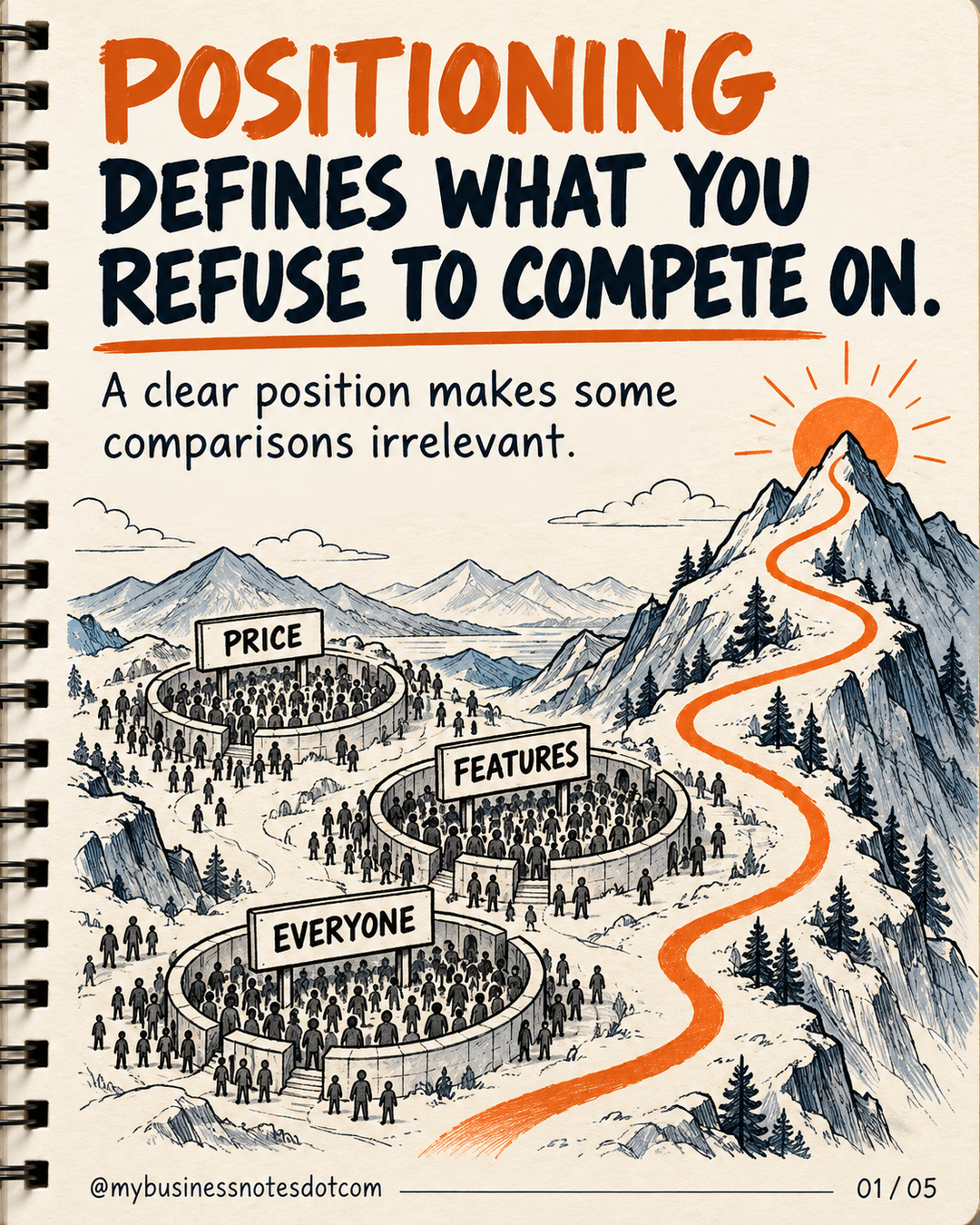
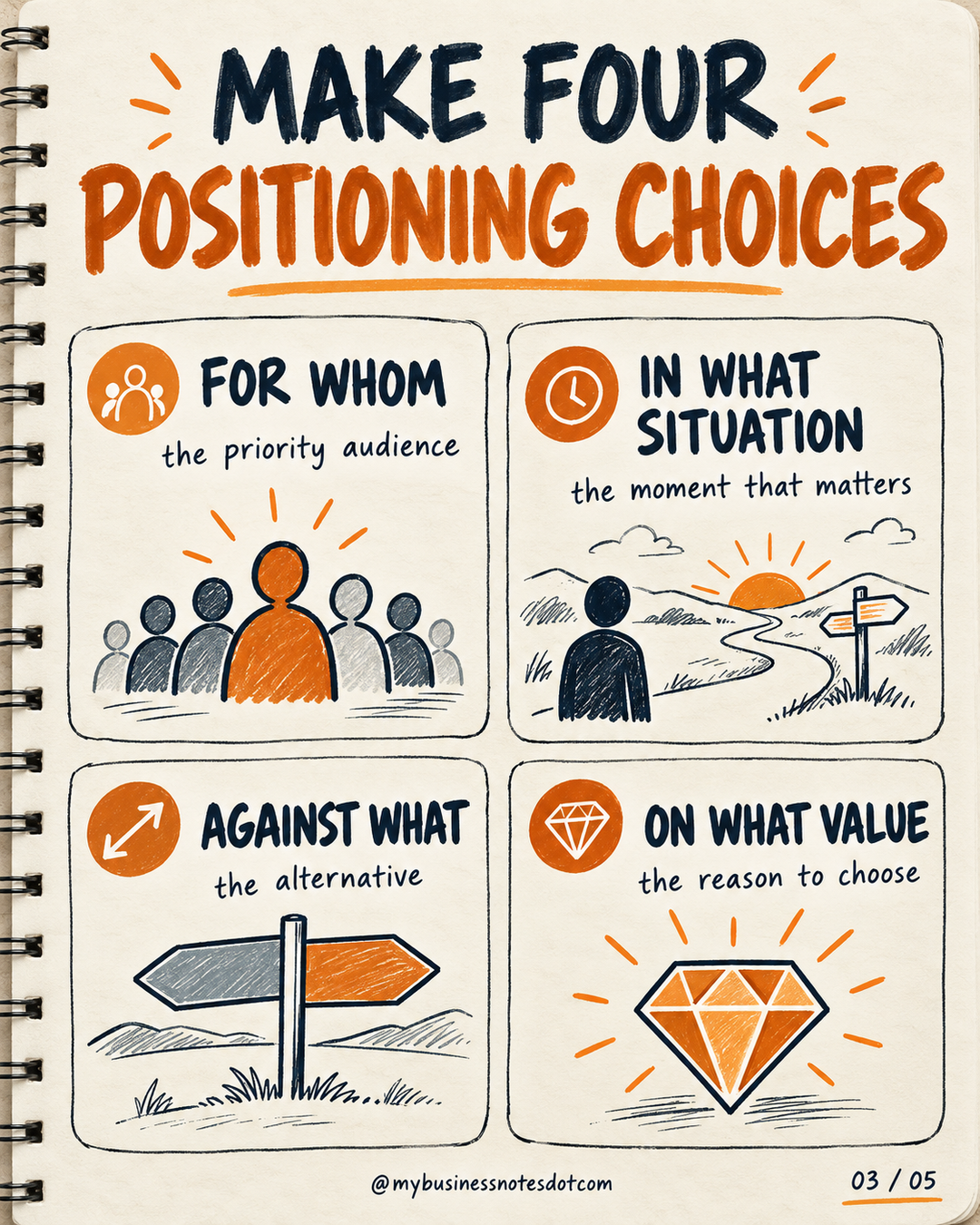
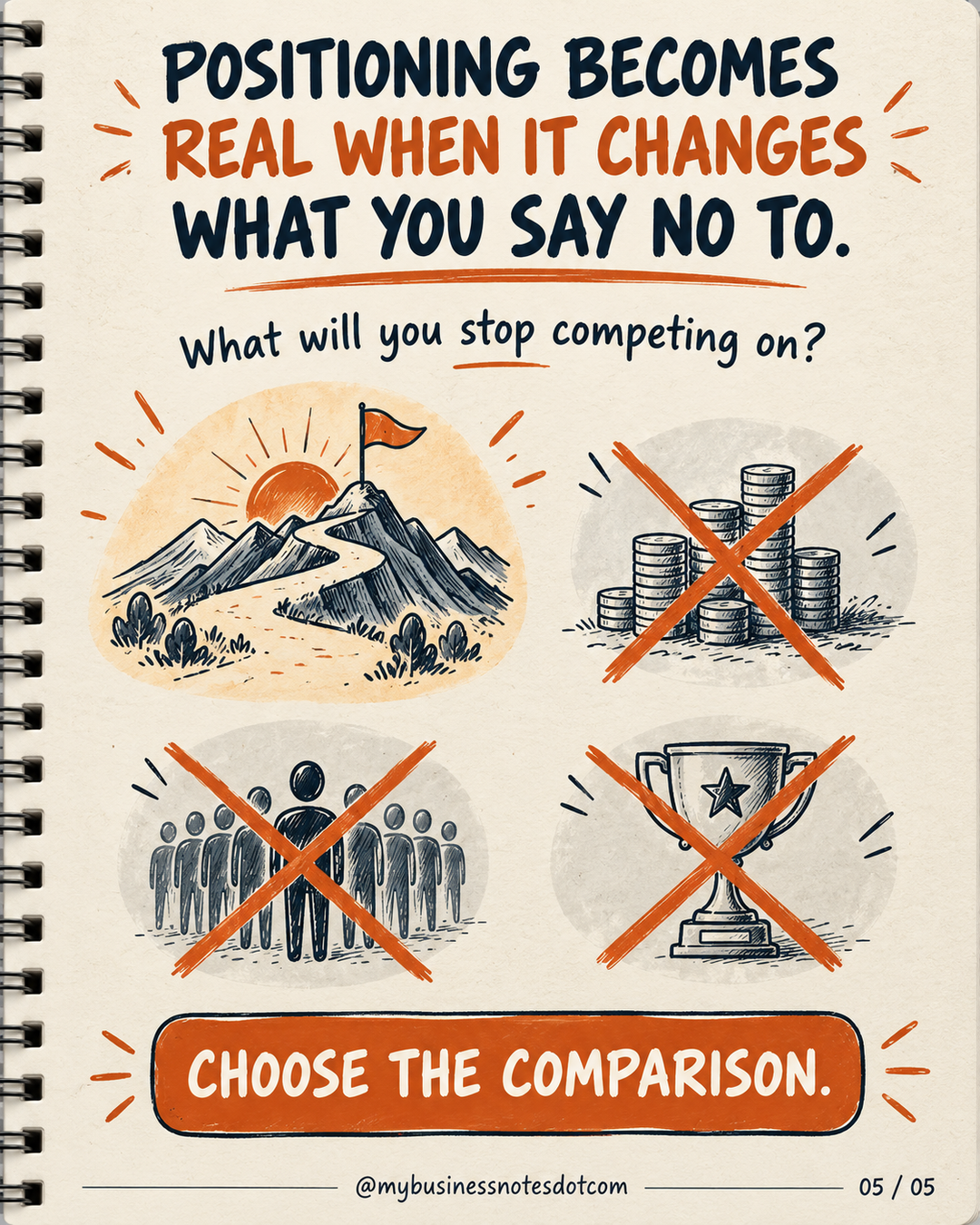
Positioning choices define the customers and situations in which your offer is a strong fit, the alternatives it should be compared with and the value that makes it different. They also reveal where you should not compete. A clear boundary protects a credible promise; it is not permission to ignore basic customer needs.

Slide 1 of 5
Refusal follows value, not attitude
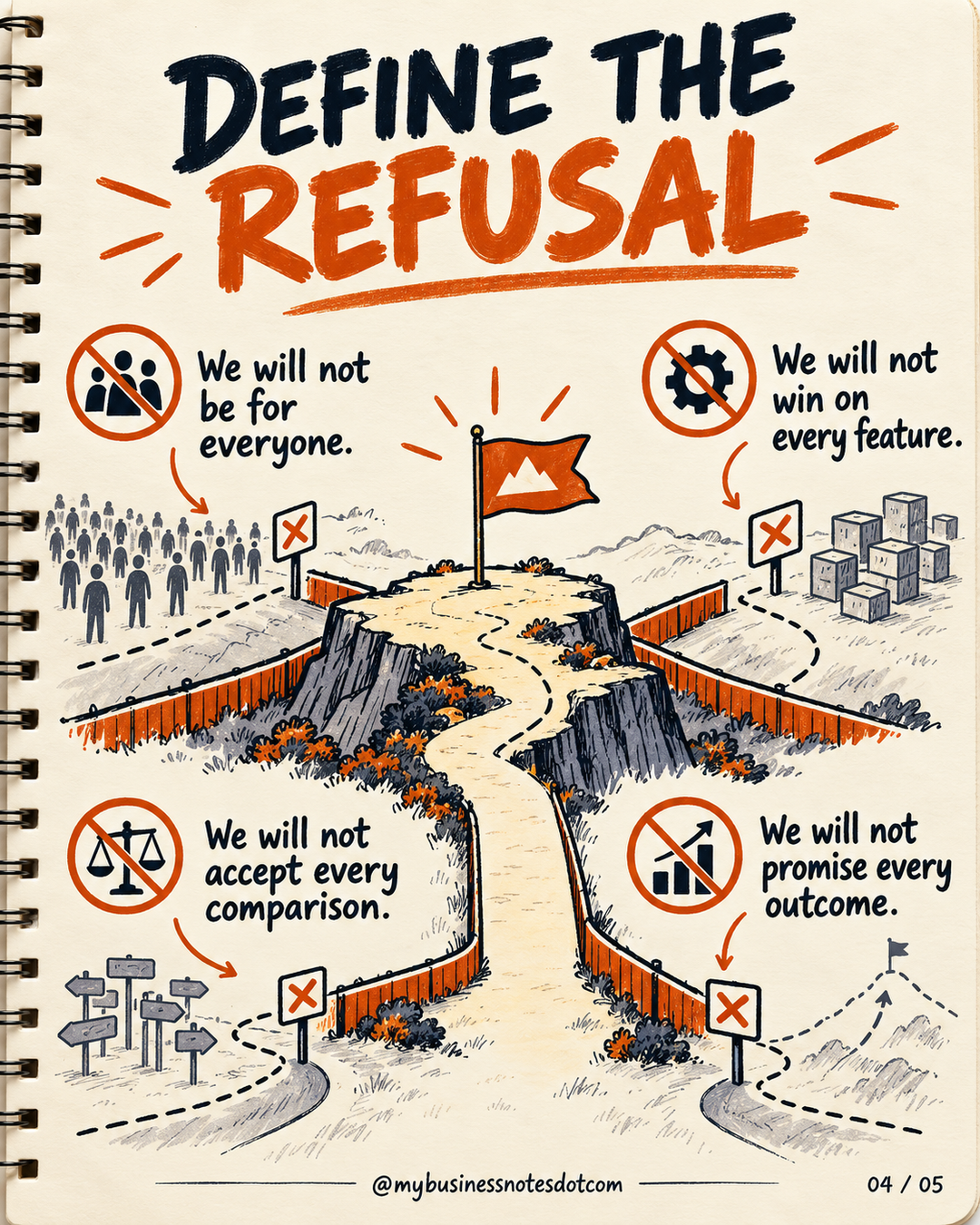
Being unwilling to compete on every dimension does not mean being dismissive or deliberately difficult. Begin with the value you can deliver reliably, then identify requests that would undermine it. A premium claim alone does not justify poor service or opaque pricing.
The Institute for Strategy and Competitiveness links strategy with trade-offs and reinforcing activities. Your refusal should be explainable in those terms: accepting this request would change the operating model or weaken the value chosen customers rely on.
Define the customer and situation
‘For ambitious companies’ rarely helps a buyer assess fit. Describe the situation that makes your approach useful: the outcome sought, constraints, current process and relevant capabilities. Jobs to Be Done directs attention to circumstances and progress, not demographics alone.
Check those descriptions against customer accounts. Distinguish a pattern from a striking anecdote and include people who did not choose you. A positioning exercise that listens only to admirers may miss a limitation that matters commercially.
Choose the comparison honestly
Ask what a relevant customer would do without your offer. The answer may be internal work or leaving the situation unchanged. Explain the difference against that real alternative, rather than inventing a weak opponent.
April Dunford describes market category as context that can create expectations. If the category implies a capability you do not have, the sales conversation must undo that misunderstanding. A clearer comparison can be more useful than a grander category label.
Turn boundaries into practical decisions
Write down which scope, delivery conditions or buyer needs are outside the offer. Give the team a respectful way to explain the boundary and, when appropriate, suggest another route. Be precise: ‘not a fit for this implementation deadline’ is more useful than ‘not our kind of customer’.
Review exceptions with the same discipline as the original position. A valuable exception may reveal a new opportunity; a stream of hidden exceptions may reveal that the stated positioning does not match the business being sold.
Example: refusing unlimited customization
Imagine a provider offering a tightly scoped implementation service. A prospect requests an unlimited redesign of adjacent processes. In this hypothetical situation, accepting may compromise timing and economics for existing customers.
The provider can explain the scope, offer a separately evaluated project or decline. It should still inspect whether the original offer solves a meaningful problem. Refusing work is not evidence of good positioning; coherent value and genuine customer fit are the tests.
Check the boundary as the market changes
Products, competitors and customer priorities evolve. Dunford’s discussion of positioning changes highlights those shifts. Keep a record of lost deals and recurring requests, without assuming every lost deal means the position is wrong.
Review what the pattern changes: description, proof, delivery or target situation. A strong position makes those choices clearer. It does not guarantee that the market will reward them, and it should never become an excuse to stop learning.
Frequently asked questions
Should we refuse to compete on price?
Not as a slogan. Explain the value and cost structure of the offer, and decide whether a particular price-driven situation is a fit.
Can a boundary change?
Yes. Revise it deliberately when evidence and capabilities justify the change, rather than through repeated hidden exceptions.
Is positioning the same as a tagline?
No. A tagline may express positioning, but the underlying customer, alternatives, value and operating choices must be clear first.
Download the complete carousel
Use the five-slide worksheet in your next working session.
Related reading: Turn learning into the next decision.
International references
- Strategyzer / Kurt Bostelaar — Customer interviews that produce insights
- Strategyzer / Nabila Amarsy — Ways to test your value proposition
- Strategyzer / Nabila Amarsy — Roadmap to test your value proposition
- Strategyzer / Alex Osterwalder — Start with critical hypotheses
- Christensen Institute — Jobs to Be Done
- Strategyzer — Value Proposition Canvas
- Harvard Business School ISC — Creating a Successful Strategy
- Harvard Business School ISC — Fit Across the Value Chain
- Atlassian — Project Trade-Off Analysis
- April Dunford — Market category as context
- April Dunford — Positioning in the Age of AI