
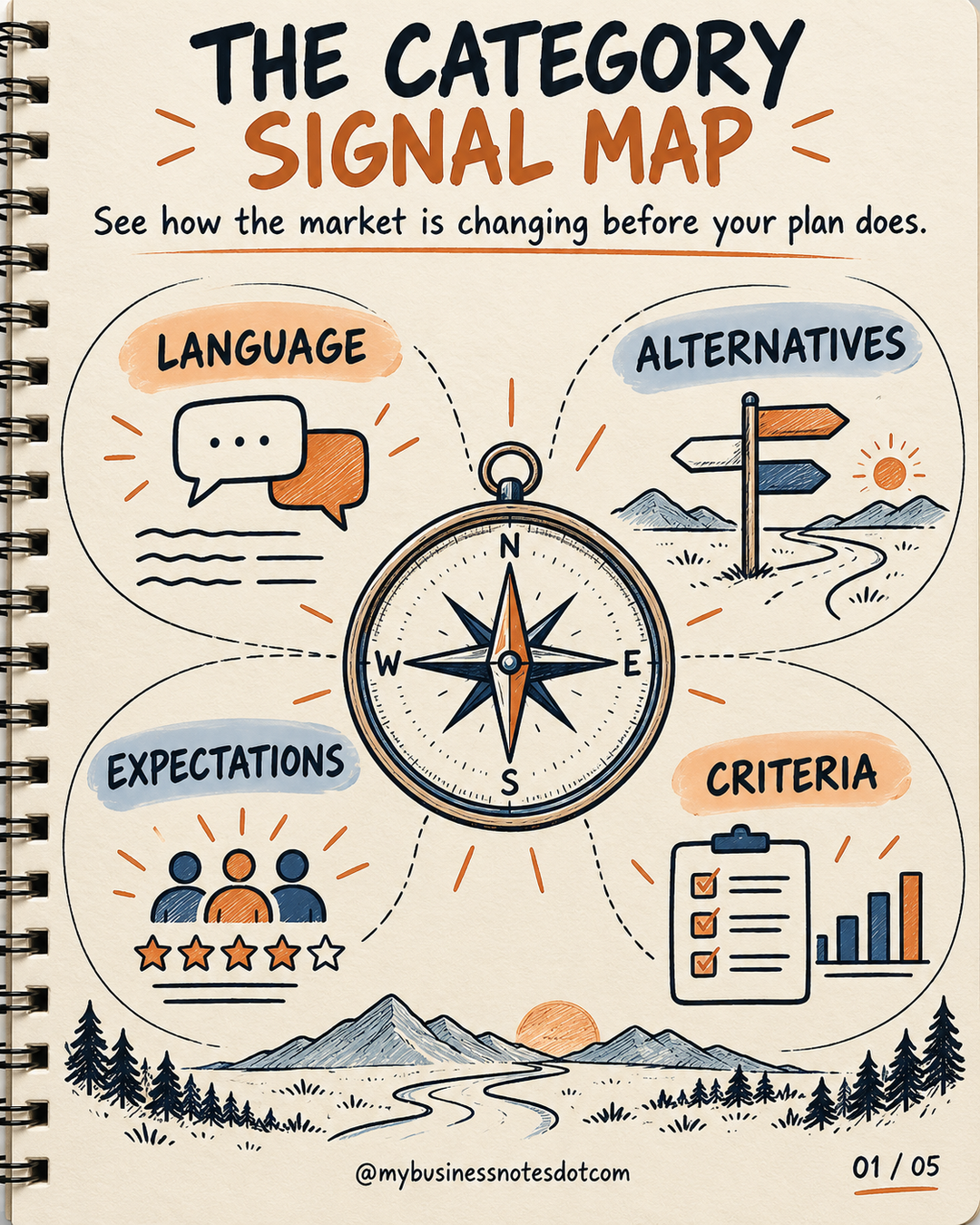
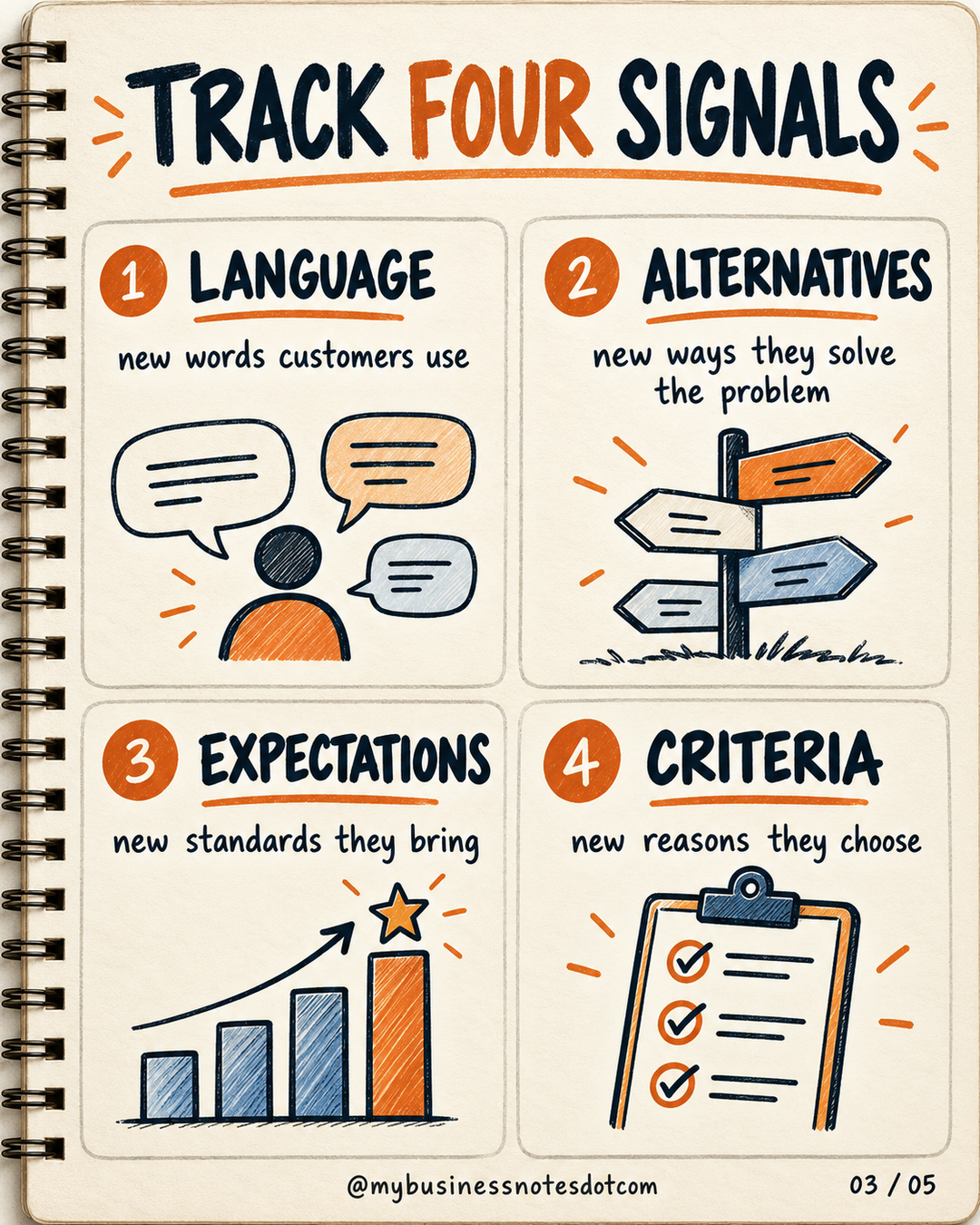
A category signal map records how buyers describe a problem, what alternatives they consider, what they expect from an offer and which criteria guide their choice. It helps a business test whether its positioning creates useful context or misleading assumptions.
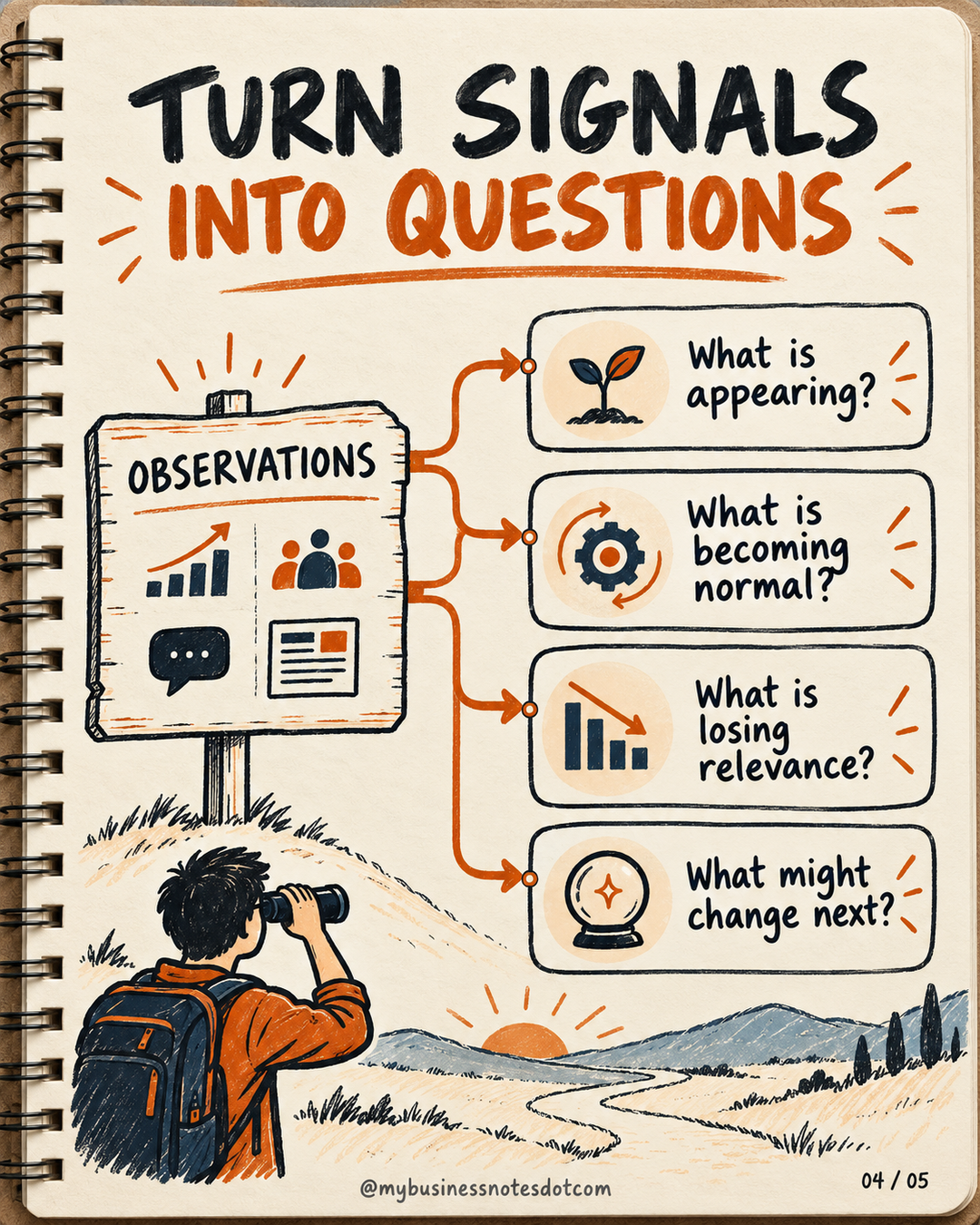
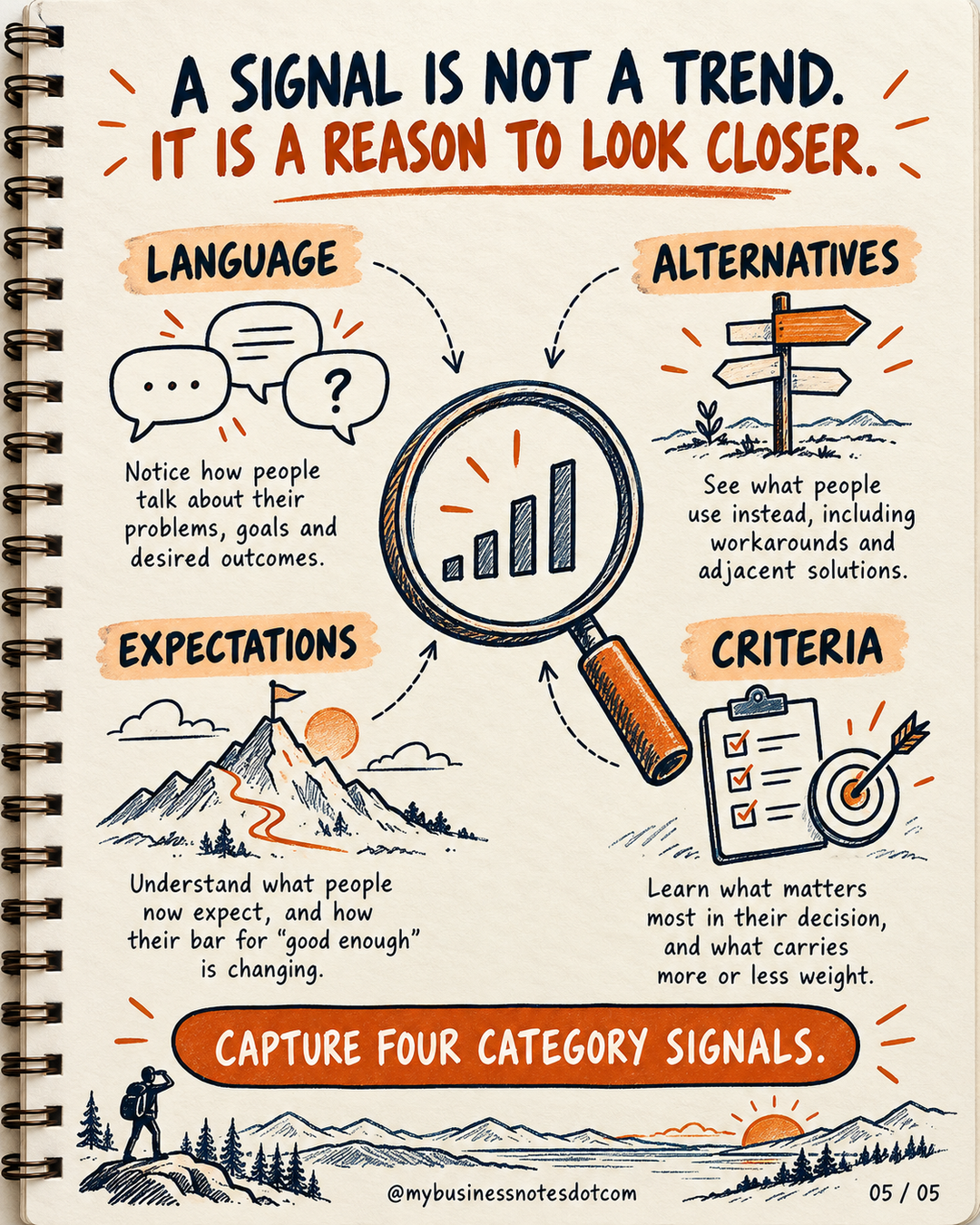
Slide 1 of 5
A category is a shortcut, not your entire positioning
A familiar label can help a prospect understand an unfamiliar product. It can also create expectations you cannot meet. April Dunford explains that market category sets context for differentiated value; it is not necessarily the right starting point for developing positioning.
The MBN map is a working research aid, not a replacement for a full positioning process. Start with what buyers are trying to accomplish, then inspect the context your language creates. The best-sounding label in an internal workshop may not help the customer make sense of the offer.
Collect the language buyers use without prompting it
Ask customers to describe the situation that made them look for help. Capture their words before showing your product description. Separate their language from your interpretation, and record the context in which a phrase appeared.
Do not turn a single vivid quote into a market insight. Compare accounts from relevant buyers, including people who chose another route. Nielsen Norman Group’s guidance on leading questions is useful here: naming the problem for participants can make agreement easier than an honest correction.
Map real alternatives, including doing nothing
A buyer may compare your service with software, an employee, an existing supplier or keeping the current process. These are different ways of making progress, even if they do not belong to the same industry category. The Christensen Institute’s Jobs to Be Done lens directs attention to circumstances and the progress people seek.
Ask what they actually considered in a recent decision. Then distinguish an active alternative from a name they recognize. A list of well-known competitors is not evidence that those companies appeared in this buyer’s choice.
Test the expectations your label creates
Show a concise description to a relevant prospect and ask what they believe the offer includes, who it is for and when they would consider it. Listen before explaining. If the category repeatedly implies capabilities or commercial terms you do not provide, record that mismatch.
Mental-model research in user experience offers a useful analogy: people act on what they believe a system does. But an analogy is not proof of a sales effect. Test the actual description in your market rather than assuming that a clearer label will automatically improve conversion.
Connect criteria to evidence, not adjectives
If buyers care about implementation effort, show what implementation involves. If they prioritize accountability, make responsibility and escalation visible. The Value Proposition Canvas helps relate customer jobs, pains and gains to what the offer delivers, but fit remains a claim until tested.
Avoid a map filled only with ‘quality’, ‘innovation’ and ‘partnership’. Ask how a buyer recognized quality, which trade-off mattered and what evidence reduced uncertainty. Those answers point toward a more useful explanation than a stronger adjective.
Example: a service that looks like the wrong product
Imagine a consulting firm describing its service as a ‘growth platform’. Prospects expect software access and self-service reporting, while the firm delivers facilitated decisions and implementation support. This hypothetical mismatch is a signal to investigate, not an argument that the word platform is always wrong.
The team tests a more concrete description and checks comprehension, relevant next steps and the questions prospects ask. It keeps the original evidence beside the revised map. Change the language when the pattern supports it; do not invent a new category merely to avoid comparison.
Frequently asked questions
Does a category signal map choose our category for us?
No. It organizes evidence for a positioning decision; it does not replace judgment or customer testing.
Can different segments need different context?
Yes. Keep segment-specific evidence separate when customers face different situations or compare different alternatives.
How do we know a description works?
Check whether relevant buyers understand the offer, expect what it actually delivers and can identify a sensible next step.
Download the complete carousel
Use the five-slide worksheet in your next working session.
International references
- Strategyzer / Kurt Bostelaar — Customer interviews that produce insights
- Strategyzer / Alex Osterwalder — Don’t believe your customers
- Strategyzer / Nabila Amarsy — Ways to test your value proposition
- Strategyzer / Nabila Amarsy — Roadmap to test your value proposition
- Strategyzer / Alex Osterwalder — Start with critical hypotheses
- GOV.UK User research community — Using in-depth interviews
- Christensen Institute — Jobs to Be Done
- Nielsen Norman Group / Jakob Nielsen — Interviewing Users
- Nielsen Norman Group / Amy Schade — Avoid Leading Questions
- Strategyzer — Value Proposition Canvas
- April Dunford — The job of a market category
- Nielsen Norman Group / Megan Chan — Mental Models
- Nielsen Norman Group / Kate Kaplan — Customer Journey Maps
- GOV.UK User research community — Analyse a research session