

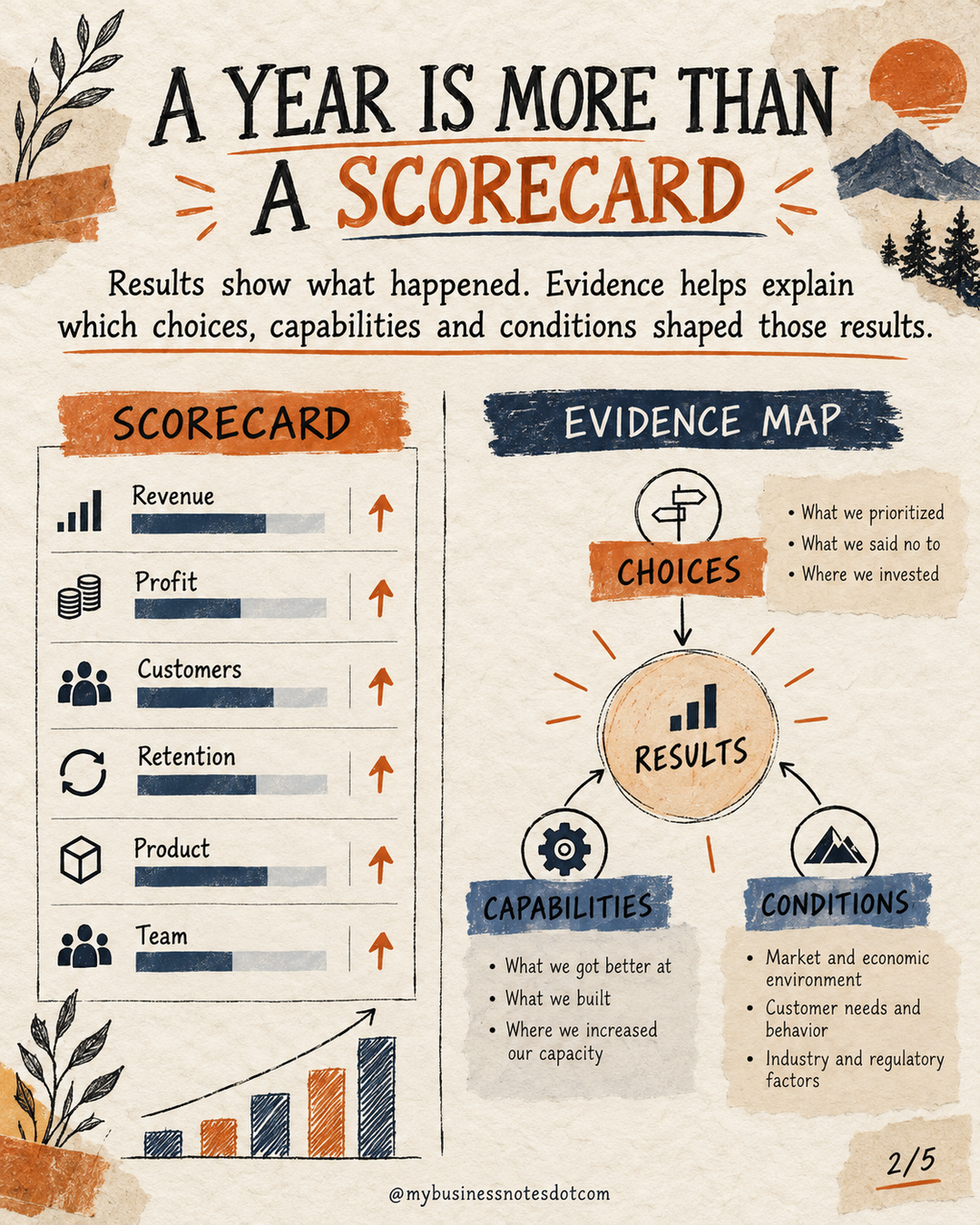
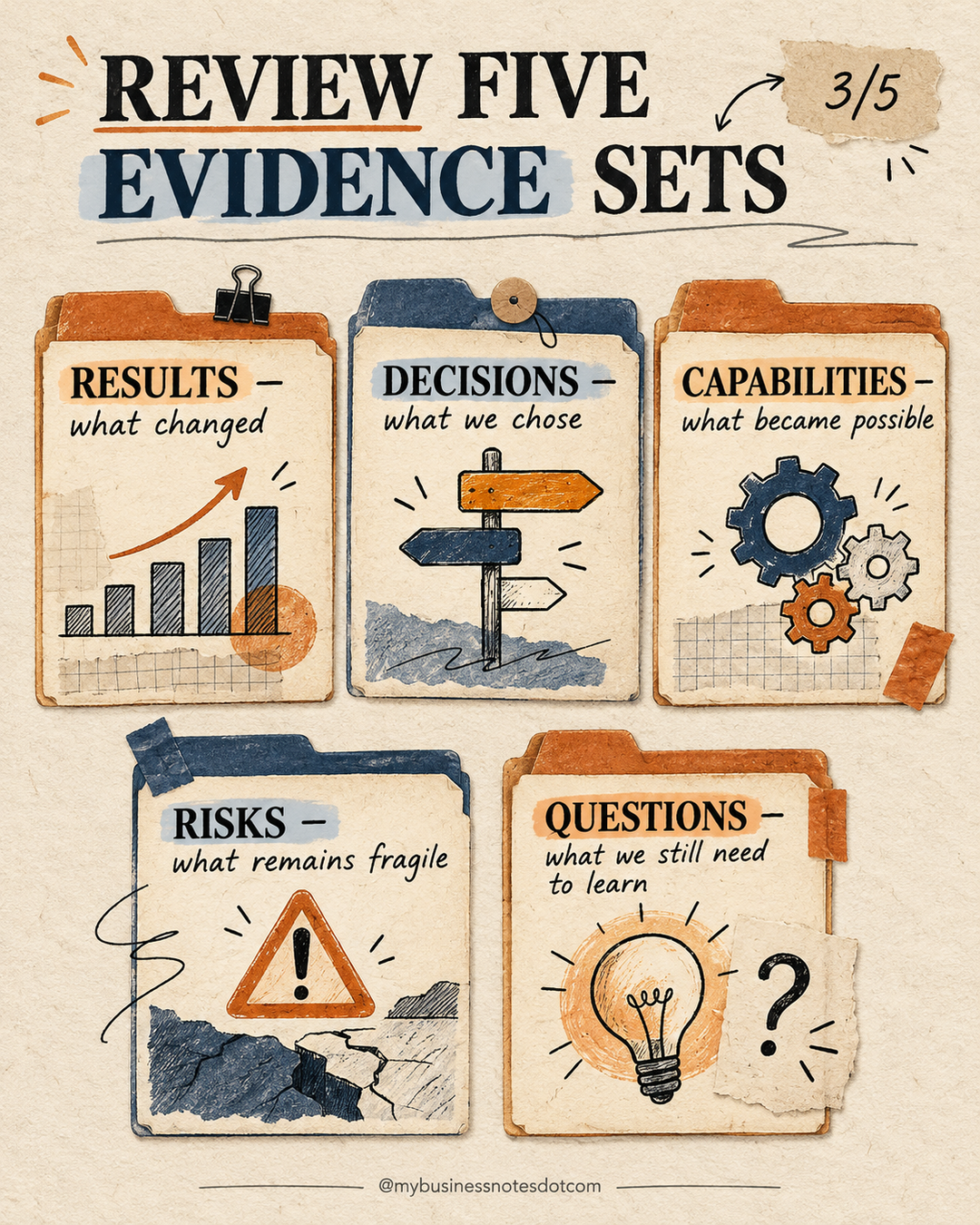
A useful year-end review separates what happened from the story told about it. Examine results, decisions, capabilities, risks and open questions, then turn the evidence into a small number of actions. The purpose is better planning, not a more convincing victory presentation.
Slide 1 of 5
What makes a year-end review useful?
A review should change a forward-looking decision. Start by naming who will use it and which choices it must inform: resource allocation, a service redesign, a capability investment or a decision to stop work.
Atlassian’s retrospective guidance moves from feedback to insights and owned actions. Adapt that structure to a longer horizon without pretending an annual meeting replaces regular learning. Collect records in advance so the loudest recent event does not become the whole year.
1. Results: what changed, compared with what?
For each important outcome, record the starting point, period, data source and relevant comparison. Distinguish completed activity from a change that mattered to customers or operations. Flag missing or inconsistent measurements rather than filling the gap with confidence.
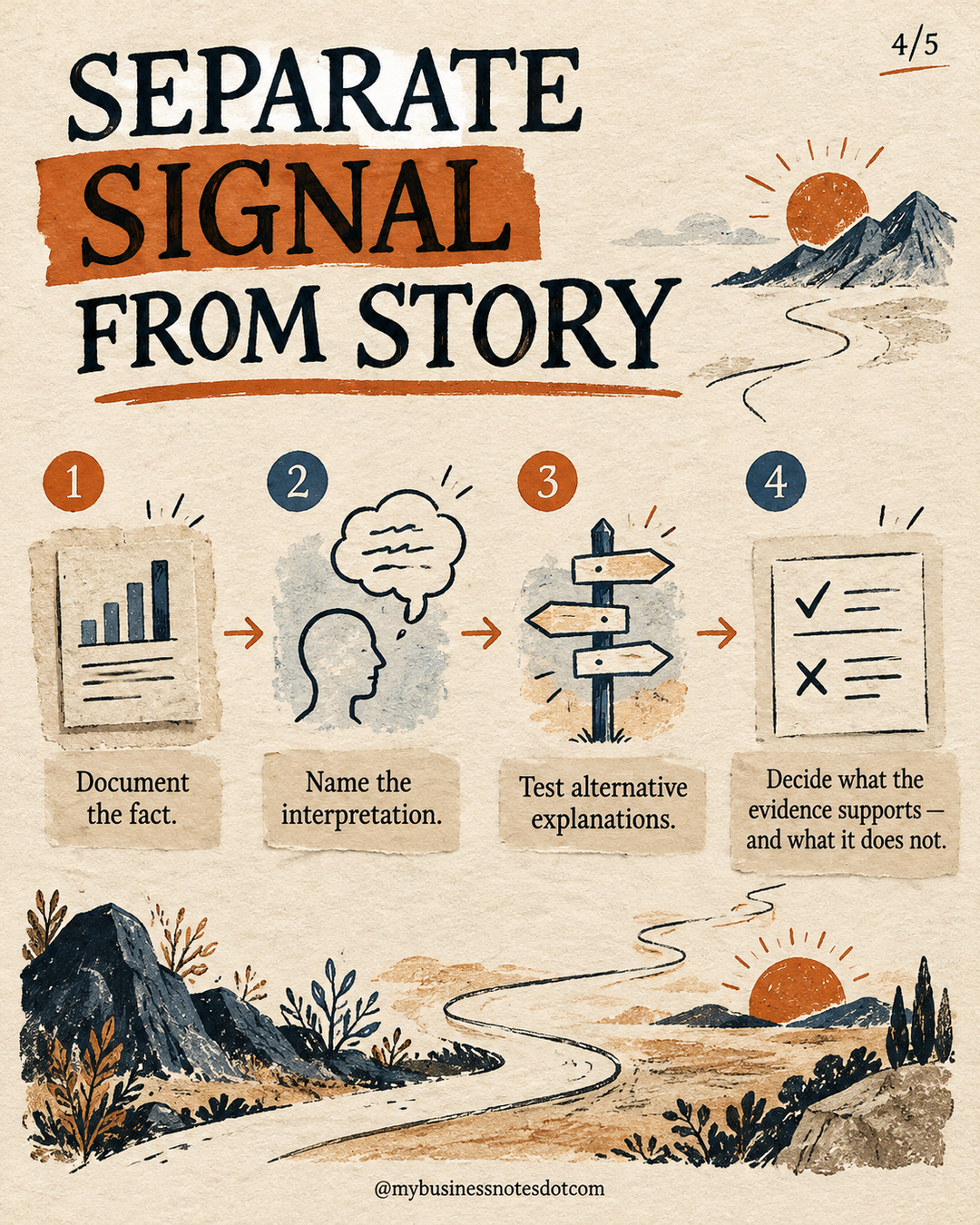
Use analysis guidance to keep observations separate from interpretation. For an illustrative service team, fewer support tickets might reflect clearer onboarding, lower usage or a reporting change. A favorable number alone does not identify the cause.
2. Decisions: what did we know at the time?
Review a few consequential choices using contemporaneous records. Ask which assumptions were explicit, what alternatives existed and which information was available. Avoid judging decision quality solely by whether the outcome was favorable.
Amazon’s discussion of reversible decisions can help examine whether the approval process matched the commitment. Strategyzer’s critical-hypothesis approach can reveal an important uncertainty that was never tested. These are analytical lenses, not a formula for proving that a decision was correct.
3. Capabilities: what can we now do reliably?
Look for evidence of repeatable ability: a documented handover that works, a faster recovery exercise or a task that more than one person can complete. A course attended is an input, not proof of operating capability.
Use capacity-planning to compare declared priorities with where time actually went. Harvard Business School’s focus on coherent activities helps ask whether new capabilities support the chosen position. More tools and more initiatives do not necessarily produce a stronger operating system.
4. Risks: what remains exposed?
Review significant incidents, near misses and dependencies that changed. The Orange Book connects monitoring with performance information and decision-making. Adapt that principle by recording which controls worked, what failed and who owns the remaining action.
A pre-mortem can then challenge next year’s proposal before commitment. Keep historical observations separate from hypothetical future scenarios. Make the trade-off explicit when accepting exposure to protect another priority; silence is not the same as an informed acceptance.
5. Open questions: what must the next cycle learn?
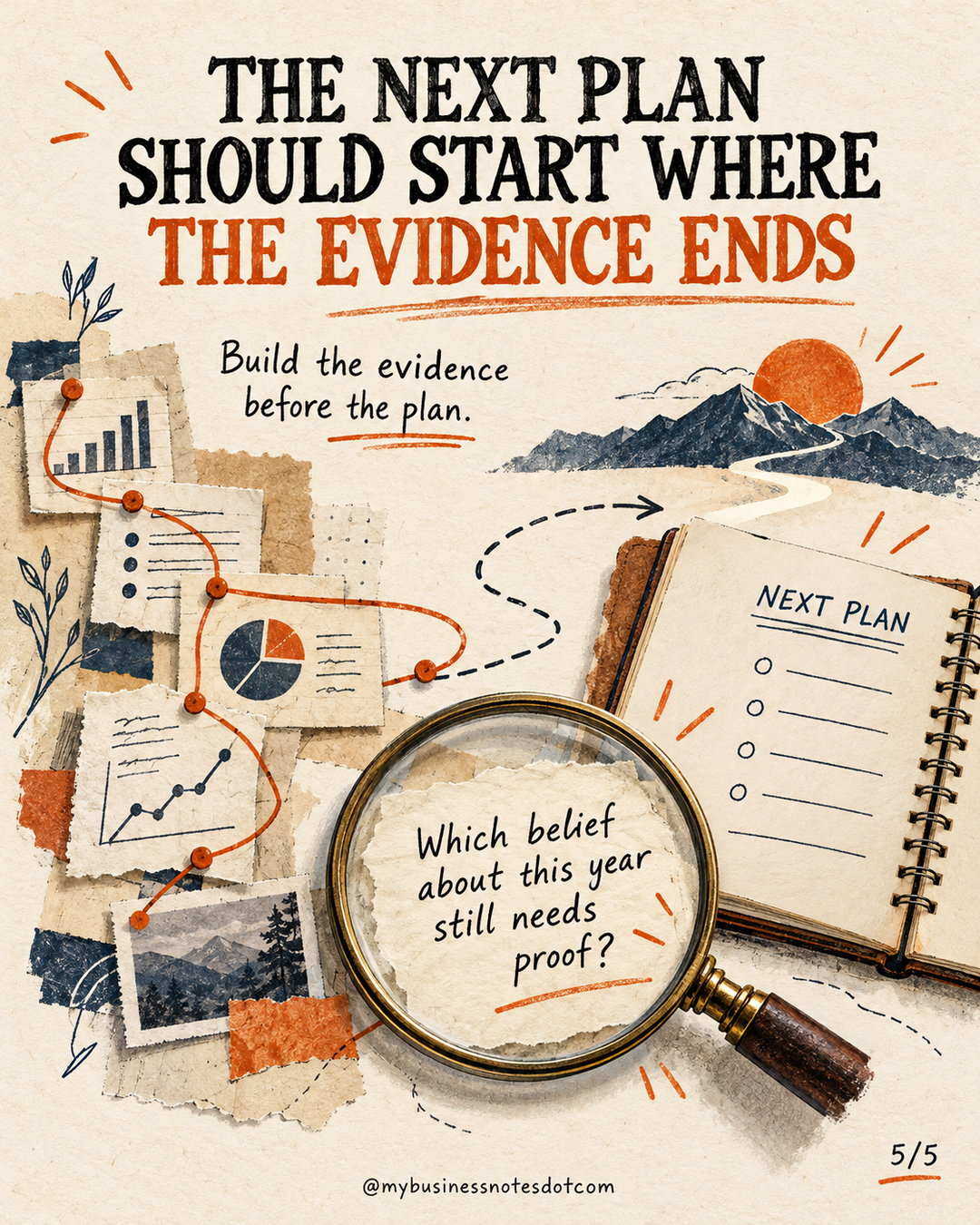
End with a short list of unresolved questions tied to decisions, not a catalogue of everything the team finds interesting. For each, name the evidence needed, owner and review date. Use PDCA to connect one proposed improvement with a later check.
The final output can be a concise record: what to continue, change, stop and investigate. Preserve alternative explanations when the evidence cannot distinguish them. An honest review may leave some questions open while still making the next commitment clearer and more accountable.
Frequently asked questions
What should a year-end review include?
Include important results, consequential decisions, demonstrated capabilities, remaining risks and open questions. Link each finding to a source and a forward-looking action.
How do you avoid hindsight bias?
Use records created when decisions were made. Separate information available at the time from later knowledge, and avoid treating a favorable outcome as proof of a good process.
Should every finding become a priority?
No. Some findings require investigation or routine maintenance. Choose priorities only after considering outcomes, trade-offs, capacity and the evidence behind the proposed commitment.
Download the complete carousel
Use the five-slide worksheet in your next working session.
Related reading: Turn learning into the next decision.
International references
- Atlassian — Pre-mortem
- Jeff Bezos / Amazon — 2016 Letter to Shareholders
- Alexander Osterwalder / Strategyzer — Test the most critical hypotheses first
- Harvard Business School ISC — Creating a Successful Strategy
- Lean Enterprise Institute — PDCA
- GOV.UK User research community — Analyse a research session
- Atlassian — Capacity planning
- Atlassian — Project trade-offs
- HM Treasury / Government Finance Function — The Orange Book
- Atlassian — Sprint retrospective