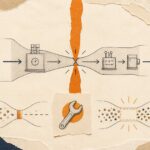

Stop continue start helps teams turn evidence from recent work into explicit operating decisions. Useful business frameworks do more than organise information. They make the next decision easier to see. This carousel turns the idea into a compact working note. Use it during planning, a team conversation or a review of current work. The goal is not to complete another template, but to make assumptions, evidence and trade-offs explicit enough to improve action. This article expands the five-slide note into a practical framework for managers, marketers and sales teams.


Slide 1 of 5
What this framework helps you decide
Use evidence from the last cycle to change the next one.
A useful framework compresses complexity without pretending it has disappeared. It gives a team shared language, exposes assumptions and clarifies the decision that should follow. The sections below turn the visual sequence into questions that can be used in planning, review or a customer conversation.
STOP
What consumes resources without supporting a priority or useful learning?
Use this part of the framework as a decision prompt. Ask what is currently assumed, what evidence supports the assumption, which trade-off follows, and who owns the next observable action. The purpose is not to complete a template; it is to improve the quality and speed of a real business decision.
CONTINUE
What is working, creating value or strengthening an important capability?
Use this part of the framework as a decision prompt. Ask what is currently assumed, what evidence supports the assumption, which trade-off follows, and who owns the next observable action. The purpose is not to complete a template; it is to improve the quality and speed of a real business decision.
START
What new action, experiment or decision is now justified by the evidence?
Use this part of the framework as a decision prompt. Ask what is currently assumed, what evidence supports the assumption, which trade-off follows, and who owns the next observable action. The purpose is not to complete a template; it is to improve the quality and speed of a real business decision.
Close with ownership.
Choose one item in each category. Name an owner and next step.
Use this part of the framework as a decision prompt. Ask what is currently assumed, what evidence supports the assumption, which trade-off follows, and who owns the next observable action. The purpose is not to complete a template; it is to improve the quality and speed of a real business decision.
A practical example
Imagine a small team using stop continue start during a weekly review. Instead of adding more activity, the team names the current situation, compares the available evidence and chooses one next action with an owner and a review date. The framework makes the reasoning visible, so colleagues can challenge the assumption and learn from the result.
The mistake to avoid
The most common mistake is treating stop continue start as a presentation exercise. A polished diagram creates little value when the team avoids a trade-off, cannot name the evidence behind the choice, or leaves the next step without an owner.
How to use the framework
- Name the business or customer decision.
- Write the current assumption in one sentence.
- Collect the minimum evidence needed to challenge it.
- Choose one action, one owner and one review date.
- Record what would cause the team to change direction.
Related guidance: How to prioritize ideas with an evaluation matrix and Strategy execution with the 4 Cs and 1 R.
Frequently asked questions
What is stop continue start?
Stop continue start is a practical way to turn evidence from recent work into explicit operating decisions. It connects a business question to explicit evidence, choices and action.
Why does stop continue start matter?
It reduces ambiguity and helps a team explain why one action deserves attention while another should wait or stop.
How do you apply stop continue start?
Start with one current decision, work through the framework, identify the largest uncertainty, assign an owner and define the evidence that will trigger the next review.
What is the main mistake to avoid?
The most common mistake is treating stop continue start as a presentation exercise. A polished diagram creates little value when the team avoids a trade-off, cannot name the evidence behind the choice, or leaves the next step without an owner.
Put it into practice
Run this review with your team. Save the carousel, use it in a working session and document the decision that follows.
Download the complete carousel
Keep the five-slide framework as a PDF for your next review.
International references
- Harvard Business Review – How to Focus on What Is Important
- Harvard Business Review – What Is Strategy?
- Atlassian – Decision making