
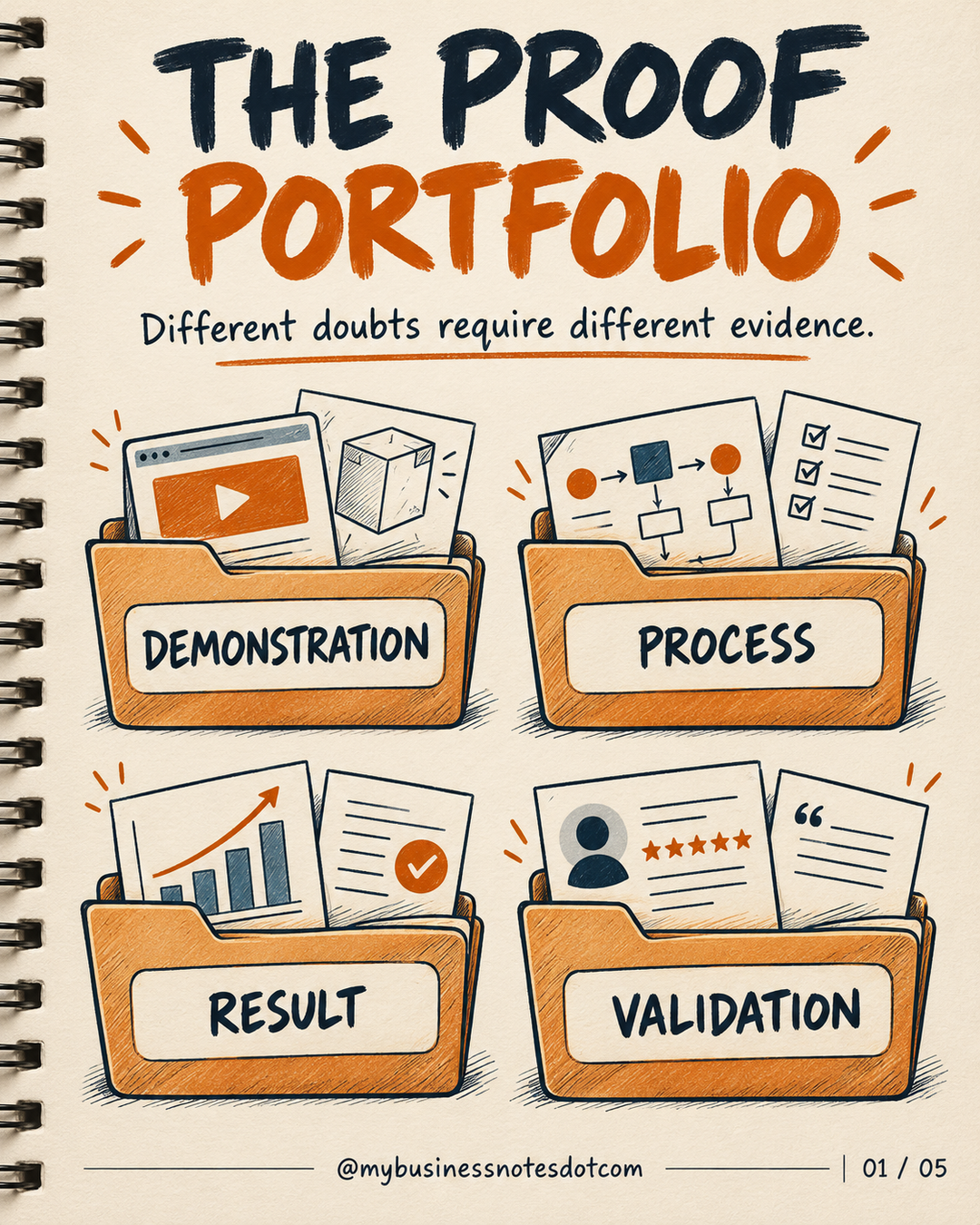
A proof portfolio is a selected set of demonstrations, process records, results and independent validation tied to specific claims. Build it around the buyer's questions, not around the number of logos or testimonials you can collect.
Slide 1 of 5
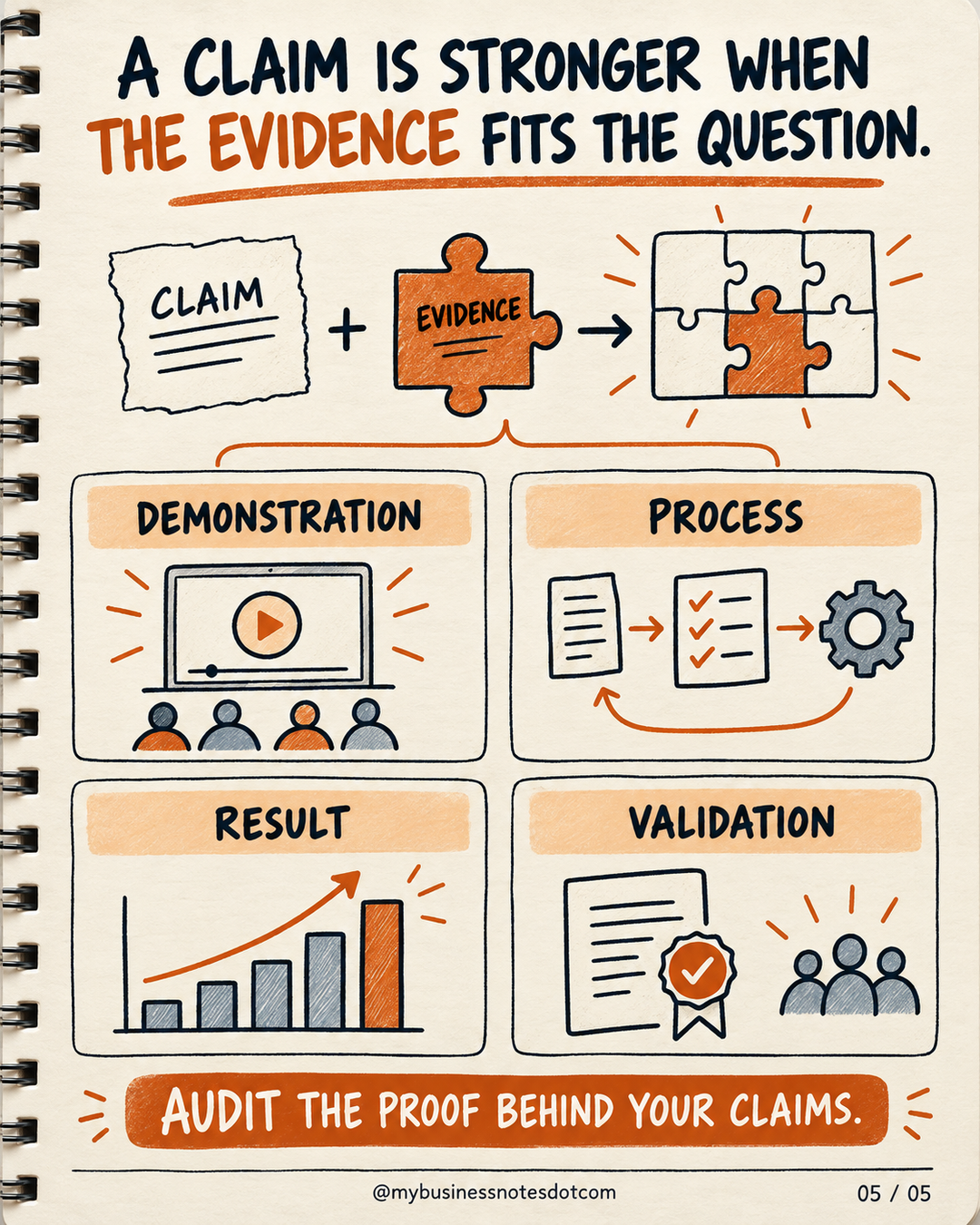
Start with the claim, not the asset
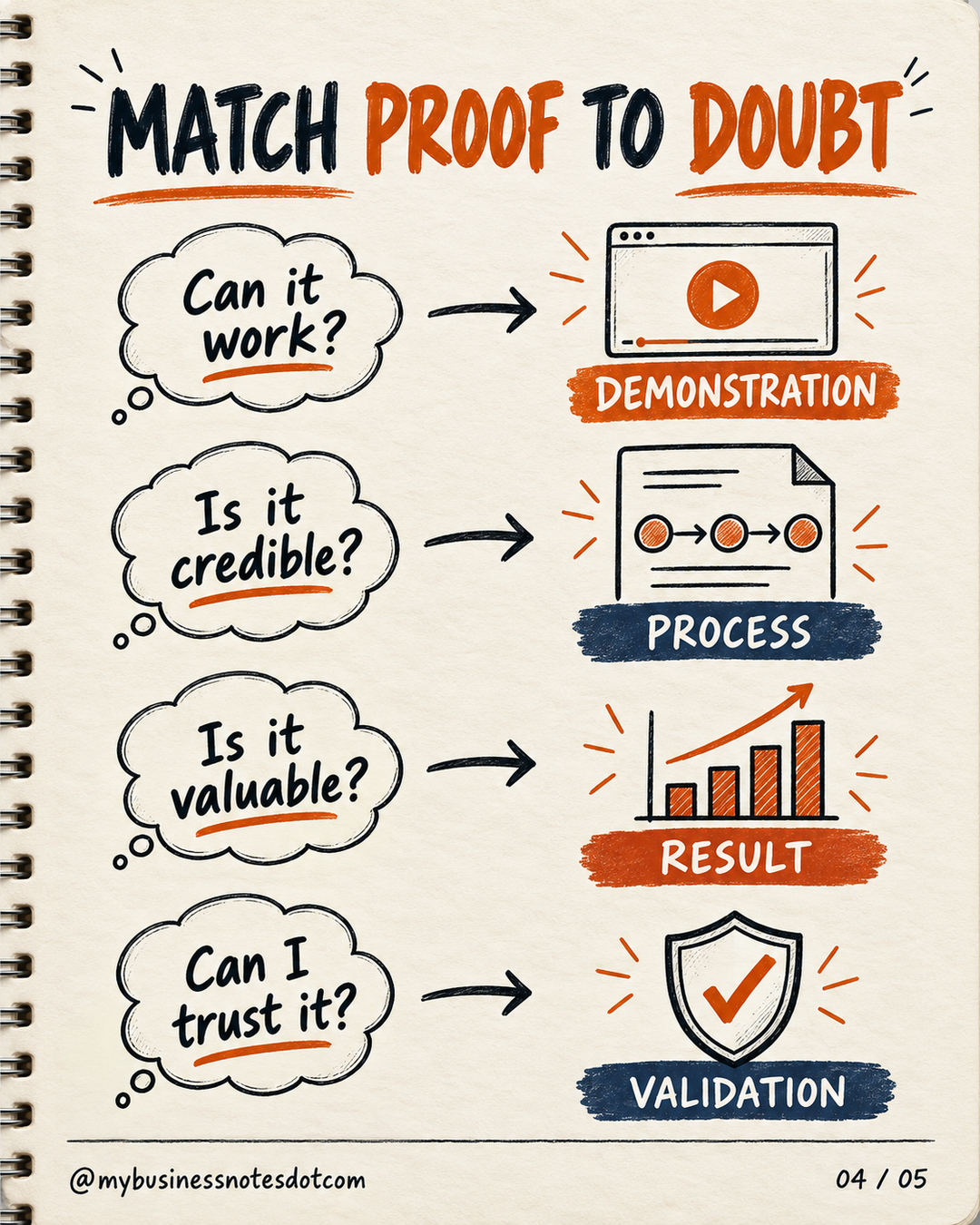
A large case-study library may still leave the buyer's central question unanswered. Write down what you are asking them to believe, who needs to evaluate it and what decision depends on it. Then identify the most direct support available.
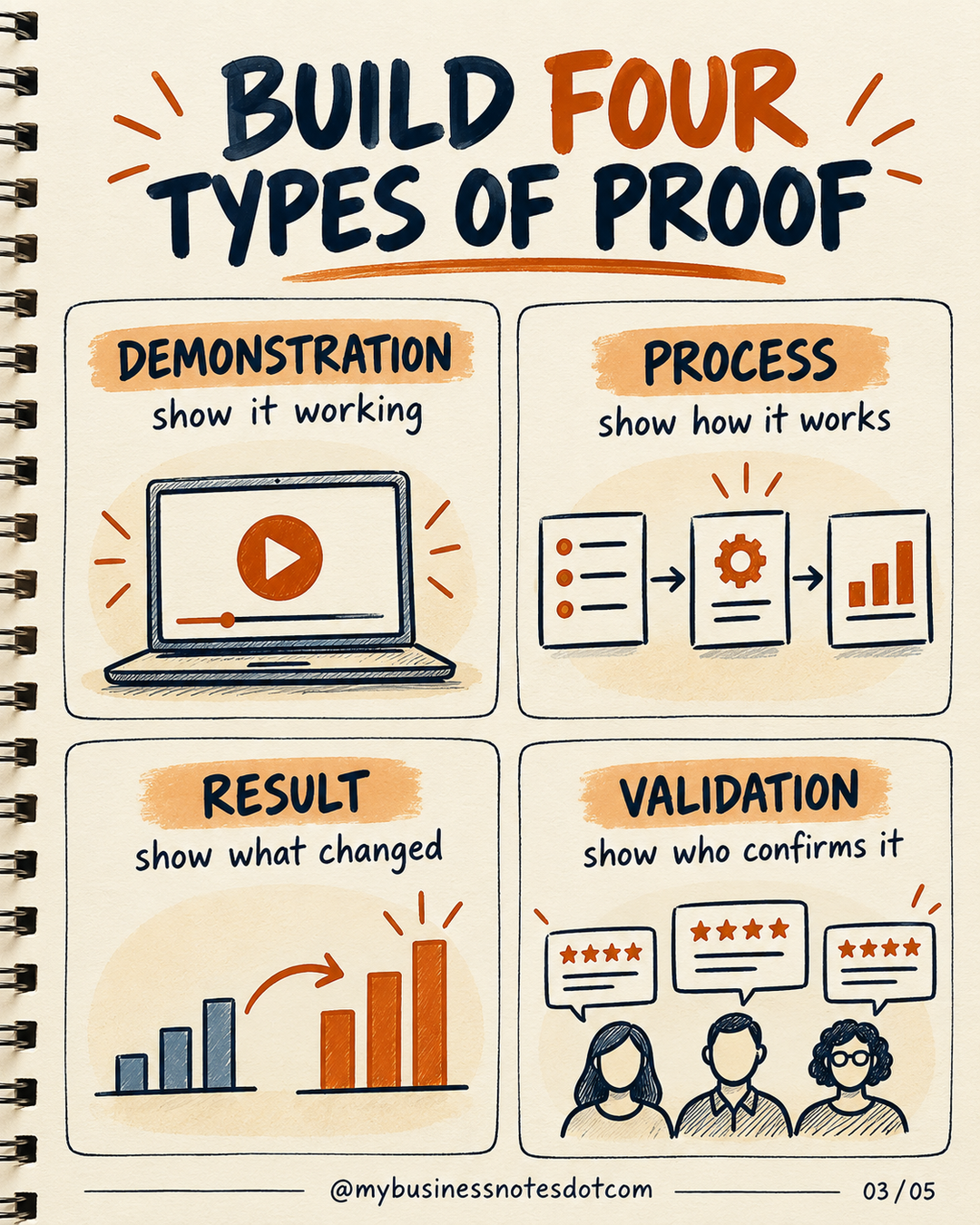
The four categories below are an MBN organizing tool. They do not form a universal hierarchy or certification. Different questions require different evidence, and a strong asset in one category cannot automatically support claims in another.
Demonstration: show the capability under stated conditions
A demonstration makes a mechanism or output visible. Let someone inspect a sample, complete a realistic task or examine how a feature behaves. State the setup, inputs and anything assisted manually.
A hypothetical software demonstration might show that a report can be generated from prepared data. It would not establish the time needed with a customer's inconsistent data, or prove an annual financial return. Strategyzer's testing guidance is helpful because it separates reactions to an idea from behavior around an actual proposition.
Process: make delivery legible
Process evidence explains how work is performed, checked and corrected. Useful assets include an annotated workflow, acceptance criteria, a sample review record and a clear division of responsibilities. Remove confidential details before sharing.
A process diagram can reduce uncertainty about delivery without proving that every engagement will succeed. Nielsen Norman Group's trustworthy-design guidance supports clear, current disclosure. Treat transparency as a way to improve evaluation, not as a substitute for competence.
Result: preserve the context behind the number
A result record should identify the baseline, measurement period, population and relevant conditions. Separate measured change from your explanation of why it occurred. If several initiatives ran together, do not attribute the entire change to yours.
For an illustrative service project, compare the same kind of task before and after the engagement and explain what changed in staffing or workload. Do not invent customer figures to make the narrative persuasive. If data is unavailable, publish a sample deliverable or a clearly labeled hypothetical example instead.
Validation: describe who checked what
Independent validation can include a properly scoped audit, certification or external evaluation. Identify the evaluator, scope, date and any relationship that affects independence. A badge without those details tells the buyer little.
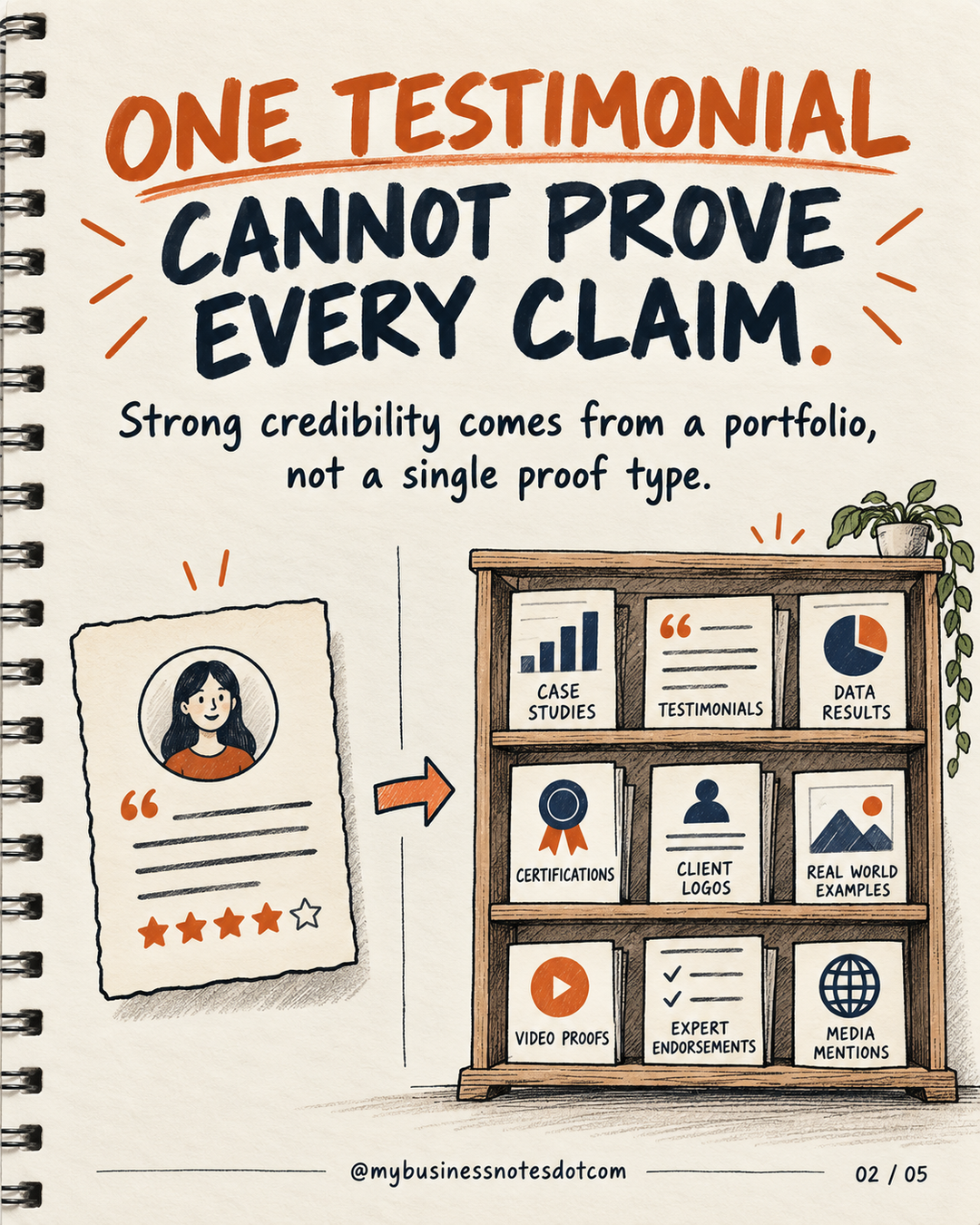
Endorsements and reviews have a different role. They can communicate experience, but cannot establish every objective performance claim. The FTC's substantiation policy provides a US regulatory example of why evidence must support the claim actually communicated, including reasonable implications.
Maintain a proof portfolio rather than a trophy wall
Create an inventory with claim, buyer question, asset, source, permission, limitations, owner and review date. Remove expired or unsupported claims from active materials. Retain a record of what changed so the commercial team does not keep using an outdated slide.
Use research interviews to learn which uncertainty matters, but do not mistake interview enthusiasm for market validation. Strategyzer distinguishes evidence about what people say from what they do. GOV.UK's analysis guidance also helps separate observations from interpretations.
Review the portfolio with a relevant buyer: can they locate the evidence, understand its scope and explain what remains unknown? Track unanswered questions as carefully as asset usage. The goal is a more inspectable decision, not a heavier sales deck.
Frequently asked questions
What belongs in a proof portfolio?
Include selected demonstrations, process records, contextual results and independent validation that support explicit claims. Keep sources, permissions and limitations attached.
Can a small business build one without case studies?
Yes. Start with accurate samples, transparent methods and realistic demonstrations. Do not present hypothetical work as a customer result.
How often should proof be reviewed?
Assign review dates based on how quickly products, methods and conditions change. Recheck evidence whenever the supported claim changes.
Download the complete carousel
Use the five-slide worksheet in your next working session.
Related reading: Turn learning into the next decision.
International references
- Strategyzer / Kurt Bostelaar — Customer interviews that produce insights
- Strategyzer / Alex Osterwalder — Don’t believe your customers
- Strategyzer / Nabila Amarsy — Ways to test your value proposition
- GOV.UK User research community — Using in-depth interviews
- Christensen Institute — Jobs to Be Done
- Nielsen Norman Group / Jakob Nielsen — Interviewing Users
- Nielsen Norman Group / Amy Schade — Avoid Leading Questions
- Strategyzer — Value Proposition Canvas
- Nielsen Norman Group / Kate Kaplan — Customer Journey Maps
- GOV.UK User research community — Analyse a research session
- Nielsen Norman Group / Aurora Harley — Trustworthy design
- FTC — Advertising substantiation policy
- FTC — Advertising FAQs for small business
- Nielsen Norman Group / Kate Moran — Technical jargon
- Strategyzer — Evidence strength