

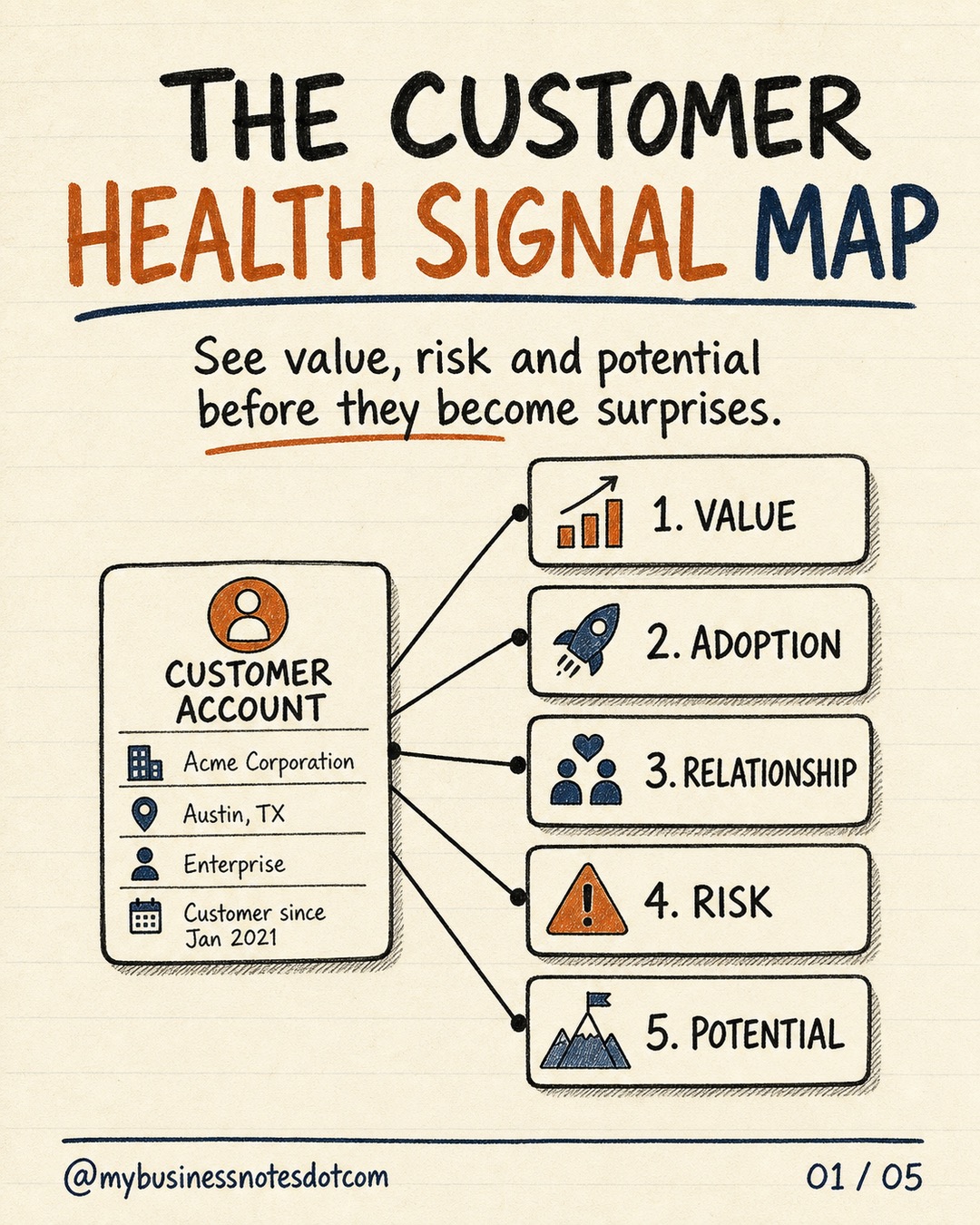
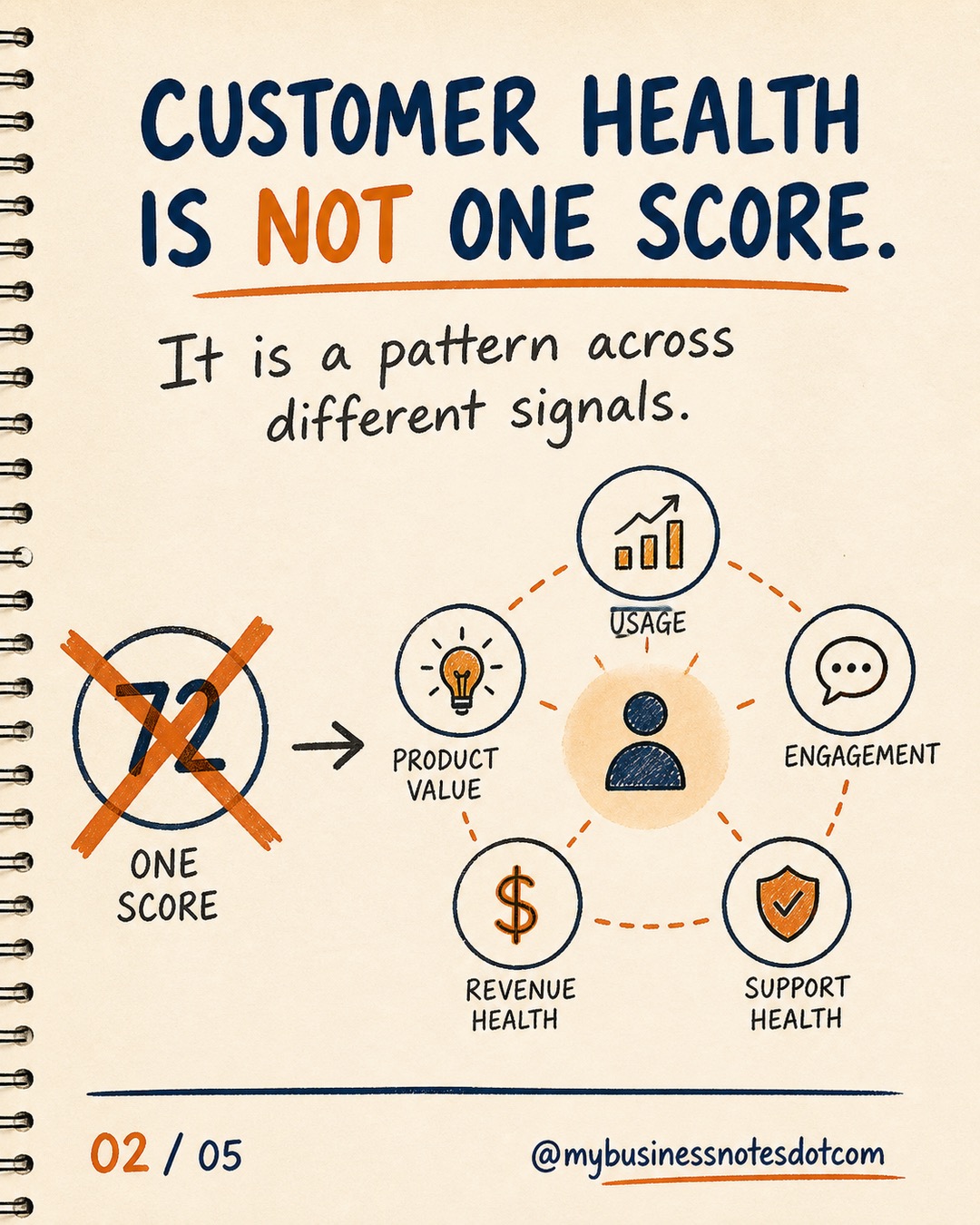
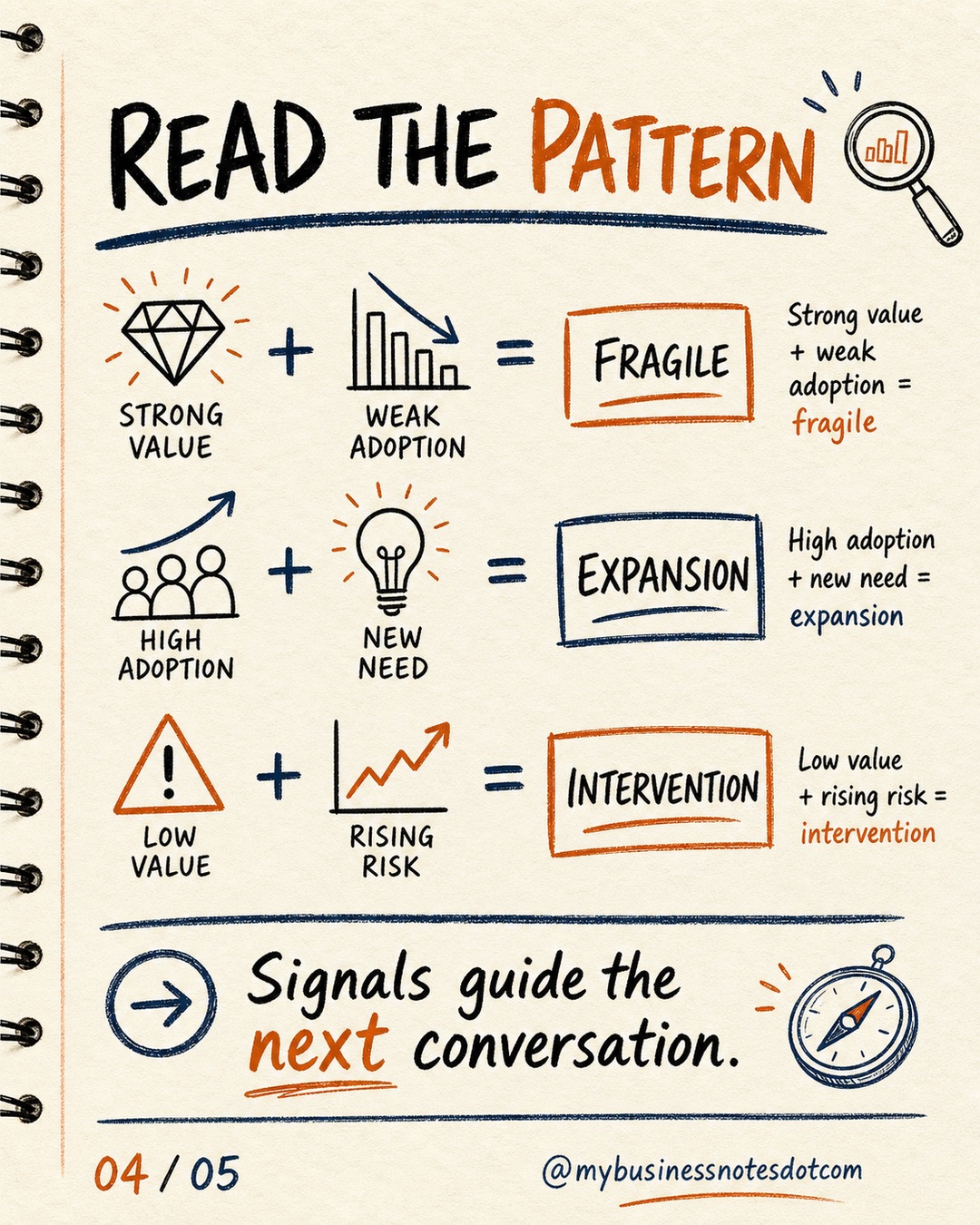
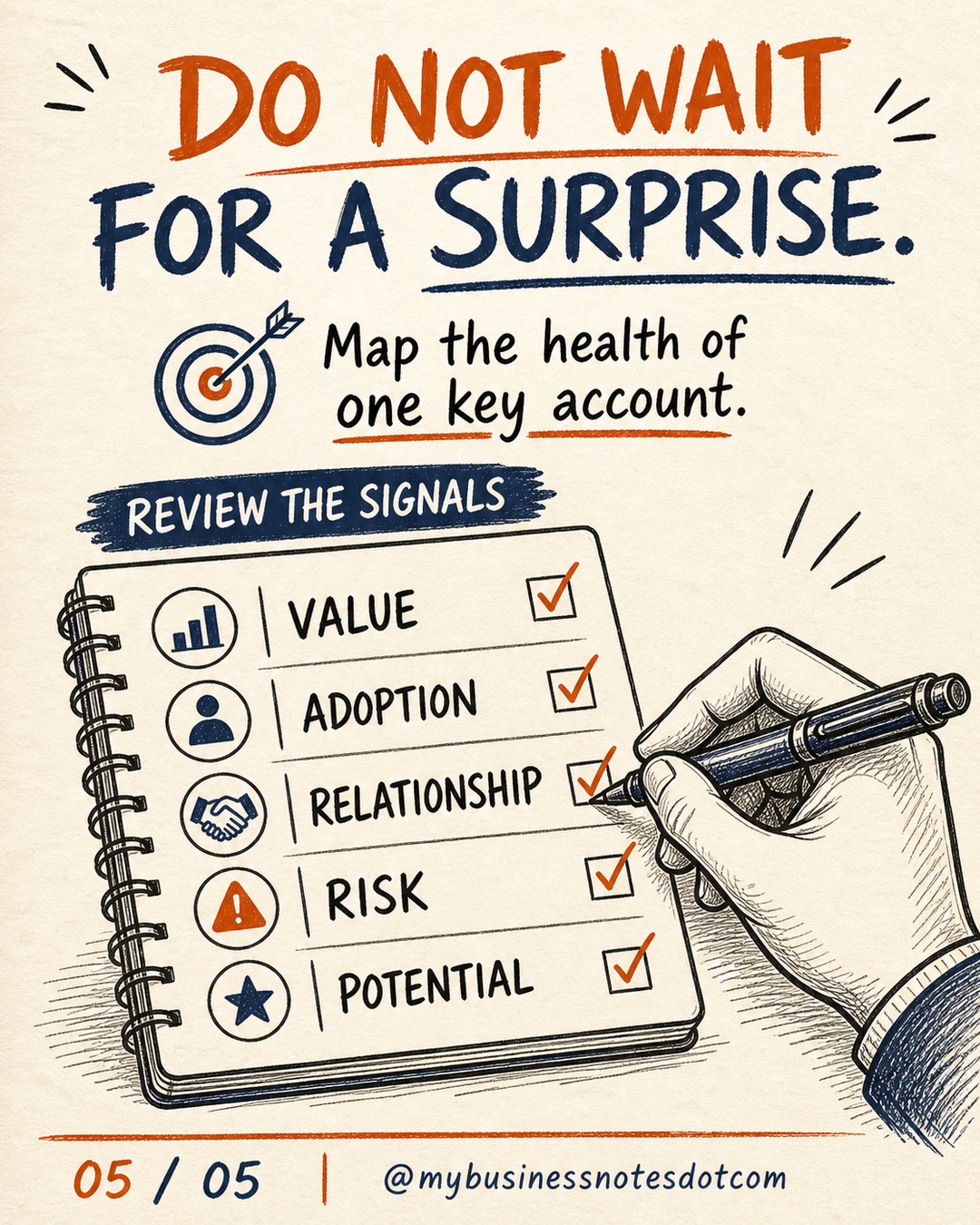
Customer health is a pattern of evidence, not one score. A customer health signal map combines value, adoption, relationship, risk and potential so teams can choose whether to protect value, support adoption, intervene or explore expansion. This guide expands the five-slide business note into a practical review with evidence, safeguards and next steps.
Slide 1 of 5
Use five lenses, not one metric
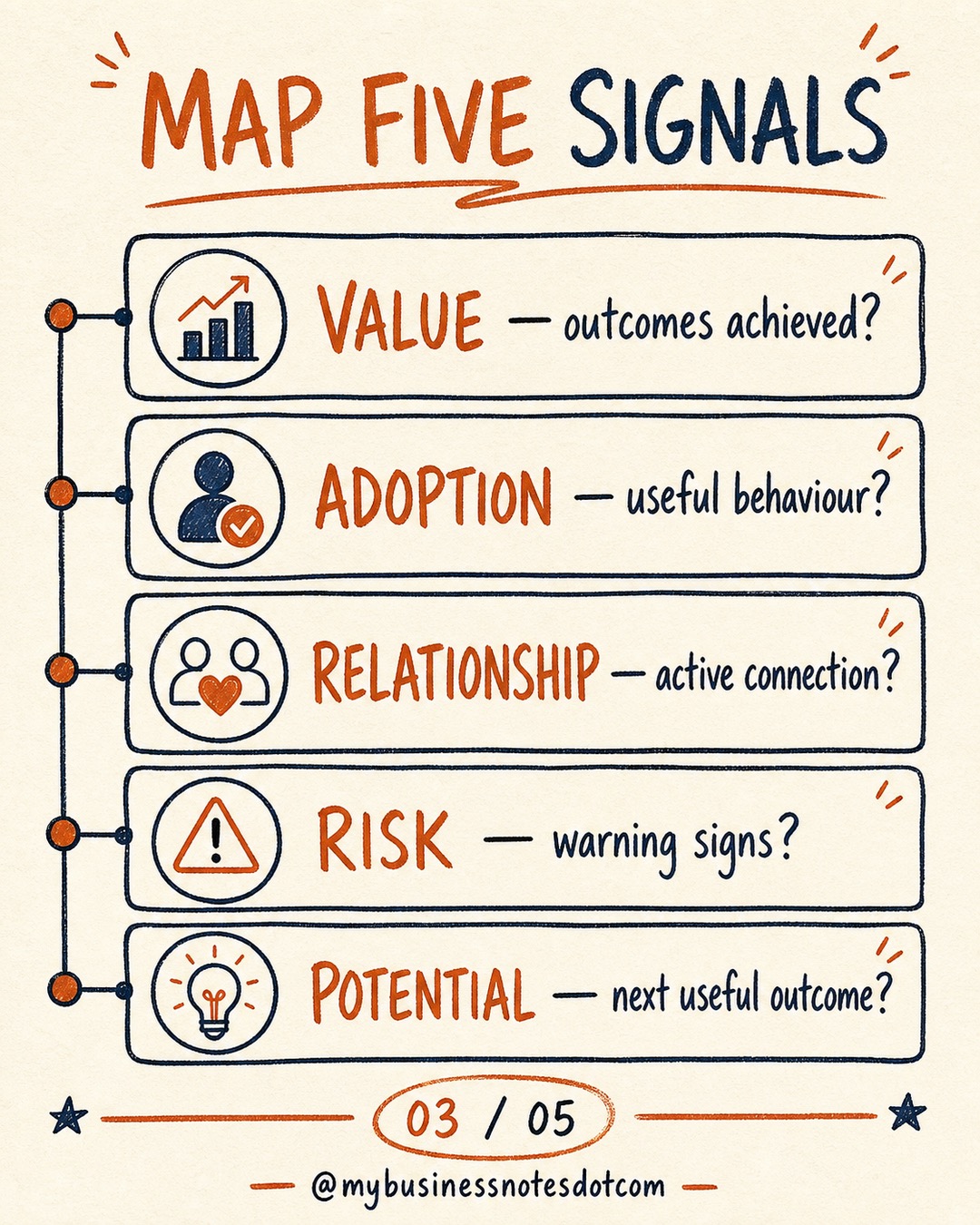
A single score can conceal why an account is changing. Review outcomes achieved, meaningful adoption, relationship strength, emerging risk and credible potential. Each lens answers a different question and should retain its underlying evidence.
Define observable signals
Choose signals tied to the customer journey: progress toward agreed outcomes, use of high-value capabilities, participation by key stakeholders, unresolved delivery or commercial risks, and new needs supported by evidence. Avoid treating activity volume as value.
Separate leading and lagging evidence
Renewal and churn are late outcomes. Earlier signals may include stalled onboarding, shrinking stakeholder participation, repeated support friction or missed value milestones. No signal should trigger a conclusion without context and trend.
Turn the map into a conversation
Use the pattern to prepare questions, not a verdict. Confirm what changed with the customer, make uncertainty explicit and select the smallest action likely to create new evidence or restore progress.
Review the model itself
Compare signals with actual outcomes and revise weak definitions. Check for data gaps and incentives that encourage optimistic scoring. A useful health map improves judgement; it does not automate accountability.
Frequently asked questions
What are customer health signals?
Evidence about customer value, adoption, relationship, risk and future potential.
Is one health score enough?
No. Keep the component signals visible so the team can understand the pattern and act appropriately.
How often should health be reviewed?
Match the cadence to customer risk, value and how quickly relevant evidence changes.
Can health predict renewal?
It can support an estimate, but it cannot remove uncertainty or replace a direct customer conversation.
Put it into practice
Apply the framework to one current customer or decision. Record the evidence, owner, next action and review date.
Download the complete carousel
Keep the five-slide framework as a PDF for your next working session.
International references
- McKinsey & Company â The net revenue retention advantage
- McKinsey & Company â The new B2B growth equation
- McKinsey & Company â Insights to impact
- Salesforce Help â Customer Success Score overview
- Salesforce Help â Customer Health Score
- Salesforce Trailhead â Customer success strategies
- Gartner â Metrics to prove customer success value
- Bain & Company â The powerful economics of customer loyalty
- Bain & Company â Converting loyalty into economic advantage
- Christensen Institute â Jobs to Be Done Theory
- Strategyzer â The Value Proposition Canvas
- Harvard Business Review â The discipline of business experimentation