
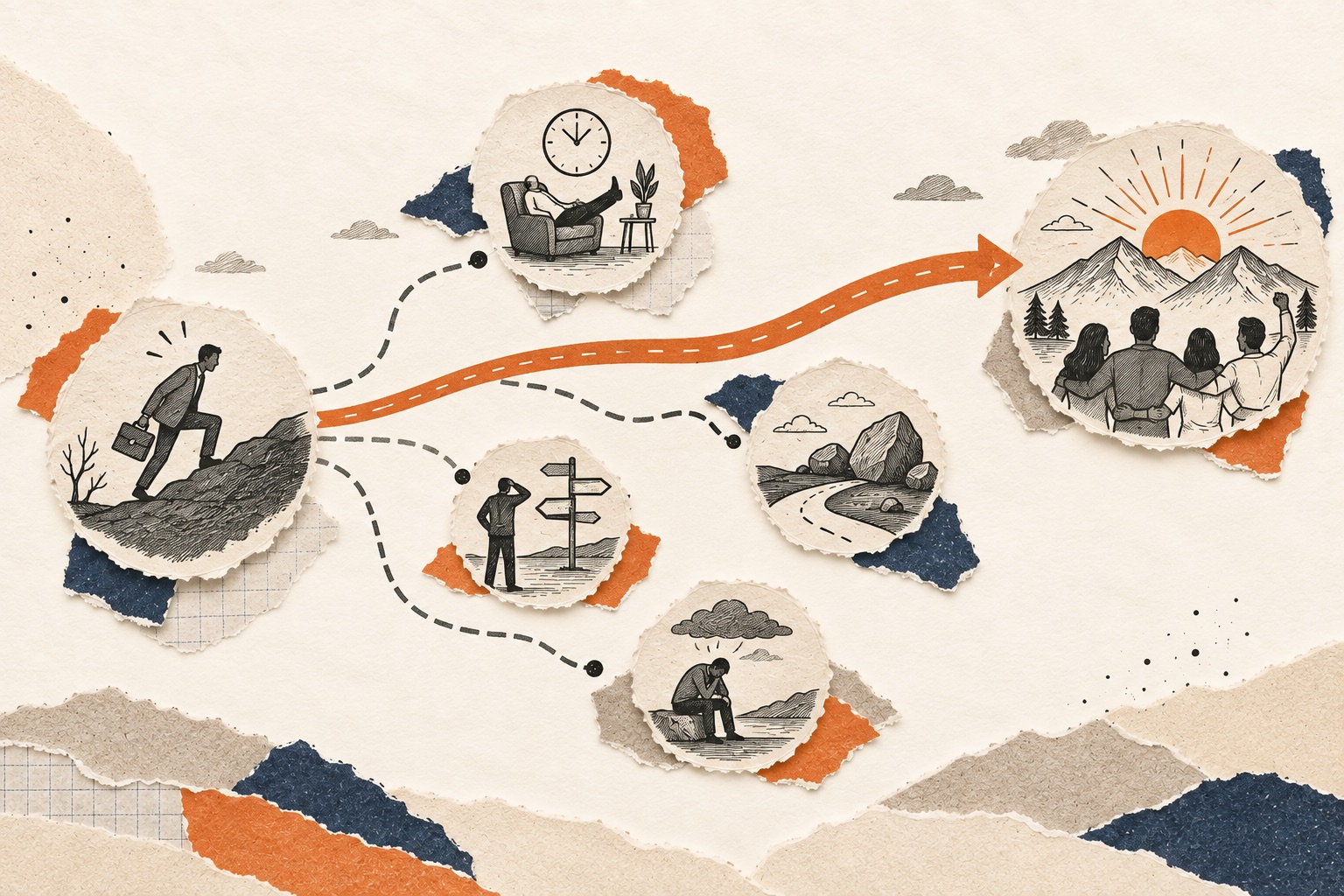
Customer progress is the change a buyer is trying to make in a specific circumstance. That means your offer competes not only with similar products, but also with current behaviour, delay and doing nothing. This guide expands the five-slide note into a practical method with criteria, examples and safeguards for managers, marketers and sales teams.


Slide 1 of 5
The real comparison happens in the customer’s life
Feature comparisons begin with products. Buying decisions begin with circumstances: something changed, the current solution became inadequate or a new outcome became important. The Christensen Institute’s explanation of Jobs to Be Done theory describes this as progress sought in a particular situation.
Identify the current state and desired state
Describe what the customer does today, where friction appears and what a better situation would enable. Include functional, social and emotional dimensions where they genuinely affect the decision. “Faster reporting” may matter because a manager needs confidence before a board meeting, not because speed is valuable in isolation.
Compare against every credible alternative
- A direct competitor.
- An internal process or spreadsheet.
- A partial workaround.
- Postponing the decision.
- Doing nothing.
The strongest alternative is the one the customer sees as good enough, not necessarily the brand your team mentions most.
Example: training software versus the status quo
A platform may have more features than competitors, yet employees already use shared documents and live sessions. The buyer compares the platform with the effort of changing behaviour. A relevant proposition shows how managers gain evidence of capability while reducing administration—not merely how many content formats the platform supports.
Make progress observable
Define the first meaningful change after adoption, the evidence that will show it and the time required. Early progress reduces uncertainty. Be explicit about prerequisites and switching costs; hiding them prevents the customer from making a sound comparison.
Rewrite the comparison question
Replace “Which features do we have that competitors lack?” with “Which progress does the customer value, what are they using now, and why would changing be worthwhile?” This moves product, marketing and sales toward the same decision logic.
Frequently asked questions
What does customer progress mean?
It is the change a customer seeks in a particular circumstance, including functional and sometimes social or emotional dimensions.
Do customers ignore features?
No. Features matter when they credibly enable capabilities and outcomes the customer values.
Who are the real competitors?
Any acceptable alternative, including manual work, internal solutions, delay and doing nothing.
How do you make progress measurable?
Define an observable before-and-after condition, relevant evidence and a realistic time horizon.
Put it into practice
Ask what progress makes your offer preferable. Record the evidence, decision, owner and next review date that follow.
Download the complete carousel
Keep the five-slide framework as a PDF for your next working session.
International references
- Christensen Institute — Jobs to Be Done Theory
- McKinsey & Company — The B2B customer decision journey
- Salesforce Trailhead — Write a sales proposal
- McKinsey & Company — Embracing the B2B omnichannel opportunity
- Salesforce Help — Einstein Opportunity Scoring
- McKinsey & Company — B2B buyers reset the bar
- Strategyzer — Value Proposition Canvas
- Strategyzer — High-value customer jobs
- Strategyzer — What great value propositions look like
- Strategyzer — Focused value for prospects
- Strategyzer — Value Proposition Canvas mistakes
- Harvard Negotiation Project — Five enduring lessons for negotiators